
Market Report · July 22, 2026

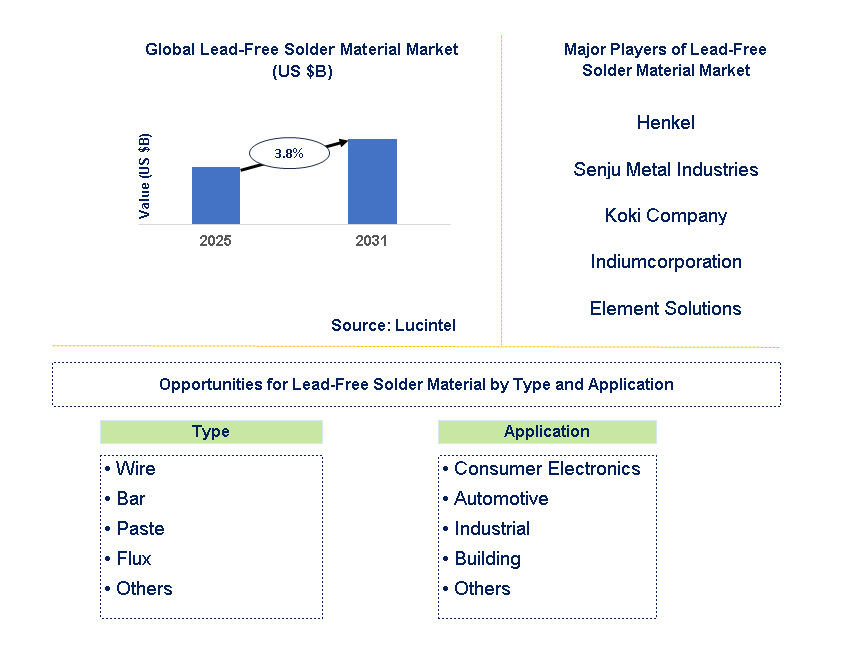
Key data points: The growth forecast = 3.8% annually for the next 7 years. Scroll below to get more insights. This market report covers Trends, opportunity and forecast in lead-free solder material market to 2031 by type (wire, bar, paste, flux, and others), application (consumer electronics, automotive, industrial, building, and others), and region (North America, Europe, Asia Pacific, and the Rest of the World)
We'll send your sample report shortly.
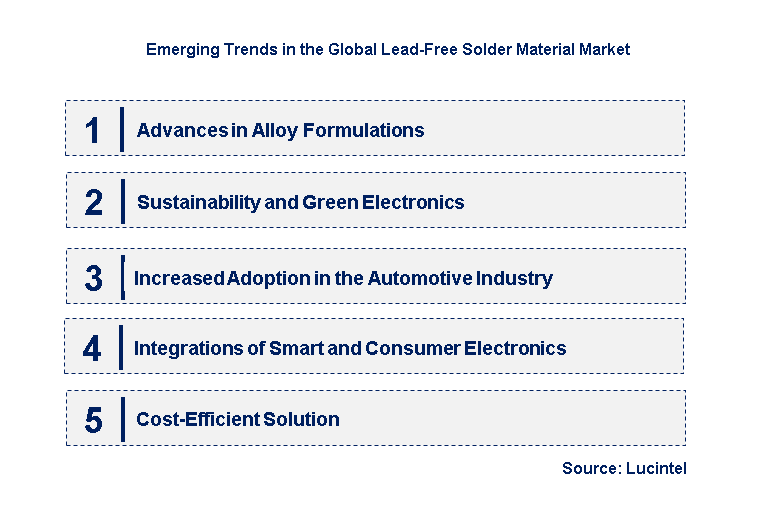
• Advances in Alloy Formulations: Lead-free solder alloys with improved properties and reliability are another market trend. There is an emphasis on developing new lead-free solder alloys with superior thermal and mechanical properties and higher resistance to fatigue and cracking. For example, the SAC alloy family of tin-silver-copper alloys is being developed further for enhanced reliability under higher stresses such as those in automotive and industrial applications. These are important advancements because industries require solder materials that can perform under increasingly demanding conditions.
• Sustainability and Green Electronics: As environmental awareness continues to rise, sustainability has become a central focus in the lead-free solder material market. The move from traditional lead-based solders to lead-free alternatives is an important step toward meeting global environmental regulations such as RoHS. Manufacturers are investing research to develop solder materials that are eco-friendly, nontoxic, and have high performance but contribute minimally to environmental degradation. This is a trend that synchronizes with the increasing need for green electronics within the consumer goods, automotive, and telecommunications industries.
• Increased Adoption in the Automotive Industry: Increased adoption of lead-free solder materials by the automobile industry in relation to environmental advantages and reliability improvement. Critical applications like electric vehicles (EVs) require lead-free solders. These assist in enhancing the component's efficiency and hardness. Diversification toward electric and hybrid cars creates a driving force for innovation in lead-free solders, replacing them with higher thermal and electrical conductivity. That expansion will continue as the automotive industry moves further in adopting sustainable and environmentally friendly technologies.
• Integrations of Smart and Consumer Electronics: The demand for lead-free solder materials in consumer electronics rises as manufacturers concentrate on developing more compact, reliable, and energy-efficient devices. Smartphones, wearables, and other smart devices are now being led by lead-free solder alloys for environmental compliance. Improved solder materials that can satisfy the demand for miniaturization and high-performance electronic components have emerged while remaining compliant with the environment. This trend is further supported by the growing preference of consumers toward eco-friendly and sustainable products.
• Cost-Efficient Solution: Though there are various advantages of lead-free solder materials, a few alloys come with a rather high cost. Focused efforts from manufacturers are towards developing cost-efficient lead-free solder materials that compromise nothing on the performance side. These firms are looking to lower the cost of lead-free solder materials by optimizing production processes and refining alloy compositions. Solutions that help make them less expensive will drive wider adoption, especially in consumer electronics, one of the highest-volume segments. Emerging trends in the lead-free solder material market are driven by the development of alloys, sustainability, adoption in the automotive industry, consumer electronics, and cost-efficiency. These factors not only force the adoption of more eco-friendly materials but also promote innovations that will continue to make lead-free soldering a vital part of various industries.
• Advanced Solder Alloys Development: Advanced solder alloys continued development is the most critical advancement within the lead-free solder market. These alloys, such as SAC305 (tin-silver-copper) and several variations, are being constantly improved for use in high-temperature environments. Henceforth, new formulations with added elements such as bismuth, indium, and silver are being explored to improve solder joint reliability and reduce the occurrence of failure due to thermal cycling, thereby extending the lifespan of electronic devices.
• Increased Reliability and Performance: Manufacturers are now working hard to make their solder materials more reliable and efficient for high-stress applications. They refine the mechanical properties of solder joints to prevent cracking, fatigue, and corrosion caused by temperature fluctuations and mechanical stresses. Improvements in soldering techniques, combined with innovation in alloy development, continue to improve the overall performance of lead-free solders in industries around the world.
• Improved Production Techniques and Productivity: Lead-free solder production is becoming more efficient and scalable as companies implement new manufacturing techniques, such as automated soldering and high-precision machinery. This makes the production process faster, cheaper, and more consistent. As demand for lead-free solder materials increases, companies are working to streamline manufacturing processes to reduce costs and improve supply chain efficiency, ensuring that lead-free materials remain competitive in the market.
• Regulatory Compliance and Industry Standards: The regulatory bodies of the world, including the European Union and the United States, have enforced stricter environmental standards, which has led to the use of lead-free solders. Companies are adapting their product lines to these standards by ensuring that their materials are RoHS-compliant and meet other industry-specific regulations. This regulatory push has sped up the transition to lead-free solders. Many companies are seeing compliance as a market differentiator, especially in the automotive, electronics, and telecommunications sectors.
• Rising Demand from Emerging Markets: Rising Demand in Emerging Markets The demand for electronics is growing in emerging markets like India and Southeast Asia. Manufacturers are looking for cost-effective, reliable, and environmentally compliant soldering solutions for a range of electronic products. Demand for lead-free solder materials in these markets will continue to rise as these regions expand and urbanize with stringent regulations on environmental sustainability. Latest developments, from alloys to the production process to regulatory compliance, all are accelerating lead-free solder material market growth. These developments don't only relate to environmental needs but also improve lead-free solders' performance and scalability, and thus are geared for further use in industries around the world.
• Automotive Industry Applications: The automotive sector, especially the electric vehicle segment, offers the greatest growth prospects for lead-free solder materials. As manufacturers increasingly shift toward electric and hybrid vehicles, demand for reliable, environmentally friendly solder materials in vehicle electronics is also rising. Lead-free solders ensure the durability and performance of high-end automotive components, such as battery packs, power control modules, and electric drive systems.
• Consumer Electronics and Smart Devices: The consumer electronics segment remains the leading sector in the lead-free solder material market. There is growing demand for eco-friendly smartphones, wearables, and other smart devices; miniaturization and increased performance are expected to be the driving trends. Smaller devices that draw less power require lead-free solder materials for use in satisfying environmental regulations- an area of opportunity for manufacturers specializing in lead-free alloys.
• Telecommunications Industry: Another important driver is the lead-free solder materials, mainly driven by telecommunications infrastructure including 5G networks. In fact, this industry, along with others, drives demand for solders with higher performance and environmental requirements. Lead-free solders are applied in telecommunications equipment like routers, base stations, and antennas; hence manufacturers will be able to offer their product portfolio with higher lead-free content.
• Renewable Energy and Green Technologies: The renewable energy sector presents new opportunities for lead-free solder materials in solar panels, wind turbines, and energy storage systems. These technologies require highly reliable and durable components that can withstand harsh environmental conditions, making lead-free solder materials a vital part of green energy solutions. As the push for sustainability grows, the demand for lead-free solders in renewable energy applications will continue to expand.
• Emerging Markets: The emerging markets that are growing in regions such as India, Southeast Asia, and Latin America are expected to drive strong growth in the lead-free solder material market. As the countries in these regions start adopting more stringent environmental regulations and expand in electronics manufacturing, the demand for lead-free solder materials will increase. Since manufacturers can find cost-effective, quality solder solutions that meet local regulatory standards, they will take advantage of these growing markets. Lead-free solder material market provides strategic growth opportunities for major sectors, such as automotive, consumer electronics, telecommunications, renewable energy, and emerging markets. Once this opportunity is seized, then the globalization of lead-free soldering materials will be accelerated, especially in light of further concerns over sustainability within the industry.
• Henkel
• Senju Metal Industries
• Koki Company
• Indiumcorporation
• Element Solutions
• Wire
• Bar
• Paste
• Flux
• Others
• Consumer Electronics
• Automotive
• Industrial
• Building
• Others
• North America
• Europe
• Asia Pacific
• The Rest of the World
• United States: The demand for lead-free solder materials in the United States has continued to grow, primarily due to strict environmental regulations and the increasing drive by the electronics industry towards sustainability. Advanced research investments have been made to improve the mechanical properties and thermal performance of lead-free solder alloys. Alternative alloys with improved reliability and durability in electronic components are developed. The U.S. is also seeing increased lead-free soldering in the automotive and consumer electronics markets, as this follows the overall green electronics trend.
• China: Lead-free solder materials have quickly been adopted by China. These were adopted by both the country's internal regulations and the requirements from abroad. China, as one of the biggest electronic manufacturing bases in the world, has been rapidly developing the lead-free solder materials to have good performance. Manufacturers are trying to produce alloys that are highly reliable in extreme conditions, which is essential for applications involving telecommunications and automotive industries. The Chinese government has also made policies to encourage the use of environment-friendly material, which has enhanced the pace of adoption of lead-free solder in the market.
• Germany: Lead-free solder materials had been widely embraced in Germany due to an emphasis on environmental sustainability by its manufacturers and on high-tech products for their industrial applications. The automotive and electronics industries were one of the initial lead-free solder alloy adopters. German firms heavily invest in R&D work that creates the lead-free solders to have enhanced longevity of performance for electronics devices. Lead-free soldering can go hand in hand with the Germans' focus on green technologies to align with European directives such as RoHS.
• India: The demand for lead-free solder materials is increasing in India, primarily driven by the electronics and automotive industries. Indian companies are responding to global environmental standards by adopting lead-free solder materials as manufacturing capabilities expand. Research initiatives in India are aimed at developing cost-effective, high-performance lead-free solder alloys that can meet the diverse needs of the electronics industry. With sustainability and eco-friendly practices, India is poised to become a leader in the lead-free solder material market.
• Japan: Japan is one of the leading countries in the development and use of lead-free solder materials. Technological innovation and quality are given a lot of importance. The lead-free solder alloys developed by Japanese manufacturers exhibit improved mechanical properties and processability, ensuring their application in high-end products like automotive, telecommunications, and consumer electronics. Japan has very strict environmental policies and is very conscious of its commitment to sustainability; hence, lead-free solder materials have become popular, making Japan a leader globally.


• Henkel
• Senju Metal Industries
• Koki Company
• Indiumcorporation
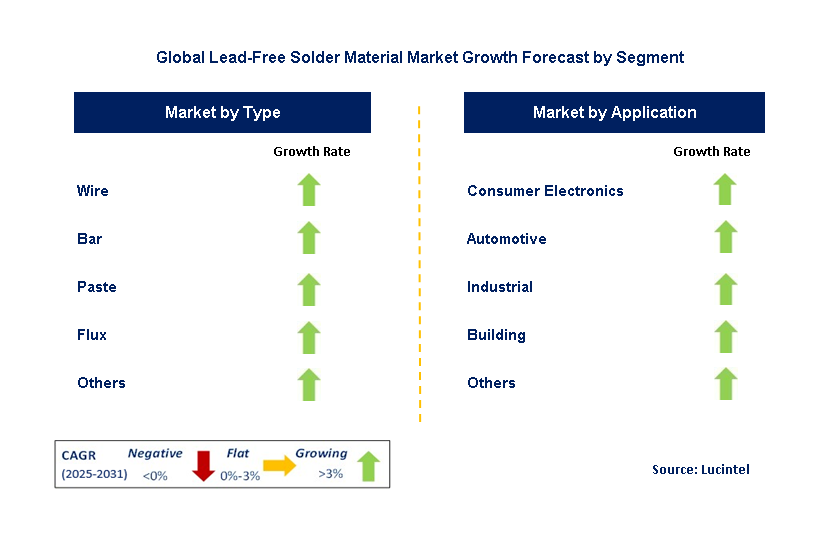
• Element Solutions Q5. Which lead-free solder material market segment will be the largest in future? Answer: Lucintel forecasts that wire is expected to witness the highest growth over the forecast period. Q6. In lead-free solder material market, which region is expected to be the largest in next 5 years? Answer: APAC is expected to witness the highest growth over the forecast period. Q7. Do we receive customization in this report? Answer: Yes, Lucintel provides 10% customization without any additional cost.


Choose a license that fits your team. Instant PDF delivery.
Prices exclude taxes. Instant delivery. Custom licensing available on request.
Market Report · July 22, 2026
Market Report · July 22, 2026
Market Report · July 22, 2026
Trusted partner for strategic intelligence and business growth


Receive a complimentary market analysis tailored to your industry. Our analysts will identify key growth opportunities and competitive dynamics specific to your business.

Market size, growth rate, and key trend analysis for your specific sector.

Top competitor positioning and market share analysis.

Strategic recommendations backed by data-driven insights.
Get curated market intelligence and competitive moves straight to your inbox.
By subscribing, you agree to receive our monthly insights. Unsubscribe anytime.
Receive a complimentary market analysis tailored to your industry. Our analysts will identify key growth opportunities and competitive dynamics specific to your business.
Market size, growth rate, and key trend analysis for your specific sector.
Top competitor positioning and market share analysis.
Strategic recommendations backed by data-driven insights.
Get curated market intelligence, emerging trends, and competitive moves straight to your inbox each month.
By subscribing, you agree to receive our monthly insights. Unsubscribe anytime.
We'll send your sample report shortly.