
Bauxite Market
The future of the global bauxite market looks promising with opportunities in the alumina production, refractory and cement markets. The global bauxite market is expected to reach an estimated $20.5 billion by 2035 with a CAGR of 2.6% from 2026 to 2035. The major drivers for this market are the increasing aluminum production driving bauxite demand, the rising infrastructure development boosting mineral consumption and the growing industrial activities supporting bauxite extraction.
• Lucintel forecasts that, within the product category, metallurgical grade will remain the largest segment over the forecast period as the rising smelter capacity supporting bauxite consumption.
• Within the application category, alumina production will remain the largest segment due to the the increasing aluminum demand driving alumina production.
• In terms of regions, North America will remain the largest region over the forecast period due to the the increasing aluminum production supporting bauxite demand.
Gain valuable insights for your business decisions with our comprehensive 150+ page report.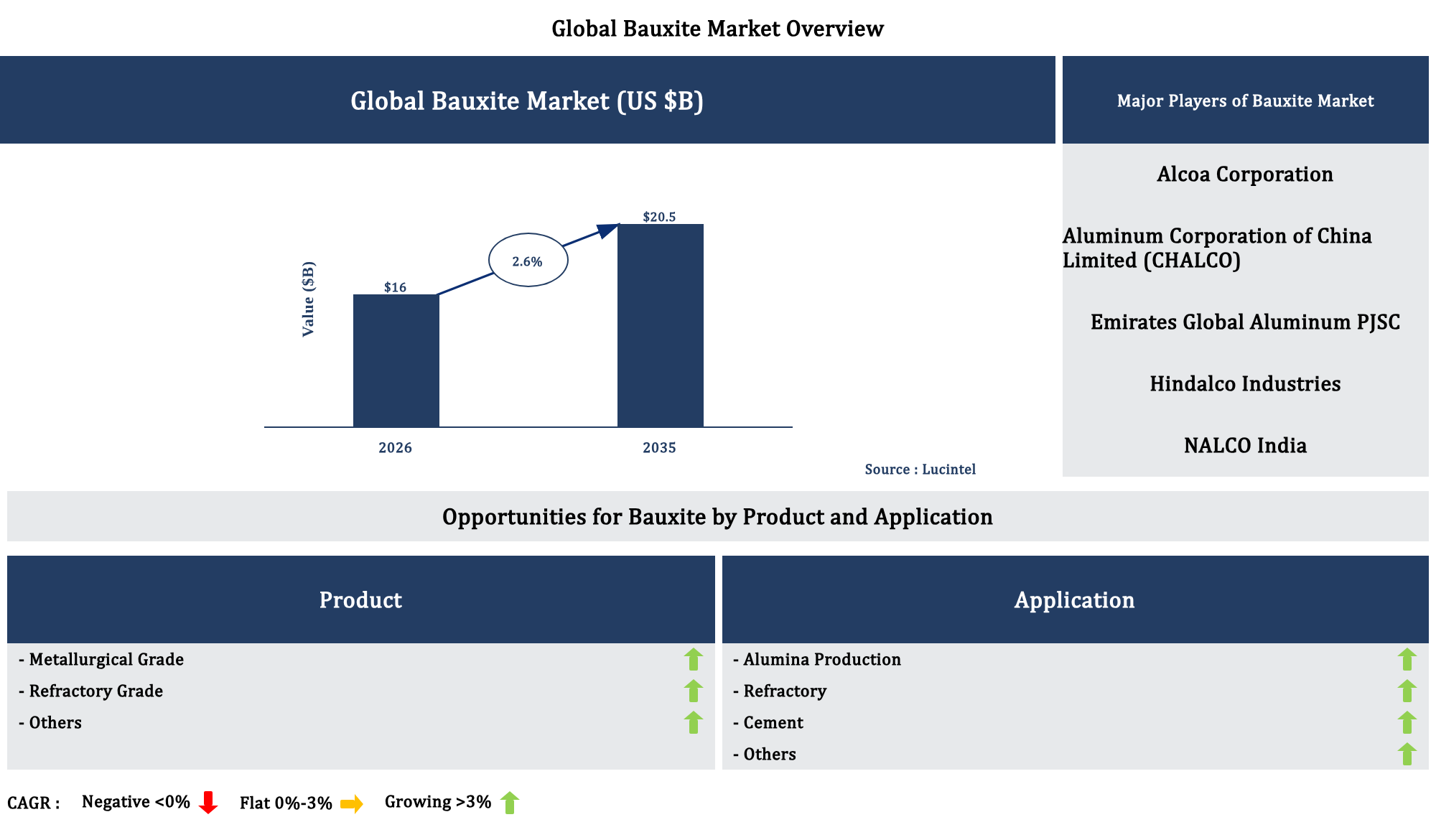
Emerging Trends in the Bauxite Market
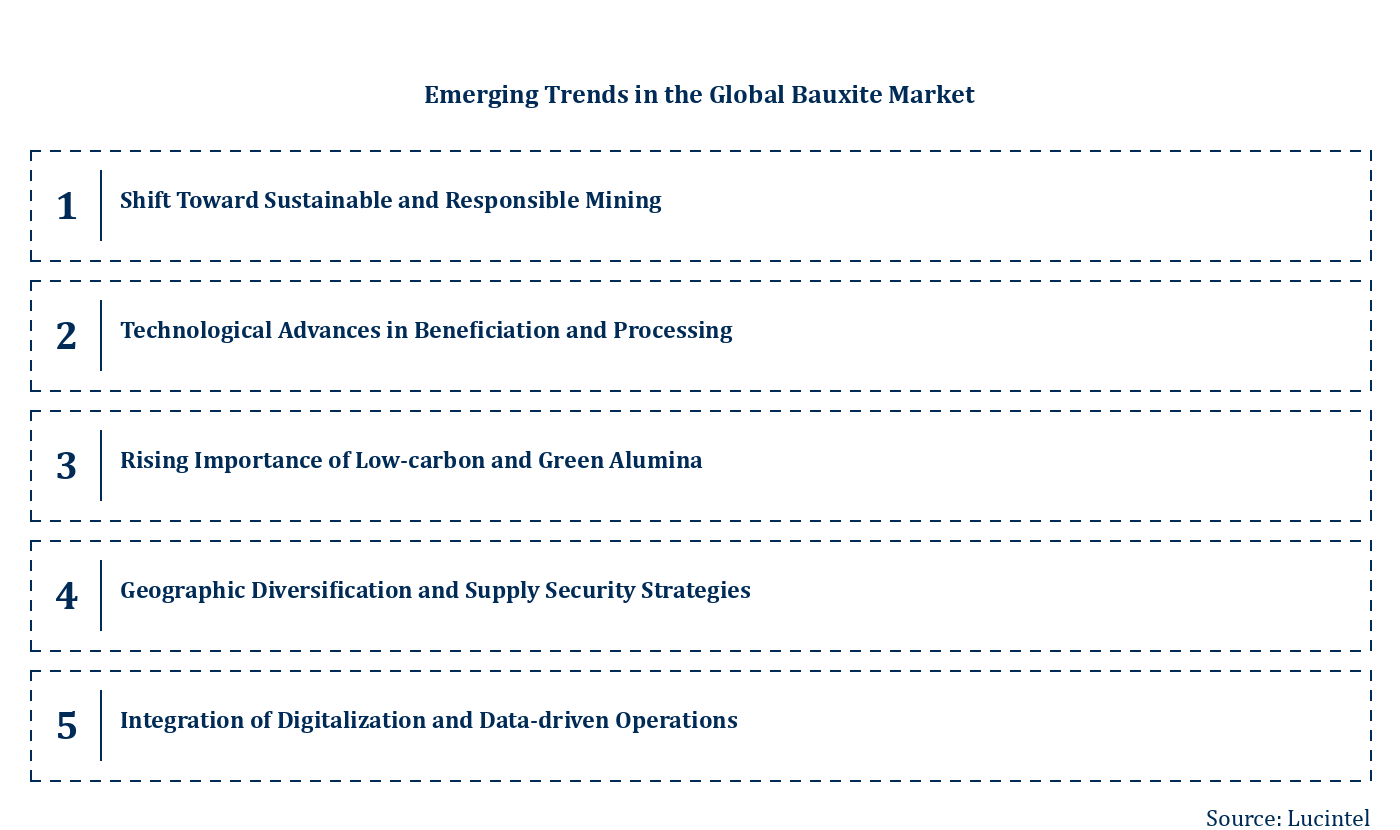
The bauxite market is undergoing a notable transformation as demand patterns, regulatory pressures, and technological capabilities evolve across the global aluminum value chain. Rising consumption in transportation, construction, and packaging is intersecting with growing scrutiny of mining practices and carbon footprints. Producers and downstream players are rethinking how bauxite is explored, extracted, processed, and traded, with a sharper focus on supply security and sustainability. Digitalization, new beneficiation technologies, and circular-economy models are reshaping competitive dynamics, while geopolitical shifts are driving diversification of supply sources. These emerging trends are redefining risk, cost structures, and long-term investment strategies in the bauxite market.
Recent Developments in the Bauxite Market
The bauxite market is undergoing notable shifts as aluminum demand, energy transition policies, and geopolitical dynamics reshape the supply–demand balance. Miners, refiners, and downstream aluminum producers are realigning strategies around resource security, sustainability, and cost competitiveness. New projects in emerging mining hubs, stricter environmental regulations, and changing trade flows are redefining where and how bauxite is produced and processed. At the same time, technological innovation in beneficiation and refining, as well as circular-economy initiatives, are influencing long‑term investment decisions. These developments collectively determine pricing trends, capital allocation priorities, and competitive positioning across the global bauxite value chain.
Strategic Growth Opportunities in the Bauxite Market
The bauxite market is entering a pivotal growth phase as demand for lightweight materials, low-carbon technologies, and advanced infrastructure accelerates worldwide. As the primary ore for aluminum, bauxite underpins critical applications ranging from transportation and construction to packaging and renewable energy systems. Shifting sustainability regulations, urbanization, and electrification are reshaping value chains and encouraging innovation in refining, recycling, and process efficiency. At the same time, new uses of alumina derivatives in chemicals, ceramics, and environmental remediation are broadening the market’s application base. Companies that strategically align with emerging demand hotspots can unlock substantial long-term growth and margin expansion.
Bauxite Market Drivers and Challenges
The global bauxite market is shaped by an intricate mix of technological, economic, and regulatory dynamics across mining, refining, and downstream aluminum value chains. Growing demand for lightweight materials, infrastructure expansion, and decarbonization trends are stimulating investment in bauxite extraction and alumina refining capacity. At the same time, cost pressures, environmental constraints, and geopolitical risks are creating operational complexity for producers and consumers. Technological innovation in mining and processing, coupled with evolving trade policies and sustainability standards, is redefining competitive advantage. Understanding these drivers and challenges is essential for stakeholders to align sourcing strategies, optimize margins, and manage long-term supply security.
The factors responsible for driving the bauxite market include:
The challenges in the bauxite market are:
The global bauxite market is propelled by structurally rising aluminum demand, urbanization, technological innovation, circular economy dynamics, and strategic resource security, but it must simultaneously navigate tightening environmental standards, cost inflation, and geopolitical uncertainty that complicate project development and trade flows. These intertwined drivers and challenges shape investment decisions, influence regional production patterns, and affect pricing across the value chain from mine to smelter. Stakeholders that proactively adapt through portfolio diversification, operational excellence, sustainability leadership, and risk-managed contracting will be better positioned to secure supply, protect margins, and capture growth opportunities in the evolving bauxite industry.
List of Bauxite Market Companies
Companies in the market compete on the basis of product quality offered. Major players in this market focus on expanding their manufacturing facilities, R&D investments, infrastructural development, and leverage integration opportunities across the value chain. Through these strategies bauxite market companies cater increasing demand, ensure competitive effectiveness, develop innovative products & technologies, reduce production costs, and expand their customer base. Some of the bauxite market companies profiled in this report include-
Bauxite Market by Segment
The study includes a forecast for the global bauxite market by product, application, and region.
Country Wise Outlook for the Bauxite Market
The global bauxite market is undergoing structural change as aluminum demand expands across transportation, construction, packaging, and energy transition technologies. Producers and policymakers are rebalancing supply chains in response to resource security concerns, evolving environmental regulations, and growing pressure for sustainable mining practices. Strategic investments are targeting high-grade reserves, logistics optimization, and value-added alumina and aluminum capacity. Trade flows are being reshaped by export policies, new refining projects, and shifts in downstream manufacturing hubs. These dynamics are particularly pronounced in the United States, China, Germany, India, and Japan, each of which is pursuing distinct approaches to secure long-term bauxite and alumina supply.
Features of the Bauxite Market
Article
Bauxite Market: Which Strategic Shifts Are Redefining the Future of Alumina and Aluminum?
Dallas, June 5, 2026 – The bauxite market is entering a period of structural change as technology, decarbonization policies, and supply realignments reshape the economics of alumina and primary aluminum production. Investors, miners, refiners, and downstream manufacturers are reassessing sourcing strategies, capital allocation, and partnership models in response to new processing technologies, rising environmental expectations, and emerging digital use cases in the broader technology industry.
Across mining regions in Asia-Pacific, West Africa, South America, and beyond, bauxite has shifted from being viewed as a bulk commodity to a strategically critical resource underpinning lightweight mobility, renewable energy infrastructure, and advanced electronics. Against this backdrop, the market is being disrupted by changes in ore quality, logistics, and the growing influence of sustainability-linked contracts and traceability requirements.
How Are Process Innovation and Low-Grade Utilization Rewiring the Bauxite Value Chain?
A key trend reshaping the bauxite market is the rapid advancement of technologies capable of processing low-grade and complex ores that were previously considered uneconomic. High-grade deposits with favorable alumina-to-silica ratios are maturing in several established producing regions, while demand for alumina continues to grow in line with primary aluminum smelting and downstream fabrication for automotive, packaging, and construction applications.
Refiners are accelerating investments in improved Bayer process configurations, enhanced caustic recovery, and advanced impurity management to expand the usable resource base. Novel hydrometallurgical and bio-leaching approaches are under active development, targeting better extraction of alumina from high-silica bauxites and marginal deposits. As processing flexibility improves, regions with abundant but lower-grade deposits are becoming more competitive, shifting trade flows and bargaining power in long-term supply contracts.
The market impact is especially visible in alumina refining hubs that are tied to export-oriented aluminum smelters. These hubs stand to benefit from a broader sourcing envelope and more resilient feedstock strategies, but they will also face competitive pressure as new refining capacity aligns with emerging mining regions and near-port logistics. Technology that enables economically viable use of low-grade bauxite is likely to compress cost curves and alter the relative competitiveness of major producing and importing markets.
Why Is Decarbonization Forcing a Rethink of Bauxite Mining and Alumina Refining Economics?
Another pivotal shift is the intensifying pressure to reduce greenhouse gas emissions along the bauxite–alumina–aluminum chain. Alumina refining is energy intensive and heavily reliant on fossil fuels in many jurisdictions, while mining operations confront rising scrutiny over land use, biodiversity, and community impacts. As downstream aluminum buyers commit to science-based climate targets, demand is rising for “low-carbon” alumina and responsibly sourced bauxite.
Refiners are piloting fuel switching from coal and heavy fuel oil to natural gas, biomass, and, increasingly, renewable power paired with electrified calciners and process equipment. Waste heat recovery systems and digital optimization tools are being deployed to reduce specific energy consumption. Carbon capture concepts are being evaluated at major refineries, even though commercial deployment remains in early stages.
This decarbonization push is poised to disrupt pricing structures and contract models. Markets that can pair bauxite resources with abundant low-carbon energy, robust environmental regulations, and transparent governance will gain a strategic edge. Premiums for certified low-carbon alumina and sustainably mined bauxite are emerging in negotiations with automotive, aerospace, and electronics manufacturers that seek to de-risk their supply chains and protect brand reputation.
Which End-Use Markets Will Feel the Strongest Impact from These bauxite market Shifts?
The most visible impact will be felt in markets where aluminum plays a structural role in lightweighting, electrification, and infrastructure modernization. Automotive manufacturers, especially in electric vehicles, will be highly exposed to changes in bauxite and alumina economics because aluminum-intensive body structures, battery enclosures, and chassis components rely on cost-competitive and responsibly sourced metal.
Packaging producers will experience continued sensitivity to alumina and aluminum cost trends as can-makers and foil producers compete with alternatives such as plastics and glass. Any sustained shift in bauxite supply costs or logistics disruptions could ripple rapidly into packaging margins and pricing.
Construction and transport infrastructure will also be significantly influenced. Large-scale transit systems, bridges, and building facades increasingly favor aluminum for weight, corrosion resistance, and recyclability. If low-carbon alumina and bauxite become more widely available at competitive prices, project developers may intensify their preference for aluminum over steel and other materials, reinforcing demand growth.
How Are Digitalization and Materials Innovation Creating New Use Cases in the Technology Industry?
While bauxite itself is not a direct input into advanced semiconductor devices, its role as the upstream source of alumina and aluminum is increasingly relevant for technology-adjacent applications. The technology industry is engaging the bauxite market in several ways that create new use cases and commercial models.
In parallel, technology companies are demanding greater visibility into the upstream origin of materials. This is catalyzing adoption of blockchain-based traceability, sensor-driven ore body monitoring, and real-time ESG data collection at bauxite mines and refineries. As technology buyers insist on auditable, low-impact materials, data and analytics are becoming integral to commercial relationships in the bauxite market.
What Key Challenges Could Slow the Pace of bauxite market Transformation?
Despite the momentum around innovation and sustainability, the bauxite market faces several structural challenges that could constrain the speed of change. Capital intensity remains high for new mines, beneficiation plants, and alumina refineries, and payback periods can be long and vulnerable to commodity price cycles. This dynamic can delay deployment of new technologies or force consolidation among smaller players that lack balance-sheet strength.
Regulatory and permitting risk is rising, particularly in regions where community opposition, land rights disputes, and environmental concerns are prominent. Delays in approvals or stricter rehabilitation requirements can alter project economics and restrict supply growth just as downstream demand accelerates. Water availability and tailings management add further complexity, especially in arid regions or areas prone to extreme weather events.
Logistics constraints constitute another critical challenge. Bauxite is a bulk commodity requiring reliable port capacity, specialized bulk handling infrastructure, and predictable marine shipping. Congestion, weather-related disruptions, and geopolitical issues affecting key maritime routes can tighten the supply-demand balance unexpectedly, forcing refiners to re-route cargoes or adjust production levels.
Where Do the Most Compelling Opportunities Emerge for Investors and Operators?
Opportunities are clustering around three strategic themes: resource diversification, value-added processing, and integration with low-carbon ecosystems. Investors that can identify underexplored bauxite districts with favorable geology and supportive policy frameworks have an opportunity to bring new supply online using state-of-the-art environmental and digital standards, securing a competitive position as older mines face depletion or social license constraints.
There is also a growing opportunity in value-added alumina and specialty grades tailored to technology and battery applications. Producers that can achieve high purity, tight particle-size control, and reliable performance characteristics stand to capture premium pricing segments that are less exposed to commodity-style volatility.
Integration with low-carbon industrial ecosystems, such as co-locating refineries with renewable energy clusters and downstream smelters, offers another path to differentiation. These integrated hubs can market traceable, low-carbon aluminum supported by verified bauxite and alumina supply, appealing to automotive, aerospace, and technology customers with ambitious emissions reduction targets.
Which Recent Developments Signal the Direction of the bauxite market?
Recent announcements from major miners and refiners highlight an accelerating pivot toward sustainability, digitalization, and resource diversification. Several leading producers have unveiled projects to electrify mine fleets, adopt autonomous haulage systems, and deploy drone-based surveying for better ore body characterization, all of which improve productivity and reduce environmental footprint at bauxite operations.
On the refining side, new partnerships between energy providers and alumina producers are emerging to trial renewable-powered calcination, biomass co-firing, and high-efficiency boilers. Pilot projects in multiple regions are testing the viability of low-emissions refineries designed from the ground up to integrate with solar, wind, or hydro generation, combining long-term power purchase agreements with process optimization.
In parallel, trading houses and downstream aluminum buyers are expanding sustainability-linked contracts that tie pricing or volume commitments to performance on emissions, tailings management, and community engagement. These contract structures, supported by digital traceability tools, are reshaping commercial incentives throughout the bauxite value chain.
In the technology space, collaborations between alumina producers, battery manufacturers, and research institutes have intensified around high-purity alumina for separator coatings and solid-state battery components. This cross-industry effort underscores how future demand growth for specific bauxite-derived materials may be more closely linked to energy storage, electronics, and mobility technologies than to traditional bulk metal consumption alone.
How Should Market Participants Position Themselves as Bauxite Becomes a Strategic Resource?
As the bauxite market transitions from volume-driven expansion to technology-enabled, sustainability-focused growth, stakeholders will need to rethink portfolio strategies and partnership models. Miners should prioritize geologically robust assets where environmental and social performance can be demonstrably managed, while investing in processing innovations that unlock lower-grade resources. Refiners will benefit from integrating digital tools that optimize energy use, stabilize quality, and provide real-time transparency to downstream customers.
For end users in automotive, construction, packaging, and especially the technology industry, procurement strategies will increasingly hinge on access to traceable, low-impact alumina and aluminum. Forming long-term strategic alliances with bauxite and alumina suppliers, co-investing in process innovation, and engaging on data-sharing for ESG metrics can create a differentiated supply advantage in competitive markets.
The emerging landscape suggests that bauxite is evolving into a strategic enabler of low-carbon mobility, digital infrastructure, and advanced manufacturing. Those who align early with technology-based efficiencies, environmental stewardship, and transparent supply chain practices are positioned to shape, rather than merely react to, the ongoing disruption in the bauxite market.
Top 5 Companies
1. Alcoa Corporation
Alcoa Corporation is one of the world’s leading producers of bauxite, alumina, and aluminum, with a heritage dating back to 1888 and headquarters in Pittsburgh, Pennsylvania, USA. The company employs several tens of thousands of people across operations in North America, South America, Europe, Australia, and select parts of Asia, giving it a broad geographic presence in major bauxite‑producing and consuming regions. Alcoa’s bauxite portfolio includes large-scale mining operations in Australia (such as Western Australia mines), Brazil, and Guinea, which supply both its own integrated alumina refineries and third-party customers. In the bauxite market, Alcoa focuses on high-quality ore grades, long-life reserves, and responsible mining practices, including land rehabilitation and community engagement. The company has pursued recent expansions and optimization projects at its Brazilian and Australian bauxite assets to improve logistics, cost competitiveness, and export capacity, often targeting key markets in China and other Asian importers. While Alcoa’s most prominent mergers and acquisitions historically related to broader aluminum and energy assets, it has also periodically restructured and streamlined its portfolio by divesting non-core mines and entering joint ventures in bauxite and alumina to secure long-term resource access. Through technological improvements in mine planning, beneficiation, and supply chain management, Alcoa continues to position itself as a major, low-cost, and sustainability-focused supplier in the global bauxite market.
2. Aluminum Corporation of China Limited (CHALCO)
Aluminum Corporation of China Limited, commonly known as CHALCO, is a leading integrated aluminum company in China with headquarters in Beijing and was established in 2001 through the restructuring of state-owned assets. CHALCO employs tens of thousands of people and operates an extensive network of bauxite mines, alumina refineries, and primary aluminum smelters primarily across China, as well as strategic assets overseas. Within the bauxite market, CHALCO is a key participant both as a domestic miner and as an importer, given China’s large refining capacity and limited domestic high-grade resources. The company’s bauxite portfolio spans mines in Shanxi, Henan, and Guangxi provinces, alongside overseas resource projects and offtake agreements in countries such as Guinea and Indonesia. CHALCO’s geographic expansion strategy in bauxite has included investments and joint ventures in West Africa, most notably in Guinea, to secure long-term ore supplies for Chinese refineries. The company’s product portfolio extends from bauxite and alumina to primary aluminum and fabricated products, enabling integrated supply to domestic construction, transportation, packaging, and power sectors. In terms of mergers, acquisitions, and restructuring related to the bauxite value chain, CHALCO has participated in state-directed consolidations of Chinese alumina and bauxite assets and entered into cooperative agreements with international partners to develop greenfield bauxite projects and associated infrastructure such as ports and railways. This integrated and expansionist approach underpins CHALCO’s strategic role in stabilizing China’s bauxite supply.
3. Emirates Global Aluminum PJSC
Emirates Global Aluminum PJSC (EGA), headquartered across Abu Dhabi and Dubai in the United Arab Emirates, is one of the largest aluminum producers in the Middle East and a notable participant in the global bauxite market. Formed in 2013 through the merger of Dubai Aluminium (DUBAL) and Emirates Aluminium (EMAL), EGA employs several thousand people and operates a vertically integrated value chain from bauxite mining to alumina refining and primary aluminum smelting. EGA’s most prominent bauxite asset is the Guinea Alumina Corporation (GAC) mine in the Boké region of Guinea, which began exports in 2019 and has quickly become a major supplier of seaborne bauxite to markets such as China, India, and Europe. This project represents a significant geographic expansion for EGA beyond the UAE, anchored in West Africa with associated port and rail infrastructure. EGA’s bauxite-related product portfolio is centered on the production and export of high-quality bauxite ore from Guinea, which supports both its own Al Taweelah alumina refinery in Abu Dhabi and third-party customers globally. While EGA itself was created by a merger of two UAE aluminum entities, its more recent strategic moves in the bauxite space have focused on capital investment and capacity expansions at GAC rather than major acquisitions. The company continues to evaluate debottlenecking opportunities and potential incremental expansions of its Guinean operations to meet rising global alumina demand, while emphasizing sustainability, community development, and environmental management at its mining sites.
4. Hindalco Industries
Hindalco Industries Limited, headquartered in Mumbai and established in 1958, is the metals flagship company of the Aditya Birla Group and one of the world’s largest integrated producers of aluminum and copper. The company employs tens of thousands of people across India, North America, Europe, and Asia, with a strong upstream bauxite and alumina footprint in India. Hindalco operates extensive bauxite mining assets in states such as Odisha, Chhattisgarh, Jharkhand, and Madhya Pradesh, which feed its captive alumina refineries at locations including Renukoot, Muri, and Utkal. These bauxite mines underpin the company’s cost-competitive aluminum operations and provide a diversified resource base across multiple deposits and grades. Beyond raw bauxite, Hindalco’s product portfolio covers metallurgical grade alumina, specialty aluminas, and a wide range of rolled and extruded aluminum products for packaging, automotive, construction, and electrical sectors, largely through its global subsidiary Novelis. In recent years, Hindalco has focused on expanding and modernizing its Indian bauxite and alumina operations, including debottlenecking at Utkal Alumina and securing additional mining leases to support long-term growth in domestic aluminum demand. Mergers and acquisitions directly centred on bauxite have been limited, with most large transactions, such as the acquisition of Novelis and Aleris, targeting downstream aluminum value-added products rather than mines. Nonetheless, these deals have strengthened Hindalco’s overall scale, enabling better integration between its Indian bauxite resources and global aluminum customer base, while the company continues to explore new mining opportunities and sustainability initiatives in India’s bauxite belts.
5. NALCO India (National Aluminium Company Limited)
National Aluminium Company Limited (NALCO), headquartered in Bhubaneswar, Odisha, India, is a prominent public sector enterprise under the Ministry of Mines and a key integrated player in the bauxite to aluminum value chain. Established in 1981, NALCO employs several thousand people and anchors its operations in eastern India, with significant social and economic impact in the region. The company’s bauxite mining operations are primarily located in the Panchpatmali hills of Odisha, where it operates one of the largest captive bauxite mines in Asia to supply its alumina refinery at Damanjodi. This integrated mine–refinery complex positions NALCO as a critical supplier of metallurgical grade alumina and provides feedstock for its aluminum smelter and captive power plant at Angul. NALCO’s product portfolio linked to the bauxite market includes bauxite ore for captive use, calcined alumina, and specialty hydrates catering to both domestic and export markets in Asia, the Middle East, and Europe. The company has explored expansions of mining capacity and alumina refining to meet growing global demand, including proposals for new bauxite blocks and brownfield expansions at existing sites, subject to regulatory and environmental approvals. Geographic expansion for NALCO in the bauxite space has largely focused on enhancing export reach for alumina and evaluating overseas resource opportunities through joint ventures, although large-scale international acquisitions have not yet materialized. As a state-backed enterprise, NALCO emphasizes sustainable mining, rehabilitation, and community development in its bauxite belts, aiming to balance resource extraction with long-term environmental stewardship and regional development.
Table of Contents
List of Figures
List of Tables
Methodology
Lucintel has been in the business of market research and management consulting since 2000 and has published over 1000 market intelligence reports in various markets / applications and served over 1,000 clients worldwide. This study is a culmination of four months of full-time effort performed by Lucintel's analyst team. The analysts used the following sources for the creation and completion of this valuable report:
- In-depth interviews of the major players in this market
- Detailed secondary research from competitors' financial statements and published data
- Extensive searches of published works, market, and database information pertaining to industry news, company press releases, and customer intentions
- A compilation of the experiences, judgments, and insights of Lucintel's professionals, who have analyzed and tracked this market over the years.
Extensive research and interviews are conducted across the supply chain of this market to estimate market share, market size, trends, drivers, challenges, and forecasts. Below is a brief summary of the primary interviews that were conducted by job function for this report.

Thus, Lucintel compiles vast amounts of data from numerous sources, validates the integrity of that data, and performs a comprehensive analysis. Lucintel then organizes the data, its findings, and insights into a concise report designed to support the strategic decision-making process. The figure below is a graphical representation of Lucintel's research process.

Buy Now
Choose a license that fits your team. Instant PDF delivery.
Prices exclude taxes. Instant delivery. Custom licensing available on request.
Frequently Asked Questions
What is the Bauxite Market size?
What is the growth forecast for Bauxite Market?
What are the major drivers influencing the growth of the Bauxite Market?
What are the major segments for Bauxite Market?
Who are the key Bauxite Market companies?
Which Bauxite Market segment will be the largest in future?
In Bauxite Market, which region is expected to be the largest in next 9 years?
Do we receive customization in this report?
Key Questions
- • What are some of the most promising, high-growth opportunities for the Bauxite Market by Product (Metallurgical Grade, Refractory Grade, and Others), Application (Alumina Production, Refractory, Cement, and Others), and region (North America, Europe, Asia Pacific, and the Rest of the World)?
- • Which segments will grow at a faster pace and why?
- • Which region will grow at a faster pace and why?
- • What are the key factors affecting market dynamics? What are the key challenges and business risks in this market?
- • What are the business risks and competitive threats in this market?
- • What are the emerging trends in this market and the reasons behind them?
- • What are some of the changing demands of customers in the market?
- • What are the new developments in the market? Which companies are leading these developments?
- • Who are the major players in this market? What strategic initiatives are key players pursuing for business growth?
- • What are some of the competing products in this market and how big of a threat do they pose for loss of market share by material or product substitution?
- • What M&A activity has occurred in the last 9 years, and what has its impact been on the industry?


