
Market Report · September 7, 2026

Key data points: The market size in 2035 = $2.4 billion, growth forecast = 5.8% annually for the next 9 years. Scroll below to get more insights. This market report covers trends, opportunities, and forecasts in the global high purity quartz market to 2035 by grade (HPQ powder, grade i, grade II and grade III), end use (semiconductor, solar, lighting, optics and others), and region (North America, Europe, Asia Pacific, and the Rest of the World)
We'll send your sample report shortly.
The future of the global high purity quartz market looks promising with opportunities in the semiconductor, solar, lighting and optics markets. The global high purity quartz market is expected to reach an estimated $2.4 billion by 2035 with a CAGR of 5.8% from 2026 to 2035. The major drivers for this market are the increasing semiconductor production driving market demand, the rising solar installations boosting quartz consumption and the growing electronics manufacturing supporting market growth.
• Lucintel forecasts that, within the grade category, grade i will remain the largest segment over the forecast period as the growing demand for ultra high purity applications increases usage.
• Within the end use category, semiconductor will remain the largest segment due to the the growing electronics manufacturing increases premium quartz material adoption.
• In terms of regions, APAC will remain the largest region over the forecast period due to the the growing electronics production strengthens material adoption.
Gain valuable insights for your business decisions with our comprehensive 150+ page report.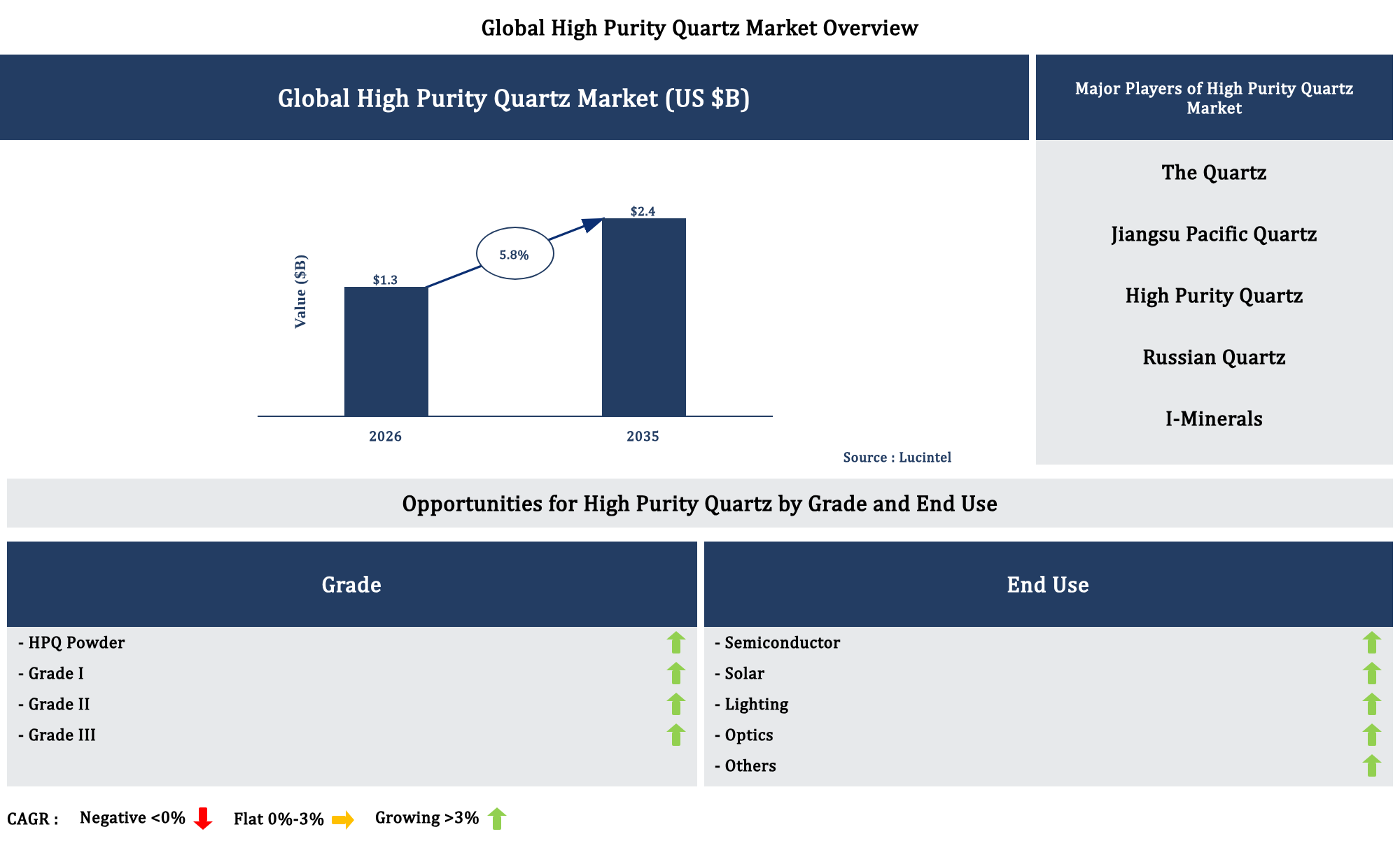
The high purity quartz market is evolving rapidly as advanced technologies demand stricter material specifications, cleaner supply chains, and more consistent performance. High purity quartz is a critical input for semiconductor wafers, solar cells, high-end optics, and specialty glass, so shifts in these downstream industries are reshaping production, processing, and investment patterns. Growing digitalization, the energy transition, and regionalization of manufacturing are all pushing producers to innovate in purification, traceability, and sustainability. These emerging trends are redefining competitive dynamics, influencing pricing structures, and encouraging closer collaboration between quartz suppliers, technology manufacturers, and research institutions.
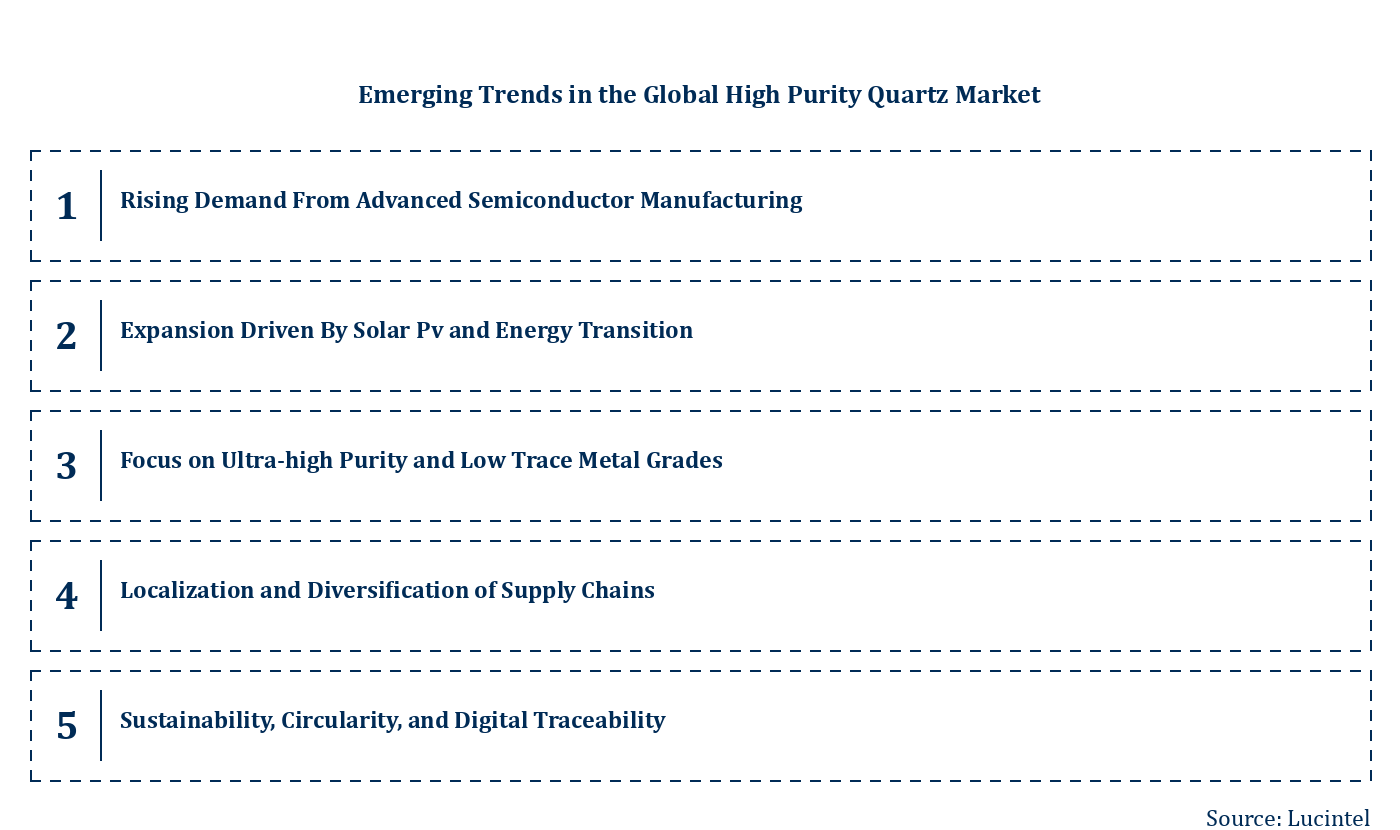
The high purity quartz market is undergoing a notable transformation driven by rapid expansion of semiconductor fabrication, advanced optics, and next‑generation photovoltaic technologies. Demand for ultra‑low impurity quartz is intensifying as device geometries shrink and power densities rise, tightening specifications on contamination, trace metals, and particle control. At the same time, supply dynamics are shifting as new deposits are assessed, processing technologies advance, and key players pursue vertical integration to secure consistent feedstock. Together, these developments are reshaping competitive positions, pricing power, and long‑term investment priorities across the global high purity quartz market.
The high purity quartz market is poised for robust strategic growth as demand accelerates across advanced technology applications and precision manufacturing. High purity quartz is a critical input for ultra-clean, high-performance components used in semiconductors, photovoltaic cells, optical systems, and specialty glass. Its exceptional chemical purity, thermal stability, and optical properties make it indispensable as device geometries shrink and efficiency standards rise. Market participants that align capacity expansions, process innovation, and long‑term supply agreements with high growth application clusters can capture premium pricing, strengthen customer lock‑in, and build resilience against raw material volatility and cyclical demand swings.
The global high purity quartz market is shaped by a dynamic mix of technological, economic, and regulatory influences. Demand is being propelled by advanced applications in semiconductors, photovoltaics, optics, and specialty glass, all of which require ultra‑low‑impurity materials to perform reliably. At the same time, producers must navigate complex mining regulations, high capital requirements for purification technologies, and volatile energy and logistics costs. Market participants that can secure high‑quality deposits, optimize processing efficiency, and comply with environmental and safety standards are best positioned to capture growth opportunities while mitigating operational and geopolitical risks.
The factors responsible for driving the high purity quartz market include:
The challenges facing this high purity quartz market include:
The combined influence of these drivers and challenges creates a nuanced outlook for the global high purity quartz market. Strong demand from semiconductors, solar photovoltaics, optics, and advanced materials continues to support robust growth prospects, while rising technical standards reinforce the need for ultra‑clean feedstock. However, limited high‑quality reserves, capital‑intensive purification processes, and tightening environmental and logistical constraints act as structural brakes on rapid capacity expansion. Market participants that can secure sustainable resources, invest in efficient and compliant processing technologies, and build resilient supply chains will be better positioned to capture value and maintain competitiveness in this specialized segment.
Companies in the market compete on the basis of product quality offered. Major players in this market focus on expanding their manufacturing facilities, R&D investments, infrastructural development, and leverage integration opportunities across the value chain. Through these strategies high purity quartz market companies cater increasing demand, ensure competitive effectiveness, develop innovative products & technologies, reduce production costs, and expand their customer base. Some of the high purity quartz market companies profiled in this report include-
The study includes a forecast for the global high purity quartz market by grade, end use, and region.
The high purity quartz market is gaining strategic importance as advanced technologies demand ultra-clean raw materials for precision components. High purity quartz is a critical input for semiconductor wafers, high‑end optics, solar PV cells, and advanced glass, all of which are expanding alongside global digitalization and energy transition trends. Supply security, impurity control, and processing know‑how are becoming major differentiators for producing nations. Companies and governments in the United States, China, Germany, India, and Japan are investing in upgraded beneficiation, purification, and value‑added processing capabilities, while also seeking long‑term offtake agreements and recycling routes to manage volatility in prices and availability.
High Purity Quartz Market: How Are Ultra-Clean Materials Redefining the Technology Supply Chain?
Dallas, July 20, 2026 – The high purity quartz market is moving from a niche materials segment to a strategic battleground for semiconductor, solar, and advanced optics supply chains. As chipmakers race to smaller nodes, solar manufacturers push higher efficiencies, and photonics players scale production, demand for ultra-low contamination quartz is surging. This shift is reshaping investment priorities, redrawing partnerships between miners, refiners, and technology OEMs, and redefining geopolitical considerations for critical mineral sourcing.
Across the technology ecosystem, the material has become a quiet but pivotal enabler. From semiconductor-grade crucibles and quartzware to high-spec optical fibers and UV optics, applications are elevating purity thresholds while tightening expectations around consistency, traceability, and sustainability. The result is a market facing both disruptive innovation and structural bottlenecks, with far-reaching implications for pricing power, regional capacity, and long-term contracts.
What Strategic Trends Are Rewiring the high purity quartz market?
The high purity quartz market is undergoing a structural shift driven by technology-centric demand and process innovation rather than commodity cycles. Several trends are steering the medium-term trajectory and competitive landscape.
Which Technology Markets Are Poised to Benefit Most from These Shifts?
The implications of innovation in the high purity quartz market will be felt most acutely in technology-intensive sectors where contamination control directly links to performance, reliability, and cost structures.
How Will These Innovations Disrupt Market Structure and Competitive Dynamics?
As demand tilts toward higher purity and higher performance, the market is shifting away from a broad commodity mindset toward a segmented, specification-driven environment. This evolution is already disrupting how producers, traders, and technology buyers structure their relationships and manage risk.
What Challenges Could Constrain Growth Despite Rising Demand?
Despite strong tailwinds from the technology industry, the high purity quartz market faces a series of structural and operational challenges that could limit its ability to scale smoothly with demand.
Where Do the Most Attractive Opportunities Emerge for Stakeholders?
Even as the market wrestles with constraints, multiple opportunity corridors are opening for miners, refiners, technology OEMs, and investors willing to position early in strategic segments.
How Is High Purity Quartz Being Deployed Across Technology Use Cases?
Within the technology industry, high purity quartz is embedded deep inside critical equipment and components that underpin digital infrastructure and clean energy systems.
What Recent Developments Are Signaling the Next Phase of Market Evolution?
Recent moves by industry leaders and new entrants indicate that the high purity quartz market is preparing for sustained demand from advanced technology applications rather than a short-lived investment cycle.
How Should Strategic Decision-Makers Position Themselves in the high purity quartz market?
As the high purity quartz market transitions into a strategically vital segment of the technology supply chain, decision-makers across the ecosystem are rethinking sourcing, partnership models, and risk frameworks. Technology manufacturers are elevating quartz from a background raw material to a board-level concern, integrating it into broader supply-security playbooks. Producers, in turn, are reorienting from volume-centric models toward precision, specification, and co-innovation with downstream users. Investors are beginning to view high purity quartz as a lever on secular themes such as semiconductor scaling, high-bandwidth connectivity, and decarbonization through solar energy. The strategic winners will be those who recognize that in an era of advanced technology, invisible materials like high purity quartz can become decisive factors shaping resilience, competitiveness, and long-term value creation.
1. The Quartz
The Quartz is recognized in the high purity quartz market as a specialist company focused on quartz materials for advanced industrial applications. The company’s activities are associated with the production and supply of high purity quartz feedstock and processed quartz products that can serve semiconductor, photovoltaic, optics, and specialty glass customers. Its headquarters location, establishment year, and total employee count are not publicly disclosed, but its market positioning suggests collaboration with customers across multiple regions where electronics and solar manufacturing clusters are present. Within the high purity quartz market, The Quartz is typically linked to products such as high purity quartz sand, refined quartz powders, and engineered grades tailored for crucibles, quartz tubes, and high-end glass components used in integrated circuit and solar ingot manufacturing. The company’s geographic presence is understood to extend through distribution partners and direct customer relationships in Asia, Europe, and North America, where demand for high-specification silica inputs is strongest. Product development focuses on consistency of chemical purity, tight particle size distribution, and low contamination to meet stringent semiconductor and PV standards. Publicly verifiable information on recent geographic expansions, mergers, or acquisitions specifically related to the high purity quartz market is limited, and no major M&A transactions with disclosed terms have been reported in global financial databases for The Quartz in recent years. Nonetheless, the company is generally viewed as part of the broader ecosystem of niche suppliers that support growth in electronics, solar, and optical markets by providing high-purity quartz raw materials and value-added formats customized to downstream manufacturing requirements.
2. Jiangsu Pacific Quartz
Jiangsu Pacific Quartz is a leading Chinese producer of high purity quartz materials and quartz products that serve semiconductor, photovoltaic, lighting, and optical industries. Headquartered in Lianyungang, Jiangsu, China, the company operates integrated facilities that cover mining, purification, and deep processing of natural quartz resources into high-value products. Founded in 1992, Jiangsu Pacific Quartz has grown to employ several hundred people across its operations and to become one of the most visible Asian suppliers of high purity quartz glass and related components. Its product portfolio for the high purity quartz market includes high purity quartz sand, quartz crucibles for monocrystalline silicon pulling, quartz tubes and rods, quartz plates, and custom quartzware for semiconductor and solar manufacturing equipment. The company’s geographic presence is strongly rooted in China but extends to export markets in East Asia, Europe, and North America through a network of distributors and direct key accounts, particularly in the solar wafer and semiconductor fabrication value chain. In recent years, Jiangsu Pacific Quartz has expanded its capacity for high purity quartz crucibles and specialized quartz glass, driven by the expansion of China’s photovoltaic and integrated circuit industries and by growing demand for domestic alternatives to imported materials. Public filings indicate ongoing capital expenditure projects to upgrade purification and melting technologies that enhance product purity and performance. No landmark international merger or acquisition deals specifically tied to the high purity quartz segment have been announced, but the company has pursued strategic cooperation agreements and incremental capacity expansions to reinforce its competitive position and align with national initiatives to strengthen China’s semiconductor and solar materials supply chain.
3. High Purity Quartz
High Purity Quartz is a specialized company associated with the well-known Spruce Pine, North Carolina, resource base, which is one of the most important sources of ultra-high purity quartz globally. From this strategic location in the United States, the company focuses on exploration, development, and processing of quartz deposits with exceptional chemical and physical characteristics suited for the most demanding applications. High Purity Quartz concentrates on supplying feedstock for high purity quartz sand and related materials used in semiconductor-grade crucibles, quartz glass, high-performance optics, and advanced ceramics. While specific information about its establishment year, total employees, and detailed financials is not disclosed, the company’s activities center on serving technology-intensive customers in North America, Europe, and Asia that require very low levels of trace metals and high consistency in quartz quality. The company’s product portfolio within the high purity quartz market includes raw and processed quartz feedstock, high purity silica products for solar and semiconductor applications, and development-stage materials intended to meet evolving purity and reliability standards. Market communications and technical documents suggest a focus on geological resource development, beneficiation, and tight process control to deliver repeatable high-purity outputs. High Purity Quartz leverages the reputation of the Spruce Pine region to position itself as a premium raw material source for downstream processors and end users. Publicly available sources do not report major mergers, acquisitions, or international plant expansions in recent years directly under the High Purity Quartz corporate banner; instead, the business appears oriented toward resource development partnerships, off-take arrangements, and supply relationships with manufacturers needing secure and consistent access to ultra-high purity quartz resources.
4. Russian Quartz
Russian Quartz is a vertically integrated producer of high purity quartz based in Kyshtym in Russia’s Chelyabinsk Region, where it operates mining and processing assets linked to the Kyshtym deposit. Established in 2002, the company is part of a broader industrial group and is recognized for supplying high purity quartz concentrates and processed products to customers in the semiconductor, solar, and specialty glass industries. Its product portfolio for the high purity quartz market includes high purity quartz concentrates, purified quartz sands, and tailored grades suitable for crucible production, quartz glass melting, and electronic-grade fillers. Russian Quartz draws on its own geological resource base, enabling control over the entire value chain from ore extraction to high-purity output, which is a key differentiator in markets where feedstock quality is critical. The company distributes its products domestically within Russia and to export markets in Europe and Asia, positioning itself as a competitive alternative source of high purity quartz feedstock. Its geographic presence is supported by logistics corridors from the Urals region to international customers. Publicly accessible information indicates that Russian Quartz has invested in upgrading beneficiation, flotation, and purification technologies to increase the share of output that meets stringent electronic and solar-grade specifications. In the context of recent developments in the high purity quartz market, Russian Quartz has pursued modernization of its plant and strengthening of export channels rather than headline-grabbing overseas acquisitions. There is limited public disclosure of major M&A transactions specifically related to high purity quartz, and no large-scale international takeovers have been widely reported. Nonetheless, the company plays a significant role in diversifying global supply sources for high purity quartz and in providing an alternative to traditional Western and Asian suppliers.
5. I-Minerals
I-Minerals is a Canadian mineral development company headquartered in Vancouver, British Columbia, with a portfolio centered on specialty industrial minerals, including high purity quartz associated with its Helmer-Bovill project in Idaho, USA. Founded in 1984, the company operates with a lean corporate structure and a small team focused on advancing its assets from exploration toward production. Within the high purity quartz market, I-Minerals is best known for its plans to develop high purity quartz, feldspar, kaolin, and halloysite resources, targeting downstream markets such as high-end glass, ceramics, fillers, and advanced materials. The high purity quartz component of the project aims to deliver low-impurity quartz products suitable for technical applications, including quartz glass and certain electronic and solar uses, although the project remains in various stages of technical and economic evaluation rather than large-scale commercial production. Geographically, I-Minerals’ core mineral assets are located in the United States, while corporate and investor relations activities are managed from Canada, giving the company a North American footprint with potential to serve global customers through exports if full-scale development proceeds. The company’s high purity quartz strategy is tied to resource delineation, pilot processing, and product testing with prospective end users. While it has issued periodic updates on feasibility, process testing, and offtake discussions, publicly available sources do not indicate substantial revenue from high purity quartz sales or from other minerals, and no major mergers or acquisitions specifically oriented to the high purity quartz market have been recorded. Instead, I-Minerals’ trajectory has focused on incremental project de-risking, engineering optimization, and engagement with potential industry partners and customers who require consistent, high-quality quartz and associated specialty mineral outputs.
Lucintel has been in the business of market research and management consulting since 2000 and has published over 1000 market intelligence reports in various markets / applications and served over 1,000 clients worldwide. This study is a culmination of four months of full-time effort performed by Lucintel's analyst team. The analysts used the following sources for the creation and completion of this valuable report:
Extensive research and interviews are conducted across the supply chain of this market to estimate market share, market size, trends, drivers, challenges, and forecasts. Below is a brief summary of the primary interviews that were conducted by job function for this report.

Thus, Lucintel compiles vast amounts of data from numerous sources, validates the integrity of that data, and performs a comprehensive analysis. Lucintel then organizes the data, its findings, and insights into a concise report designed to support the strategic decision-making process. The figure below is a graphical representation of Lucintel's research process.

Choose a license that fits your team. Instant PDF delivery.
Prices exclude taxes. Instant delivery. Custom licensing available on request.
Market Report · September 7, 2026
Market Report · July 22, 2026
Market Report · July 22, 2026
Trusted partner for strategic intelligence and business growth


Receive a complimentary market analysis tailored to your industry. Our analysts will identify key growth opportunities and competitive dynamics specific to your business.

Market size, growth rate, and key trend analysis for your specific sector.

Top competitor positioning and market share analysis.

Strategic recommendations backed by data-driven insights.
Get curated market intelligence and competitive moves straight to your inbox.
By subscribing, you agree to receive our monthly insights. Unsubscribe anytime.
Receive a complimentary market analysis tailored to your industry. Our analysts will identify key growth opportunities and competitive dynamics specific to your business.
Market size, growth rate, and key trend analysis for your specific sector.
Top competitor positioning and market share analysis.
Strategic recommendations backed by data-driven insights.
Get curated market intelligence, emerging trends, and competitive moves straight to your inbox each month.
By subscribing, you agree to receive our monthly insights. Unsubscribe anytime.
We'll send your sample report shortly.