
Market Report · July 22, 2026

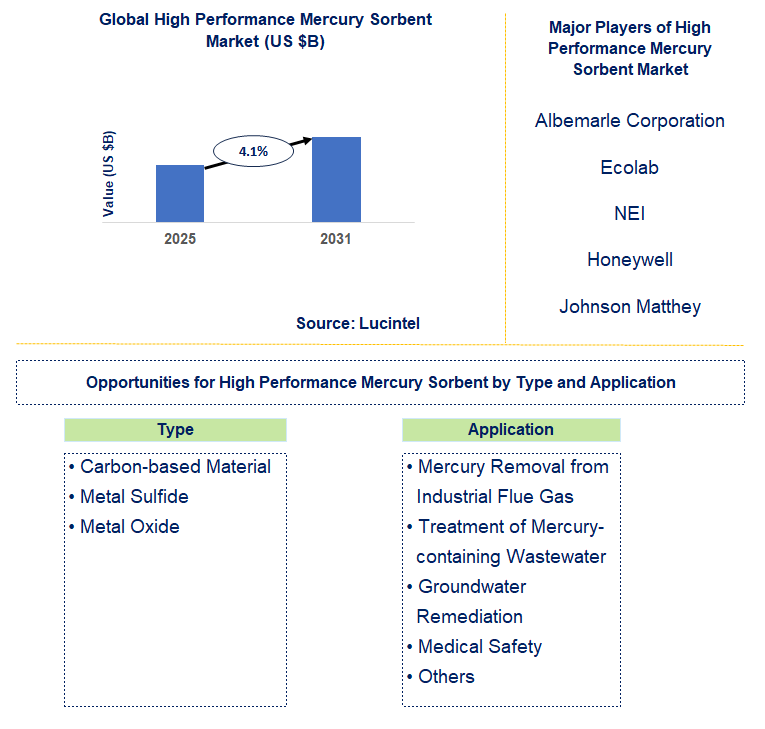
Key data points: The growth forecast = 4.1% annually for the next 7 years. Scroll below to get more insights. This market report covers trends, opportunities and forecasts in high performance mercury sorbent market to 2031 by type (carbon-based material, metal sulfide, and metal oxide), application (mercury removal from industrial flue gas, treatment of mercury-containing wastewater, groundwater remediation, medical safety, and others), and region (North America, Europe, Asia Pacific, and the Rest of the World)
We'll send your sample report shortly.
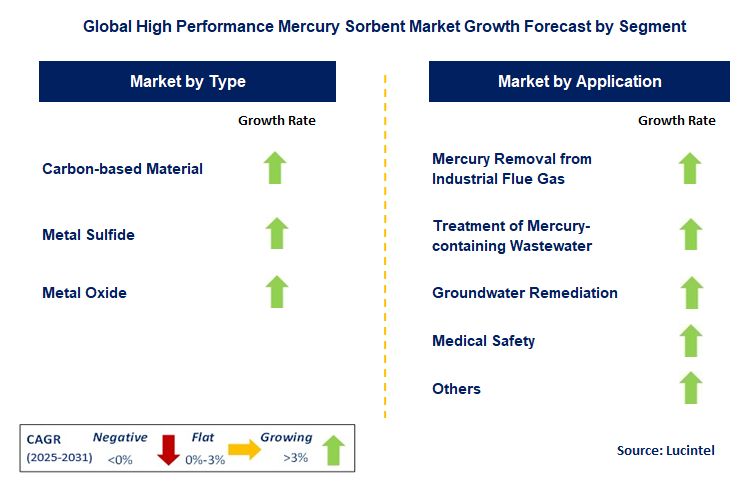
• Lucintel forecasts that, within the type category, metal sulfide is expected to witness the highest growth over the forecast period.
• Within the application category, treatment of mercury-containing wastewater is expected to witness the highest growth.
• In terms of region, APAC is expected to witness the highest growth over the forecast period. Gain valuable insights for your business decisions with our comprehensive 150+ page report. Sample figures with some insights are shown below.
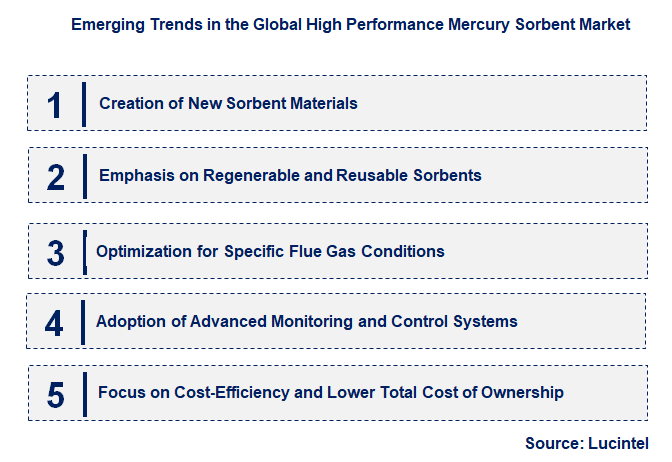
• Creation of New Sorbent Materials: There is an increasing trend towards research and development of new sorbent materials replacing conventional activated carbon. These include metal-organic frameworks (MOFs), zeolites, functionalized polymers, and nanocomposites. These emerging materials tend to provide better mercury adsorption capacity, better selectivity towards particular mercury species (elemental vs. oxidized), and better performance under fluctuating temperature and flue gas conditions. The outcome is a broader variety of designed solutions for particular industrial mercury emission issues, and thereby possible more efficient and cost-effective mercury removal.
• Emphasis on Regenerable and Reusable Sorbents: Sustainability and waste minimization are fueling a movement toward the creation of regenerable and reusable mercury sorbents. In contrast to disposable sorbents that end up as hazardous waste once saturated, regenerable sorbents can be processed to release the trapped mercury in a concentrated state for safer disposal or recycling and reuse. This trend is having an effect on the market by lowering the amount of hazardous waste that is produced, decreasing operational expenses related to sorbent disposal, and encouraging a circular economy strategy in industrial abatement of mercury.
• Optimization for Specific Flue Gas Conditions: One of the trends is the creation of high-performance mercury sorbents tailored to the specialized nature of various industrial flue gas streams, including different temperatures, humidity, and concentrations of other emissions such as SO2 and NOx. Customization guarantees optimum mercury capture efficiency under actual operating conditions. This direction results in more efficient mercury capture systems, less sorbent usage, and better compliance for various industries such as coal-fired power plants, cement kilns, and smelters, going beyond one-size-fits-all solutions.
• Adoption of Advanced Monitoring and Control Systems: The market is experiencing a shift toward merging high-performance mercury sorbents with sophisticated monitoring and control systems. This includes real-time emission monitoring of mercury and automated injection systems for sorbents that respond to dosage according to flue gas conditions and mercury level. This synergy affects the market by maximizing sorbent use, minimizing operating expenses, maintaining consistent emission limit compliance, and offering data-driven process improvement in industrial plants, which results in intelligent and efficient mercury abatement.
• Focus on Cost-Efficiency and Lower Total Cost of Ownership: High performance is important, but there is a growing trend towards designing mercury sorbents with a lower total cost of ownership (TCO) for industrial customers. This is not just a matter of price per unit of sorbent but also other considerations such as the longevity of the sorbent, its ease of handling, cost of disposal, and the effect on overall system efficiency. This trend is forcing companies to innovate in production technologies, material compositions, and regeneration processes in order to offer economically competitive solutions that are stringent on the environment but do not result in unbearably high financial loads for industries. These trends are basically transforming the high performance mercury sorbent market by propelling innovation towards more efficient, environmentally-friendly, customized, and economically sound solutions. They are making it possible for industries to comply with ever tighter environmental rules with increased accuracy and accountability, ultimately leading to a cleaner environment and protection of public health.
• Innovative Activated Carbon Modifications: Recent trends involve large leaps in modifying activated carbon to improve its adsorption ability towards mercury. This entails activating activated carbon using different chemical agents, e.g., sulfur, halides (e.g., bromine or chlorine), or noble metals. These changes provide additional reactive sites on the carbon surface, enhancing its capacity to capture various mercury species, particularly elemental mercury (Hg0), which is hard to capture. This innovation also leads to increased removal efficiencies and wider applicability in different industrial flue gas streams.
• Development of Non-Carbon-Based Sorbents: A recent significant trend is the increasing occurrence and commercialization of non-carbon-based mercury sorbents. Examples of these are metal oxides (e.g., iron oxides), zeolites, silica-based sorbents, and composite materials. These materials are being created to supplement limitations of activated carbon, including possible combustion or select flue gas composition problems. This trend broadens the market by providing specialized products that might be more effective in specific industrial processes or provide enhanced renderability.
• Regenerable Sorbent Technologies Development: Recent advances emphasize a strong trend towards regenerable mercury sorbents. This entails the development of sorbents that can be desorbed of retained mercury, enabling the sorbent material to be reused time and again. The desorbed mercury can subsequently be recovered in a concentrated, more tractable form for safe disposal or recycling. This innovation is important in minimizing the amount of toxic waste, decreasing operational expenses with respect to sorbent replacement and disposal, and achieving a greener strategy for mercury abatement.
• Improved Sorbent Delivery and Injection Systems: Current advancements go beyond the sorbent material itself to encompass developments in sorbent delivery and injection systems. These systems are becoming increasingly advanced, enabling exact and optimized sorbent dosing into flue gas streams. Greater distribution and contact effectiveness between the sorbent and mercury vapor guarantee maximum capture. This innovation results in more efficient utilization of sorbents, decreased consumption, and enhanced overall system performance, directly influencing the cost of operations and compliance levels of industry plants.
• Expanded Emphasis on Mercury Speciation Control: One newer trend is the expanded emphasis on controlling certain mercury species, especially elemental mercury (Hg0) and oxidized mercury (Hg2+), whose behavior varies in flue gas. Sorbent technology more and more is directed toward certain species for better removal by frequently enhancing Hg0 oxidation to Hg2+ to facilitate capture by current pollution control devices or by specialized sorbents. This development allows for a more tailored and efficient approach to mercury abatement, addressing the complexities of mercury chemistry in industrial emissions. These advancements are significantly influencing the high performance mercury sorbent market by allowing industries to achieve enhanced levels of mercury emission reduction in a more efficient and sustainable manner. They are creating a more technologically sophisticated and diverse market with customized solutions that respond to the unique needs of different industrial applications while supporting global efforts in environmental conservation.
• Coal-Fired Power Plants: In spite of the worldwide trend towards the use of renewable sources of energy, coal-fired power plants continue to be a significant source of anthropogenic mercury emissions, particularly in the developing economies. Tight emission standards, like the Minamata Convention on Mercury and domestic regulations, continue to propel the market demand for high performance mercury sorbents in this application. This provides a wide growth potential for sorbents that are capable of efficiently removing mercury from widely varying coal combustion flue gas compositions, such as those containing different sulfur levels and temperatures, in compliance and allowing operation to continue.
• Cement Manufacturing: Cement kilns represent another major source of mercury emissions because of the amount of mercury in raw materials such as limestone and due to the combustion processes. The cement industry is increasingly subject to regulatory scrutiny, presenting a very significant growth opportunity for mercury sorbents. Sorbents that are specifically designed to address the distinctive flue gas conditions of cement kilns, including frequently high temperatures and high dust loading, are in great demand to assist manufacturers in complying with emissions standards and embracing more environmentally friendly production protocols.
• Waste Incineration: Incinerators for municipal solid waste and hazardous waste release mercury from the combustion of mercury-containing products. As regulation of waste management continues to tighten worldwide, the need for high-performance mercury sorbents in this application increases. This opportunity is centered around sorbents that are able to effectively capture mercury from various and frequently changing flue gas streams so that waste-to-energy operations are compliant environmentally and help to produce cleaner air.
• Non-Ferrous Metals Production: Smelting and refining operations in non-ferrous metal manufacturing (e.g., copper, zinc, lead, gold) have been known to release large quantities of mercury. Increased environmental regulations on this industry produce a particular growth potential for mercury sorbents. Sorbents must be strong and effective under highly specialized and usually aggressive flue gas conditions, solving the particular problems of mercury extraction from metallurgical operations to stringent air quality requirements.
• Oil and Gas Processing: Natural gas and crude oil may have differing concentrations of mercury, which may lead to equipment corrosion (liquid metal embrittlement) and to contamination of the environment if not captured. Upstream and midstream oil and gas processing necessitates high performance mercury sorbents to safeguard infrastructure, maintain product purity (e.g., LNG), and avoid environmental release. This use is a consistent growth opportunity for sorbents that can successfully remove mercury from hydrocarbon streams under high-pressure and changing temperature environments. These growth prospects are deeply influencing the high performance mercury sorbent market by promoting specialization and innovation. They are pushing manufacturers to create customized solutions that address the unique and high-stakes needs of different industrial uses, allowing for efficient mercury abatement and supporting industries in meeting environmental standards while staying efficient and accountable.
• Albemarle Corporation
• Ecolab
• NEI
• Honeywell
• Johnson Matthey
• CalgonCarbon Corporation
• Norit
• Carbon-based Material
• Metal Sulfide
• Metal Oxide
• Mercury Removal from Industrial Flue Gas
• Treatment of Mercury-containing Wastewater
• Groundwater Remediation
• Medical Safety
• Others
• North America
• Europe
• Asia Pacific
• The Rest of the World
• United States: The U.S. market for high performance mercury sorbents is primarily influenced by the Mercury and Air Toxics Standards (MATS) and current efforts to minimize industrial emissions. Recent trends are the development of highly effective activated carbon-based sorbents and new non-carbon-based materials tailored for given industrial flue gas conditions. There is intense emphasis on improving sorbent injection equipment and creating products with greater strength for decreasing operating expenses and maintaining long-term compliance with coal-fired power plants, cement kilns, and other industrial power plants.
• China: China is a significant market for high performance mercury sorbents because it has such an extensive industrial base and progressively stringent environmental protections, specifically for coal-fired power plants and industrial boilers. Recent advances in China involve studies on low-cost and highly efficient sorbents, generally based on domestic raw materials. Particular attention has been given to the development of tailored sorbents capable of efficiently capturing mercury from flue gas mixtures with various compositions, including those with high sulfur dioxide concentrations, in order to comply with national emission standards and maintain continued pollution control in different industries.
• Germany: Germany's high performance mercury sorbent market is spurred on by the European Union's strict environmental directives and domestic laws for reducing the emission of mercury. The latest trends in Germany focus on the creation of new advanced sorbent technologies with high capacities of adsorption and selectivity towards different mercury species. There is much emphasis placed on sustainable and regenerable sorbents, as well as the optimization of mercury removal processes for sectors such as waste incineration and coal combustion, in Germany's approach to environmental conservation and technological innovation.
• India: High performance mercury sorbent market is growing rapidly, mainly because of India's fast-paced industrialization and enforcement of tighter environmental standards on power plants and other industries. Indian developments pertain to expanded research in cost-effective and indigenous sorbent technologies. High-performance sorbents are being developed that can efficiently operate under difficult industrial conditions, responding to Indian coal's particular properties and industrial emissions, to enable industries to meet changing national mercury emission regulations.
• Japan: Japan's high performance mercury sorbent market is dominated by strong demand for advanced technological approaches and stringent environmental conformity. Recent activity in Japan involves the study of highly efficient and selective sorbents, frequently involving novel materials for mercury removal from various industrial streams, such as natural gas processing and waste incineration. Continuous efforts are aimed at producing sorbents that have long service life and high performance even at low mercury levels, demonstrating Japan's adherence to high environmental quality standards.


• Albemarle Corporation
• Ecolab
• NEI
• Honeywell
• Johnson Matthey
• CalgonCarbon Corporation
• Norit Q5. Which high performance mercury sorbent market segment will be the largest in future? Answer: Lucintel forecasts that, within the type category, metal sulfide is expected to witness the highest growth over the forecast period. Q6. In high performance mercury sorbent market, which region is expected to be the largest in next 5 years? Answer: In terms of region, APAC is expected to witness the highest growth over the forecast period. Q7. Do we receive customization in this report? Answer: Yes, Lucintel provides 10% customization without any additional cost.


Choose a license that fits your team. Instant PDF delivery.
Prices exclude taxes. Instant delivery. Custom licensing available on request.
Market Report · July 22, 2026
Market Report · July 22, 2026
Market Report · July 22, 2026
Trusted partner for strategic intelligence and business growth


Receive a complimentary market analysis tailored to your industry. Our analysts will identify key growth opportunities and competitive dynamics specific to your business.

Market size, growth rate, and key trend analysis for your specific sector.

Top competitor positioning and market share analysis.

Strategic recommendations backed by data-driven insights.
Get curated market intelligence and competitive moves straight to your inbox.
By subscribing, you agree to receive our monthly insights. Unsubscribe anytime.
Receive a complimentary market analysis tailored to your industry. Our analysts will identify key growth opportunities and competitive dynamics specific to your business.
Market size, growth rate, and key trend analysis for your specific sector.
Top competitor positioning and market share analysis.
Strategic recommendations backed by data-driven insights.
Get curated market intelligence, emerging trends, and competitive moves straight to your inbox each month.
By subscribing, you agree to receive our monthly insights. Unsubscribe anytime.
We'll send your sample report shortly.