
Market Report · May 18, 2026

This market report covers trends, opportunities, and forecasts in the global workforce management market to 2031 by technology (cloud and on-premise), end use industry (academia, automotive & manufacturing, bfsi, government, healthcare, retail, and others), and region (North America, Europe, Asia Pacific, and the Rest of the World)
We'll send your sample report shortly.
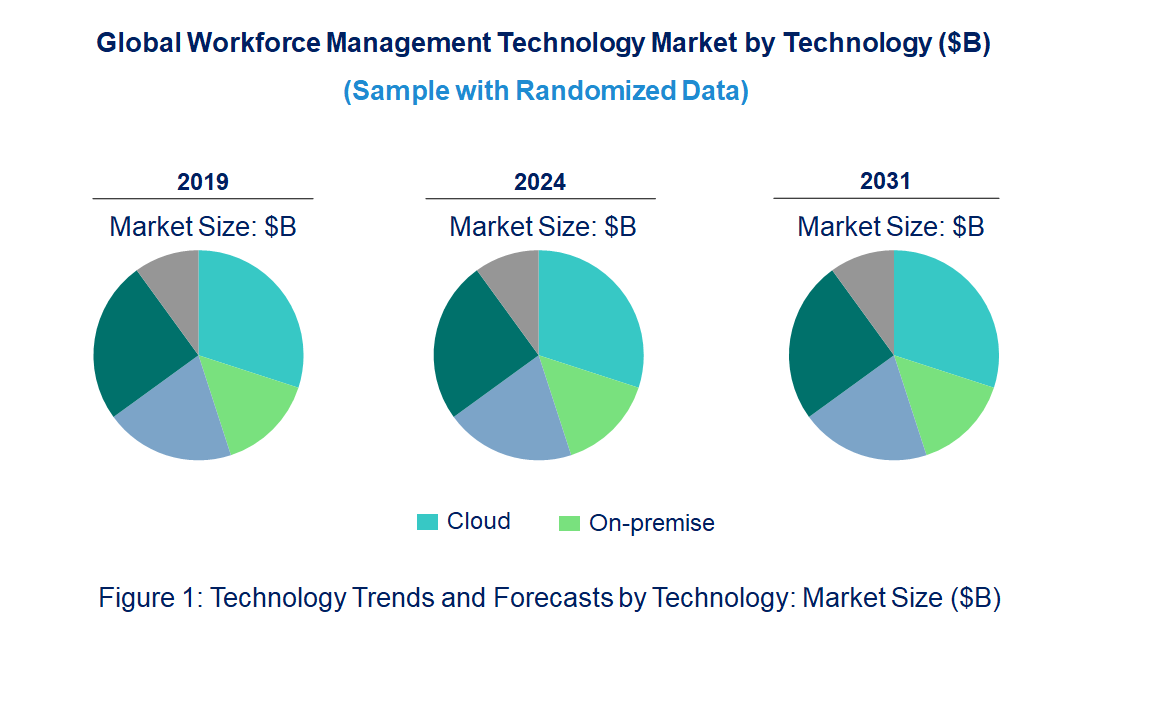
![Workforce Management Market Trend and Forecast by End Use Industry [Value from 2019 to 2031]:](https://lucintel.com/images/Workforce-Management-Technology-Market-Segment.png "Workforce Management Market Trend and Forecast by End Use Industry [Value from 2019 to 2031]:")
• Cloud-Based Workforce Management Solutions: The migration to cloud-based platforms is allowing businesses to streamline workforce management processes and access data from anywhere, thus enhancing flexibility and scalability. Cloud systems support remote workforces and allow for better collaboration, reduce operational costs, and provide real-time updates.
• AI and Machine Learning for Predictive Analytics: AI and machine learning are increasingly becoming part of WFM systems to predict labor needs and optimize the schedule. These tools analyze the historical data, predict fluctuations in demand, and suggest optimum levels of staffing, hence improving workforce efficiency and reducing overstaffing or understaffing.
• Mobile Accessibility and Self-Service: Mobile-enabled WFM solutions enable employees to manage their schedules, request time off, and track performance through mobile applications. This enhances employee satisfaction as it provides them with more control over their work schedules and improves communication between employees and managers.
• Integration with Other Enterprise Systems: WFM tools are now more and more integrated with other enterprise software such as payroll, HR systems, and ERP solutions. The integration makes sure all the functions work in coherence with each other, thus minimizing manual data entry and providing managers with an integrated view of workforce performance and operational efficiency.
• Focus on Employee Engagement and Well-Being: WFM systems are now including features that enhance employee engagement and well-being, such as flexible scheduling, feedback mechanisms, and wellness programs. These systems are expected to improve retention rates and productivity by offering more personalized and supportive work experiences. Emerging trends in workforce management technology are transforming how companies optimize labor, engage employees, and use data for informed decisions. As the deployment of cloud-based solutions and AI-powered tools is rising and as employee engagement capabilities continue to advance, so will organizations' abilities to better address the evolving workforce's needs, which can increase their operational efficiency and levels of employee satisfaction.
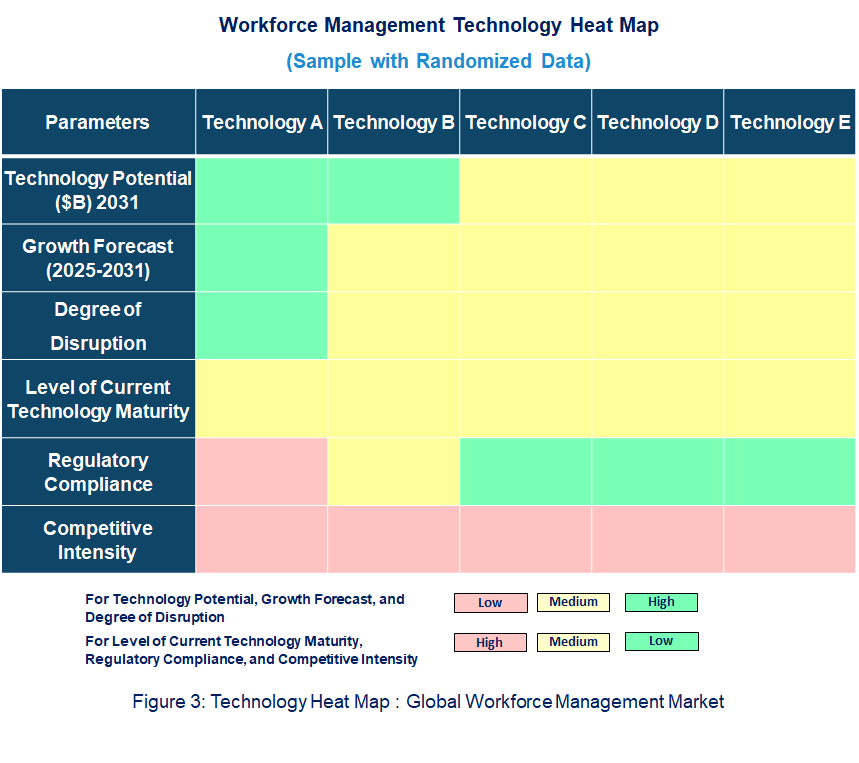
• Potential in Technology: This is because AI, machine learning, cloud-based systems, and mobile solutions are increasingly coming into use, giving firms new ways to optimize workforce scheduling, improve productivity, and enhance workforce satisfaction. Substantial disruption of traditional workforces is expected as companies go for automation, real-time data analytics, and self-service tools. These technologies enable businesses to streamline operations, reduce costs, and improve decision-making.
• Degree of Disruption: The degree of disruption is high, as AI-driven predictive analytics and automation can replace manual scheduling and resource allocation processes. Cloud-based systems also provide greater scalability and accessibility, making it easier for businesses to adapt to changing labor requirements in real-time.
• Current Technology Maturity Level: Current technology maturity has reached a high level: cloud platforms and AI tools are already integrated into many solutions for WFM. There are still challenges in ensuring an easy integration of multiple systems within large organizations with complex structures.
• Regulatory Compliance: Increasingly, WFM technologies are being developed concerning labor laws, data privacy regulations, and industry-specific standards. The WFM solutions that companies have in place need to meet the requirements in these areas of data security and worker rights.
• UKG (Ultimate Kronos Group): UKG has taken steps forward in integrating AI-driven predictive scheduling, which has enabled businesses to optimize their labor resources based on demand forecasts. The company's concentration on employee experience through mobile access and self-service tools enhances the workforce's satisfaction, reduces turnover, and improves productivity.
• SAP: SAP Workforce Management solutions have also merged into an all-in-one HR offering through SAP SuccessFactors. The more recent data-driven analytics and intelligent automation have improved their ability to optimize labor costs and maintain compliance with regulatory requirements, especially in multinational operations.
• Oracle Corporation: Oracle's WFM has leveraged its strong cloud infrastructure to provide a cohesive solution for scheduling, time tracking, and analytics. Some of the recent updates even incorporate more advanced machine learning models to improve demand forecasting and better optimize the workforce, thus enhancing the operational efficiency of large-scale enterprises.
• WorkForce Software, LLC: WorkForce Software has highlighted how cloud-based WFM systems work with mobile-first approaches, where employees can handle all matters related to scheduling as well as leave requests on a variety of devices. Through added predictive analytics, the company bolstered its platform to better predict labor, an essential factor in making organizational teams agile in dynamic markets.
• NICE: NICE introduces new AI-powered features in WFM to streamline scheduling, forecasting, and agent performance management. Enhanced automation and integration into customer service platforms help improve workforce productivity and customer satisfaction, especially in call center environments.
• ActiveOps PLC: ActiveOps has concentrated primarily on automating back-office operations and workforce management through its Workware platform. Recent developments in workflow automation, AI-driven insights, and resource optimization are especially useful to service-oriented industries in achieving high operational efficiency.
• Infor: Infor's WFM solutions boast enormous improvements in real-time data processing and AI analytics. Its cloud-native WFM suite provides advanced tools for labor optimization and improved features on employee engagement, giving organizations the flexibility to quickly change according to business needs.
• Ceridian HCM: Ceridian's Dayforce platform continues to advance employee experience through an integrated approach to workforce management, payroll, and benefits. With mobile and AI-powered features, Ceridian helps organizations achieve greater workforce efficiency while maintaining compliance with labor regulations.
• EG Solutions: EG Solutions focuses on workforce optimization for service-driven industries to improve scheduling and resource usage. Recent AI and real-time analytics enhancements have enabled a business to make data-driven decisions about workforce management, thereby optimizing productivity and savings. These developments are reshaping the WFM market by providing more intuitive, automated, and integrated solutions. As companies increasingly embrace digital transformation, the impact of these innovations continues to grow, helping businesses improve operational efficiency, enhance workforce satisfaction, and stay ahead of evolving market demands.
• Adoption of Cloud-Based Solutions: Cloud technology promotes flexibility, scalability, and cost efficiency. Real-time data and seamless collaboration deliver faster decision-making and operational efficiency through cloud-based WFM solutions. Companies with dispersed workforces or multinational operations will appreciate this even more.
• AI and Automation: AI and automation are being rapidly integrated into WFM solutions to improve optimization in scheduling, forecasting, and performance management. It ensures less manual intervention with improvements in accuracy, making a business more responsive to variability in demand, enhancing labour productivity, and reducing errors associated with scheduling.
• Employee Engagement and Experience: Improving employee experience and engagement has made WFM platforms include self-service tools and mobile apps. The ability to control their schedules allows employees to increase satisfaction, retention, and productivity in the business.
• Integration with Other Enterprise Systems: The integration of WFM platforms with other enterprise software, such as HR, payroll, and ERP systems, enables businesses to streamline operations, reduce data entry errors, and have a holistic view of workforce performance. This reduces inefficiencies and enhances operational visibility. Challenges:
• Data Security and Privacy Concerns: With the increased dependency on cloud-based solutions and mobile applications, data security and privacy are key concerns for businesses. Ensuring that sensitive employee data is secure and compliant with regulations such as GDPR is a challenge for WFM solution providers.
• Integration Challenges: Businesses often face an issue in integrating new WFM solutions with existing systems. The complex organizational structure, along with legacy systems, creates bottlenecks, and a transition to advanced solutions will be slow and costly and thus deterring adoption.
• Regulatory Compliance: This could be challenging for a company having a global workforce since compliance with labor laws and regulations in various regions keeps changing. The need to continually adapt WFM solutions to changing regulatory requirements introduces additional complexity in implementation and maintenance. Advances in cloud solutions, AI, automation, and employee engagement are driving the evolving Workforce Management technology market. Opportunities exist for businesses to optimize labor costs, improve productivity, and enhance workforce satisfaction with these technologies. However, issues surrounding data security, system integration, and regulatory compliance continue to hinder these opportunities. Businesses will only continue to advance operational efficiency and establish competitive advantage by adopting such technologies, but must not ignore the challenges that come with the new technologies.
• UKG
• SAP
• Oracle Corporation
• Workforce Software
• NICE
• ActiveOps
• Technology Readiness by Technology Type: Cloud technologies are very mature and can be deployed instantly in various sectors such as workforce management, customer relationship management, and enterprise resource planning. They support flexibility and global access, hence perfect for organizations looking to modernize and scale. On-premise technologies are still valid, but they tend to be customized for particular use cases where data privacy and regulatory compliance are the top priority. Key applications of on-premise systems are banking, government, and healthcare, which involve sensitive data handling. Both technologies are evolving, but cloud platforms tend to incorporate more AI, automation, and IoT capabilities while on-premise systems emphasize security.
• Disruption Potential by Technology Type: The workforce management market in cloud-based applications promises to disrupt industries if offered greater flexibility, scalability, and cost efficiencies in contrast to traditional on-premise systems. Through the application of cloud technologies, a company can access up-to-date information and collaborate virtually around the globe, cutting down on investments for infrastructure and infrastructural maintenance. On-premise technologies, however, give companies much control over customization, especially data security in the short term; though they are way too costly and less responsive. The cloud is becoming more of a choice for businesses when it comes to innovation and cost-effectiveness, but on-premise solutions remain relevant for organizations with strict data governance requirements or legacy infrastructure.
• Competitive Intensity and Regulatory Compliance: The competitive intensity between cloud and on-premise solutions is increasing as companies look for the most efficient way to manage their operations. It is a highly flexible and scalable solution that most businesses would prefer, which has made it very popular, especially for the likes of AWS and Microsoft Azure. Organisations operating in industries that are more strictly regulated find on-premise solutions very appealing due to tighter controls over data security and compliance. Compliance for cloud as well as on-premise technologies involves rigorous data protection protocols, but cloud providers continuously improve their compliance certifications. Companies have to weigh between these two options, security concerns, regulatory requirements, and competitive pressures.
• Cloud
• On-premise
• Academia
• Automotive & Manufacturing
• BFSI
• Government
• Healthcare
• Retail
• Others
• North America
• Europe
• Asia Pacific
• The Rest of the World
• Latest Developments and Innovations in the Workforce Management Technologies
• Companies / Ecosystems
• Strategic Opportunities by Technology Type


Choose a license that fits your team. Instant PDF delivery.
Prices exclude taxes. Instant delivery. Custom licensing available on request.
Market Report · May 18, 2026
Market Report · May 18, 2026
Market Report · May 18, 2026
Trusted partner for strategic intelligence and business growth


Receive a complimentary market analysis tailored to your industry. Our analysts will identify key growth opportunities and competitive dynamics specific to your business.

Market size, growth rate, and key trend analysis for your specific sector.

Top competitor positioning and market share analysis.

Strategic recommendations backed by data-driven insights.
Get curated market intelligence and competitive moves straight to your inbox.
By subscribing, you agree to receive our monthly insights. Unsubscribe anytime.
Receive a complimentary market analysis tailored to your industry. Our analysts will identify key growth opportunities and competitive dynamics specific to your business.
Market size, growth rate, and key trend analysis for your specific sector.
Top competitor positioning and market share analysis.
Strategic recommendations backed by data-driven insights.
Get curated market intelligence, emerging trends, and competitive moves straight to your inbox each month.
By subscribing, you agree to receive our monthly insights. Unsubscribe anytime.
We'll send your sample report shortly.