
Market Report · May 18, 2026

This market report covers trends, opportunities, and forecasts in the global wafer laser slotting machine market to 2031 by technology (manual, semi-automatic, and fully automatic), application (scribing, dicing, grooving, and others), and region (North America, Europe, Asia Pacific, and the Rest of the World)
We'll send your sample report shortly.
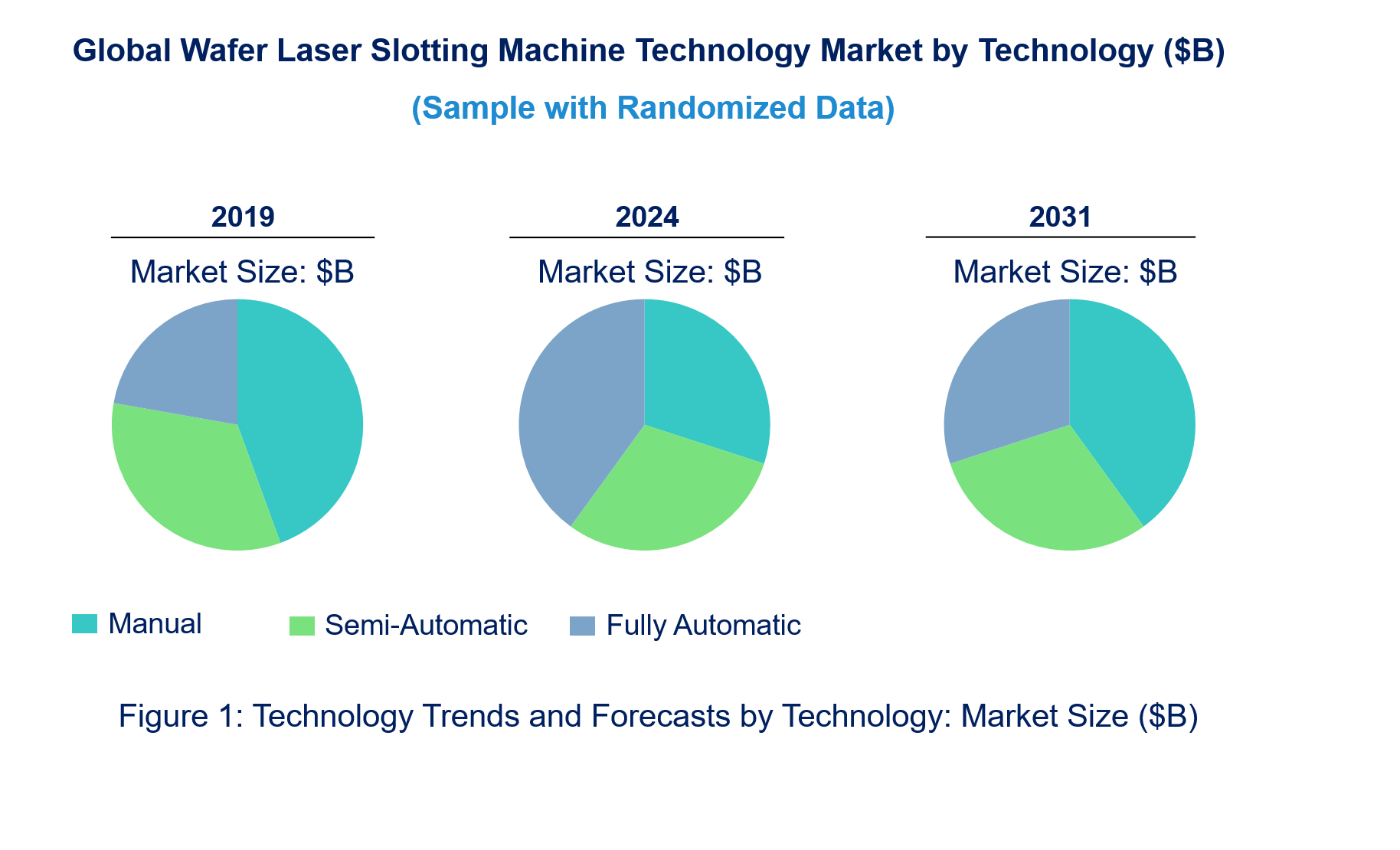
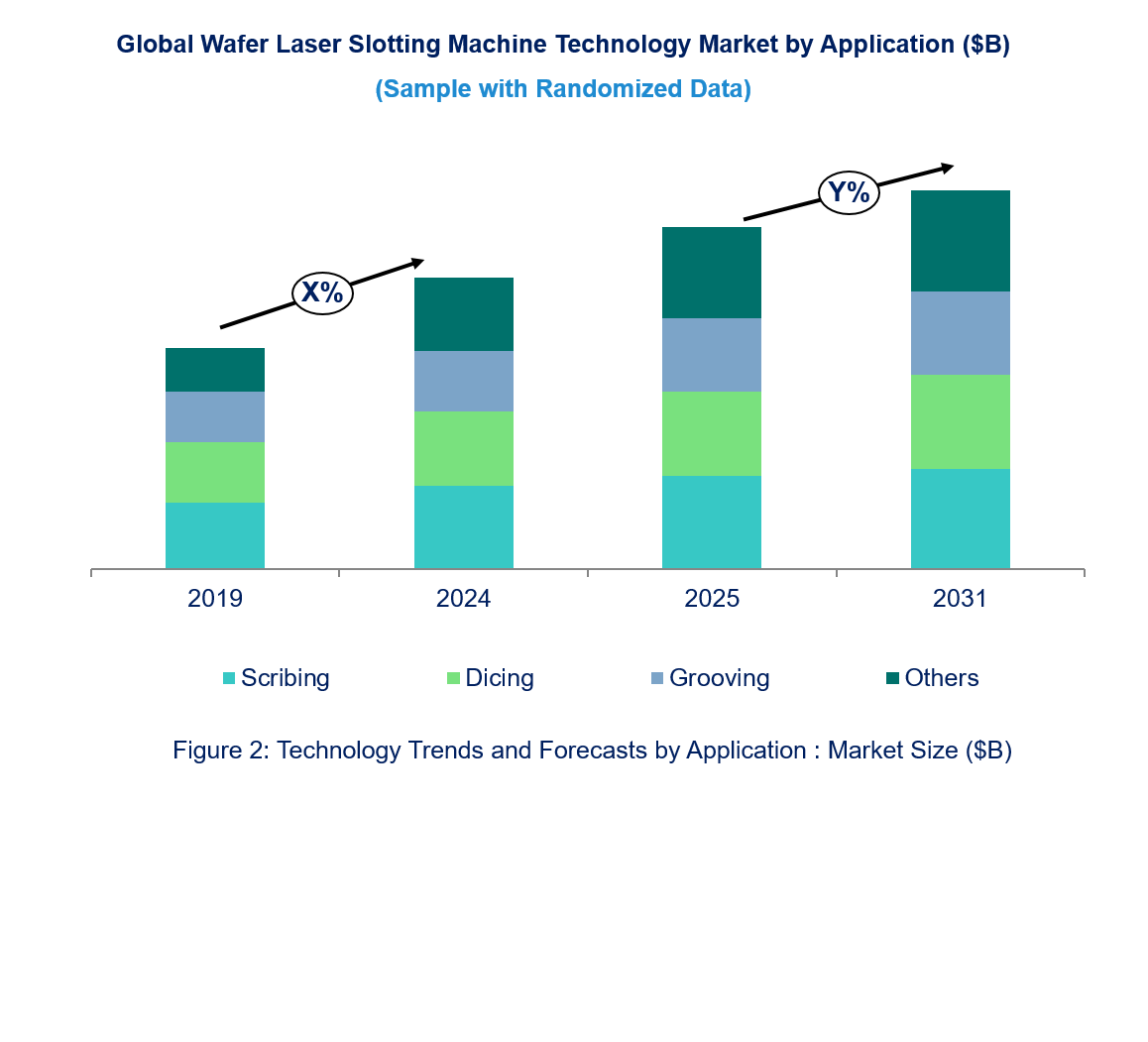
• Adoption of Ultra-Fast Laser Technology: Ultra-fast laser systems integrate into wafer slotting machines with higher precision and reduced thermal damage. This trend improves wafer quality and reduces material waste, to the needs of the industry in terms of efficient and reliable semiconductor manufacturing processes.
• Increased demand for automation and AI integration: Automation and AI transform the process of wafer laser slotting to facilitate real-time monitoring, predictive maintenance, and adaptive operations. This development improves throughput, reduces errors in operations, and enhances production efficiency generally in meeting the demands of modern industry at high volumes.
• Photovoltaic Applications are Expanded: The adoption of wafer laser slotting machines in the photovoltaic (PV) cell manufacturing industry is becoming a significant trend. This machine provides precise slotting for advanced PV designs, making it possible to achieve higher energy efficiency and fewer manufacturing defects, as the renewable energy markets expand around the world.
• Compact and Modular Designs: The companies are launching compact and modular wafer laser slotting machines for small and medium-scale businesses. Such designs reduce installation space, enhance flexibility during operation, and reduce the cost; therefore, the technology is within the reach of even more industries.
• Focus on Green Manufacturing Practices: The new awareness of sustainability has led to the development of energy-efficient wafer laser slotting machines. It saves energy and reduces waste, which is in the context of the global efforts being implemented to reduce the environmental effects of industrial processes. The wafer laser slotting machine market is being reshaped by advancements in ultrafast lasers, automation, photovoltaic applications, compact designs, and green manufacturing practices. These trends not only address industry demands for precision and efficiency but also align with broader goals of sustainability and cost-effectiveness, driving the market’s evolution in the semiconductor and related industries.
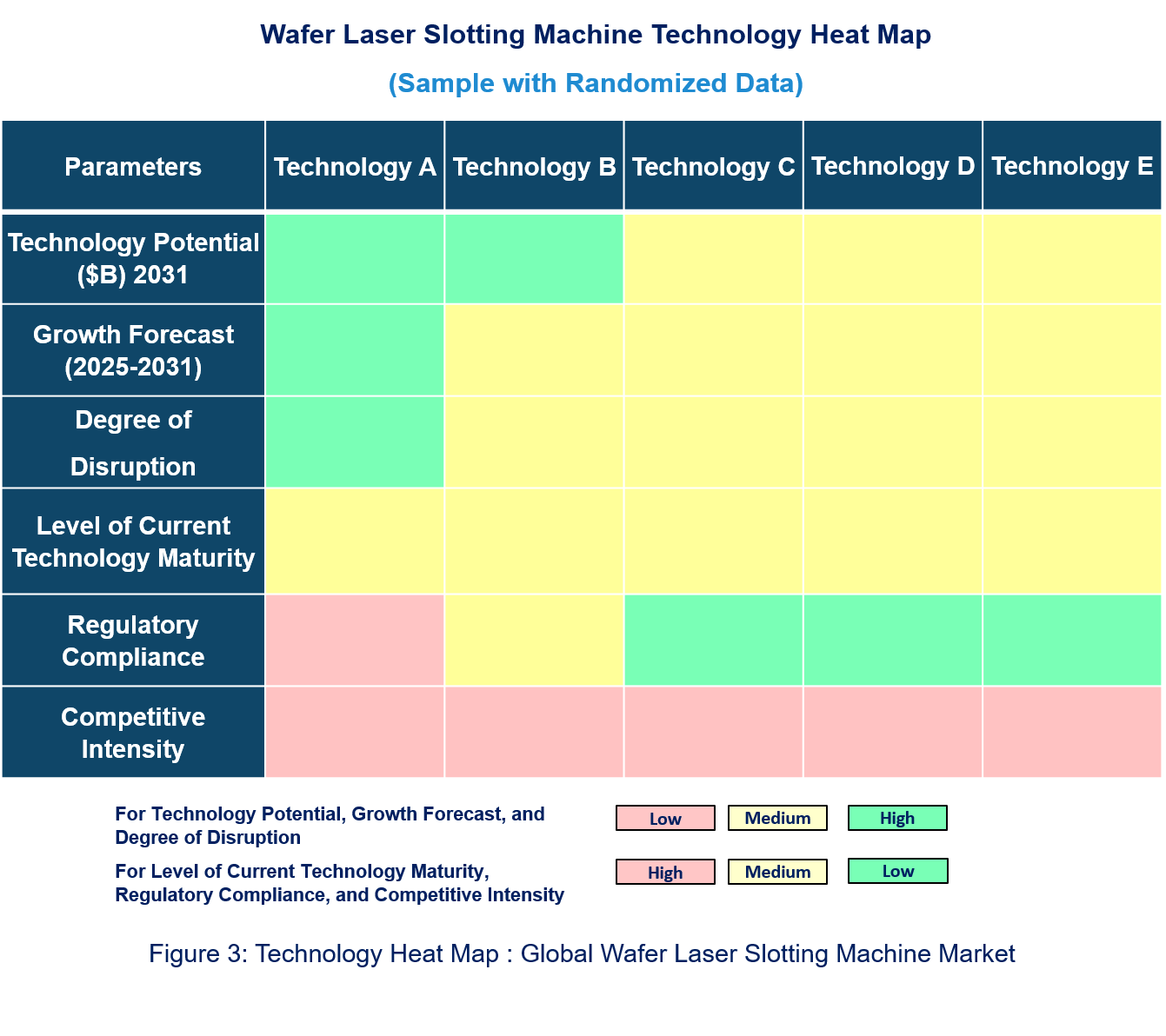
• Potential in Technology: There are some opportunities for wafer laser slotting machines that take up the growing demand in terms of high-performance semiconductors and advanced packaging solutions. With a continuously expanding semiconductor application across AI, 5G, and electric vehicles, it calls for highly precise processing of wafers. Laser technology enables very high-throughput processing with minimum defect count and high yield in its manufacturing process, thereby playing a very crucial role in large-volume manufacturing.
• Degree of Disruption: The technology is a disruption within the wafer processing industry. Compared to conventional mechanical techniques, laser slotting machines reduce physical stress applied to wafers thus ensuring quality products. Laser slotting machines are enhancing production processes through efficiency; they make it possible for the production of next-generation electronic devices.
• Current Technology Maturity Level: Laser slotting technology has matured but continues evolving with improvements in laser sources, optics, and control systems. Modern machines that are AI and automation-embedded are more precise with fewer operational complexities and are very appropriate for mass production.
• Compliance with Regulations: Compliance with industry standards for safety, environmental effects, and precision is the most important aspect. High-quality wafer laser slotting machines meet very tight regulations to ensure quality in semiconductor manufacturing, especially for consumer electronics, automotive, and telecommunication industries.
• Advanced Dicing Technologies: Advanced Dicing Technologies has made great strides in the development of high-precision wafer dicing and slotting systems. Their latest machines have incorporated advanced laser technologies that improve the cutting precision and reduce the kerf loss in wafer slicing. The company has also integrated automated systems that streamline the wafer handling process, enhancing productivity in the semiconductor manufacturing process.
• ASMPT: ASMPT has introduced innovations in its wafer laser slotting machines with a focus on automation and speed. Their new models feature improved automation capabilities that reduce manual intervention, leading to more consistent results and faster processing times. ASMPT's latest advancements have improved throughput in high-volume semiconductor manufacturing, offering cost-effective solutions for customers in the consumer electronics and automotive sectors.
• DISCO Corporation: The current leader in ultrafine precision wafer cutting solutions is DISCO Corporation. In recent innovations, it has enhanced the processing of very thin wafers, which are progressively deployed in mobile phones and high-end consumer electronic products. Its laser slotting machines have improved the processing speed, energy consumption, and accuracy of the next generation of semiconductor products.
• Han's Laser Technology Industry Group: Han's Laser enhanced its laser slotting machines with higher precision and faster cutting speeds to enhance efficiency in semiconductor processing. Their latest machines embrace advanced laser technology that involves minimal thermal impact on the wafer, thus risking damage during the slotting process. Such innovations make it more suitable for smaller, fragile wafers in automobile and IoT applications.
• Kulicke & Soffa Industries: Kulicke & Soffa has placed its emphasis on making its wafer laser slotting machines more versatile by integrating them with state-of-the-art automation systems. The innovations here include systems that combine the dicing and slotting of wafers in one single process, thereby enhancing efficiency and reducing production time. It supports the flexibility and high throughput processes, which are ideal for mobile and consumer electronics.
• LAM Research Corporation: LAM Research has unveiled new wafer laser slotting machines that combine their experience in etching and deposition with high-precision laser slotting. The new systems have been engineered to accommodate larger wafer sizes while ensuring accuracy and minimizing process variation. This enables increased production efficiency in semiconductor foundries, particularly for integrated circuits in advanced technologies like 5G and AI.
• Meyer Burger Technology: Meyer Burger has launched advanced wafer laser slotting systems for high-throughput manufacturing with minimal downtime. Its innovations focus on increasing the speed of wafer slicing while maintaining high quality and precision. The company's solutions are particularly aimed at the photovoltaic and semiconductor industries, providing faster, more efficient cutting processes for high-demand applications.
• Plasma-Therm: Plasma-Therm has made high precision and automation in their wafer laser slotting machines. The newest versions have advanced control systems, enabling a much better real-time process monitoring and adjustments, particularly very helpful for the semiconductor industry that produces the component pieces of consumer electronics and communication technologies, requiring high volumes and precision.
• Schunk Xycarb Technology: Schunk Xycarb has designed wafer laser slotting machines to optimize thermal management and accuracy. The technologies of the company aim at the minimization of thermal damage that might be induced in wafers during the cutting process. The application of high cooling technologies makes it possible for the processing of wafers without a significant amount of stress, which is necessary for producing sensitive semiconductor materials to be applied in high-performance applications.
• SCREEN Semiconductor Solutions: SCREEN Semiconductor Solutions has added the most modern laser technologies to its wafer slotting machines for greater precision and throughput. The latest models have added sophisticated control algorithms to make cutting more precise and with minimum loss of material. The upgraded systems make SCREEN suitable for the manufacture of high-precision, complex-design semiconductor devices that are often required in automotive and IoT products. These developments point to a clear trend in the wafer laser slotting machine market toward higher precision, increased automation, and faster processing speeds. These innovations are crucial to meet the growing demands of semiconductor manufacturers as they shift toward producing smaller, more complex devices for a wide range of applications.
• Demand for high-precision manufacturing. With the advancement of semiconductor and PV industries, the need for high-precision slotting machines has become more significant. The slotting machines enable manufacturers to meet certain guidelines and thus improve the quality of wafers, and hence the semiconductor devices and the cells inside PV, performing well and reliably.
• Automation and AI Integration Automation and artificial intelligence (AI) are driving efficiency improvements in wafer laser slotting. Automated systems optimize production cycles, reduce human error, and allow for real-time monitoring of machine performance. AI helps with predictive maintenance and data analysis, enhancing the overall production process and reducing downtime.
• Growth of Renewable Energy Industry The rising demand for photovoltaic cells and modules requires the wafer laser slotting machine. It is useful in precise cuts of PV wafers that ensure higher energy efficiency with reduced defects. This will primarily be supported by global efforts in renewable energy production.
• Laser system technological advancements Advances in the ultra-fast and high-power laser system improve the efficiency and precision of wafer slotting. They allow for faster processing and a significant reduction in material wastage. With better technology, better-quality wafers can be manufactured. This in turn pushes demand for more advanced machines like the wafer laser slotting machine.
• Compact and Flexible Machine Designs Compact and modifiable configurations are now becoming a viable feature for wafer slotting machines to become versatile while consuming minimal space. The characteristic has huge appeal to manufacturers with compact setups and to those who require slotting machines that can present multiple production processes. This flexibility enhances production capabilities and reduces expenses on operation. Challenges in the wafer laser slotting machine market are:
• A significant upfront cost The wafer laser slotting machines are often very expensive for small manufacturers or companies just entering the market. The sophisticated laser technologies and high precision mechanisms of these machines make them very expensive, which may contribute to limiting its use and slowing market growth in many regions.
• Operational Complexity Operating wafer laser slotting machines require highly skilled people with more advanced technical knowledge. The machines are very complex, and regular maintenance and calibration can be a problem for companies that lack technical expertise or resources, making the adoption rate low in some industries.
• Economic Factors and Market Volatility Economic factors such as fluctuations in semiconductor demand or raw material costs can impact the market for wafer laser slotting machines. A downturn in key industries, like semiconductor manufacturing or photovoltaics, may lead to reduced investment in new machinery, affecting the overall market growth and development.
• Technological Integration and Compatibility Issues With more advanced wafer laser slotting machines, integration can pose difficulties. Older machinery or systems with which they are intended to work may be incompatible, henceforth creating delays, increased cost, and inefficiency. Elimination of these barriers is important as this allows the smooth use of the new technology in question.
• Environmental and Regulatory Concerns Environmental regulations regarding energy consumption, waste management, and chemical usage in wafer manufacturing are becoming more stringent. Wafer laser slotting machines have to be designed with these regulations in mind, which can increase the cost of manufacturing and require additional investments in sustainable technologies and processes. Technological advancements, demand for precision, and the growth of renewable energy sectors drive the wafer laser slotting machine market. Nonetheless, high costs, operation complexity, and economic factors may hamper adoption. Overcoming such challenges, which will emerge in the future market, is crucial for long-term growth and sustainability.
• Advanced Dicing Technologies
• ASMPT
• Disco Corporation
• Han'S Laser Technology Industry Group
• Kulicke & Soffa Industries
• Lam Research Corporation
• Technology Readiness by Technology Type: Fully automatic wafer laser slotting machines are the most advanced and widely used for medium to high-volume productions mainly in the semiconductor manufacturing sector. Semi-automatic is primarily used for medium-scale operations; manual machines are mostly found on smaller-scale or laboratory operations. All of the above comply with rules and standards.
• Competitive Intensity and Regulatory Compliance: The market for wafer laser slotting machine is very competitive. Fully automatic systems are considered the industry standard because of their productivity and precision. All systems have strict regulatory compliance, which is focused on safety, environmental standards, and maintaining high-quality manufacturing processes in semiconductor production.
• Disruption Potential by Technology Type: There is a difference in disruption potential for manual, semi-automatic, and fully automatic wafer laser slotting machines. The fully automatic ones are the most efficient, precise, and low human intervention, hence driving the industry towards high throughput and quality control. Semi-automatics fall somewhere in the middle. Manual machines remain relevant in low-volume production environments.
• Manual
• Semi-Automatic
• Fully Automatic
• Scribing
• Dicing
• Grooving
• Others
• North America
• Europe
• Asia Pacific
• The Rest of the World
• Latest Developments and Innovations in the Wafer Laser Slotting Machine Technologies
• Companies / Ecosystems
• Strategic Opportunities by Technology Type




Choose a license that fits your team. Instant PDF delivery.
Prices exclude taxes. Instant delivery. Custom licensing available on request.
Market Report · May 18, 2026
Market Report · May 18, 2026
Market Report · May 18, 2026
Trusted partner for strategic intelligence and business growth


Receive a complimentary market analysis tailored to your industry. Our analysts will identify key growth opportunities and competitive dynamics specific to your business.

Market size, growth rate, and key trend analysis for your specific sector.

Top competitor positioning and market share analysis.

Strategic recommendations backed by data-driven insights.
Get curated market intelligence and competitive moves straight to your inbox.
By subscribing, you agree to receive our monthly insights. Unsubscribe anytime.
Receive a complimentary market analysis tailored to your industry. Our analysts will identify key growth opportunities and competitive dynamics specific to your business.
Market size, growth rate, and key trend analysis for your specific sector.
Top competitor positioning and market share analysis.
Strategic recommendations backed by data-driven insights.
Get curated market intelligence, emerging trends, and competitive moves straight to your inbox each month.
By subscribing, you agree to receive our monthly insights. Unsubscribe anytime.
We'll send your sample report shortly.