
Market Report · July 31, 2026

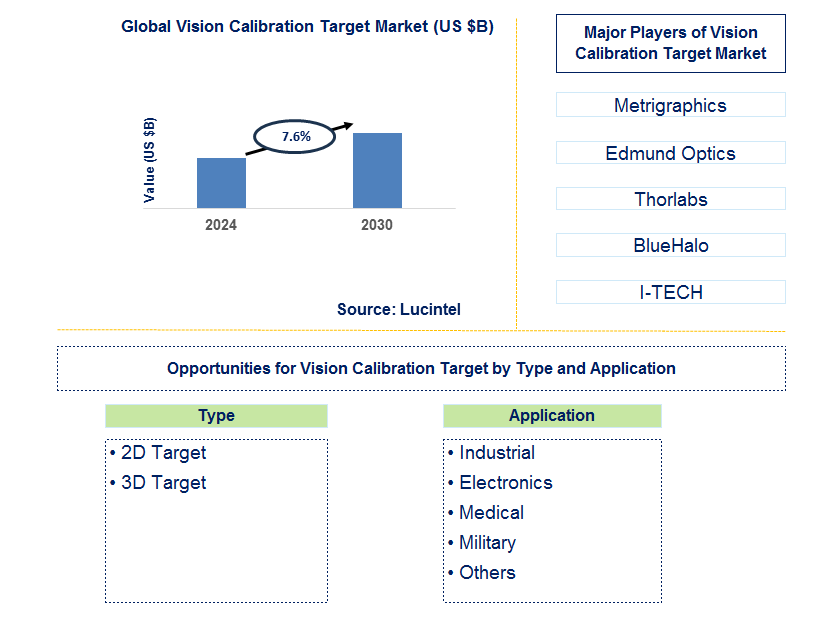
Key data points: The growth forecast = 7.6% annually for the next 6 years. Scroll below to get more insights. This market report covers trends, opportunities, and forecast in the global vision calibration target market to 2030 by type (2D target and 3D target), application (industrial, electronics, medical, military, and others), and region (North America, Europe, Asia Pacific, and the Rest of the World)
We'll send your sample report shortly.
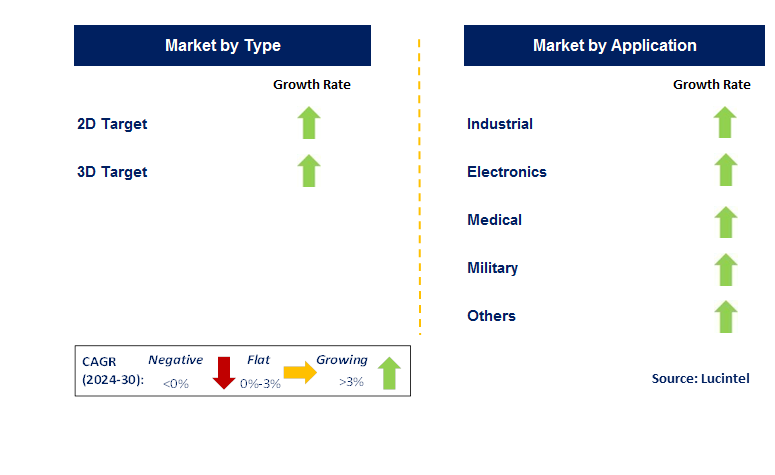
• Lucintel forecasts that, within the type category, the 2D target is expected to witness a higher growth over the forecast period.
• Within the application category, industrial is expected to witness the highest growth.
• In terms of regions, APAC is expected to witness the highest growth over the forecast period. A more than 150-page report is developed to help in your business decisions.
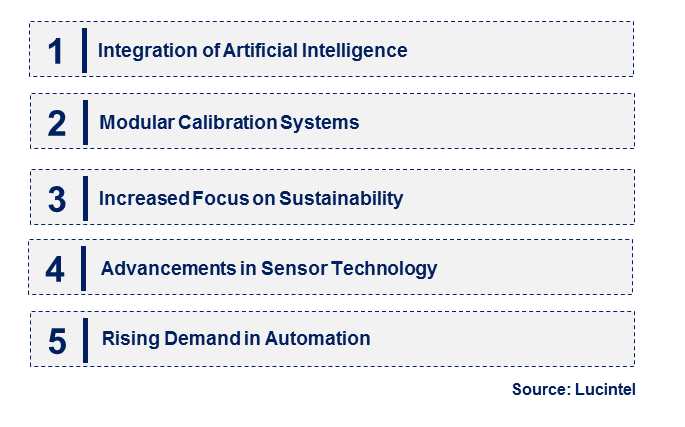
• Integration of Artificial Intelligence: The incorporation of AI into calibration systems is improving accuracy and efficiency. AI algorithms enable automated adjustments and real-time analysis, reducing human error and enhancing operational workflows in various industries.
• Modular Calibration Systems: The development of modular calibration systems allows for flexibility and customization across applications. These systems can be tailored to specific needs, making them suitable for various industries, from automotive to aerospace.
• Increased Focus on Sustainability: There is a growing emphasis on sustainable manufacturing practices. Companies are investing in environmentally friendly materials and processes for vision calibration targets, aligning with global sustainability goals.
• Advancements in Sensor Technology: Innovations in sensor technologies are enhancing the performance of vision calibration systems. High-resolution sensors provide better image quality, leading to more accurate calibration results and improved overall system performance.
• Rising Demand in Automation: The surge in automation across industries is driving demand for advanced vision calibration targets. As manufacturing processes become more automated, the need for precise calibration solutions is increasing to ensure optimal system performance. In summary, these trends are reshaping the vision calibration target market by promoting innovation, enhancing flexibility, and meeting the demands of a rapidly evolving technological landscape.
• Introduction of AI-Powered Calibration Systems: The launch of AI-powered vision calibration systems has revolutionized the calibration process. These systems provide real-time data analysis and automated adjustments, improving accuracy and reducing downtime in manufacturing environments.
• Enhanced Calibration Target Materials: Companies are developing high-precision materials for calibration targets, improving durability and accuracy. This enhancement is crucial for industries requiring strict quality control and high-performance standards in their calibration processes.
• Collaborative Research Initiatives: Partnerships between academic institutions and industry players are fostering innovation in vision calibration technologies. These collaborations aim to develop advanced calibration methods that enhance the efficiency and accuracy of imaging systems.
• Expansion of Market Offerings: Manufacturers are broadening their product offerings to include a variety of calibration targets designed for specific applications. This diversification is addressing the unique needs of various industries, promoting growth and adoption of calibration solutions.
• Focus on User-Friendly Software Solutions: The development of intuitive software for calibration processes is making systems more accessible. User-friendly interfaces simplify calibration procedures, enabling operators to achieve accurate results without extensive training. These developments are significantly impacting the vision calibration target market by enhancing product offerings, promoting innovation, and improving overall efficiency in calibration processes.
• Manufacturing Automation: The increasing trend toward manufacturing automation provides substantial opportunities for vision calibration targets. As companies adopt automated systems, the demand for precise calibration solutions will rise, enabling manufacturers to expand their product offerings.
• Aerospace and Defense Applications: The aerospace and defense sectors require high-precision vision calibration targets. Companies can leverage this opportunity by developing specialized calibration solutions that meet the stringent quality and performance standards of these industries.
• Healthcare Imaging Systems: The growing demand for advanced imaging technologies in healthcare presents opportunities for vision calibration targets. Manufacturers can focus on developing calibration solutions that enhance the accuracy of medical imaging systems, improving diagnostics and treatment.
• Consumer Electronics Market: The rapid evolution of consumer electronics is driving the need for reliable vision calibration targets. As devices become more complex, companies can target this market by providing calibration solutions tailored to specific consumer electronics applications.
• Research and Development Laboratories: Research institutions require precise calibration tools for their experiments. Companies can explore partnerships with R&D labs to supply customized vision calibration targets that meet unique research needs. In conclusion, these strategic growth opportunities are shaping the future of the vision calibration target market, allowing companies to diversify their applications and expand their market presence.
• Technological Advancements: Continuous innovations in imaging technologies enhance calibration processes, driving market growth by improving accuracy and efficiency.
• Growing Demand for Automation: The rise of automation across industries increases the need for precise vision calibration solutions to ensure optimal system performance.
• Focus on Quality Control: Industries are emphasizing quality control in production processes, boosting demand for reliable vision calibration targets.
• Investment in R&D: Increased investments in research and development foster innovation in calibration technologies, expanding market opportunities.
• Collaborative Industry Partnerships: Collaborations between manufacturers and research institutions are driving advancements in calibration methodologies and technologies. Challenges in the vision calibration target market are:
• Regulatory Compliance: Stricter regulations regarding quality standards may pose challenges for manufacturers in meeting compliance requirements.
• High Initial Investment: The cost of advanced vision calibration systems can be a barrier for small and medium enterprises looking to adopt new technologies.
• Market Competition: Intense competition among manufacturers can pressure pricing and profit margins, impacting overall market dynamics. In summary, the interplay between these drivers and challenges is shaping the vision calibration target market, influencing its growth trajectory and overall dynamics.
• Metrigraphics
• Edmund Optics
• Thorlabs
• BlueHalo
• I-TECH
• Applied Image
• Avian Technologies
• Ealing Catalog
• Hubbs Machine & Manufacturing
• Image Science Associates
• 2D Target
• 3D Target
• Industrial
• Electronics
• Medical
• Military
• Others
• North America
• Europe
• Asia Pacific
• The Rest of the World
• United States: The U.S. is focusing on integrating AI-driven technologies into vision calibration systems, improving precision and reducing calibration time. Companies are also developing advanced software solutions that provide real-time analysis and adjustments, which enhance operational efficiency in various applications.
• China: China is witnessing rapid advancements in manufacturing capabilities for vision calibration targets. The introduction of high-resolution calibration targets has improved the quality of image processing in automation. Government support for automation in industries is further driving innovation in calibration technologies.
• Germany: Germany is emphasizing precision engineering in vision calibration targets. There is a significant focus on developing modular calibration systems that offer versatility across different applications. Collaborative projects between industry leaders and research institutions are fostering advancements in calibration methodologies.
• India: In India, the vision calibration market is gaining traction due to increasing investments in manufacturing automation. Local companies are focusing on developing cost-effective calibration solutions tailored for small and medium enterprises, driving growth in various sectors, including textiles and automotive.
• Japan: Japan continues to lead in advanced imaging technologies, with innovations in vision calibration targets that incorporate high-precision optics and sensor technologies. This advancement is enhancing the performance of vision systems in robotics and automation, aligning with Japan's focus on smart manufacturing.


• Metrigraphics
• Edmund Optics
• Thorlabs
• BlueHalo
• I-TECH
• Applied Image
• Avian Technologies
• Ealing Catalog
• Hubbs Machine & Manufacturing
• Image Science Associates Q5. Which vision calibration target market segment will be the largest in the future? Answer: Lucintel forecasts that the 2D target is expected to witness a higher growth over the forecast period. Q6. In the vision calibration target market, which region is expected to be the largest in the next 5 years? Answer: APAC is expected to witness the highest growth over the forecast period. Q.7 Do we receive customization in this report? Answer: Yes, Lucintel provides 10% customization without any additional cost.


Choose a license that fits your team. Instant PDF delivery.
Prices exclude taxes. Instant delivery. Custom licensing available on request.
Market Report · July 31, 2026
Market Report · July 22, 2026
Market Report · July 20, 2026
Trusted partner for strategic intelligence and business growth


Receive a complimentary market analysis tailored to your industry. Our analysts will identify key growth opportunities and competitive dynamics specific to your business.

Market size, growth rate, and key trend analysis for your specific sector.

Top competitor positioning and market share analysis.

Strategic recommendations backed by data-driven insights.
Get curated market intelligence and competitive moves straight to your inbox.
By subscribing, you agree to receive our monthly insights. Unsubscribe anytime.
Receive a complimentary market analysis tailored to your industry. Our analysts will identify key growth opportunities and competitive dynamics specific to your business.
Market size, growth rate, and key trend analysis for your specific sector.
Top competitor positioning and market share analysis.
Strategic recommendations backed by data-driven insights.
Get curated market intelligence, emerging trends, and competitive moves straight to your inbox each month.
By subscribing, you agree to receive our monthly insights. Unsubscribe anytime.
We'll send your sample report shortly.