
Forestry Equipment Market
The future of the global forestry equipment market looks promising with opportunities in the felling equipment, extracting equipment, on-site processing equipment and separately sold parts and attachments markets. The global forestry equipment market is expected to reach an estimated $13.9 billion by 2035 with a CAGR of 3.5% from 2026 to 2035. The major drivers for this market are the increasing demand for timber harvesting, the rising adoption of advanced machinery and the growing investments in forest management.
• Lucintel forecasts that, within the power type category, oil power will remain the largest segment over the forecast period as the rising need for durable heavy-duty equipment performance.
• Within the equipment category, extracting equipment will remain the largest segment due to the the growing adoption of advanced extraction technologies.
• In terms of regions, Europe will remain the largest region over the forecast period due to the the increasing demand for sustainable timber harvesting.
Gain valuable insights for your business decisions with our comprehensive 150+ page report.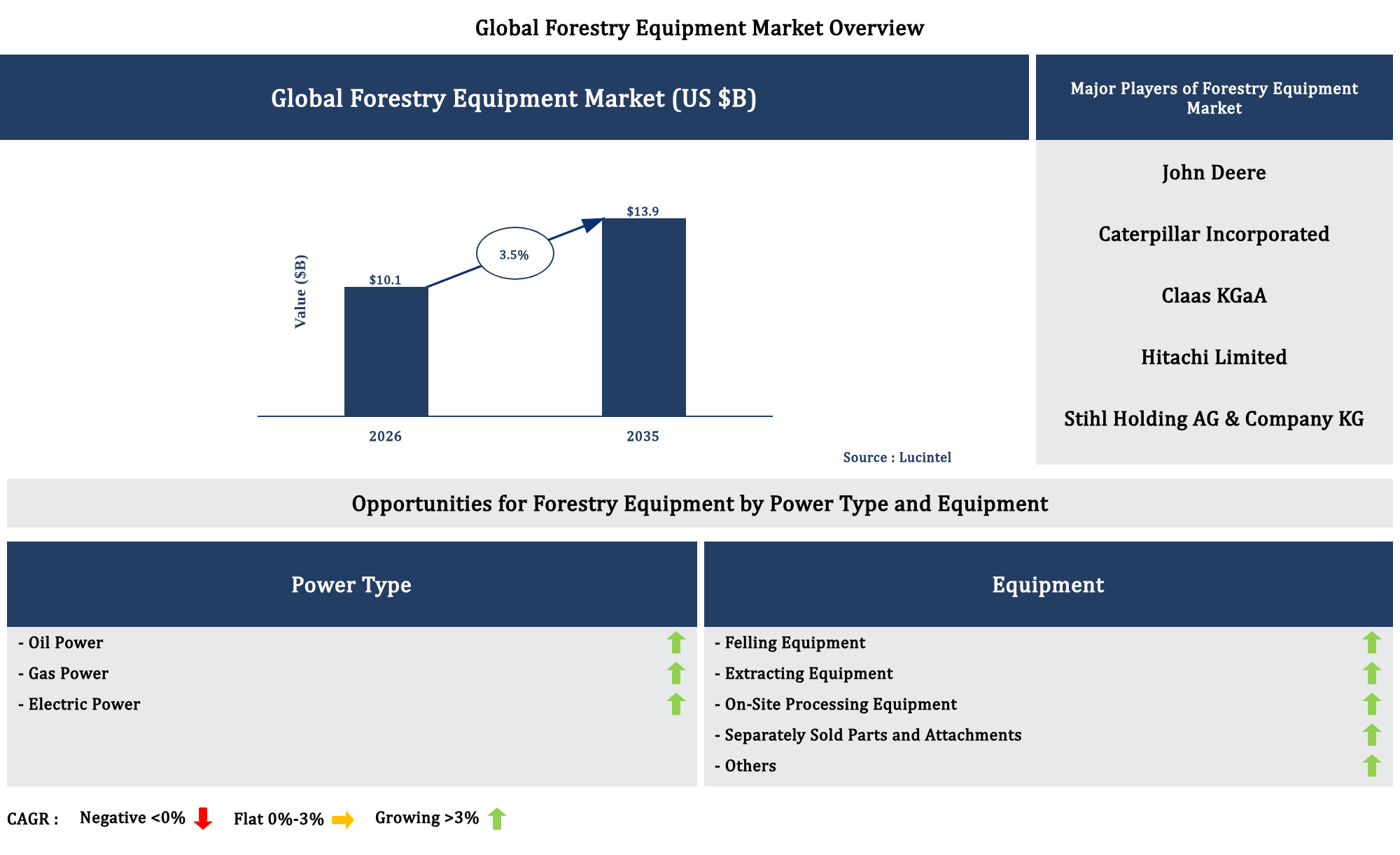
Emerging Trends in the Forestry Equipment Market
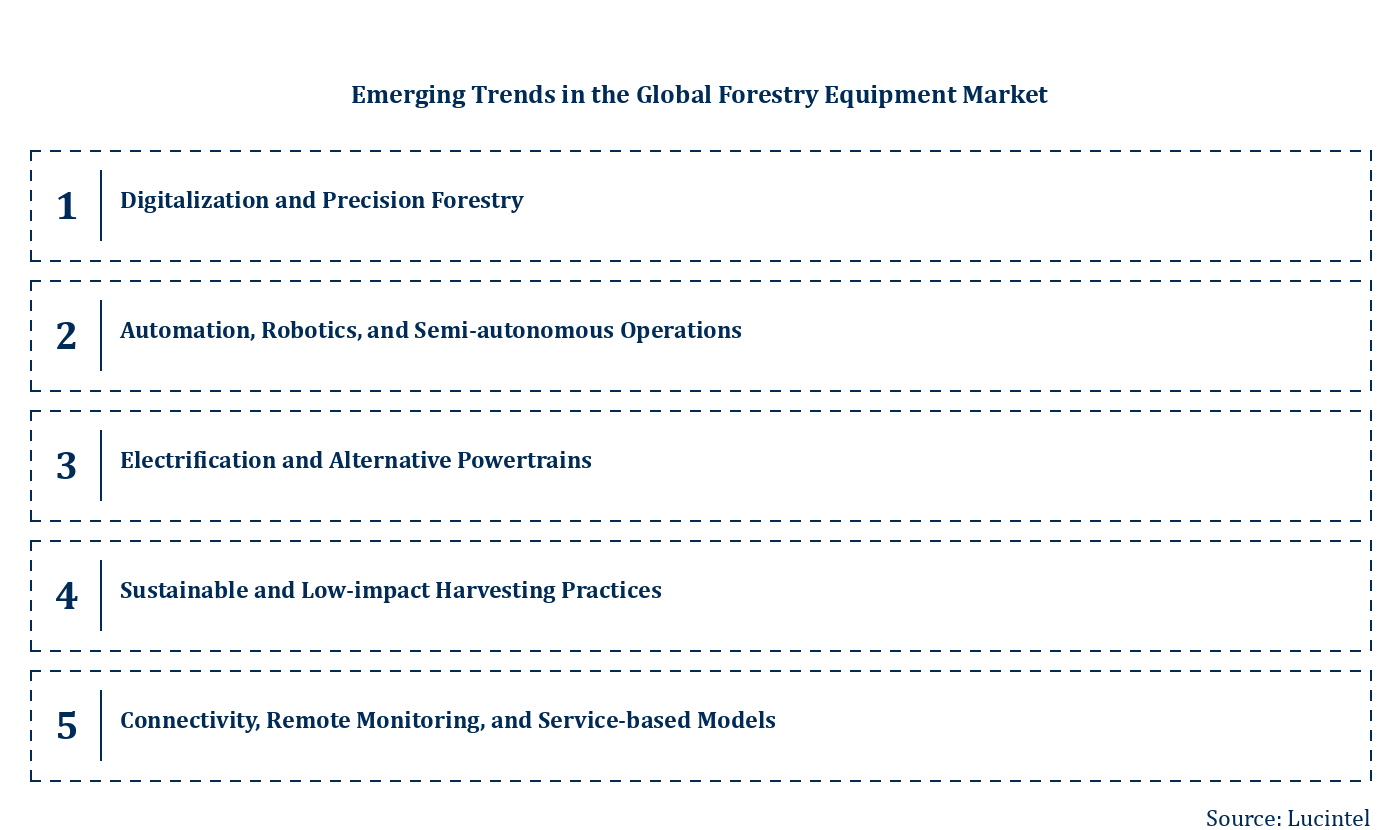
The forestry equipment market is undergoing a significant transformation driven by digitalization, sustainability imperatives, and shifting industry economics. Logging, thinning, and harvesting operations are increasingly automated and data enabled, while regulators and customers demand lower environmental impact and safer working conditions. Manufacturers are responding with smarter, modular, and more energy-efficient machines that integrate seamlessly into broader forest management systems. At the same time, workforce shortages and rising operational costs are accelerating adoption of remote and autonomous solutions. These emerging trends are redefining how value is created and captured across the forestry value chain, from standing timber to mill gate.
Recent Developments in the Forestry Equipment Market
The forestry equipment market is undergoing notable transformation as sustainability pressures, digitalization, and labor constraints reshape how forest operations are planned and executed. Equipment manufacturers and forest owners are adopting smarter, more efficient machines that reduce fuel use, emissions, and damage to forest ecosystems while improving worker safety and productivity. Regulatory changes, certification requirements, and rising demand for responsibly sourced timber are also driving innovation in harvesting, forwarding, and processing technologies. At the same time, consolidation among manufacturers and new service-based business models are redefining competitive dynamics and customer relationships across the forestry equipment market worldwide.
Strategic Growth Opportunities in the Forestry Equipment Market
The forestry equipment market is evolving rapidly as sustainable forest management, bioenergy demand, and digitalization reshape how timber resources are harvested, processed, and maintained. Growth opportunities are emerging across logging, silviculture, biomass handling, infrastructure development, and environmental services, each requiring more efficient, safer, and lower-emission machinery. Advances in automation, electrification, and data analytics are improving productivity while helping operators meet stricter environmental and labor regulations. At the same time, expanding wood-based value chains and climate commitments are prompting investments in specialized equipment. Companies that align product portfolios with these application-specific shifts can unlock resilient, long-term growth.
Forestry Equipment Market Drivers and Challenges
The forestry equipment market is shaped by a mix of technological, economic, environmental, and regulatory forces that together define its growth trajectory. Demand for sustainable timber, advances in mechanization, and digital technologies are expanding opportunities for manufacturers and service providers. At the same time, the sector faces constraints linked to fluctuating raw material prices, stringent environmental regulations, and operational risks in forest environments. Understanding the principal drivers and challenges allows stakeholders to calibrate investment, product development, and geographic expansion strategies, while also managing exposure to cyclical construction activity, climate-related disruptions, and evolving sustainability expectations.
The factors responsible for driving the forestry equipment market include:
The challenges in the forestry equipment market are:
The forestry equipment market evolves under the combined influence of strong drivers related to mechanization, sustainable wood demand, technological innovation, and rural development, counterbalanced by economic, regulatory, and workforce-related challenges. While capital intensity and compliance complexity can inhibit rapid modernization, the long-term shift toward sustainable construction, low-carbon materials, and precision forestry supports continued investment in advanced machinery. Stakeholders that effectively manage financing models, training programs, and regulatory engagement are positioned to benefit most. Over time, cooperative efforts among manufacturers, forest owners, and policymakers will be critical to unlocking the market’s full growth and sustainability potential.
List of Forestry Equipment Market Companies
Companies in the market compete on the basis of product quality offered. Major players in this market focus on expanding their manufacturing facilities, R&D investments, infrastructural development, and leverage integration opportunities across the value chain. Through these strategies forestry equipment market companies cater increasing demand, ensure competitive effectiveness, develop innovative products & technologies, reduce production costs, and expand their customer base. Some of the forestry equipment market companies profiled in this report include-
Forestry Equipment Market by Segment
The study includes a forecast for the global forestry equipment market by power type, equipment, and region.
Country Wise Outlook for the Forestry Equipment Market
The global forestry equipment market is undergoing a period of rapid modernization as climate commitments, bioenergy demand, and digital transformation reshape how forests are managed and harvested. Advances in automation, telematics, and electrification are improving productivity while responding to stricter environmental and safety regulations. At the same time, labor shortages in logging and growing pressure to track carbon and biodiversity are accelerating adoption of smart, data-driven machinery. The United States, China, Germany, India, and Japan each exhibit distinct development paths, reflecting their forest resources, policy priorities, and industrial strengths, yet all are investing in more sustainable and efficient forestry solutions.
Features of the Forestry Equipment Market
Article
Forestry Equipment Market: Which Strategic Shifts Are Redefining the Future of the Woods Economy?
Dallas, July 20, 2026 – The forestry equipment market is entering a decisive phase as digital technologies, automation, and sustainability pressures converge on one of the world’s most traditional resource industries. From sensor-enabled harvesters to satellite-guided planning tools, market participants are racing to modernize logging, plantation management, and downstream wood processing. This transformation is not just changing how forests are harvested; it is reshaping cost structures, labor models, and environmental performance across the wider bioeconomy, including construction, packaging, energy, and technology-enabled services.
Driven by rising demand for timber, biomass, and engineered wood products, equipment manufacturers, software providers, and forest owners are engaging in a wave of experimentation. Strategic alliances between machinery OEMs, analytics companies, and connectivity providers are accelerating the shift from mechanical to data-centric forestry. At the same time, regulatory scrutiny, climate commitments, and social expectations are setting a new bar for traceability and low-impact operations, pushing the market toward smarter, cleaner, and more connected solutions.
Which Technology-Driven Trends Are Most Likely to Reshape the forestry equipment market?
A central trend is the rapid spread of precision forestry systems built on GNSS positioning, LiDAR, and sensor fusion. Modern harvesters, forwarders, and skidders are being integrated with onboard computers that capture tree-level data such as diameter, species, and quality in real time. These systems enable optimized cutting patterns, reduced waste, and more accurate yield forecasting. The outcome is not only higher productivity in mature markets with advanced infrastructure but also a step-change in planning accuracy for forestry companies operating in remote or fragmented landholdings.
Another defining movement lies in electrification and hybridization of forestry machinery. OEMs are investing heavily in electric drive trains for smaller equipment and hybrid powertrains for heavy-duty harvesters and loaders. This shift aims to cut fuel consumption, lower operating noise, and meet tightening emissions regulations on off-highway equipment. While diesel will continue to dominate in many rugged applications over the medium term, hybrid solutions are already proving attractive in regions with high fuel costs and strict decarbonization policies. Over time, this trend will alter lifecycle economics and encourage new ownership and leasing models built around total cost of operation rather than upfront capex.
Digital platforms and automation are also emerging as a major disruptive driver. Remote monitoring, predictive maintenance, and semi-autonomous operation features are being layered onto classic mechanical platforms. Equipment is increasingly shipped with connectivity modules that synchronize with cloud-based fleet management software, inventory systems, and customer portals. In tandem, machine vision and AI-based guidance systems are moving the industry toward autonomous forwarding in controlled environments and robotic applications in nurseries and mills. These technologies promise to alleviate skilled labor shortages, enhance safety in hazardous terrains, and enable continuous improvement based on data feedback loops.
Sustainable forest management is becoming a commercial as well as regulatory imperative. Tools that minimize soil disturbance, protect biodiversity, and support climate reporting are gaining traction. Low-impact machines with narrower tracks, better weight distribution, and precise boom controls enable selective harvesting and reduced compaction. When combined with remote sensing tools such as drones and satellite analytics, forestry operators can track carbon stocks, monitor compliance, and align operations with certification standards. This sustainability shift is no longer niche; it is emerging as a core differentiator for equipment providers who can integrate environmental performance into the value proposition of their machines.
How Will These Innovations Impact Key Markets and Disrupt Traditional Forestry Economics?
The near-term impact of these innovations is likely to be pronounced in industrial forestry regions where vertically integrated players manage large estates and operate modern mills. Markets with strong infrastructure, high labor costs, and stringent environmental regulations are well positioned to adopt precision and automation technologies quickly. These operators are already piloting data-driven harvest planning tools that integrate growth models, real-time machine data, and market demand to orchestrate harvest schedules, logistics, and mill intake with unprecedented granularity.
Emerging timber frontiers are set to experience a different pattern of disruption. As new plantations expand in regions with weaker infrastructure, the introduction of connected and partially autonomous equipment will allow operators to leapfrog older technology generations. Compact, fuel-efficient, and mobile machinery, combined with satellite-based planning solutions, will support scalable plantation development even where skilled labor and historical data are scarce. This scenario favors technology providers and OEMs that can offer rugged, modular platforms with simplified digital interfaces and remote training capabilities.
Secondary markets such as biomass power, engineered wood, and advanced building materials are also poised to benefit. Consistent, data-rich feedstock from precision forestry will enable mills to refine process parameters, reduce variability, and develop higher value products for construction and packaging industries seeking low-carbon alternatives to steel, concrete, and plastics. As digital traceability improves, downstream buyers will gain visibility into forest practices, supporting premium pricing for certified or low-impact wood products. Such differentiation will put pressure on operators relying on older, low-transparency harvesting methods.
Disruption is also expected in the value chain structure itself. As data becomes a core asset, traditional boundaries between equipment manufacturers, forestry companies, and technology providers will blur. Integrated platforms may emerge where OEMs bundle hardware, software, service, and analytics under subscription-based models. In this shift, market power is likely to gravitate toward players who control the data ecosystem, not only those who build the heaviest machinery. Smaller contractors and independent operators may align with platform providers to access planning tools, financing, and digital compliance services that were previously confined to large industrial groups.
What Strategic Challenges Must the Forestry Equipment Ecosystem Address?
The capital intensity of advanced forestry equipment remains a central barrier. Precision-enabled harvesters, hybrid drive systems, and autonomous capabilities increase upfront costs at a time when many forestry operators face volatile demand and fluctuating commodity prices. Financing models and total cost of ownership transparency need to evolve to encourage adoption, particularly among mid-sized and small contractors who play a critical role in harvesting and transport.
Data integration and interoperability pose another structural challenge. Operators now contend with machine data from multiple OEMs, satellite feeds, drone imagery, enterprise resource planning systems, and regulatory reporting tools. Without common standards and open interfaces, the risk of fragmented systems and underutilized data is high. This fragmentation could slow the adoption of analytics-driven decision making and erode the potential benefits of connected equipment.
On the positive side, these challenges give rise to new opportunity spaces. Financial institutions and OEMs can collaborate to create performance-based financing, leasing, and pay-per-use models. Software and analytics firms have the chance to define de facto standards and middleware that harmonize data across equipment brands and geographic regions. Training providers and edtech platforms can develop modular upskilling programs for operators, mechanics, and planners focused on digital forestry competencies.
Where Do Technology Industry Use Cases Connect Most Directly with Forestry Equipment?
Technology industry players are increasingly embedded in the forestry equipment market through a variety of use cases that hinge on connectivity, analytics, and automation. Equipment telematics platforms represent one prominent use case, with technology firms supplying cloud infrastructure, device management, and data visualization for mixed-brand fleets. These platforms integrate fuel consumption data, idle times, maintenance logs, and production metrics into intuitive dashboards.
Another important use case lies in AI and machine learning for forest inventory and yield prediction. Technology companies work with forest managers to analyze satellite imagery, LiDAR scans, and on-machine measurements to forecast harvest volumes, assess disease risks, and optimize thinning strategies. These capabilities are often delivered as software-as-a-service offerings, creating recurring revenue for tech providers and more stable planning horizons for forestry operators.
These technology-driven applications are turning forestry from a largely analog industry into one that relies on continuous data flows and digital decision support. For the technology sector, forestry represents a complex proving ground where solutions must function in remote, harsh environments yet still integrate with enterprise-grade systems and stringent compliance regimes.
What Recent Market Developments Signal the Direction of Forestry Equipment Innovation?
Recent years have seen an uptick in strategic partnerships between forestry OEMs and technology companies focused on connectivity, analytics, and automation. Equipment manufacturers are increasingly embedding standardized telematics units and offering customers access to cloud-based portals for fleet monitoring and remote diagnostics. Updates to machine control software are being delivered over the air, reducing downtime and supporting continuous performance improvements.
Several machinery makers have introduced hybrid or fully electric prototypes for forwarders, harvesters, and compact loaders aimed at operations near residential areas, sensitive habitats, or emission-regulated zones. While most platforms remain in pilot or limited commercial release, early adopters are reporting reductions in fuel use and noise levels, which can open new operating windows and improve community relations around forestry activities. These developments indicate a broader industry commitment to decarbonization, even in energy-intensive off-road segments.
Together, these developments portray a forestry equipment market in the midst of strategic realignment. Companies that can blend robust mechanical engineering with advanced digital capabilities, flexible financing models, and sustainability-focused design are likely to set the pace. For investors, technology providers, and forest asset owners, the coming years will test who can translate innovation into resilient, data-driven, and environmentally credible forestry operations that meet the rising global demand for wood-based materials and renewable biomass.
Top 5 Companies
1. John Deere
John Deere is a leading global manufacturer of agricultural, construction, and forestry machinery with a strong presence in the worldwide forestry equipment market. Headquartered in Moline, Illinois and founded in 1837, the company employs tens of thousands of people across North America, Europe, Asia-Pacific, Latin America, and Africa. Its forestry portfolio includes harvesters, forwarders, skidders, swing machines, feller bunchers, knuckleboom loaders, and attachments engineered for logging, thinning, and timber extraction operations. John Deere also provides digital solutions such as telematics, machine health monitoring, and fleet management platforms that enhance productivity and sustainability in forest operations. The company has expanded its forestry footprint through manufacturing and distribution facilities in key timber regions and dealer networks that support operators with parts, service, and training. John Deere has executed selective acquisitions and technology partnerships to strengthen its precision forestry capabilities, including advanced automation, operator assistance systems, and data-driven planning tools that optimize harvesting and reduce environmental impact. Its global geographic reach, diverse product line, and continuous investment in innovation position John Deere as one of the dominant players serving industrial forestry companies, contractors, and governmental agencies engaged in commercial forestry and forest management.
2. Caterpillar Incorporated
Caterpillar Incorporated is one of the world’s largest manufacturers of construction and mining equipment and is an important supplier to the forestry equipment market through its heavy machinery and purpose-built forest products. Headquartered in Irving, Texas and established in 1925, Caterpillar employs a large global workforce supporting operations in more than 190 countries through an extensive dealer network. Within forestry, Caterpillar’s offering includes tracked and wheeled harvesters, forestry excavators, log loaders, skidders, dozers, wheel loaders, and specialized attachments designed for road building, timber extraction, and mill yard handling. Many of its construction-class machines are configured in forestry variants with reinforced structures, guarding, and high-visibility cabs suited to harsh logging environments. Caterpillar supports forestry customers with digital solutions, including remote monitoring, condition-based maintenance, and productivity analytics through its telematics platform. The company has expanded its geographic reach in timber-producing regions such as North America, Latin America, Europe, and Asia-Pacific via localized production and dealer investment. Caterpillar’s history includes portfolio adjustments and partnerships in forest machinery to refine its focus on high-value segments and integrated solutions. Its broad equipment base, parts and service ecosystem, and reputation for durable machines make Caterpillar a key competitor serving large-scale forestry and infrastructure projects linked to timber harvesting and forest road construction.
3. Claas KGaA
Claas KGaA is a prominent European agricultural machinery manufacturer best known for its combine harvesters, forage harvesters, and tractors, with selective relevance to the forestry equipment market in mechanized handling and land management at the agriculture–forestry interface. Headquartered in Harsewinkel, Germany and founded in 1913, Claas employs thousands of staff across Europe, the Americas, and Asia, operating production plants and sales companies in key farming and rural regions. While its core portfolio is focused on agriculture, Claas equipment such as high horsepower tractors, loaders, and material-handling implements is used in agro-forestry applications, biomass harvesting, residue collection, and transport of wood chips and energy crops. The company emphasizes precision technologies including guidance systems, telematics, and yield data platforms that can support integrated land management strategies where forestry and agriculture intersect. Claas continues to expand internationally through new subsidiaries, dealer partnerships, and localized production in markets such as Eastern Europe and Asia, indirectly broadening its role in regions where small-scale forestry and mixed-use rural land are common. Although not a dedicated forest machinery brand, Claas participates in segments adjacent to the forestry equipment market by providing high-capacity tractors and harvesting systems that are adapted by contractors and cooperatives working in biomass, short-rotation coppice, and other wood-based value chains.
4. Hitachi Limited
Hitachi Limited is a diversified global technology and industrial group with significant activities in infrastructure, information technology, and heavy machinery, contributing to the forestry equipment market primarily through construction equipment and advanced digital solutions. Headquartered in Tokyo and founded in 1910, Hitachi employs tens of thousands of people in Japan, the Americas, Europe, Asia-Pacific, and the Middle East. Through its construction machinery business, Hitachi supplies excavators and loaders that are configured for forestry tasks such as road building, land clearing, log handling, and loading at log yards and ports. Its machines can be fitted with purpose-built forestry booms, grapples, and processing heads through specialized partners, enabling use in selective harvesting and timber logistics. Hitachi’s strength in operational technology and information technology allows it to deliver telematics, remote diagnostics, and data analytics that enhance uptime and efficiency for forest contractors operating fleets in remote areas. The company has expanded globally via manufacturing bases, joint ventures, and dealer networks, including strong positions in Asia and Oceania where plantation forestry and export-driven timber supply chains are well developed. Hitachi has pursued acquisitions and partnerships in digital and industrial technology that support smart construction and could increasingly be applied to precision forestry, autonomous operation, and safety systems in forest environments.
5. Husqvarna Group
Husqvarna Group is a leading global manufacturer of outdoor power products with a strong and long-standing position in the forestry equipment market. Based in Stockholm and founded in 1689, the company employs thousands of people across Europe, North America, Latin America, and Asia-Pacific. Husqvarna’s forestry portfolio centers on professional and consumer chainsaws, clearing saws, brushcutters, battery-powered saws, forestry helmets and protective gear, and complementary tools for felling, pruning, and timber preparation. The company also offers related products such as portable winches, hedge trimmers, blowers, and ground care equipment that are used around forest roads, utility corridors, and woodland properties. Husqvarna has been expanding its battery and robotics technologies, introducing cordless chainsaws and connected tools that reduce emissions and noise while supporting sustainable forestry practices. Its geographic presence is reinforced through a wide distribution and dealer network, including dedicated professional forestry dealers in major timber markets such as Scandinavia, Central Europe, North America, and parts of Latin America. Husqvarna has undertaken focused acquisitions and brand integrations in outdoor power equipment to broaden its product portfolio and channel reach, complementing its core Husqvarna brand with regional brands serving forestry and arborist communities. The group’s combination of professional-grade saws, safety equipment, and innovative battery solutions secures a central role in both industrial forestry operations and smaller-scale woodland management worldwide.
Table of Contents
List of Figures
List of Tables
Methodology
Lucintel has been in the business of market research and management consulting since 2000 and has published over 1000 market intelligence reports in various markets / applications and served over 1,000 clients worldwide. This study is a culmination of four months of full-time effort performed by Lucintel's analyst team. The analysts used the following sources for the creation and completion of this valuable report:
- In-depth interviews of the major players in this market
- Detailed secondary research from competitors' financial statements and published data
- Extensive searches of published works, market, and database information pertaining to industry news, company press releases, and customer intentions
- A compilation of the experiences, judgments, and insights of Lucintel's professionals, who have analyzed and tracked this market over the years.
Extensive research and interviews are conducted across the supply chain of this market to estimate market share, market size, trends, drivers, challenges, and forecasts. Below is a brief summary of the primary interviews that were conducted by job function for this report.

Thus, Lucintel compiles vast amounts of data from numerous sources, validates the integrity of that data, and performs a comprehensive analysis. Lucintel then organizes the data, its findings, and insights into a concise report designed to support the strategic decision-making process. The figure below is a graphical representation of Lucintel's research process.

Buy Now
Choose a license that fits your team. Instant PDF delivery.
Prices exclude taxes. Instant delivery. Custom licensing available on request.
Frequently Asked Questions
What is the Forestry Equipment Market size?
What is the growth forecast for Forestry Equipment Market?
What are the major drivers influencing the growth of the Forestry Equipment Market?
What are the major segments for Forestry Equipment Market?
Who are the key Forestry Equipment Market companies?
Which Forestry Equipment Market segment will be the largest in future?
In Forestry Equipment Market, which region is expected to be the largest in next 9 years?
Do we receive customization in this report?
Key Questions
- • What are some of the most promising, high-growth opportunities for the Forestry Equipment Market by Power Type (Oil Power, Gas Power, and Electric Power), Equipment (Felling Equipment, Extracting Equipment, On-Site Processing Equipment, Separately Sold Parts and Attachments, and Others), and region (North America, Europe, Asia Pacific, and the Rest of the World)?
- • Which segments will grow at a faster pace and why?
- • Which region will grow at a faster pace and why?
- • What are the key factors affecting market dynamics? What are the key challenges and business risks in this market?
- • What are the business risks and competitive threats in this market?
- • What are the emerging trends in this market and the reasons behind them?
- • What are some of the changing demands of customers in the market?
- • What are the new developments in the market? Which companies are leading these developments?
- • Who are the major players in this market? What strategic initiatives are key players pursuing for business growth?
- • What are some of the competing products in this market and how big of a threat do they pose for loss of market share by material or product substitution?
- • What M&A activity has occurred in the last 9 years, and what has its impact been on the industry?


