
Market Report · May 18, 2026

This market report covers trends, opportunities, and forecasts in the global virtual machine market to 2031 by technology (system virtual machines and process virtual machines), end use industry (bfsi, telecommunications & ites, government & public sector, healthcare & life sciences, and others), and region (North America, Europe, Asia Pacific, and the Rest of the World)
We'll send your sample report shortly.
![Virtual Machine Market Trend and Forecast by End Use Industry [Value from 2019 to 2031]:](https://lucintel.com/images/Virtual-Machine-Technology-Market-Segment.png "Virtual Machine Market Trend and Forecast by End Use Industry [Value from 2019 to 2031]:")
• Containerization and Kubernetes Integration: Container technology, led by Kubernetes, is gaining momentum fast because it offers faster deployment and better scalability than traditional VMs. Containers are lightweight, portable, and integrate well with microservices architecture, enabling businesses to build, deploy, and scale applications with greater efficiency.
• Hybrid Cloud and Multi-Cloud Strategies: Organizations are increasingly adopting hybrid cloud and multi-cloud models, as performance is improved, costs are cut, and redundancy is enhanced. Virtual machines are designed today for multiple clouds and on-premises infrastructure for flexibility, scalability, and business continuity.
• Virtualization with AI and Machine Learning: AI and machine learning are being integrated into VM technology to automate routine tasks, optimize resource allocation, and predict system performance. Intelligent virtualization helps reduce downtime, increase efficiency, and ensure better resource management across enterprise infrastructure.
• Serverless Computing Integration: The rise of serverless architecture is affecting VM technology because providers now offer solutions that implement a combination of serverless computing with traditional VMs, permitting organizations to scale and enhance cost efficiency in running applications without the need for underlying infrastructure.
• Enhanced Security and Compliance Measures: As cybersecurity threats expand, virtualization tools start to incorporate more robust security features, such as encryption, access controls, and real-time monitoring. Compliance-focused solutions can ensure that the global data protection regulations are followed to preserve organizational data integrity and privacy. It's this emerging trend that makes the Virtual Machine Technology market adapt to the current, modern business requirements: scalability, cost efficiency, automation, and security. The inclusion of containerization, hybrid cloud strategy, AI-driven optimizations, and serverless computing is helping to evolve towards more agile, cost-effective, and robust IT infrastructure. As such, it provides competitive advantages in the midst of changing digital landscapes.
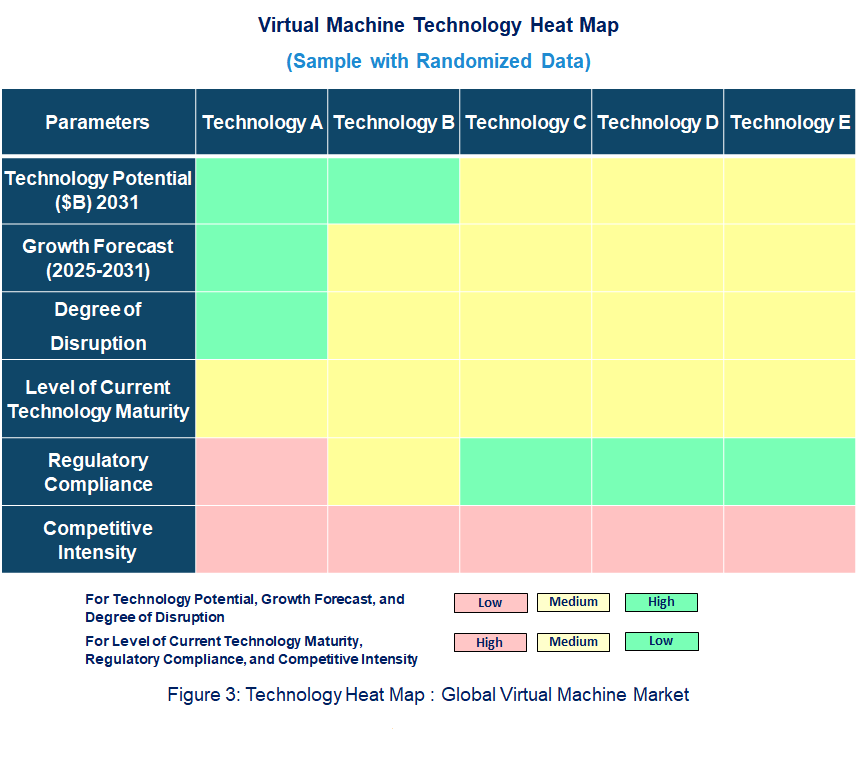
• Technology Potential: VM technology has vast potential in terms of scalability, cost efficiency, and disaster recovery options. Organizations can use cloud-based virtual machines to achieve global accessibility and real-time collaboration, which ensures higher productivity and operational continuity.
• Degree of Disruption: VM technology is being disrupted by the adoption of containerization (Kubernetes), serverless computing, and cloud-native architectures. These innovations reduce reliance on traditional hypervisors and infrastructure investments, prioritizing speed, flexibility, and scalability.
• Level of Current Technology Maturity: Virtual machine technology has reached high maturity. The vendors are now mature enough, including VMware, Microsoft, and Amazon, to offer well-established enterprise-ready solutions. Newer trends, however, like serverless architecture and AI-driven orchestration, continue to push the boundaries of maturity and functionality.
• Regulatory Compliance: With changing global regulations for data protection (for example, GDPR, HIPAA), virtual machine technologies incorporate better encryption, access control, and audit features. Most cloud service providers have built-in certifications that ensure compliance with the standards of international and regional data protection and privacy. Organizations thereby maintain accountability and trust among their users.
• Hewlett-Packard Enterprise (HPE): HPE has also bolstered its hybrid cloud offerings with GreenLake, which integrates on-premises infrastructure with cloud services. This would then provide enterprises with scalability, cost efficiency, and a seamless hybrid environment, thus enabling flexibility in managing workloads across data centers and public clouds.
• Amazon.com: AWS expands its EC2 Instances offering to keep performance optimization and cost efficiency at the top of its list. This means now it combines machine learning-based auto-scaling with advanced networking features to help enterprises run always-on, scalable applications on their global infrastructure.
• VMware: VMware has made advancements in vSphere and Tanzu in multi-cloud orchestration, containerization, and tight integration with Kubernetes. These advancements will allow enterprises to achieve greater scalability, efficiency in operations, and more flexibility in workload management, both in private and public clouds.
• Huawei Technologies: Huawei has developed more advanced virtualization solutions with its FusionCloud platform as a comprehensive optimization of enterprise workloads through strong performance, security, and scalability. These virtualization solutions provide global and on-premises integration, catering to various needs of enterprises' infrastructure.
• Oracle Corporation: Oracle has updated its Oracle Cloud Infrastructure (OCI) to include high-performance virtual machines and AI-driven resource optimization features. This ensures cost efficiency, faster deployment, and scalability for enterprises operating mission-critical workloads.
• Citrix Systems: Citrix develops a Virtual Desktop Infrastructure solution that combines the benefits of virtualized applications and desktops: Citrix Virtual Apps and Desktops, secure access remotely, and high-performance virtualization. Enterprises can, therefore, scale virtual desktop environments with minimal downtime or effort to support productive work across distributed teams. Microsoft Azure virtual machines platform enables complete integration with Windows Server and Linux distributions with AI-driven scaling and automated deployment for supporting global enterprises in high availability, cost optimization, and hybrid cloud solutions.
• Red Hat Red Hat has strengthened its OpenShift Kubernetes platform by integrating virtualization features that support cloud-native development, container orchestration, and hybrid infrastructure scalability and has ensured enterprise agility across on-premises and cloud environments.
• Parallels Parallels focuses on cross-platform virtualization solutions with Parallels Desktop, enhancing the integration of macOS and Windows. This development helps businesses maintain seamless workflows on virtual machines across multiple operating systems.
• International Business Machines (IBM) IBM integrates its virtualization capability at the advanced level, through IBM Cloud and Red Hat OpenShift, where hybrid cloud orchestration, AI optimization, and multi-cloud integration are focused, enabling robust scalability, security, and operational efficiency in its operations across the globe. These recent developments reflect the ongoing evolution of Virtual Machine Technology, with companies prioritizing cloud integration, hybrid environments, scalability, cost-efficiency, and AI-driven automation. Innovations in orchestration, containerization, and security continue to drive a more flexible, agile, and cost-effective IT infrastructure, ensuring that enterprises across industries remain competitive and operationally resilient.
• Increased Cloud Adoption: The growing preference for cloud-based infrastructure offers significant opportunities for VM technology. Organizations can leverage scalable cloud solutions, reduce costs, and ensure global accessibility, making deployment and management seamless across distributed environments.
• Containerization and Kubernetes Integration: The integration of virtualization with containerization technologies like Kubernetes enables faster development, deployment, and scaling of applications. This reduces infrastructure overhead while improving system performance, agility, and collaboration among development and operations teams.
• AI and Machine Learning Optimization: Virtual machines powered by AI-driven orchestration and analytics optimize resource allocation and automate operations. This ensures better performance, cost efficiency, and predictive maintenance, reducing downtime and improving operational efficiency across enterprises. Challenges
• Hybrid and Multi-Cloud Solutions: The adoption of hybrid and multi-cloud strategies enables enterprises to maintain flexibility, reduce risks, and optimize costs. Virtual machine technologies facilitate seamless integration across public and private cloud environments, ensuring scalability and resilience.
• Enhanced Disaster Recovery and Business Continuity: VM technology improvements offer robust disaster recovery options with features like automated failover, redundancy, and cloud-based backups, ensuring business continuity and minimizing downtime in case of system failures or unexpected disruptions. The opportunities in virtual machine technology, driven by cloud integration, containerization, AI optimization, and hybrid solutions, are reshaping the IT landscape. Organizations are increasingly prioritizing scalability, cost efficiency, and disaster recovery resilience, ensuring better performance, flexibility, and reliability across modern enterprise infrastructure.
• Hewlett Packard Enterprise LP
• Amazon.Com
• Vmware
• Huawei Technologies
• Oracle
• Citrix Systems
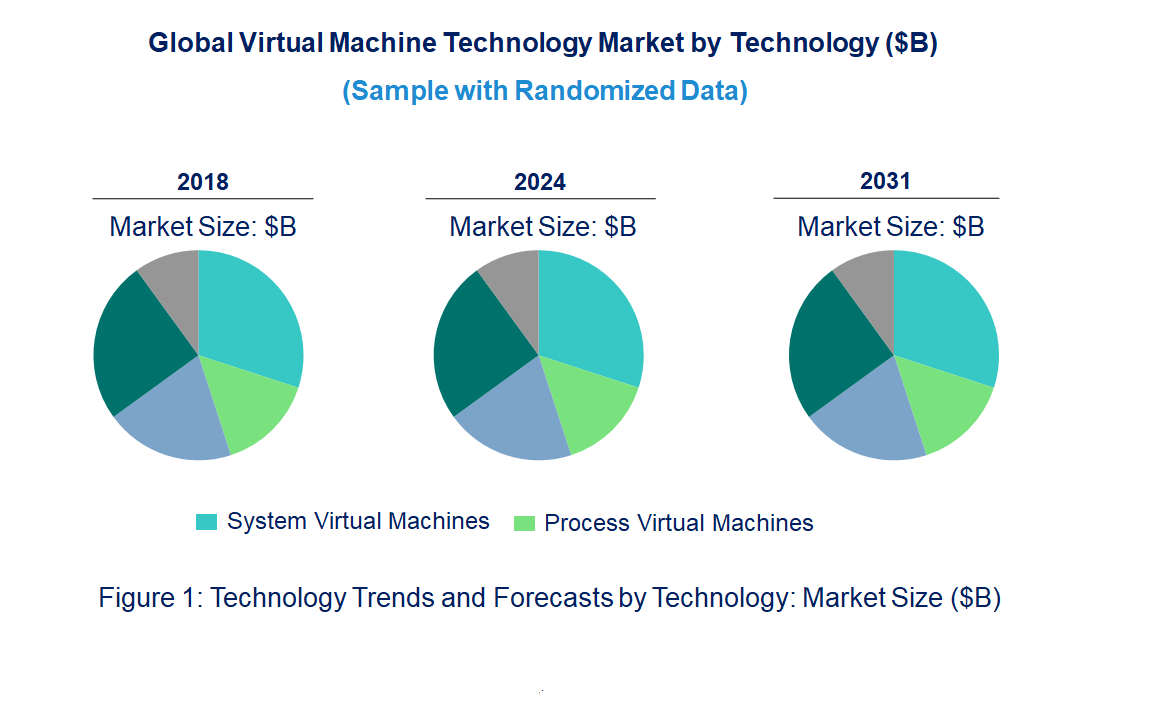
• Technology Readiness by Technology Type: System Virtual Machines (SVMs) are mature technologies that are the foundation of enterprise infrastructure solutions, providing proven scalability, cost efficiency, and high availability. They are widely used in data centers and cloud environments through platforms like VMware vSphere and Microsoft Hyper-V, supporting large-scale virtualization and hybrid infrastructure integration. Key use cases for SVMs include disaster recovery, server consolidation, and scalable cloud deployments, all in the pursuit of business continuity and cost optimization. PVMs are also mature but are more application-level virtual.NElization. Technologies include JVM and .NET CLR. PVMs support cross-platform development and deployment to ensure that the software runs flawlessly across Windows, Linux, and macOS. Key applications include web application hosting, distributed software development, and multi-platform support for enterprise applications. Both SVMs and PVMs are becoming more tightly coupled with AI-driven orchestration tools and cloud services to maximize efficiency and scalability. With businesses moving toward hybrid and multi-cloud strategies, both technologies serve key roles in keeping the flexibility of operation while staying cost-efficient.
• Competitive Intensity and Regulatory Compliance: The competitive space for system virtual machines (SVMs) and process virtual machines (PVMs) is pretty aggressive, with leading cloud and virtualization players like VMware, Microsoft, Oracle, and Amazon. SVMs involve infrastructure-level virtualization in terms of scalability, performance, and cost efficiency; PVMs, meanwhile, focus on application-level portability and cross-platform compatibility. Regulatory compliance is a critical challenge for SVMs as companies have to adhere to data sovereignty laws and industry standards like GDPR and HIPAA. PVMs also face compliance issues but are more focused on code integrity, cross-platform security, and maintaining application-level privacy standards. Cloud providers frequently embed built-in compliance certifications into both technologies, ensuring global adherence to regional and international data protection norms. Such integrated tools as containerization, along with orchestration, using SVMs, increase both scalability and operational efficiency. PVMs remain pivotal for driving innovation in building and deploying applications to provide cross-platform consistency. More and more organizations seek to rely on SVMs for infrastructure solutions and then depend on PVMs when implementing scalable application portability; both these technologies remain competitive in enterprises or industries, and strict compliance.
• Disruption Potential by Technology Type: System virtual machines (SVMs) and process virtual machines (PVMs) both represent significant technological disruption, but in different ways. SVMs, such as VMware or Hyper-V, virtualize entire hardware systems, providing scalability and flexibility to enterprises while cutting down on infrastructure costs. PVMs, such as the Java Virtual Machine (JVM), enable cross-platform application execution, promoting application portability and developer productivity. SVMs disrupt traditional IT infrastructure by replacing physical hardware setups with virtual environments, ensuring scalability and cost savings. PVMs, on the other hand, disrupt application development by enabling platform-independent software deployment. The integration of AI and machine learning enhances automation in both SVM and PVM environments, increasing operational efficiency. Along with the growing demand for cloud-native solutions, SVMs ensure seamless integration of multi-cloud infrastructures, and PVM ensures consistent application performance on diversified platforms. Both the SVMs and PVM technologies transform legacy operations into agile, scalable, and cost-efficient environments. Both are maturing in themselves as this maturity increases their capabilities for remolding enterprise infrastructure and its subsequent software deployment exponentially across different industries, thus transforming industries into better collaboration, scalable, and resilient organizations.
• System Virtual Machines
• Process Virtual Machines
• BFSI
• Telecommunications & ITES
• Government & Public Sector
• Healthcare & Life Sciences
• Others
• North America
• Europe
• Asia Pacific
• The Rest of the World
• Latest Developments and Innovations in the Virtual Machine Technologies
• Companies / Ecosystems
• Strategic Opportunities by Technology Type


Choose a license that fits your team. Instant PDF delivery.
Prices exclude taxes. Instant delivery. Custom licensing available on request.
Market Report · May 18, 2026
Market Report · May 18, 2026
Market Report · May 18, 2026
Trusted partner for strategic intelligence and business growth


Receive a complimentary market analysis tailored to your industry. Our analysts will identify key growth opportunities and competitive dynamics specific to your business.

Market size, growth rate, and key trend analysis for your specific sector.

Top competitor positioning and market share analysis.

Strategic recommendations backed by data-driven insights.
Get curated market intelligence and competitive moves straight to your inbox.
By subscribing, you agree to receive our monthly insights. Unsubscribe anytime.
Receive a complimentary market analysis tailored to your industry. Our analysts will identify key growth opportunities and competitive dynamics specific to your business.
Market size, growth rate, and key trend analysis for your specific sector.
Top competitor positioning and market share analysis.
Strategic recommendations backed by data-driven insights.
Get curated market intelligence, emerging trends, and competitive moves straight to your inbox each month.
By subscribing, you agree to receive our monthly insights. Unsubscribe anytime.
We'll send your sample report shortly.