
Market Report · May 18, 2026

This market report covers trends, opportunities, and forecasts in the global telecommunication & devices osat market to 2031 by packaging technology (wire bond, flip chip, wafer level, and others), application (telephone, radio and television, internet, satellite, phones & tablet, and optical), and region (North America, Europe, Asia Pacific, and the Rest of the World)
We'll send your sample report shortly.
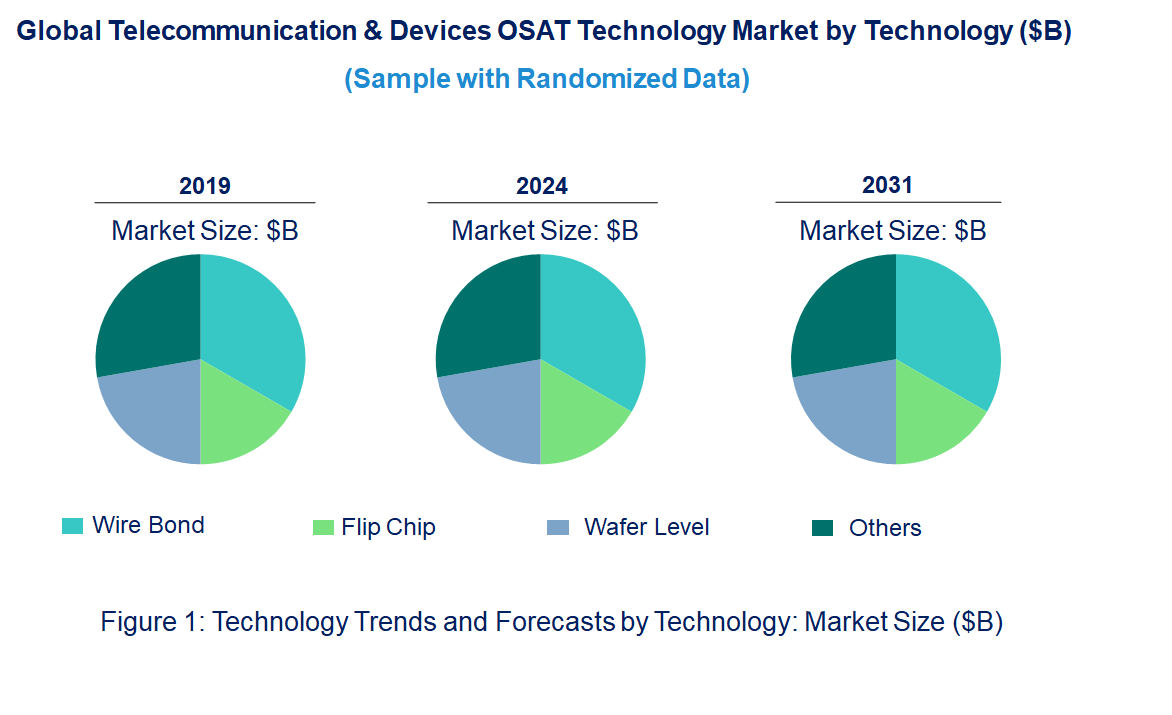
![Telecommunication & Devices OSAT Market Trend and Forecast by Application [Value from 2019 to 2031]:](https://lucintel.com/images/Telecommunication-&-Devices-OSAT-Technology-Market-Segment.png "Telecommunication & Devices OSAT Market Trend and Forecast by Application [Value from 2019 to 2031]:")
• Advanced System-in-Package (SiP) Solutions Adoption The use of SiP technology is on the rise as it allows for the integration of multiple semiconductor devices into a single package. This trend will enable high-performance, space-saving designs that are necessary for AI-driven telecommunication devices and IoT applications. SiP improves overall system efficiency and reduces the footprint of AI-enabled devices.
• Integration of AI in Automated Testing and Quality Control Improving semiconductor assembly yield and minimizing defects while using AI-driven automated testing systems, machine learning algorithms may predict failures and optimize tests. It enhances the reliability of telecom devices and helps get products into the market faster.
• Advanced integration techniques and 3D packaging: 3D packaging technology offers greater integration density and enhanced performance in AI systems. By stacking several layers of semiconductor devices, this technology supports more powerful and compact telecommunication devices. It is very important to fulfill the need for enhanced data transmission and processing in modern AI applications.
• Advanced Materials Used for Better Performance: The use of new advanced materials, including high-performance substrates and encapsulants, will further improve OSAT’s reliability and thermal management of AI-driven telecommunication devices in high-speed performance and stability under various operating conditions. More demanding applications can thus be opened for the growth of AI.
• Sustainability and Energy Efficiency Initiatives: The industry is working toward implementing energy-efficient manufacturing and testing processes that can help minimize its environmental impact. The OSAT market is also coming into line with the global sustainability targets by embracing more eco-friendly materials and greener assembly practices. This is a growing requirement as telecommunication technologies start spreading further. These technology trends are radically changing the telecommunication & devices OSAT technology landscape, making it more efficient, compact, and sustainable. The infusion of AI into processes is driving innovation and improving performance, and puts the industry in a position to support the growing demands of high-speed, high-volume AI applications in telecommunications.
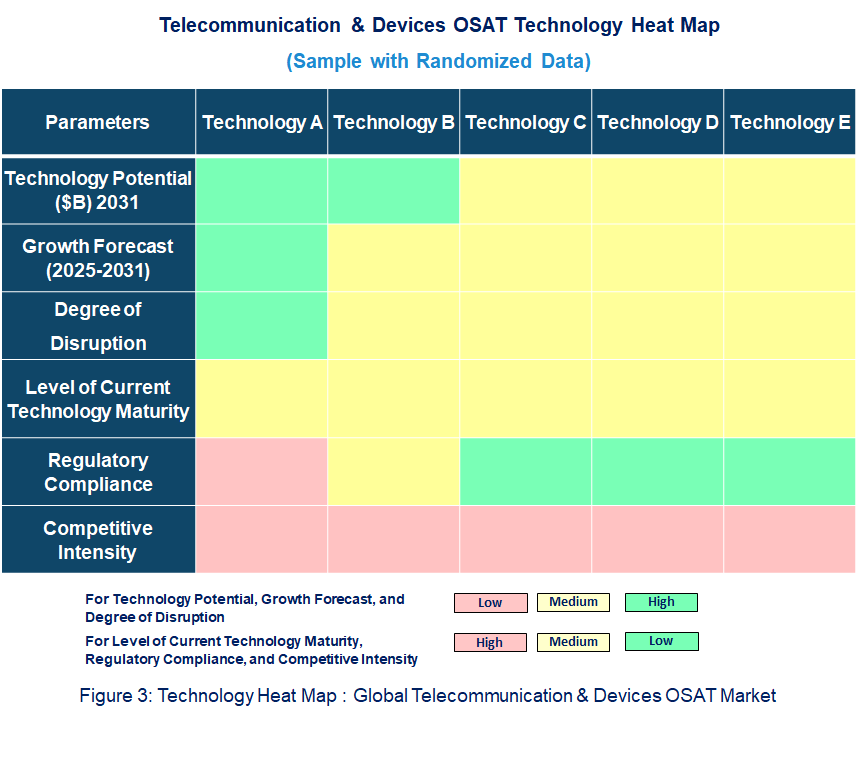
• Potential in Technology: Telecommunication & Devices OSAT technology in AI has a high growth potential. As AI is revolutionizing the telecommunication sector, OSAT technologies play a crucial role in supporting the performance and efficiency of next-generation AI-driven devices, especially those applied in 5G, IoT, and edge computing. OSAT solutions provide the ability to assemble, test, and package complex semiconductor devices that form the AI system’s backbone.
• Degree of Disruption: The disruption from AI-driven OSAT technologies is high, given that they streamline production, improve yield rates, and enhance testing processes through automation and AI-powered tools. This innovation is changing how semiconductor devices are manufactured, tested, and integrated into devices, reducing costs and accelerating time-to-market.
• Current Technology Maturity Level: Current technology maturity is high, with many OSAT providers already implementing AI tools in testing and packaging. However, the integration of advanced 3D packaging and System-in-Package (SiP) solutions is still evolving and presents significant opportunities.
• Regulatory Compliance: With rising regulatory complexity in this market, governments worldwide are now imposing stricter rules on semiconductor manufacturing, environmental sustainability, and data privacy in AI applications. OSAT providers need to ensure compliance with changing regulations, as the processes must meet industry standards and environmental requirements.
• Advanced Semiconductor Engineering: ASE has scaled up its advanced package technology capabilities by focusing on its high-performance SiP and 3D-IC packaging solutions. This upgrade strengthens the company’s competencies in offering support for high-bandwidth-low-latency applications of AI-related applications in telecommunication domains. The investments by ASE strive to address the growing demand for compact and efficient semiconductor applications.
• Amkor Technology: Amkor has invested in cutting-edge wafer-level packaging (WLP) and advanced testing solutions tailored for AI-powered telecommunications devices. Their emphasis on integrating AI into the testing phase boosts accuracy and reduces cycle times, leading to enhanced operational efficiency and product reliability. This makes Amkor a leader in providing scalable solutions for next-gen telecommunications.
• Jiangsu Changjiang Electronics Technology (JCET): JCET has concentrated more on the expansion of its semiconductor packaging services and process integration to develop for the demands of AI-enhanced 5G networks. The innovations include high-density packaging and micro-electromechanical systems (MEMS), which are essential for augmenting the performance of telecommunication devices.
• Siliconware Precision Industries (SPIL): SPIL introduced the innovation of chip-on-chip (CoC) and chip-on-wafer (CoW) to support the high-speed implementation of AI and IoT in telecommunications. CoC and CoW technologies reduce power consumption while increasing processing speed, two necessary characteristics for AI applications in real-time operations.
• PTI (Powertech Technology Inc.): PTI has led the charge in developing more advanced packaging solutions, such as through-silicon vias (TSV) and fine-pitch packaging, that AI requires in terms of high-performance and small-form-factor devices. These new developments allow for complex AI algorithms to be efficiently handled in telecom devices, opening doors to enhanced user experiences and robust connectivity. These developments from key players are fueling the growth of the telecommunication & devices OSAT technology sector by enhancing the performance, speed, and energy efficiency of devices crucial for AI and next-gen telecommunications.
• Increasing demand for AI-powered communication solutions: The shift toward AI-based communication networks is forcing OSAT manufacturers to develop high-performance energy-efficient solutions. Increasing demand based on AI computation and data processing capability of telecom devices helped OSAT innovators gear up packaging technologies in that direction. This is very important for furthering 5G and IoT applications.
• Advancements in Advanced Packaging Technologies: New packaging methods such as 3D ICs and system-in-package (SiP) solutions improve the processing power and reduce the footprint of telecom devices. These are important for AI integration since smaller, more powerful, and highly interconnected chips are required for real-time data analysis and faster response times.
• Growing need for sophisticated testing solutions: With AI and telecommunications becoming progressively integrated, rigorous and scalable testing solutions have become paramount. Automation and AI-driven testing improve efficiency and precision and enable rapid deployment at lower operational costs for telecom devices.
• High Research and Development and Production Costs: Although progress is advantageous, it is associated with high R&D costs and high production expenditure. The companies have to make a balance between high investments in new technologies and maintaining profitability and competitive pricing, which becomes a challenge for the market players.
• Regulatory Compliance and Security Concerns: With greater connectivity and data transfer, regulatory requirements for data security and privacy are becoming more stringent. OSAT providers need to adapt to these evolving standards, which can slow down development cycles and increase compliance costs. The telecommunication & devices OSAT technology market is experiencing transformative growth due to increased AI integration, innovative packaging methods, and enhanced testing solutions. However, challenges like high costs, complex R&D, and regulatory constraints continue to impact the sector. Companies focusing on addressing these challenges through strategic investments and advanced technologies are better positioned to benefit from the market’s expansion.
• Advanced Semiconductor Engineering
• Amkor
• Jiangsu Changjiang Electronics Technology (JCET)
• Siliconware Precision Industries
• PTI (Powertech Technology Inc.)
• Technology Readiness: Wire Bond is well-established and widely utilized for standard, low-cost applications, including simple electronic devices and automotive components. Flip Chip is ready for applications that require high performance, such as high-speed communication devices and AI chips with a need for speed and integration. Wafer Level Packaging is gaining momentum and is ready for high-density, high-functionality applications, such as smartphones, IoT devices, and wearable technology. Each technology aligns with the requirements for its application: Wire Bond for cost efficiency, Flip Chip for performance, and Wafer Level for fully miniaturized and integrated systems. As a result, their roles are shaping the ever-changing electronics landscape driven by compact electronics.
• Competitive Intensity and Regulatory: The competitive intensity of Wire Bonds, Flip Chips, and Wafer Level technologies is high. Each of these technologies competes for applications that require performance and efficiency. Wire Bond, however, remains a competitive choice because it is low-cost, whereas Flip Chip and Wafer Level are favored for more advanced, high-performance applications. Regulatory compliance varies from technology to technology. Wafer Level Packaging generally faces strict environmental and safety regulations because its processes are highly complex. Flip Chip aligns with high-tech industry standards for miniaturization and efficiency. Companies need to navigate these regulatory compliance measures to stay ahead and align with global industry expectations.
• Disruption potential: One such technology is Wire Bond. Another is Flip Chip. There is also a third technology referred to as Wafer Level. However, these technologies have differing degrees of potential. The more commonly applied of these technologies has a relatively strong degree of potential. They include higher density and higher performance for electrical functionality. This disrupts traditional processes, including the creation of compact, high-speed circuits. Wafer Level Packaging, with its reduced size and improved thermal management, is increasingly becoming a disruptive force in applications that require high integration and performance, such as AI and 5G devices. The evolution of these technologies reshapes how the telecommunications and semiconductor industries approach design and manufacturing.
• Wire Bond
• Flip Chip
• Wafer Level
• Others
• Telephone
• Radio and Television
• Internet
• Satellite
• Phones & Tablet
• Optical
• North America
• Europe
• Asia Pacific
• The Rest of the World
• Latest Developments and Innovations in the Telecommunication & Devices OSAT Technologies
• Companies / Ecosystems
• Strategic Opportunities by Technology Type


Choose a license that fits your team. Instant PDF delivery.
Prices exclude taxes. Instant delivery. Custom licensing available on request.
Market Report · May 18, 2026
Market Report · May 18, 2026
Market Report · May 18, 2026
Trusted partner for strategic intelligence and business growth


Receive a complimentary market analysis tailored to your industry. Our analysts will identify key growth opportunities and competitive dynamics specific to your business.

Market size, growth rate, and key trend analysis for your specific sector.

Top competitor positioning and market share analysis.

Strategic recommendations backed by data-driven insights.
Get curated market intelligence and competitive moves straight to your inbox.
By subscribing, you agree to receive our monthly insights. Unsubscribe anytime.
Receive a complimentary market analysis tailored to your industry. Our analysts will identify key growth opportunities and competitive dynamics specific to your business.
Market size, growth rate, and key trend analysis for your specific sector.
Top competitor positioning and market share analysis.
Strategic recommendations backed by data-driven insights.
Get curated market intelligence, emerging trends, and competitive moves straight to your inbox each month.
By subscribing, you agree to receive our monthly insights. Unsubscribe anytime.
We'll send your sample report shortly.