
Market Report · May 18, 2026

This market report covers trends, opportunities, and forecasts in the global taxi battery market to 2031 by type technology (absorbent glass mat and enhanced flooded battery), application (fuel type and electric type), and region (North America, Europe, Asia Pacific, and the Rest of the World)
We'll send your sample report shortly.
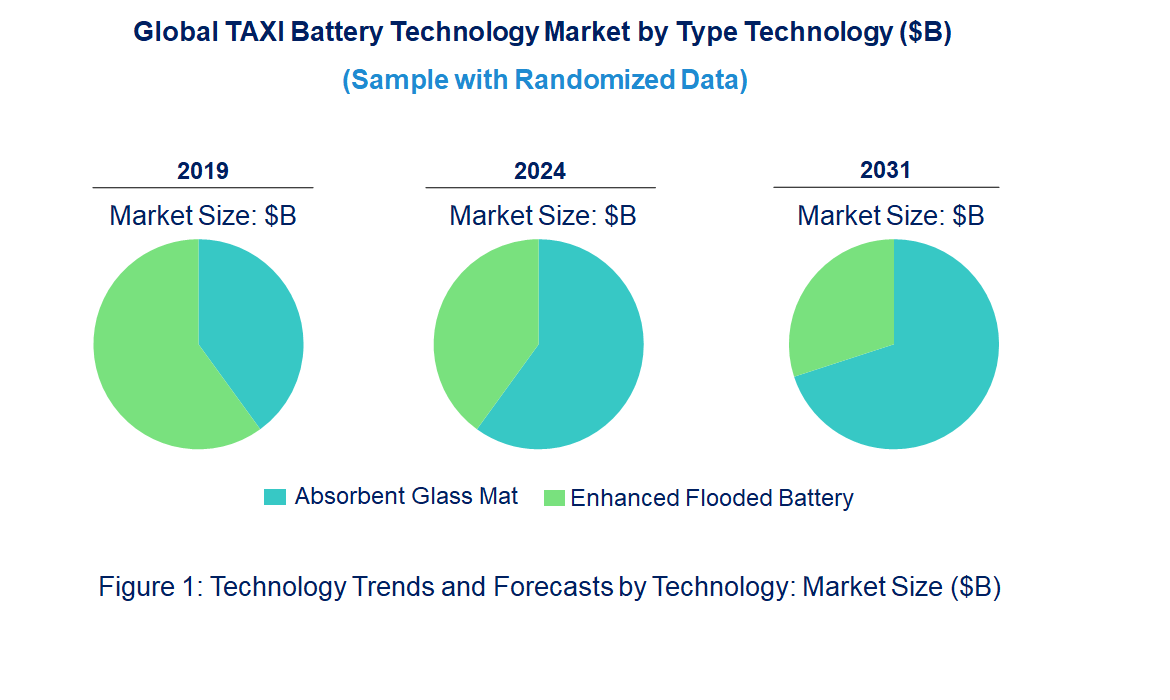
![TAXI Battery Market Trend and Forecast by Application [Value from 2019 to 2031]:](https://lucintel.com/images/TAXI-Battery-Technology-Market-Segment.png "TAXI Battery Market Trend and Forecast by Application [Value from 2019 to 2031]:")
• Adoption of High-Energy-Density Batteries Advances in lithium-ion and solid-state batteries have led to increased energy density, enabling longer driving ranges for electric taxis. High-energy-density batteries are essential for reducing downtime and maximizing revenue for taxi operators, driving their widespread adoption.
• Faster Charging Technologies: The e-taxi industry is transformed by fast-charging infrastructure and battery compatibility, reducing the recharge time. Ultra-fast charging stations and swappable battery systems have reduced waiting times, enhancing taxi availability and operational efficiency.
• BMS Integration: Advanced BMS implementation enhances the life, safety, and performance of the battery. These systems monitor temperature, charge cycles, and efficiency, which enables predictive maintenance and cost reduction, making electric taxis more reliable for 24/7 operations.
• Shift Towards Sustainable Battery Materials: Growing environmental concerns have pushed the market towards eco-friendly battery chemistries, such as cobalt-free and recyclable batteries. Manufacturers are investing in sustainable materials to align with global green initiatives and regulatory frameworks.
• Government Incentives and Regulatory Push: Government incentives such as subsidies, tax benefits, and zero-emission targets are pushing electric taxis forward. Low-emission zones and financial support for EV infrastructure are transforming the competitive landscape. The taxi battery market is on the path toward transformative growth, driven by technological development, sustainability strategies, and supportive regulations. Fast charging systems, from eco-friendly materials, boost operational efficiency, reduce cost, and support the shift towards cleaner urban transportation. While the market evolves, innovations in battery technology will play a major role in shaping the future of electric taxis and meeting economic and environmental goals.
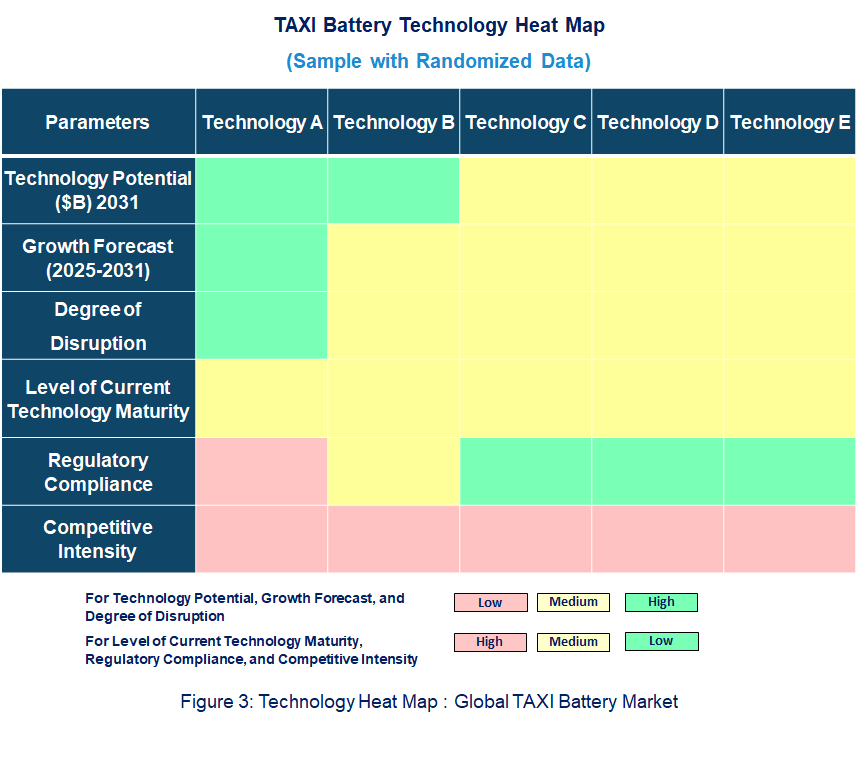
• Potential in Technology: There is tremendous potential for technology in the TAXI Battery Market, fueled by improvements in battery chemistry, energy density, and charging infrastructure. Technologies such as ultra-fast charging and battery-swapping solutions enhance operational efficiency by mitigating downtime and vehicle range-related issues.
• Degree of Disruption: The degree of disruption is high as electric taxi batteries challenge conventional fuel-based systems. They offer reduced operational costs, eco-friendly performance, and improved energy efficiency, making them a compelling alternative. Innovations in battery technologies are reshaping urban mobility and accelerating the adoption of electric taxis.
• Current Technology Maturity Level: Currently, lithium-ion batteries are the most mature technology, dominating the market. However, emerging technologies like solid-state batteries are at the developmental stage and hold immense potential for future advancements in performance, safety, and energy capacity.
• Regulatory Compliance: Regulatory compliance is a key driver, with governments worldwide implementing stringent emissions policies, offering incentives for electric vehicle adoption, and promoting zero-emission zones. These regulations support the growth and adoption of battery-powered taxis.
• Hyundai Sungwoo Holdings: Hyundai Sungwoo Holdings launched its high-performance AGM battery designed specifically for electric and hybrid taxis. Its primary focus is on extended life with improved energy storage capability catering to the increasing demand of the electric taxi fleets.
• Lucas: Lucas introduced an advanced EFB line, which offers high-performance stop-start taxis. The EFB technology reduces emissions and increases the durability of batteries, which is the primary requirement for modern taxi systems.
• Sonnenschein: Sonnenschein enhanced its portfolio of gel-based batteries, focusing on long-life maintenance-free solutions. In regions where hybrid taxis are implemented, these batteries are quite significant as they ensure reliability and cost-effectiveness.
• Bosch: Bosch also claimed a breakthrough in technology in lithium-ion batteries, oriented towards fast charging for electric taxis. This significantly reduces the downtime for charging as well as increases the operational efficiency of electric taxis, making this a more viable option for operators of taxi fleets.
• Numax: Numax launched an ecosensitive range of AGM batteries that reduce the carbon footprint on taxi fleets. These batteries have advanced energy density and better power performance under demanding urban driving conditions.
• Banner: Banner introduced a new generation of EFB and AGM batteries tailored for modern taxis with start-stop systems. The technology provides increased cycle life and robust performance, addressing the needs of energy-intensive urban taxi fleets.
• Trojan: Trojan has focused on deep-cycle battery innovation, launching a series of products tailored for electric taxi applications. These batteries enhance energy storage capacity and durability, supporting longer driving ranges for EV taxis.
• Varta: Varta has produced high-performance AGM batteries with a focus on extended service in electric and hybrid taxis. These batteries are proving very popular in areas that are strictly enforcing emission limits.
• US Batteries: US Batteries has unveiled lead-acid batteries meant for heavy-duty applications specifically suited for conventional fuel-powered taxis. Their products focus on cost-effectiveness while ensuring reliability and performance for intensive use cases. Each of these milestones marks a step forward to the improvement of energy efficiency, durability, and sustainability in the TAXI Battery Market, helping taxi operators navigate changing environmental standards and technological demands.
• Rising Demand for Electric Taxis: Governments and cities are in favor of implementing electric taxis for the reduction of emissions and urban pollution. The growing demand is investing in advanced battery technologies to enhance the range and efficiency. This, in turn, is growing the market.
• Battery Technology Innovation: Innovations in lithium-ion and solid-state batteries enhance energy density, charging speed, and lifespan. All these innovations are crucial to meeting the operational needs of taxis, minimizing downtime, and reducing long-term costs for taxi operators.
• Government Policies and Incentives: Favorable policies, subsidies, and financial incentives boost the adoption of electric taxis. Tax rebates, investments in EV infrastructure, and low-emission zones motivate fleet operators to switch to electric vehicles, which increases the demand for batteries.
• Declining Battery Costs: Manufacturing process innovations and economies of scale have continuously reduced the cost of battery production. Lower prices make electric taxis more affordable, promoting their adoption in cost-sensitive markets and thus favorably impacting overall market growth.
• Expanding Charging Infrastructure: Fast-charging networks and swappable battery stations reduce operational delays for taxi drivers. Improved infrastructure enhances the reliability and availability of electric taxis, thus making them viable for large-scale adoption. Challenges in the taxi battery market are:
• High initial investment costs: Despite the decline in battery prices, initial electric taxi and advanced battery costs continue to be high. That acts as a deterrent in most emerging economies where a high budget constraint slows the rate of transition to electric mobility.
• Inadequate Charging Infrastructure: There is currently not enough charging infrastructure, including both urban rural, and semi-urban. This restricts growth for the electric taxi market since an unreliable infrastructure causes operator as well as user range anxiety.
• Degradation of Battery Performance: Batteries in electric taxis deteriorate with time and lead to reduced capacity and efficiency. The frequent usage in taxi operations accelerates this degradation, thus raising the cost of maintenance and affecting profitability for operators.
• Environmental Issues in Battery Disposal: The environmental impact of battery production and disposal is a significant issue. Poor recycling and disposal of lithium-ion batteries raise sustainability concerns and pressure the market to embrace greener solutions.
• Grid Dependency and Power Supply Issues: Heavy dependence on electrical grids for charging strains energy systems, especially during peak demand. In regions with unreliable power infrastructure, the dependency on the grid becomes a significant barrier to scaling electric taxi operations. The taxi battery market is growing at a robust pace, propelled by technological advancements, government initiatives, and increasing demand for sustainable transportation. Nevertheless, high costs, limitations in infrastructure, and environmental concerns will have to be tackled to fully unlock the market. Balancing these drivers and challenges will be key to shaping the future of electric taxis globally.
• Hyundai Sungwoo Holdings
• Lucas
• Sonnenschein
• Bosch
• Numax
• Banner
• Technology Readiness: The readiness of the technologies for AGM and EFB varies in the TAXI Battery Market. AGM batteries are very mature, with deep cycling capability, durability, and reliability, making them a strong competitor in demanding taxi environments. AGM's ability to withstand high usage and extend operational lifespans makes it well-suited for urban taxi fleets. EFB batteries, though competitive and widely available, offer lower durability and shorter lifespans compared to AGM. However, EFB technology is cost-effective and is compliant with regulatory requirements. Hence, it will be adopted, especially in emerging markets. AGM's high-performance level makes it the best for high-demand operations, while EFB is more suitable for budget-conscious taxi operators looking for a more economical solution. Both technologies play an important role in the market, and AGM is the advanced option for intensive use.
• Competitive Intensity and Regulatory Compliance: The competitive intensity of the taxi battery market is influenced by the growing demand for affordable, reliable, and eco-friendly technologies like AGM and EFB. AGM technology performs better but is more costly and thus may not attract buyers in price-sensitive markets. EFB is not as durable as AGM, but it is relatively inexpensive, which makes it the favorite of operators that give priority to cost rather than extended battery life. Regulatory compliance is beneficial to both technologies as governments encourage the adoption of cleaner alternatives that adhere to strict standards of emissions. AGM would fit better into these standards since it lasts longer and is more efficient, but EFB meets the necessary standards at a lower price, which encourages wider acceptance in the transition to electric taxis.
• Disruption Potential: There is a strong disruption potential for Absorbent Glass Mat (AGM) and Enhanced Flooded Battery (EFB) technologies in the TAXI Battery Market because they can enhance both battery performance and reliability. AGM batteries have strong power, deep cycling, and longer lifespans over the competition, which places them in high demand in taxi operations. EFB batteries are more affordable as well as offer enhanced start-stop functionality, which is helpful in cost-sensitive taxi fleets. While AGM batteries provide better performance and require less maintenance, EFB batteries are more cost-effective and widely available. Both technologies are contributing to the shift away from traditional lead-acid batteries, helping to reduce emissions and improve energy efficiency, though lithium-ion batteries remain the dominant long-term alternative
• Absorbent Glass Mat
• Enhanced Flooded Battery
• Fuel Type
• Electric Type
• North America
• Europe
• Asia Pacific
• The Rest of the World
• Latest Developments and Innovations in the TAXI Battery Technologies
• Companies / Ecosystems
• Strategic Opportunities by Technology Type


Choose a license that fits your team. Instant PDF delivery.
Prices exclude taxes. Instant delivery. Custom licensing available on request.
Market Report · May 18, 2026
Market Report · May 18, 2026
Market Report · May 18, 2026
Trusted partner for strategic intelligence and business growth


Receive a complimentary market analysis tailored to your industry. Our analysts will identify key growth opportunities and competitive dynamics specific to your business.

Market size, growth rate, and key trend analysis for your specific sector.

Top competitor positioning and market share analysis.

Strategic recommendations backed by data-driven insights.
Get curated market intelligence and competitive moves straight to your inbox.
By subscribing, you agree to receive our monthly insights. Unsubscribe anytime.
Receive a complimentary market analysis tailored to your industry. Our analysts will identify key growth opportunities and competitive dynamics specific to your business.
Market size, growth rate, and key trend analysis for your specific sector.
Top competitor positioning and market share analysis.
Strategic recommendations backed by data-driven insights.
Get curated market intelligence, emerging trends, and competitive moves straight to your inbox each month.
By subscribing, you agree to receive our monthly insights. Unsubscribe anytime.
We'll send your sample report shortly.