
Market Report · July 22, 2026

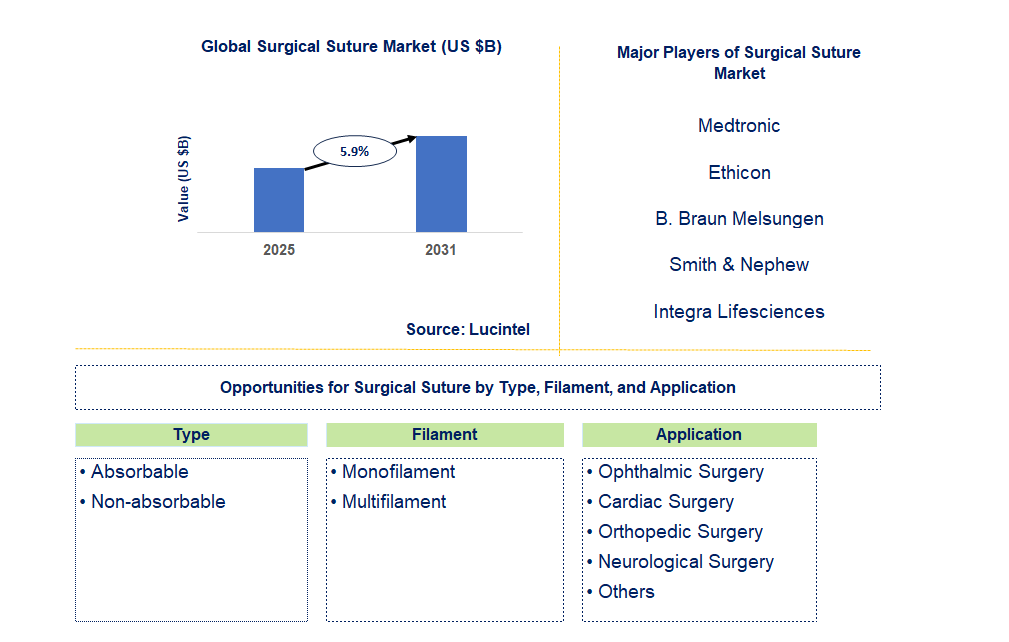
Key data points: The growth forecast = 5.9% annually for the next 7 years. Scroll below to get more insights. This market report covers trends, opportunities and forecasts in surgical suture market to 2031 by type (absorbable and non-absorbable), filament (monofilament and multifilament), application (ophthalmic surgery, cardiac surgery, orthopedic surgery, neurological surgery, and others), and region (North America, Europe, Asia Pacific, and the Rest of the World)
We'll send your sample report shortly.
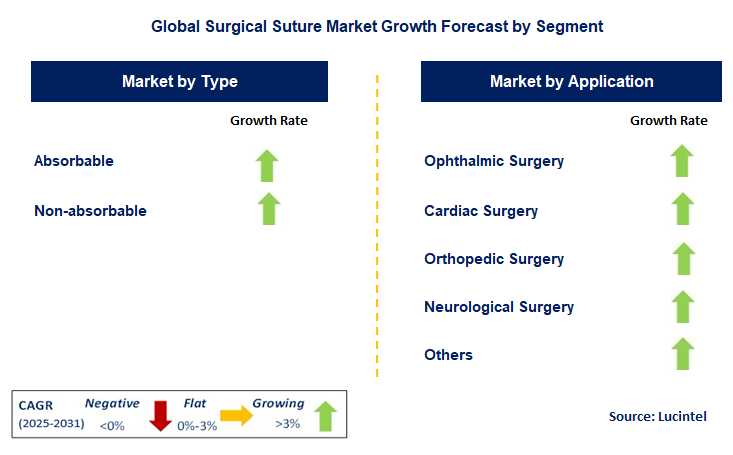
• Lucintel forecasts that, within the type category, absorbable is expected to witness higher growth over the forecast period.
• Within the application category, cardiac surgery is expected to witness the highest growth.
• In terms of region, North America will remain the largest region over the forecast period. Gain valuable insights for your business decisions with our comprehensive 150+ page report. Sample figures with some insights are shown below.
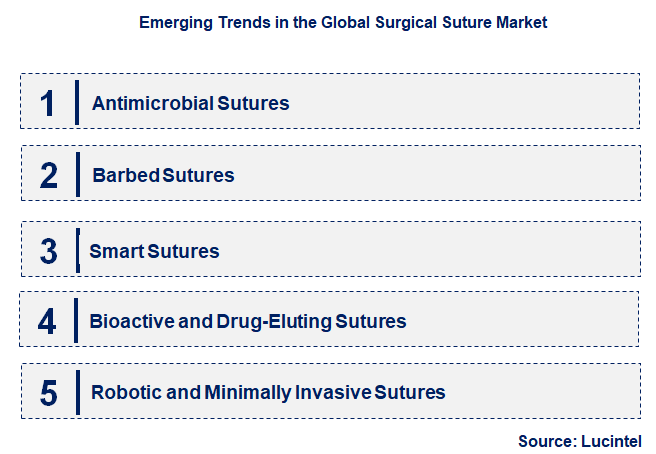
• Antimicrobial Sutures: Antimicrobial sutures are coated with inhibitors of bacterial growth, which significantly lower the likelihood of surgical site infection (SSI). The trend is significant in enhancing patient safety and lowering infection-related healthcare costs. With the increasing threat of antibiotic resistance, the use of antimicrobial sutures will increasingly become adopted, especially in risky procedures and immunocompromised patients. Their effectiveness against post-operative complications renders them an important step in contemporary surgical practice, propelling their expanded market penetration.
• Barbed Sutures: Barbed sutures contain small protrusions that obviate the formation of surgical knots, allowing for stable tissue approximation and even tension distribution. This configuration facilitates wound closure, decreases operative time, and possibly minimizes the risk of complications related to knots. Barbed sutures are also increasingly popular in many specialties of surgery, such as plastic surgery, bariatric surgery, and gynecologic procedures, where tight tissue alignment and secure wound closure are critical. Ease of use and enhanced cosmetic results are the prime motivators for increasing adoption among surgeons.
• Smart Sutures: At the cutting edge of the future, smart sutures have embedded sensors, drug delivery systems, or diagnostic properties. These new sutures might track wound healing, provide local medication, or even sense imminent infection. Though still mostly in research and development, intelligent sutures have huge potential to transform post-operative care and offer real-time feedback on the healing process. Their future commercialization may result in more tailored and effective patient care approaches, having a profound impact on surgical outcomes and recovery periods.
• Bioactive and Drug-Eluting Sutures: These are designed to elute therapeutic drugs directly into the wound, facilitating healing, inflammation reduction, or infection prevention. For instance, certain sutures may elute growth factors to speed up tissue regeneration, whereas others may release painkillers to reduce post-surgery pain. This localized therapy is a major improvement over systemic drug delivery, with less chance of side effects and more therapeutic potency. Their creation is broadening the function of wound closure beyond simple mechanical approximation.
• Robotic and Minimally Invasive Sutures: The growing use of robotic-assisted and other minimally invasive surgical methods requires sutures that are easily manipulated and delivered through small incisions. Many such sutures incorporate greater ergonomics, pre-formed knots, or specialized delivery systems to help place precise sutures in limited surgical fields. The trend toward less invasive procedures will continue to drive innovation in this category, focusing on sutures that maximize efficiency and safety in these sophisticated surgical settings. These nascent trends are coming together to collectively transform the surgical suture market by propelling innovation toward improved efficacy, greater patient safety, and better surgical outcomes. The transition toward specialized, functional sutures is a noteworthy development from more conventional wound closure practices. As these trends come to fruition, they will probably result in a more dispersed but highly specialized marketplace, where sutures are customized not only to particular surgical procedures but also to the unique needs of individual patients, eventually redefining the face of surgical care.
• Emergence of Absorbable and Synthetic Sutures: There is a significant move away from conventional non-absorbable sutures and towards synthetic and absorbable ones. This is fueled by their advantages, such as having predictable degradation patterns, minimized foreign body reaction, and avoidance of suture removal. These new sutures are more favored in a broad spectrum of surgical interventions, resulting in fewer complications and enhanced patient comfort. The ongoing research into newer synthetic polymers with better properties is also speeding up this trend.
• Expanded Use of Barbed Sutures: Barbed sutures have picked up a lot of momentum with their knotless closure features, which enable simpler and quicker tissue approximation with better tension distribution. This does away with the time-consuming knot-tying process, making surgical interventions more efficient. Their applications have widened in specialties such as plastic surgery, bariatric surgery, and gynecology, where accurate closure and shorter operating time are greatly appreciated. The continuous improvements in barbed suture designs are making them increasingly versatile and consistent.
• Innovation of Antimicrobial-Coated Sutures: The increasing worldwide concern regarding surgical site infections has prompted the innovation of sutures with antimicrobial coatings. Such sutures fight off bacterial colonization on the wound surface actively, greatly reducing the rate of infection. Such advancement is vital for patient safety, particularly among immunocompromised patients or those receiving prosthetic implant procedures. With healthcare systems aiming to control infection, the need for antimicrobial sutures is gradually growing, impacting hospital purchasing decisions globally.
• Minimally Invasive Surgery Compatible Sutures: With a growing incidence of minimally invasive surgical procedures, such as laparoscopic and robotic surgery, the market has been spurred on by the need for specialty sutures that are suited for these procedures. Such sutures typically have improved handling properties, reduced needle sizes, and specialized delivery systems to better accommodate their use in small incisions. Producers are continually developing ways of making sutures that maximize efficiency and accuracy within the limitations of MIS environments, underpinning the ongoing expansion of these less invasive techniques.
• Development of Bioactive and Drug-Eluting Sutures: A particular breakthrough is the incorporation of bioactive elements or drug-delivery capabilities into sutures. These sutures are sophisticated enough to be able to release localized therapeutic agents, such as growth factors to heal wounds faster, antibiotics to avoid infection, or anti-inflammatory drugs to minimize pain. This trend is away from mechanical wound closure alone and towards a more therapeutic intervention, with the intent of actively facilitating the healing process and enhancing post-operative results, a huge advancement in suture technology. These recent advances are together influencing the market for surgical sutures by driving innovation, strengthening patient safety, and optimizing surgical efficiency. The transition to more functionally specialized, user-friendly, and technologically advanced sutures is prompted by both technological progress and changing clinical requirements. As these advances keep evolving and become increasingly adopted, they not only grow the market but are also significantly reshaping the purpose of sutures in contemporary surgical practice, resulting in improved care for patients and more efficient surgical processes.
• Cardiovascular Surgery: The growing worldwide incidence of cardiovascular diseases and increasing volumes of bypass grafting, valve replacement, and vascular repairs offer tremendous opportunities for dedicated sutures. Such procedures require sutures with high tensile strength, low tissue reactivity, and good knot security. Some of the innovations in cardiovascular sutures are with better lubricity to slide smoothly through fine tissue, and those in robotic cardiac surgery. The global population’s increasing age will further propel the need for these essential surgeries.
• Orthopedic Surgery: Expansion in orthopedic procedures, such as joint replacements, fracture repairs, and ligament reconstructions, provides an enormous market for bio-absorbable and high-strength sutures. Orthopedic surgeons need sutures that are resistant to high biomechanical stress but support optimal tissue healing. There is potential for sutures with improved knot integrity, controlled rate of degradation, and compatibility with newer fixation devices. Sports activity and an ageing population susceptible to musculoskeletal problems will drive this segment.
• General Surgery: Overall, general surgical operations, including abdominal operations, herniorrhaphies, and gastrointestinal operations, are a fundamental and ever-growing use for surgical sutures. The sheer number of these operations, combined with the ever-advancing technology of laparoscopic surgery, fuels demand for a wide range of sutures, from the absorbable to the non-absorbable to the tissue-specific. Innovations directed at the prevention of infection and enhanced wound healing across general surgery in general will remain pivotal to market expansion.
• Minimally Invasive Surgery: The worldwide trend toward minimally invasive surgical methods across nearly all medical specialties provides a compelling growth path for specialty sutures. MIS procedures require sutures that can be readily manipulated through small incisions with assistance from endoscopic or robotic equipment. This generates demand for pre-tied, barbed, and sutures with advanced delivery systems. As MIS becomes more popular because of decreased recovery times for patients and decreased post-surgical pain, the MIS-compatible suture market will grow in proportion.
• Wound Closure & Topical Applications: Aside from internal surgical interventions, the wider class of wound closure, such as trauma therapy, lacerations, and dermal surgeries, offers continued expansion prospects. The category takes advantage of both conventional sutures and newer technologies such as topical skin glue and staples. Nonetheless, for more severe and intricate wounds, sutures are still unavoidable. Innovation in this field includes antimicrobial sutures, those that speed healing, and specialty sutures for cosmetic purposes that leave minimal scarring. These strategic growth prospects are greatly influencing the surgical suture market by forcing innovation and specialization. Growing demand from across all surgical disciplines is inducing manufacturers to create application-specific solutions that address unique procedural demands and patient specifications. This emphasis on application-specific sutures is creating a diversified and healthier market where material innovation and design improvements address the singular challenges of each surgical discipline to ultimately improve surgical efficacy and patient outcomes.
• Medtronic
• Ethicon
• B. Braun Melsungen
• Smith & Nephew
• Integra Lifesciences
• Peter Surgical
• Internacional farmaceutica
• Absorbable
• Non-absorbable
• Monofilament
• Multifilament
• North America
• Europe
• Asia Pacific
• The Rest of the World
• United States: The United States market for surgical sutures is growing robustly on the back of a high frequency of surgical interventions, technological innovation, and greater usage of absorbable and barbed sutures. An increased focus on minimally invasive procedures is driving demand for purpose-designed sutures that provide improved knot security and tissue approximation. Additionally, R&D activities are targeting antimicrobial coating sutures in order to minimize surgical site infections and smart sutures that can deliver drugs or detect physiological changes. Health spending and a strong regulatory environment also underpin the market’s growth trend.
• China: China’s surgical suture market is growing at a brisk pace, driven by its huge population, growing healthcare spending, and the rising incidence of surgical procedures. Although conventional non-absorbable sutures continue to command a major share, there is a definite trend towards state-of-the-art absorbable and synthetic sutures as a result of better patient comfort and fewer complications. Domestic players are stepping up their R&D efforts, focusing on competing with global companies by providing cost-competitive yet quality products. Government efforts to enhance health infrastructure and access in rural regions also support market growth.
• Germany: The surgical suture market in Germany has a dominant trend towards high-end, innovative products, fueled by its sophisticated healthcare system and strict regulatory guidelines. Advanced synthetic absorbable sutures are highly preferred, especially for complex procedures involving delicate wound closure. German producers are at the forefront of creating highly specialized sutures for use in particular surgical procedures, including cardiovascular and orthopedic procedures. The industry also experiences a consistent use of antimicrobial sutures to improve patient safety and prevent healthcare-associated infections, demonstrating dedication to excellence in patient outcomes.
• India: The Indian market for surgical sutures is experiencing significant growth, driven by the growing incidence of chronic diseases, improved access to surgical procedures, and an emerging medical tourism industry. While cost considerations continue to be an important factor, there is a progressive shift towards better quality absorbable and synthetic sutures. Home industry players are assuming a progressively important role, serving both the domestic market and export markets. Government programs to enhance the public health infrastructure and make quality healthcare affordable will continue to spur growth in the adoption of advanced surgical suture technologies.
• Japan: The surgical suture market in Japan is mature and highly developed, with high demand for high-quality, technologically sophisticated products. The country’s high age ratio and high incidence of chronic diseases require a high volume of surgeries, generating sustained demand. Japanese healthcare professionals are inclined towards sutures that reduce tissue trauma, diminish healing time, and provide better tensile strength. Recent developments in bio-absorbable material and custom-made sutures for sensitive surgeries such as ophthalmic and neurosurgery are high on priority, demonstrating the nation’s focus on precision medicine as well as patient safety.


• Medtronic
• Ethicon
• B. Braun Melsungen
• Smith & Nephew
• Integra Lifesciences
• Peter Surgical
• Internacional farmaceutica Q5. Which surgical suture market segment will be the largest in future? Answer: Lucintel forecasts that, within the type category, absorbable is expected to witness higher growth over the forecast period. Q6. In surgical suture market, which region is expected to be the largest in next 5 years? Answer: In terms of region, North America will remain the largest region over the forecast period. Q7. Do we receive customization in this report? Answer: Yes, Lucintel provides 10% customization without any additional cost.


Choose a license that fits your team. Instant PDF delivery.
Prices exclude taxes. Instant delivery. Custom licensing available on request.
Market Report · July 22, 2026
Market Report · July 22, 2026
Market Report · July 22, 2026
Trusted partner for strategic intelligence and business growth


Receive a complimentary market analysis tailored to your industry. Our analysts will identify key growth opportunities and competitive dynamics specific to your business.

Market size, growth rate, and key trend analysis for your specific sector.

Top competitor positioning and market share analysis.

Strategic recommendations backed by data-driven insights.
Get curated market intelligence and competitive moves straight to your inbox.
By subscribing, you agree to receive our monthly insights. Unsubscribe anytime.
Receive a complimentary market analysis tailored to your industry. Our analysts will identify key growth opportunities and competitive dynamics specific to your business.
Market size, growth rate, and key trend analysis for your specific sector.
Top competitor positioning and market share analysis.
Strategic recommendations backed by data-driven insights.
Get curated market intelligence, emerging trends, and competitive moves straight to your inbox each month.
By subscribing, you agree to receive our monthly insights. Unsubscribe anytime.
We'll send your sample report shortly.