
Market Report · July 22, 2026

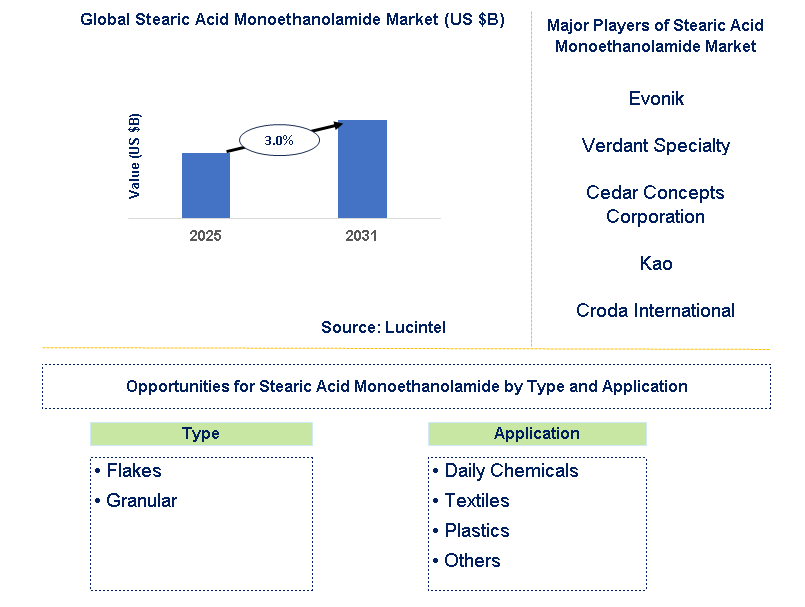
Key data points: The growth forecast = 3% annually for the next 7 years. Scroll below to get more insights. This market report covers trends, opportunities and forecasts in stearic acid monoethanolamide market to 2031 by type (flakes and granular), application (daily chemicals, textiles, plastics, and others), and region (North America, Europe, Asia Pacific, and the Rest of the World)
We'll send your sample report shortly.
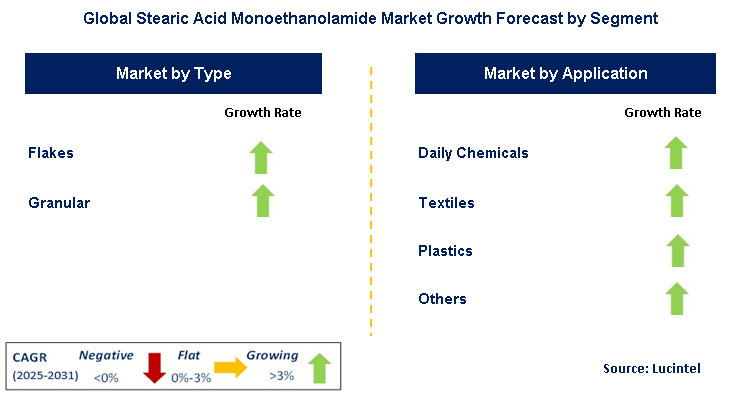
• Lucintel forecasts that, within the type category, granular is expected to witness higher growth over the forecast period.
• Within the application category, plastic is expected to witness the highest growth.
• In terms of region, APAC is expected to witness the highest growth over the forecast period. Gain valuable insights for your business decisions with our comprehensive 150+ page report. Sample figures with some insights are shown below.
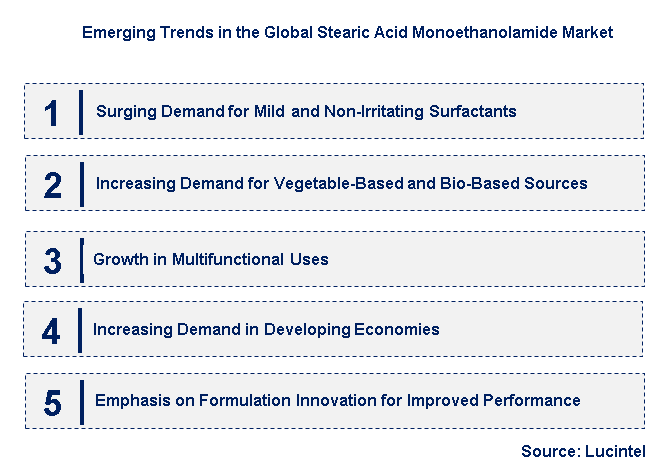
• Surging Demand for Mild and Non-Irritating Surfactants: Consumers now look for personal care and cleaning products that are mild on the skin and will not cause any irritation. SMEA, being mild and possessing excellent emulsifying strength, is becoming a desirable surfactant and viscosity modifier in formulations specifically for sensitive skin and baby care. This is driven by a greater consciousness of skin health and the ill effects of harsh chemicals.
• Increasing Demand for Vegetable-Based and Bio-Based Sources: There is increasing consumer and regulatory demand for manufacturers to use sustainable and bio-based feedstocks. SMEA from vegetable oils, e.g., palm oil or coconut oil, is increasingly in demand over animal-based sources. This follows the overall trend of using more sustainable and ethically sourced material across industries.
• Growth in Multifunctional Uses: The multifunctionality of SMEA as an emulsifier, viscosity builder, pearlizing agent, and antistatic agent is propelling its use in more varied applications outside its common use in personal care and detergents. This includes its growing role as a lubricant and release agent during plastics processing, textiles, and metalworking fluids, which also shows its extensive versatility across various industrial uses.
• Increasing Demand in Developing Economies: The growing middle class and rising disposable incomes in developing economies, especially in Asia-Pacific, are driving the demand for household cleaning and personal care products. With these markets growing, the demand for SMEA as an integral component in these products is also growing significantly, thus making these markets essential for the overall growth of the market.
• Emphasis on Formulation Innovation for Improved Performance: Manufacturers of cosmetics and detergents are constantly seeking to enhance product performance and appearance. SMEA is central to these innovations, delivering desirable textures, foam stability, and pearlescence. Research and development continue to identify new means to optimize SMEA‘s properties and include it in next-generation formulations. These trends collectively are transforming the stearic acid monoethanolamide market as a whole by propelling innovation towards more sustainable, mild, and multi-functional uses, and increasing its geographical reach through growing demand in emerging economies.
• Sustainable Production Technology Advances: One of the most important developments is the growing emphasis and investment in more sustainable production technologies for SMEA. This involves the use of renewable feedstocks, minimizing waste generation, and enhancing energy efficiency in manufacturing processes. These advances are intended to reduce the environmental footprint of SMEA production and be consistent with international sustainability efforts.
• High-Purity and Specialty Grades Development: Increasing demand is being seen for high-purity SMEA as well as customized grades for applications, including odor-reduced or improved color-stability types suitable for cosmetics. Companies are spending on improving processes to produce the same to their specific needs, which can have premium pricing power and address niches in market segments.
• Strategic Partnerships and Collaborations: Recent trends involve expanded partnerships between SMEA producers and end-use markets, e.g., detergent manufacturers and cosmetic formulators. These collaborations enable the production of new products and uses that exploit the special properties of SMEA, supporting market expansion and product diversification.
• Regulatory Changes‘ Effects on Ingredient Utilization: Changing rules about the safety and environmental concerns of chemical ingredients in industrial and personal care products can have a huge effect on the SMEA market. Advances involve constant evaluations of SMEA‘s safety profile and any limitations or guidelines for using it, which may affect its usage in various regions and applications.
• Raw Material Price Volatility: The raw material used most in the production of SMEA, stearic acid, is subject to price variation in accordance with fluctuating supply and demand of animal fats and vegetable oils. What happens in agriculture and the broader commodity markets in recent times could hence directly influence the cost of SMEA manufacturing and its selling price, the latter affecting purchases and market structure. These advances are affecting the stearic acid monoethanolamide market by pushing innovation in manufacturing, product quality, and use, as well as demanding manufacturers and consumers to keep up with changing sustainability standards, regulatory environments, and raw material cost volatility.
• Expanding Applications in Eco-Friendly Cosmetics and Personal Care: The increasing consumer demand for natural and sustainable beauty products offers a significant growth opportunity for SMEA derived from vegetable sources. Marketing SMEA as a key ingredient in "green" formulations can attract environmentally conscious consumers and align with the clean beauty trend.
• Infiltration into the Expanding Market for Mild Cleaning Products and Detergents: With an expanding concern about skin allergies and sensitivities, there is an increasing market for mild and non-irritating domestic cleaning products. SMEA‘s mild surfactant characteristics provide it with the potential to become a key ingredient in these products, opening up opportunities for higher uptake in this market.
• Capitalizing on SMEA‘s Multifunctionality in Industrial Uses: Exploiting and showcasing SMEA‘s advantages as a lubricant, release agent, and antistatic agent in plastics, textile, and powder metallurgy industries can create new growth opportunities outside its historical applications in personal care and detergents.
• Capitalizing on the Growth in Emerging Economies: The increasing middle class and rising consumption of personal care and household goods in markets such as Asia-Pacific and Latin America present significant opportunities for growth for SMEA manufacturers. Customization of products and marketing campaigns to the particular regional needs can contribute to dramatic volume growth.
• Creating New SMEA Derivatives and Formulations: Spurring research and development to generate new SMEA derivatives having improved characteristics or creating new formulations that complement SMEA with other active ingredients may lead to new products and differentiation opportunities, tapping higher value segments. These strategic expansion opportunities emphasize the potential for the stearic acid monoethanolamide market to grow through leveraging consumer shifts towards sustainability and mildness, venturing into varied industrial uses, pursuing high-growth emerging markets, and driving innovation in product development.
• Evonik
• Verdant Specialty Solutions
• Cedar Concepts Corporation
• Kao
• Croda International
• Jiaxing Zhongcheng Ecotechnology Industry
• Zhongnuoyaxing Biotechnology
• Flakes
• Granular
• Daily Chemicals
• Textiles
• Plastics
• Others
• North America
• Europe
• Asia Pacific
• The Rest of the World
• United States: US demand for SMEA is stimulated by the major demand from personal care and cosmetics markets. Recent trends consist of a rising interest in SMEA as a more sustainable and safer replacement for certain synthetic emulsifiers and thickeners. High-purity SMEA is being targeted by manufacturers for use in premium products. Reshoring of certain manufacturing processes has also marginally boosted the demand for SMEA in industrial lubricants and metalworking fluids.
• China: China is a large and fast-developing market for SMEA, chiefly because of its growing manufacturing bases in personal care, detergents, and plastics. The recent trends include expanding domestic capacities to produce SMEA to catch up with increasing demand and the growing focus on quality and uniformity in producing SMEA. The use of SMEA in environmentally friendly formulas is also increasingly popular, complementing Chinas overall sustainability program.
• Germany: In Germany, the SMEA market is dominated by a strong emphasis on high-quality and sustainable ingredients, especially in personal care. Recent trends involve the use of SMEA from vegetable-based sources and its growing application in sensitive skin products owing to its mild character. Environmental regulations also promote the use of biodegradable and less toxic compounds like SMEA in industrial uses.
• India: India‘s SMEA market is witnessing tremendous growth, driven by the growing cosmetics and detergent markets and heightened consumer consciousness about hygiene and personal care. Developments of late include the growth of domestic SMEA manufacturing to meet this increasing demand and competitive pricing by local players. There is also a slow shift towards better-quality SMEA for premium personal care brands.
• Japan: The Japanese SMEA market is defined by a demand for high-purity and specialized grades, in particular for use in cosmetics and personal care products with emphasis on mildness and skin compatibility. New trends encompass an increasing interest in natural and sustainable ingredients, with vegetable-derived SMEA seeing growing uptake. Industrial applications of SMEA as a lubricant and release agent are also constant.


• Evonik
• Verdant Specialty Solutions
• Cedar Concepts Corporation
• Kao
• Croda International
• Jiaxing Zhongcheng Ecotechnology Industry
• Zhongnuoyaxing Biotechnology Q5. Which stearic acid monoethanolamide market segment will be the largest in future? Answer: Lucintel forecasts that, within the type category, granular is expected to witness higher growth over the forecast period. Q6. In stearic acid monoethanolamide market, which region is expected to be the largest in next 5 years? Answer: In terms of region, APAC is expected to witness the highest growth over the forecast period. Q7. Do we receive customization in this report? Answer: Yes, Lucintel provides 10% customization without any additional cost.


Choose a license that fits your team. Instant PDF delivery.
Prices exclude taxes. Instant delivery. Custom licensing available on request.
Market Report · July 22, 2026
Market Report · July 22, 2026
Market Report · July 22, 2026
Trusted partner for strategic intelligence and business growth


Receive a complimentary market analysis tailored to your industry. Our analysts will identify key growth opportunities and competitive dynamics specific to your business.

Market size, growth rate, and key trend analysis for your specific sector.

Top competitor positioning and market share analysis.

Strategic recommendations backed by data-driven insights.
Get curated market intelligence and competitive moves straight to your inbox.
By subscribing, you agree to receive our monthly insights. Unsubscribe anytime.
Receive a complimentary market analysis tailored to your industry. Our analysts will identify key growth opportunities and competitive dynamics specific to your business.
Market size, growth rate, and key trend analysis for your specific sector.
Top competitor positioning and market share analysis.
Strategic recommendations backed by data-driven insights.
Get curated market intelligence, emerging trends, and competitive moves straight to your inbox each month.
By subscribing, you agree to receive our monthly insights. Unsubscribe anytime.
We'll send your sample report shortly.