
Pulp And Paper Chemicals Market
The future of the global pulp and paper chemicals market looks promising with opportunities in the newsprint, packaging and industrial papers, printing and writing papers and pulp mills and drinking plants markets. The global pulp and paper chemicals market is expected to reach an estimated $68.1 billion by 2035 with a CAGR of 2.6% from 2026 to 2035. The major drivers for this market are the increasing paper packaging demand driving growth, the rising recycled paper production boosting demand and the growing sustainable paper manufacturing supporting adoption.
• Lucintel forecasts that, within the type category, bleaching agents will remain the largest segment over the forecast period as the rising paper quality standards boosting bleaching chemical adoption.
• Within the application category, packaging and industrial papers will remain the largest segment due to the the growing industrial packaging requirements increasing paper chemical demand.
• In terms of regions, APAC will remain the largest region over the forecast period due to the the rising tissue production boosting specialty chemical usage.
Gain valuable insights for your business decisions with our comprehensive 150+ page report.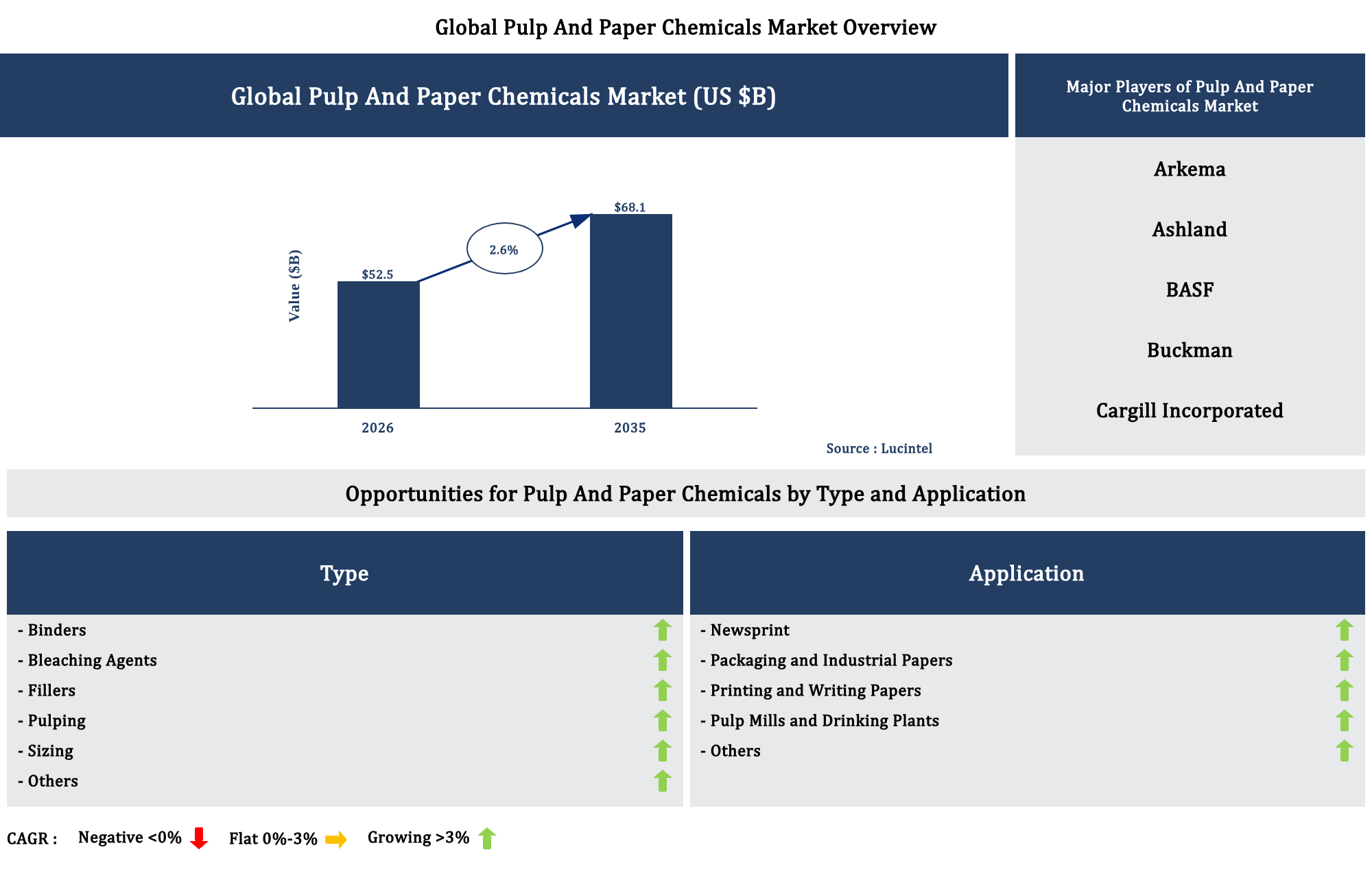
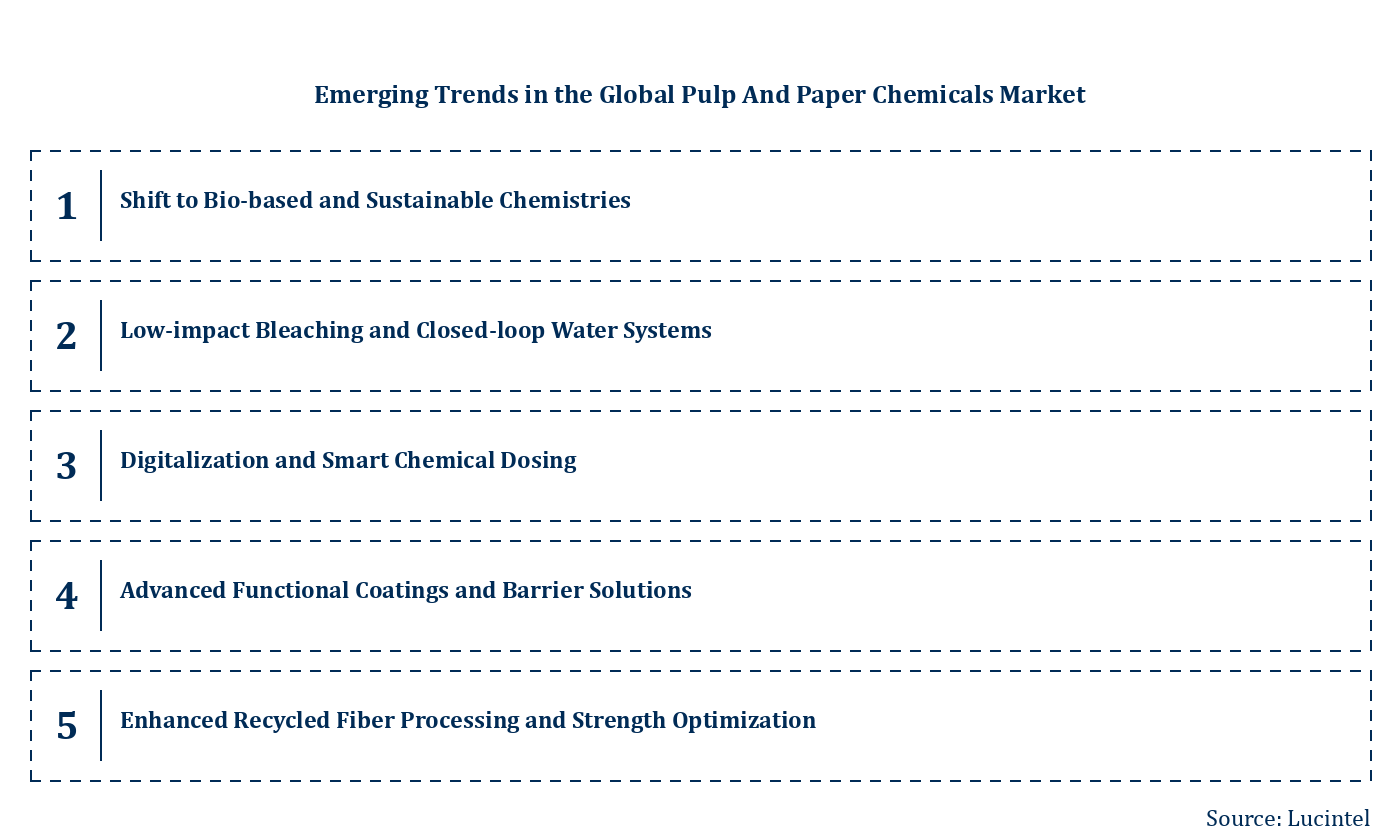
Emerging Trends in the Pulp And Paper Chemicals Market
The pulp and paper chemicals market is undergoing a structural shift as sustainability, digitalization, and performance optimization reshape production strategies worldwide. Stricter environmental regulations, changing consumer preferences, and cost pressures are driving mills to rethink chemical use, from pulping and bleaching to coating and wastewater treatment. Suppliers are responding with bio-based chemistries, process automation, and multifunctional additives that deliver better fiber utilization and reduced environmental impact. At the same time, advances in recycling, lightweight packaging, and barrier technologies are expanding the role of specialty chemicals. Together, these trends are redefining value creation across the global pulp and paper supply chain.
Recent Developments in the Pulp And Paper Chemicals Market
The pulp and paper chemicals market is undergoing notable transformation as producers respond to sustainability pressures, shifting fiber availability, and changing end-user expectations. Across the value chain, chemical suppliers are re-engineering portfolios to reduce environmental impact, enhance process efficiency, and enable higher-performance paper and packaging grades. Regulatory tightening on effluents and emissions, together with brand-owner commitments to circularity, are accelerating innovation in functional and process chemicals. At the same time, digitalization and advanced analytics are reshaping how chemicals are dosed, monitored, and optimized in mills. These recent developments are reshaping competitiveness, cost structures, and long-term growth prospects.
Strategic Growth Opportunities in the Pulp And Paper Chemicals Market
The pulp and paper chemicals market is evolving as producers seek higher efficiency, lower costs, and improved environmental performance across key applications. Chemical suppliers are innovating in areas such as pulping, bleaching, papermaking, and functional coatings to address stricter regulations, shifting customer expectations, and the rise of specialty grades. Growth opportunities center on advanced process aids, sustainable chemistries, performance enhancement, and circular economy solutions. By aligning portfolios with high value applications such as packaging, tissue, and graphical papers, companies can capture premium margins, deepen customer partnerships, and differentiate in a highly competitive global marketplace.
Pulp And Paper Chemicals Market Drivers and Challenges
The global pulp and paper chemicals market is shaped by a multifaceted mix of technological, economic, and regulatory forces. Demand for higher-quality paper products, the shift toward sustainable manufacturing, and productivity-focused process innovations are all pivotal growth engines. At the same time, volatile raw material prices, environmental regulations, and shifting end‑use patterns create structural headwinds. Market participants must continually upgrade formulations, optimize costs, and comply with tightening standards while supporting digitalization and circular economy goals. Understanding how these drivers and challenges interact is critical for producers, distributors, and paper manufacturers seeking resilient, long‑term growth.
The factors responsible for driving the pulp and paper chemicals market include:
The challenges in the pulp and paper chemicals market are:
The global pulp and paper chemicals market is simultaneously propelled by quality requirements, growth in packaging and tissue, efficiency needs, sustainability imperatives, and technological progress, while constrained by input volatility, regulatory tightening, and structural shifts in paper consumption. These opposing forces create a landscape where scale, technical expertise, and innovation capabilities determine competitive advantage. Suppliers that can deliver high‑performance, compliant, and cost‑effective solutions, supported by data-driven service models, are best positioned to thrive. Conversely, players unable to adapt face margin erosion and shrinking relevance as customers consolidate suppliers and demand more integrated, outcome‑oriented partnerships.
List of Pulp And Paper Chemicals Market Companies
Companies in the market compete on the basis of product quality offered. Major players in this market focus on expanding their manufacturing facilities, R&D investments, infrastructural development, and leverage integration opportunities across the value chain. Through these strategies pulp and paper chemicals market companies cater increasing demand, ensure competitive effectiveness, develop innovative products & technologies, reduce production costs, and expand their customer base. Some of the pulp and paper chemicals market companies profiled in this report include-
Pulp And Paper Chemicals Market by Segment
The study includes a forecast for the global pulp and paper chemicals market by type, application, and region.
Country Wise Outlook for the Pulp And Paper Chemicals Market
The pulp and paper chemicals market is undergoing a period of transformation as producers respond to tightening environmental regulations, shifting demand patterns, and the push for higher resource efficiency. Across major economies, chemical suppliers and mills are investing in advanced additives, biobased chemistries, and process optimization solutions that reduce water, energy, and carbon intensity while improving paper performance. Digitalization, circular economy targets, and growth in packaging and tissue grades are reshaping product portfolios and partnerships along the value chain. Recent developments in the United States, China, Germany, India, and Japan illustrate how regional priorities are driving differentiated innovation trajectories.
Features of the Pulp And Paper Chemicals Market
Article
Pulp And Paper Chemicals Market: Are New Chemistries Rewriting The Future Of Fiber-Based Materials?
Dallas, July 17, 2026 – The pulp and paper chemicals market is entering a decisive phase as sustainability pressures, digitalization, and new material science converge. Once viewed as a mature, slow-moving segment of the broader chemicals ecosystem, it is now being reshaped by bio-based additives, advanced process optimization, circular-economy business models, and cross-industry collaboration with technology players. These shifts are redefining how fiber is produced, processed, and functionalized for packaging, tissue, specialty papers, and increasingly for high-value technical applications across the technology industry.
How Are Sustainability And Regulatory Pressure Steering Innovation In Pulp And Paper Chemicals?
A central trend is the rapid pivot away from conventional chemistries—especially substances of concern such as certain fluorochemicals, formaldehyde-releasing agents, and some optical brighteners—toward safer, more sustainable alternatives. Regulators are tightening rules around effluents, carbon emissions, and persistent pollutants, while major brand owners and retailers are demanding low-toxicity, low-carbon packaging and paper solutions across global supply chains. Chemical producers are responding with bio-based sizing agents, enzymatic bleaching aids, low-volatile organic compound (VOC) coatings, and water-based barrier systems that aim to match or surpass the performance of legacy products.
This sustainability-led innovation is expected to have strongest impact in packaging, tissue, and food-contact applications where environmental scrutiny and consumer visibility are highest. Fiber-based packaging for e-commerce and consumer goods is becoming a priority testbed for bio-based barriers, recyclable coatings, and plastic-replacement chemistries. The shift is disruptive because it challenges incumbent suppliers, alters cost structures, and accelerates reformulation efforts at paper mills, prompting new alliances between chemical companies, converters, and brand owners.
Which Performance-Enhancing Trends Are Transforming Mill Operations And Cost Structures?
Another key trend is the focus on chemistry that improves fiber yield, machine productivity, and resource efficiency. Mills are under concurrent pressure to cut energy consumption, reduce water usage, and stabilize quality despite variable raw material inputs, including increased use of recycled fiber and alternative non-wood fibers. To address this, suppliers are rolling out higher-performance retention and drainage aids, smart defoamers, advanced wet- and dry-strength resins, and multi-functional additives that reduce the number of individual products needed in the wet end.
Markets with high energy and water costs, as well as those heavily dependent on recycled fiber, are likely to see the most immediate benefits. Containerboard, corrugating medium, and newsprint producers are testing chemistries that enable faster machine speeds, better formation, and reduced downtime, while tissue manufacturers are adopting softening and strength systems that balance bulk, softness, and absorbency at lower basis weights. This performance-driven innovation is reshaping procurement decisions and enabling mills to reposition themselves competitively against alternative materials such as plastics and flexible laminates.
Why Is Digitalization Emerging As A Strategic Lever In Pulp And Paper Chemicals?
The integration of digital tools with chemical programs is steadily redefining service models in the pulp and paper chemicals market. Advanced process monitoring, machine learning-driven dosage optimization, and predictive modeling of chemical interactions along the production line are turning chemicals from commodity inputs into data-enabled performance packages. Leading suppliers are investing in digital twins of mill processes, cloud-based monitoring platforms, and remote optimization capabilities, often in collaboration with industrial automation and analytics firms.
These digital-chemistry solutions particularly benefit large integrated mills, multi-mill groups, and producers with complex product portfolios that require tight quality specifications. By correlating real-time process data with chemical usage, mills are fine-tuning dosage to reduce waste, prevent deposits and scaling, and narrow quality variability. This trend is disrupting traditional sales and service relationships, shifting value from pure volume of chemicals supplied toward outcome-based contracts linked to productivity, quality, and sustainability metrics.
How Are Barrier And Functional Coatings Redefining Market Boundaries?
Rising demand for fiber-based alternatives to plastics is catalyzing intense innovation in barrier and functional coatings. Suppliers are developing water-based dispersions, bio-based polymers, nanocellulose-enhanced layers, and hybrid chemistries that deliver moisture, grease, oxygen, and vapor barriers while preserving recyclability and compostability. This is moving the pulp and paper chemicals market closer to the domains of packaging films, flexible packaging, and even electronics substrates.
High-growth impact is anticipated in folding boxboard, foodservice packaging, and specialty technical papers, where the market is seeking to replace polyethene extrusion coatings and per- and polyfluoroalkyl substance (PFAS) barriers. As these new coating systems scale, they may substantially disrupt both traditional packaging value chains and polymer suppliers, prompting strategic partnerships between paper producers, chemical innovators, technology companies, and consumer-goods brands aiming to launch differentiated, sustainable packaging portfolios.
Where Do Technology Industry Use Cases Create New Demand For Pulp And Paper Chemicals?
The technology industry is emerging as a surprisingly important driver of specialty demand in the pulp and paper chemicals space. Beyond conventional applications such as printing grades for marketing collateral or instructions, several new use cases are shaping requirements for high-performance fiber-based materials and chemistries.
What Key Challenges Could Slow The Trajectory Of Market Transformation?
Despite rising momentum, the pulp and paper chemicals market faces multiple structural and operational challenges that could moderate or delay the adoption of new solutions. Economic cyclicality, overcapacity in certain paper grades, and volatile raw material costs continue to pressure margins for both mills and chemical suppliers. Capital-intensive mill upgrades needed to fully exploit advanced chemistries and digital capabilities can be difficult to justify in a low-margin, price-sensitive environment.
Another major challenge stems from regulatory uncertainty and differences in regional standards for chemicals, recyclability, and food-contact safety. Fragmentation complicates global product harmonization and increases development costs. Additionally, the shift toward bio-based and specialty products can strain supply chains for biomass feedstocks and competing uses such as biofuels and bioplastics. Talent and expertise gaps, especially at the intersection of data science, process engineering, and chemistry, may also slow the pace at which mills adopt sophisticated digital-chemical solutions.
Where Do The Most Attractive Opportunities Emerge For Stakeholders?
Even as these challenges persist, the opportunity landscape is broadening. Chemical companies that can deliver integrated portfolios combining sustainable products, process expertise, and digital optimization are well positioned to capture share and command premium pricing in strategic segments. Collaborations with technology companies, packaging designers, and brand owners open pathways for co-created solutions that move beyond transactional chemical supply toward long-term innovation partnerships.
Major upside is visible in high-growth packaging and tissue markets, but also in niche specialty papers serving batteries, filtration, and printed electronics. Players that build capabilities in life-cycle analysis, eco-design, and circular business models can become key enablers of corporate sustainability strategies, particularly for large consumer brands and tech manufacturers under intense investor and consumer scrutiny. Furthermore, emerging markets with rapidly expanding e-commerce and urban populations may adopt advanced chemistries and process controls to leapfrog legacy technologies and build more efficient, sustainable mill fleets from the outset.
What Recent Developments Signal The Direction Of The pulp and paper chemicals market?
Recent developments underscore how quickly the market is evolving, with activity clustered around sustainability, digitalization, and specialty applications. Major chemical producers have launched new bio-based sizing agents and strength resins derived from renewable raw materials, explicitly targeted at improving recyclability and reducing carbon footprints. Several suppliers have introduced PFAS-free oil and grease barrier systems for food packaging and foodservice items, already being trialed by converters serving global quick-service restaurant chains.
On the digital front, leading vendors have expanded their smart service platforms to integrate machine learning, real-time sensor data, and remote technical support for mills. Multi-year contracts are being signed that link chemical supply agreements to performance indicators such as reduced freshwater intake, improved fiber retention, and fewer unplanned shutdowns, signaling a shift toward outcome-based commercial models.
Alliances between pulp and paper chemical providers and technology sector companies are also emerging around advanced packaging for electronics, smart labeling, and battery materials. These collaborations often involve joint development of new coating chemistries, substrate treatments, and process control tools that ensure compatibility with sensitive electronic components and demanding performance specifications.
Strategic Implications: How Should Market Participants Position Themselves For The Next Cycle?
The transformation of the pulp and paper chemicals market reveals a sector moving away from commoditization and toward differentiated, solution-oriented value propositions. Market participants that emphasize innovation portfolios aligned with sustainability regulations, invest in digital capabilities to quantify and guarantee performance, and forge partnerships across the value chain will be better prepared for the next investment cycle. Technology industry demand, particularly in high-performance packaging and specialty substrates, will reinforce this dynamic and open new revenue streams for agile players.
As fiber-based materials compete more directly with plastics, foams, and films, chemical innovation will be central to determining which mills and suppliers capture emerging growth. Companies that anticipate regulatory changes, build resilient feedstock supply chains, and quantify their impact in terms of carbon, water, and recyclability will hold a strategic edge. The market for pulp and paper chemicals is therefore not only responding to disruption but actively shaping how sustainable materials and advanced manufacturing will develop in the coming decade.
Top 5 Companies
1. Arkema
Arkema is a global specialty materials company headquartered in Colombes, France, formed in 2004 following the reorganization of Total’s chemicals business. The company employs more than 21,000 people and operates in over 55 countries across Europe, North America, Asia Pacific, and Latin America. Within the pulp and paper chemicals market, Arkema offers a broad portfolio that includes sizing agents, waterborne binders, rheology modifiers, dispersants, biocides, defoamers, and process chemicals designed to enhance paper strength, printability, and runnability. Its solutions support packaging papers, tissue, specialty papers, and board grades, with strong focus on reduced energy consumption and lower environmental impact. Arkema has expanded its presence in North America and Asia through investments in acrylics, waterborne additives, and bio-based performance products that are increasingly adopted by pulp and paper mills targeting sustainable production. The company’s acquisitions in adhesives, waterborne resins, and performance additives, such as Bostik and various niche additives businesses, have strengthened its integrated offering to paper and packaging customers. Arkema works closely with paper producers to tailor chemical packages for wet-end optimization, deposit control, and surface treatment, supporting both virgin-fiber and recycled-fiber applications. Through its innovation centers, Arkema actively develops low-VOC, APEO-free, and bio-sourced chemistries aligned with tightening environmental regulations and brand-owner sustainability commitments in the global pulp and paper value chain.
2. Ashland
Ashland is a global specialty chemicals company headquartered in Wilmington, Delaware, USA, with origins dating back to 1924. The company employs several thousand people and serves customers in more than 100 countries, with manufacturing and technical centers across North America, Europe, Asia, and Latin America. In the pulp and paper chemicals market, Ashland is recognized for its strong portfolio of specialty additives, including water-soluble polymers, rheology modifiers, coating binders, surface sizes, barrier coatings, and functional additives that improve strength, print performance, and converting efficiency. Ashland’s chemistries are widely used in printing and writing grades, packaging and board, tissue and towel, and specialty papers, with particular expertise in coating and surface treatment formulations. The company has reinforced its geographic presence in high-growth regions such as Asia Pacific and Latin America via upgrades to application labs and collaboration centers that support local paper mills with customized formulations. Its strategic repositioning toward specialty ingredients has focused resources on higher-value paper solutions like barrier and oil‑ and grease‑resistant coatings for food packaging and e‑commerce board. Ashland has engaged in portfolio streamlining and divestments to concentrate on high-margin businesses while selectively investing in innovation and customer technical service for paper chemicals. Through close collaboration with mills and OEMs, Ashland supports customers’ transitions to lightweighting, increased recycled content, and reduced fossil‑based plastics, positioning the company as a key partner in sustainable pulp and paper performance solutions.
3. BASF
BASF, headquartered in Ludwigshafen, Germany and founded in 1865, is one of the world’s largest chemical companies, employing more than 110,000 people and operating production sites and R&D centers in over 90 countries. BASF is a leading supplier of chemicals to the global pulp and paper industry through a comprehensive portfolio that covers process chemicals, functional chemicals, and surface solutions. Its offerings include retention and drainage aids, wet‑ and dry‑strength resins, sizing agents, coating binders, dispersants, defoamers, deposit control agents, and optical brightening agents used across printing and writing papers, tissue, packaging, board, and specialty grades. BASF has a particularly strong presence in Europe, North America, and Asia Pacific, supported by a large technical service network and application labs located close to major paper-producing regions. The company has reoriented parts of its business toward sustainable solutions, focusing on water-based, low-VOC, and resource-efficient chemistries for paper and board. In recent years, BASF has rationalized and reshaped its paper chemicals portfolio, including strategic divestments and partnerships, while continuing to invest in innovations that support higher machine efficiency, improved fiber utilization, and higher recycled content. Its global manufacturing footprint and integrated Verbund sites provide reliable supply and logistics advantages to pulp and paper customers. Through its expertise in polymers, surfactants, and performance additives, BASF remains a key technology partner to mills seeking productivity gains, better product quality, and environmental performance in the pulp and paper chemicals market.
4. Buckman
Buckman is a privately held, specialty chemicals company headquartered in Memphis, Tennessee, USA, founded in 1945. The company employs several thousand people and operates in more than 90 countries through manufacturing sites, sales offices, and technical service teams across North America, Latin America, Europe, Asia, and Africa. Buckman is highly focused on the pulp and paper chemicals market and is widely recognized for its deep process expertise in pulp mills, tissue machines, packaging and board, and printing and writing paper production. Its portfolio spans microbiological control agents, deposit control and cleaning technologies, sizing and strength additives, felt and fabric conditioners, enzymatic solutions, and a wide range of process aids that improve runnability, yield, and water and energy efficiency. Buckman’s strong field‑service model embeds technical experts at mills to optimize chemical programs in real time, often integrating data-driven monitoring and digital tools. The company has expanded its geographic reach and capacity in key paper-producing regions, including Latin America and Asia, by strengthening local supply chains and technical centers. Buckman has undertaken targeted acquisitions and partnerships to broaden its enzymatic and digital capabilities in pulp and paper applications, further differentiating its offering. Sustainability is central to Buckman’s value proposition, with programs designed to reduce freshwater use, improve fiber recovery, and lower the environmental footprint of paper production. Its close collaboration with customers and sharply focused industry expertise make Buckman a prominent specialized player in the global pulp and paper chemicals space.
5. Cargill Incorporated
Cargill Incorporated, headquartered in Wayzata, Minnesota, USA and founded in 1865, is one of the world’s largest privately held corporations with operations in more than 70 countries and a global workforce of over 150,000 employees. While best known for agriculture, food, and commodity trading, Cargill is also an important supplier of bio-based ingredients and industrial starches that serve the pulp and paper chemicals market. Its portfolio for paper and packaging includes native and modified starches, cationic and oxidized grades, and specialty bio-based binders used for wet-end retention, surface sizing, coating, and strength development in packaging papers, tissue, and specialty boards. Cargill’s extensive sourcing and processing network for corn and other crops underpins reliable, large-scale supply of starch derivatives to paper mills globally, with manufacturing and application centers across North America, Europe, Asia, and Latin America. The company has increased its focus on sustainable, renewable raw materials and traceable supply chains, aligning well with the pulp and paper industry’s shift toward bio-based and recyclable packaging solutions. Recent investments in starch modification capacity and technical application labs in Europe and Asia have strengthened Cargill’s geographic reach and its ability to co-develop tailored formulations with regional paper producers. Through selective acquisitions and joint ventures in bioindustrial and specialty ingredients, Cargill continues to broaden its portfolio of plant-based functional additives for paper and board. Its combination of agricultural integration, bio-based chemistry, and global logistics positions Cargill as a key partner to pulp and paper producers seeking renewable alternatives to petrochemical-based performance additives.
Table of Contents
List of Figures
List of Tables
Methodology
Lucintel has been in the business of market research and management consulting since 2000 and has published over 1000 market intelligence reports in various markets / applications and served over 1,000 clients worldwide. This study is a culmination of four months of full-time effort performed by Lucintel's analyst team. The analysts used the following sources for the creation and completion of this valuable report:
- In-depth interviews of the major players in this market
- Detailed secondary research from competitors' financial statements and published data
- Extensive searches of published works, market, and database information pertaining to industry news, company press releases, and customer intentions
- A compilation of the experiences, judgments, and insights of Lucintel's professionals, who have analyzed and tracked this market over the years.
Extensive research and interviews are conducted across the supply chain of this market to estimate market share, market size, trends, drivers, challenges, and forecasts. Below is a brief summary of the primary interviews that were conducted by job function for this report.

Thus, Lucintel compiles vast amounts of data from numerous sources, validates the integrity of that data, and performs a comprehensive analysis. Lucintel then organizes the data, its findings, and insights into a concise report designed to support the strategic decision-making process. The figure below is a graphical representation of Lucintel's research process.

Buy Now
Choose a license that fits your team. Instant PDF delivery.
Prices exclude taxes. Instant delivery. Custom licensing available on request.
Frequently Asked Questions
What is the Pulp And Paper Chemicals Market size?
What is the growth forecast for Pulp And Paper Chemicals Market?
What are the major drivers influencing the growth of the Pulp And Paper Chemicals Market?
What are the major segments for Pulp And Paper Chemicals Market?
Who are the key Pulp And Paper Chemicals Market companies?
Which Pulp And Paper Chemicals Market segment will be the largest in future?
In Pulp And Paper Chemicals Market, which region is expected to be the largest in next 9 years?
Do we receive customization in this report?
Key Questions
- • What are some of the most promising, high-growth opportunities for the Pulp And Paper Chemicals Market by Type (Binders, Bleaching Agents, Fillers, Pulping, Sizing, and Others), Application (Newsprint, Packaging and Industrial Papers, Printing and Writing Papers, Pulp Mills and Drinking Plants, and Others), and region (North America, Europe, Asia Pacific, and the Rest of the World)?
- • Which segments will grow at a faster pace and why?
- • Which region will grow at a faster pace and why?
- • What are the key factors affecting market dynamics? What are the key challenges and business risks in this market?
- • What are the business risks and competitive threats in this market?
- • What are the emerging trends in this market and the reasons behind them?
- • What are some of the changing demands of customers in the market?
- • What are the new developments in the market? Which companies are leading these developments?
- • Who are the major players in this market? What strategic initiatives are key players pursuing for business growth?
- • What are some of the competing products in this market and how big of a threat do they pose for loss of market share by material or product substitution?
- • What M&A activity has occurred in the last 9 years, and what has its impact been on the industry?


