
Market Report · July 22, 2026

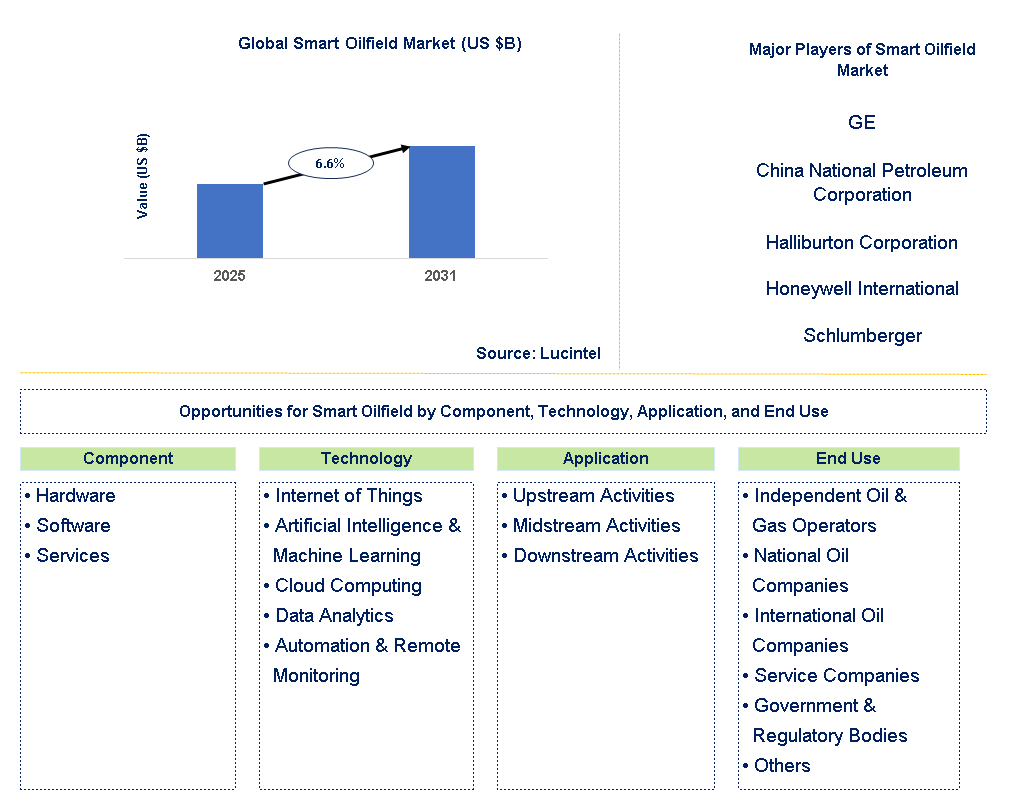
Key data points: The growth forecast = 6.6% annually for the next 7 years. Scroll below to get more insights. This market report covers trends, opportunities and forecasts in smart oilfield market to 2031 by component (hardware, software, and services), technology (internet of things, artificial intelligence & machine learning, cloud computing, data analytics, and automation & remote monitoring), application (upstream activities, midstream activities, and downstream activities), end use (independent oil & gas operators, national oil companies, international oil companies, service companies, government & regulatory bodies, and others), and region (North America, Europe, Asia Pacific, and the Rest of the World)
We'll send your sample report shortly.
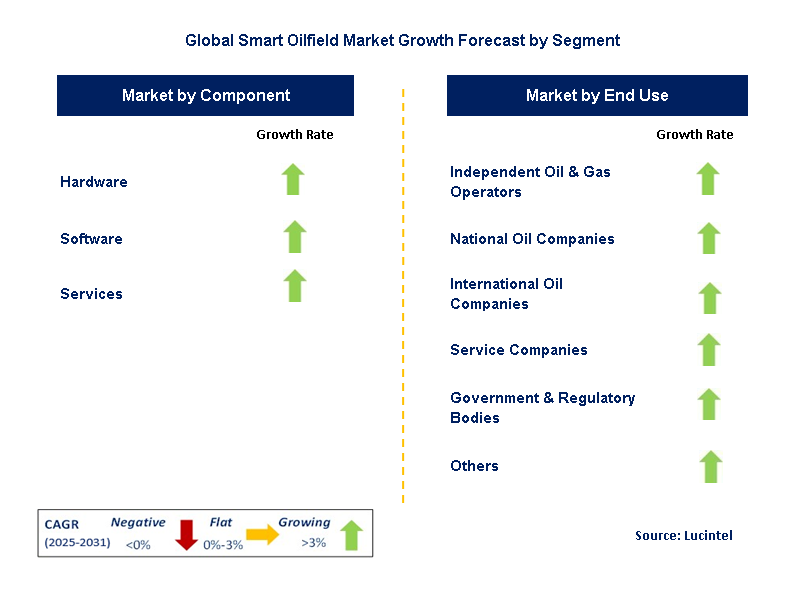
• Lucintel forecasts that, within the component category, hardware is expected to witness the highest growth over the forecast period.
• Within the end use category, international oil company is expected to witness the highest growth.
• In terms of region, APAC is expected to witness the highest growth over the forecast period. Gain valuable insights for your business decisions with our comprehensive 150+ page report. Sample figures with some insights are shown below.
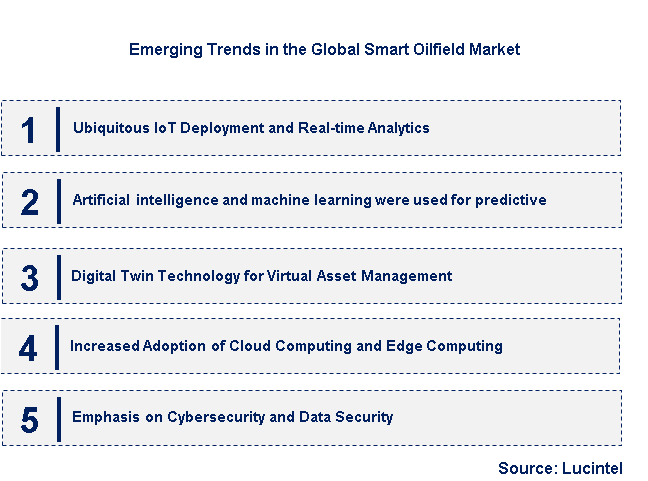
• Ubiquitous IoT Deployment and Real-time Analytics: The use of Internet of Things (IoT) sensors and networked devices is becoming pervasive throughout oilfield operations, from downhole sensors to surface facilities. These devices capture enormous amounts of real-time data on parameters such as pressure, temperature, flow rates, and equipment health. This data is subsequently input into sophisticated analytics platforms to yield instantaneous insights.
• Artificial intelligence and machine learning were used for predictive: Artificial intelligence (AI) and machine learning (ML) algorithms are being used more and more to analyze the gigantic datasets created by intelligent oilfields. These technologies find applications in predictive maintenance, reservoir modeling, drilling optimization, and even anomaly detection in complicated operational settings. AI-based insights make forecasting more precise and make adjustments automatically.
• Digital Twin Technology for Virtual Asset Management: Digital twin technology involves creating virtual replicas of physical oilfield assets, processes, or entire systems. These digital models are continuously updated with real-time data from sensors, allowing for simulations, performance analysis, and predictive modeling in a virtual environment. This enables scenario planning and optimization without physical intervention.
• Increased Adoption of Cloud Computing and Edge Computing: The volume of data that smart oilfields generate requires heavy-duty computing infrastructure. Scalable storage and processing capacity are offered through cloud computing, along with remote access and collaboration, whereas edge computing facilitates real-time processing of data at the point of origin. This combined strategy maximizes data flow and minimizes latency.
• Emphasis on Cybersecurity and Data Security: An emerging trend is the increased focus on robust cybersecurity measures and data encryption protocols to protect sensitive operational data and critical infrastructure, preventing cyberattacks against both operational integrity and data privacy. With oilfield operations becoming increasingly digitized and connected, the very real risk of cyber threat increases. These emerging trends are fundamentally reshaping the smart oilfield market by driving a complete digital transformation across the oil and gas industry. They are enabling operators to move from traditional, reactive approaches to proactive, data-driven strategies, leading to unprecedented levels of operational efficiency, cost reduction, and safety. The market is going towards highly interconnected, intelligent, and autonomous systems that are critical for maximizing recovery from mature fields and navigating the complexities of modern energy production.
• Advanced Sensor Technology and IoT Deployment: A major trend is the spread of sophisticated sensor technologies in conjunction with extensive Internet of Things (IoT) implementation throughout oilfield assets. The sensors capture real-time data on essential parameters such as pressure, temperature, flow rates, vibration, and equipment integrity. This is sent wirelessly for instantaneous analysis.
• AI and Machine Learning: Predictive Analytics and Optimization: AI and ML algorithms are transforming the way data is interpreted in smart oilfields. These technologies analyze massive amounts of sensor data to find patterns that can predict equipment failure, optimize drilling trajectories, and improve reservoir characterization. These AI-driven models give more accurate predictions and expedite decision-making.
• Digital Twin for Improved Asset Management and Simulation: The development of digital twins, virtual representations of physical oilfield assets and operations, is revolutionary. They are digital models that are updated continuously with real-time information from their physical counterparts, enabling them to be subject to complete simulations, performance monitoring, and scenario planning in a virtual world.
• Remote Operations and Autonomous Systems: Recent trends involve a significant emphasis on remote operation and the use of more autonomous systems. This includes the centralization of control centers, utilizing high-bandwidth communications networks, and robotic solutions to jobs in hostile or distant locales. Inspection drones and autonomous drilling platforms are now more popular.
• Cybersecurity and Data Governance: In an increasingly networked smart oilfield ecosystem, there is a more recognized and intense investment in rigorous cybersecurity measures and comprehensive data governance frameworks. Advanced encryption and intrusion detection systems and strict access controls are called for in protecting sensitive operational data against cyber-attacks on critical infrastructure. These developments are cumulatively impacting the smart oilfield market by driving a comprehensive digital transformation that emphasizes efficiency, safety, and data-driven decision-making. It allows the operator to leverage maximum value from their assets, reduce operational costs, and decrease exposure to environmental and regulatory risks. The smart oilfield market is becoming more automated, intelligent, and networked, which are highly necessary to face the complexities and challenges involved in modern oil and gas exploration and production.
• Drilling Optimization and Automation: One of the key opportunities for growth is in offering advanced smart solutions for drilling optimization. This comprises AI-based algorithms for real-time well planning, automated drilling units that modify parameters in real time, and predictive analytics for drill bit performance and wellbore stability. The aim is to shorten drilling time, decrease non-productive time, and improve drilling accuracy.
• Production Optimization and Asset Performance Management: Maximizing continuing production and maintaining maximum asset performance is an ever-present growth opportunity. This includes using IoT sensors to continuously monitor wellhead performance, pumps, and pipelines and augmenting with AI-driven analytics for failure prediction, flow rate optimization, and artificial lift system management. It is also possible to address enhanced energy efficiency of production facilities.
• Reservoir Characterization and Management: Strategic opportunities for growth lie in creating intelligent solutions to improve reservoir characterization and dynamic management. This encompasses high-end seismic data processing with machine learning, real-time reservoir simulation, and data integration platforms that integrate geological, geophysical, and production data. The goal is to enhance the understanding of subsurface dynamics for maximum recovery.
• Safety and Environmental Monitoring: As regulatory oversight accelerates and corporate focus on ESG (Environmental, Social, and Governance) considerations grows, intelligent oilfield solutions for environmental monitoring and safety present an attractive growth prospect. These include real-time leakage detection platforms, predictive maintenance analytics against equipment failure to avoid spills, drone inspection, and remote emissions monitoring.
• Integrated Operations and Remote Collaboration: One key strategic play is in delivering end-to-end integrated operations platforms that integrate fragmented data sources and systems within the oilfield. Such solutions enable remote collaboration across distributed teams, real-time decision-making, remote operation control, and virtual training through AR/VR technologies. These strategic opportunities for growth are collectively transforming the smart oilfield market by inducing innovation and large-scale deployment of digital technologies throughout the entire value chain of hydrocarbons. They are driving a move towards more data-centric, automated, and sustainable operations, contributing to better efficiency, lower costs, and better safety and environmental performance. The market is transforming into a more integrated and intelligent system, which is key to efficiently and responsibly addressing the world’s energy needs.
• GE
• China National Petroleum Corporation
• Halliburton Corporation
• Honeywell International
• Schlumberger
• Accenture
• Kongsberg Gruppen
• Microseismic
• National Oilwell Varco
• Paradigm
• Hardware
• Software
• Services
• Internet of Things
• Artificial Intelligence & Machine Learning
• Cloud Computing
• Data Analytics
• Automation & Remote Monitoring
• Upstream Activities
• Midstream Activities
• Downstream Activities
• Independent Oil & Gas Operators
• National Oil Companies
• International Oil Companies
• Service Companies
• Government & Regulatory Bodies
• Others
• North America
• Europe
• Asia Pacific
• The Rest of the World
• United States: The United States smart oilfield market is at the forefront of digitalization, marked by heavy investment in high-tech technology. Recent advances witness a clear emphasis on combining AI and machine learning to optimize drilling as well as oil recovery. Collaborations between technology companies and large oil and gas corporations are growing automated drilling solutions by harnessing combined technologies for better well construction and efficiency. The major focus is on the application of statistical and analytical software to boost production from mature wells, lower operational risk, and optimize capital investment, especially in unconventional plays.
• China: China’s intelligent oilfield market is growing fast, with increasing emphasis on intelligent intervention technologies in well services. The latest trends point towards the exploitation of cutting-edge solutions in coiled tubing digitalization, coiled tubing drilling, and offshore. There is a concerted move to marry neural network technology with geophysical approaches to seismic exploration, developing large-scale AI models for increasing industry quality, reserves, and safety. Government incentives and the enormous local energy appetite are propelling significant innovations in smart oil and gas well engineering.
• Germany: Germany’s intelligent oilfield industry, although not a significant oil producer itself, makes a meaningful contribution through its technological expertise. Recent innovation is centered on creating and deploying advanced digital oilfield solutions that prioritize operational efficiency, predictive maintenance, and real-time monitoring. German firms lead the charge in cloud-based platforms that enable active monitoring of production processes while minimizing carbon emissions. Their solutions bank on sophisticated data analytics and automation to solve inefficiencies in manual production, looking to optimize resource extraction and hit exact production targets.
• India: India’s smart oilfield market is experiencing encouraging growth as the need to maximize the recovery of oilfields and boost efficiency from mature fields continues to grow. Recent advancements consist of an increasing deployment of intelligent oilfield solutions to eliminate downtime and increase profitability through integrated workflows. Businesses are more and more including sophisticated software, hardware, and data analysis methods to considerably increase exploration and production (E&P) efficiency. The constant rising need for energy and the depleting nature of easily accessible oil reserves are supporting the uptake of such intelligent solutions.
• Japan: Japan’s intelligent oilfield market is fueled mainly by its technological advancement and efforts to maximize the efficiency of its limited indigenous production and foreign investments. Recent trends point towards the use of IoT, automation, big data analytics, AI, and cloud computing for enhanced real-time monitoring and decision-making. Japanese companies are investing in smart oilfield technologies to lower operational expenses by means of better asset management, predictive maintenance, and less downtime. There is also increased interest in bringing renewable energy into the upstream business, with the help of smart oilfield systems.


• GE
• China National Petroleum Corporation
• Halliburton Corporation
• Honeywell International
• Schlumberger
• Accenture
• Kongsberg Gruppen
• Microseismic
• National Oilwell Varco
• Paradigm Q5. Which smart oilfield market segment will be the largest in future? Answer: Lucintel forecasts that, within the component category, hardware is expected to witness the highest growth over the forecast period. Q6. In smart oilfield market, which region is expected to be the largest in next 5 years? Answer: In terms of region, APAC is expected to witness the highest growth over the forecast period. Q7. Do we receive customization in this report? Answer: Yes, Lucintel provides 10% customization without any additional cost.


Choose a license that fits your team. Instant PDF delivery.
Prices exclude taxes. Instant delivery. Custom licensing available on request.
Market Report · July 22, 2026
Market Report · June 26, 2026
Market Report · May 18, 2026
Trusted partner for strategic intelligence and business growth


Receive a complimentary market analysis tailored to your industry. Our analysts will identify key growth opportunities and competitive dynamics specific to your business.

Market size, growth rate, and key trend analysis for your specific sector.

Top competitor positioning and market share analysis.

Strategic recommendations backed by data-driven insights.
Get curated market intelligence and competitive moves straight to your inbox.
By subscribing, you agree to receive our monthly insights. Unsubscribe anytime.
Receive a complimentary market analysis tailored to your industry. Our analysts will identify key growth opportunities and competitive dynamics specific to your business.
Market size, growth rate, and key trend analysis for your specific sector.
Top competitor positioning and market share analysis.
Strategic recommendations backed by data-driven insights.
Get curated market intelligence, emerging trends, and competitive moves straight to your inbox each month.
By subscribing, you agree to receive our monthly insights. Unsubscribe anytime.
We'll send your sample report shortly.