
Market Report · July 22, 2026

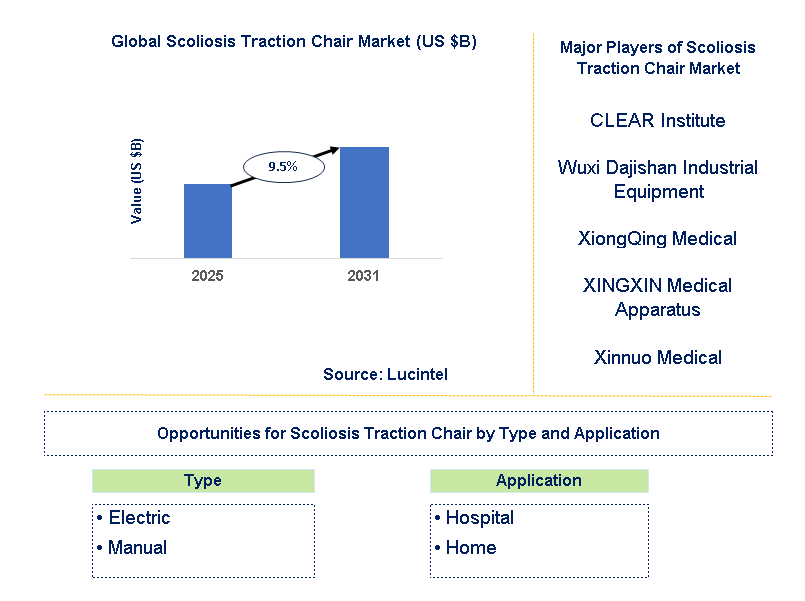
Key data points: The growth forecast = 9.5% annually for the next 7 years. Scroll below to get more insights. This market report covers trends, opportunities and forecasts in scoliosis traction chair market to 2031 by type (electric and manual), application (hospital and home), and region (North America, Europe, Asia Pacific, and the Rest of the World)
We'll send your sample report shortly.
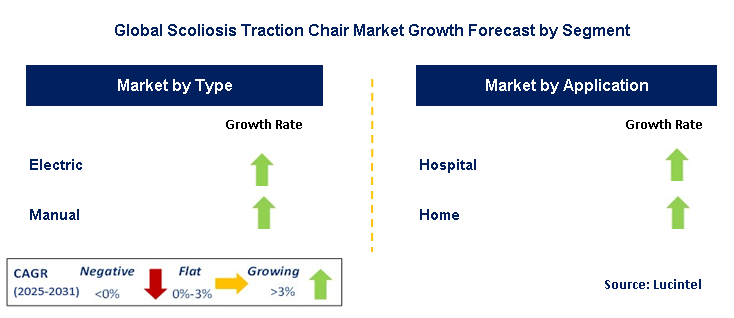
• Lucintel forecasts that, within the type category, electric is expected to witness higher growth over the forecast period.
• Within the application category, hospital is expected to witness higher growth.
• In terms of region, North America is expected to witness the highest growth over the forecast period. Gain valuable insights for your business decisions with our comprehensive 150+ page report. Sample figures with some insights are shown below.
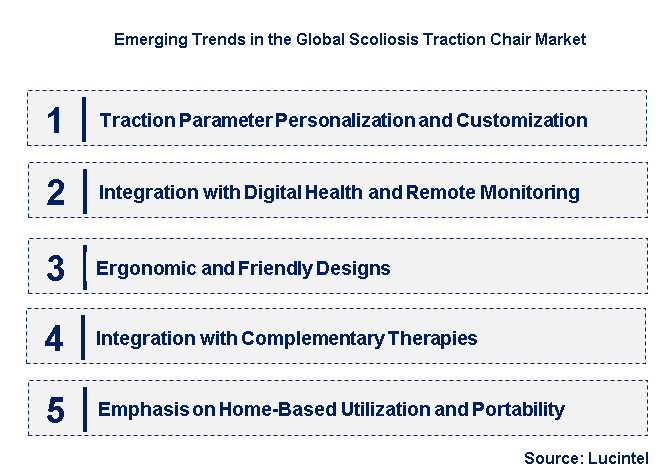
• Traction Parameter Personalization and Customization: A growing trend is the expanding capability for personalizing and customizing traction parameters such as force, angle, and duration on the basis of a specific patient's own spinal curvature and progression. This extends beyond a universal approach. The effect is maximizing the effectiveness of treatment by enabling therapists to deliver highly localized forces that address the patient's individual spinal deformity. Customized parameters can result in more efficient curve reduction, better spinal alignment, and increased patient comfort, ultimately leading to better outcomes.
• Integration with Digital Health and Remote Monitoring: The industry is experiencing a shift towards integrating scoliosis traction chairs with digital health platforms, wearable sensors, and remote monitoring functions. This enables real-time patient compliance tracking, treatment posture, and treatment progress. The effect is improving patient compliance and allowing healthcare professionals to remotely monitor and change the treatment plan. Such integration supports home-based therapy, increases access to treatment, and offers insightful data for unbiased determination of treatment outcomes, bridging the gap between home and clinic.
• Ergonomic and Friendly Designs: There is growing emphasis on creating scoliosis traction chairs with increased ergonomic benefits and user-friendly designs. This involves adjustable elements, cushioned comfort, and easy-to-use controls to enhance patient experience during therapy sessions. The effect is providing greater patient comfort and compliance, both of which are essential to the success of long-term rehabilitation. The ergonomic design reduces discomfort and makes the chairs more accessible to a broader population of patients, ranging from teenagers to adults, and allows for regular use.
• Integration with Complementary Therapies: The integration of using scoliosis traction chairs with other complementary non-surgical therapies, including selective exercises (e.g., Schott method), chiropractic adjustments, and physical therapy modalities, is a distinctive trend. The effect is creating a more holistic and integrative management of scoliosis, resulting in possibly improved and more sustainable correctional results. Integration of modalities capitalizes on the advantages of each, where the traction chair offers spinal elongation and decompression that has the potential to maximize the success of other corrective exercises.
• Emphasis on Home-Based Utilization and Portability: The market is seeing a move towards designing more portable, compact, and easy-to-store scoliosis traction chairs for home-based utilization. This enables patients to receive regular traction therapy outside a clinical environment. The effect is greatly enhancing convenience and accessibility for patients, decreasing the time and energy required for repeat clinic visits. Home application can help facilitate increased therapy consistency, speed up progress, and enable patients to become more active participants in their own ongoing spinal health care. These new trends are all coming together to transform the scoliosis traction chair market towards a more customized, technology-enabled, patient-focused, and comprehensive way of treating scoliosis. The emphasis on individualization, digital health, ergonomics, integrative therapy, and at-home use is making traction chairs more effective, convenient, and desirable as a non-surgical treatment for spinal curvature.
• Higher Customization and Adjustability: One of the major advances in recent times has been the introduction of scoliosis traction chairs with a much greater degree of customization and adjustability. This encompasses more accurate control of traction force, adjustable angles for particular curve types, and modularity that can be customized to each patient anthropometry. The effect is enabling therapists to deliver highly customized treatment protocols, optimizing the effectiveness of the traction by focusing on particular spinal segments and curve patterns. This results in more optimal results and patient adaptation.
• Incorporation of Real-Time Feedback Mechanisms: Advances have included the addition of real-time feedback mechanisms, for example, pressure sensors and digital indicators, into scoliosis traction chairs. These features provide immediate data on the applied force and patient posture during treatment. The impact is enabling both patients and practitioners to ensure correct usage and optimal therapeutic positioning. This data-driven approach enhances the safety and efficacy of the treatment, allowing for on-the-spot adjustments and better tracking of session-to-session consistency.
• Ergonomics and Patient Comfort Focus: There has been tremendous recent innovation in prioritizing the ergonomic design and overall patient comfort of scoliosis traction chairs. Companies are employing advanced padding technologies, breathable textiles, and contouring to enhance the patient experience during typically extended treatment sessions. The result is enhancing patient compliance and adherence to treatment plans, which is essential for delivering successful long-term outcomes. Ergonomic designs also make the treatment more bearable for younger patients, who might require extended use
• Emerging of Portable and Home-Based Models: Recent advancements reflect a trend towards smaller, lighter, and easier-to-transport scoliosis traction chairs for home use. Patients can thus add clinic-based therapy with periodic sessions at home. The effect is considerably boosting the accessibility and ease of scoliosis traction treatment. Home-use models encourage treatment consistency, minimize the weight of frequent clinic visits, and allow patients to take a more active role in their regular spinal health care.
• Research and Evidence-Based Application: There is growing recent advancement in the form of clinical studies and research comparing the effectiveness of scoliosis traction chairs, leading to an evidence-based method of application. This research assists in determining optimal treatment protocols and selection criteria for patients. The effect is establishing credibility for scoliosis traction chairs as a viable non-surgical treatment option and informing health professionals of best practices. This scientific confirmation serves to promote adoption and ensure integration into thorough scoliosis care plans. These new advances are together influencing the scoliosis traction chair market by pushing the direction of innovation toward more accurate, comfortable, accessible, and evidence-based therapeutic options. The emphasis on tailoring, real-time feedback, ergonomics, portability, and clinical efficacy is upgrading the function of traction chairs in the conservative treatment of scoliosis.
• Adolescent Idiopathic Scoliosis (AIS) Management: A primary strategic growth opportunity lies in the management of Adolescent Idiopathic Scoliosis (AIS), which is the most common form of scoliosis. Traction chairs are used as an adjuvant therapy to exercise regimens or bracing to assist in the reduction of curves and alignment of the spine during times of accelerated growth. The effect is treating a high volume of patients with a significant need for non-surgical interventions to stop curve advancement and possibly eliminate surgery. Manufacturers can address chairs that are tailored for adolescent comfort and effectiveness.
• Adult Degenerative Scoliosis Rehabilitation: There is a strong strategic growth potential in treating Adult Degenerative Scoliosis, which is commonly linked to aging, disc degeneration, and spinal instability. Traction chairs can provide relief from pain, enhance posture, and serve as a gentle decompression for spinal nerves. The effect is serving an aging population of people with spinal pain and functional restriction. This product is aimed at pain management, improving function, and retarding progression, providing a non-surgical and non-pharmacological solution for a common condition.
• Post-Surgical Spinal Fusion Rehabilitation and Support: Scoliosis traction chairs can identify a strategic growth niche in post-surgical spinal fusion rehabilitation. Although not for acute post-operative purposes, in later cases, very controlled traction can be beneficial in relaxing the muscles, enhancing spinal mechanics above or below the fusion, and overall spinal well-being. The effect is augmenting surgical results by assisting in long-term spinal alignment and diminishing compensatory stress. This specialty use provides a rehabilitative aid for sustaining surgical benefits and preventing adjacent segment disease.
• Integration in Chiropractic and Physical Therapy Clinics: There exists a large strategic growth potential in growing the use of scoliosis traction chairs among chiropractic and physical therapy clinics with a focus on spinal health. The chairs can be an integral part of a multi-modal treatment protocol combined with manual adjustments, targeted exercises, and postural retraining. The effect is offering clinicians a high-tech device to maximize treatment effectiveness, recruit additional scoliosis patients, and provide a full non-surgical care path. Training programs for these professionals can promote market penetration.
• Home-Based Therapy Programs with Remote Guidance: Creating and selling scoliosis traction chairs especially for home-based therapy, along with remote guidance and monitoring offerings, is an essential strategic growth area. This enables patients to conduct routine traction sessions under professional guidance without regular visits to the clinic. The effect is increasing market reach by providing convenience and accessibility, enhancing patient compliance, and lowering healthcare expenses. This model takes advantage of technology to take clinical care into the patient's everyday world, ensuring a more sustainable treatment. These growth opportunities are having a profound influence on the scoliosis traction chair market through expansion into various patient populations and clinics. Through targeting adolescent and adult scoliosis, post-operative support, professional use, and therapy in home settings, manufacturers and providers are able to release high market growth with increased traction chair involvement in total spinal care.
• CLEAR Institute
• Wuxi Dajishan Industrial Equipment
• XiongQing Medical
• XINGXIN Medical Apparatus
• Xinnuo Medical
• Pioneer Medical Equipment
• Shengchang Medical Equipment
• Electric
• Manual
• Hospital
• Home
• North America
• Europe
• Asia Pacific
• The Rest of the World
• United States: The American market for scoliosis traction chairs is a major innovator, with extensive focus on research and development by specialist institutions such as the CLEAR Scoliosis Institute, which was the originator of the idea. Recent advances involve improvement in chair design to provide improved patient customization, ergonomic comfort, and compatibility with other non-surgical treatments. There is also a drive for increased awareness and use of these chairs as an alternative or adjunct treatment to bracing, particularly for adolescent idiopathic scoliosis, a highly prevalent segment in the region.
• China: China's market for scoliosis traction chairs is in the growth stage, bolstered by a huge patient base, rising healthcare spending, and growing emphasis on non-invasive treatment modalities. Current developments show an increase in local producers creating more affordable and accessible traction chairs. Although classical practices prevail, there is a steady movement towards the inclusion of up-to-date rehabilitation equipment. The market is also experiencing attempts to promote wider awareness and professional education of healthcare professionals on the advantages and proper application of these chairs to address the high demand.
• Germany: The German scoliosis traction chair market prioritizes precision engineering and incorporation into an overall orthopedic and rehabilitation setup. The latest trends center on high-end, long-lasting traction chairs which can be easily integrated into physiotherapy and chiropractic centers. Though particular information regarding the innovation of traction chairs is less well-publicized than with bracing or surgical interventions, overall German practice is towards evidence-based non-surgical interventions, favoring ongoing use and development of such chairs as part of an integrative treatment strategy for spinal deformities.
• India: India's scoliosis traction chair industry is a burgeoning one, with rising awareness of scoliosis and an expanding need for affordable treatment options. Recent occurrences have seen the introduction of local manufacturers that offer more affordable chairs with adaptations suited to the local market. An emphasis on enhancing access in city centers and initial interest in incorporating these chairs into current physiotherapy and chiropractic services exists. Difficulties still exist in regard to broad awareness and sufficient qualified personnel, but the market has high potential for expansion.
• Japan: Japan's scoliosis traction chair market is influenced by its advanced healthcare infrastructure and a focus on non-invasive interventions, particularly for an aging population that may also experience adult-onset scoliosis. Recent developments involve incorporating advanced materials for lighter, more ergonomic designs and potential integration with digital monitoring tools for therapy adherence. Though less heavily promoted than bracing, the scoliosis traction chair is appreciated for its function in decompression and alignment of the spine as part of integrated rehabilitation protocols, an indicator of Japan's regard for precision and patient comfort.


• CLEAR Institute
• Wuxi Dajishan Industrial Equipment
• XiongQing Medical
• XINGXIN Medical Apparatus
• Xinnuo Medical
• Pioneer Medical Equipment
• Shengchang Medical Equipment Q5. Which scoliosis traction chair market segment will be the largest in future? Answer: Lucintel forecasts that, within the type category, electric is expected to witness higher growth over the forecast period. Q6. In scoliosis traction chair market, which region is expected to be the largest in next 5 years? Answer: In terms of region, North America is expected to witness the highest growth over the forecast period. Q7. Do we receive customization in this report? Answer: Yes, Lucintel provides 10% customization without any additional cost.


Choose a license that fits your team. Instant PDF delivery.
Prices exclude taxes. Instant delivery. Custom licensing available on request.
Market Report · July 22, 2026
Market Report · July 22, 2026
Market Report · July 22, 2026
Trusted partner for strategic intelligence and business growth


Receive a complimentary market analysis tailored to your industry. Our analysts will identify key growth opportunities and competitive dynamics specific to your business.

Market size, growth rate, and key trend analysis for your specific sector.

Top competitor positioning and market share analysis.

Strategic recommendations backed by data-driven insights.
Get curated market intelligence and competitive moves straight to your inbox.
By subscribing, you agree to receive our monthly insights. Unsubscribe anytime.
Receive a complimentary market analysis tailored to your industry. Our analysts will identify key growth opportunities and competitive dynamics specific to your business.
Market size, growth rate, and key trend analysis for your specific sector.
Top competitor positioning and market share analysis.
Strategic recommendations backed by data-driven insights.
Get curated market intelligence, emerging trends, and competitive moves straight to your inbox each month.
By subscribing, you agree to receive our monthly insights. Unsubscribe anytime.
We'll send your sample report shortly.