
Market Report · May 18, 2026

This market report covers trends, opportunities, and forecasts in the global quick charge integrated circuit market to 2031 by technology (charging protocols, integration level, and semiconductor material), end use industry (aftermarket parts & services and oems), and region (North America, Europe, Asia Pacific, and the Rest of the World)
We'll send your sample report shortly.
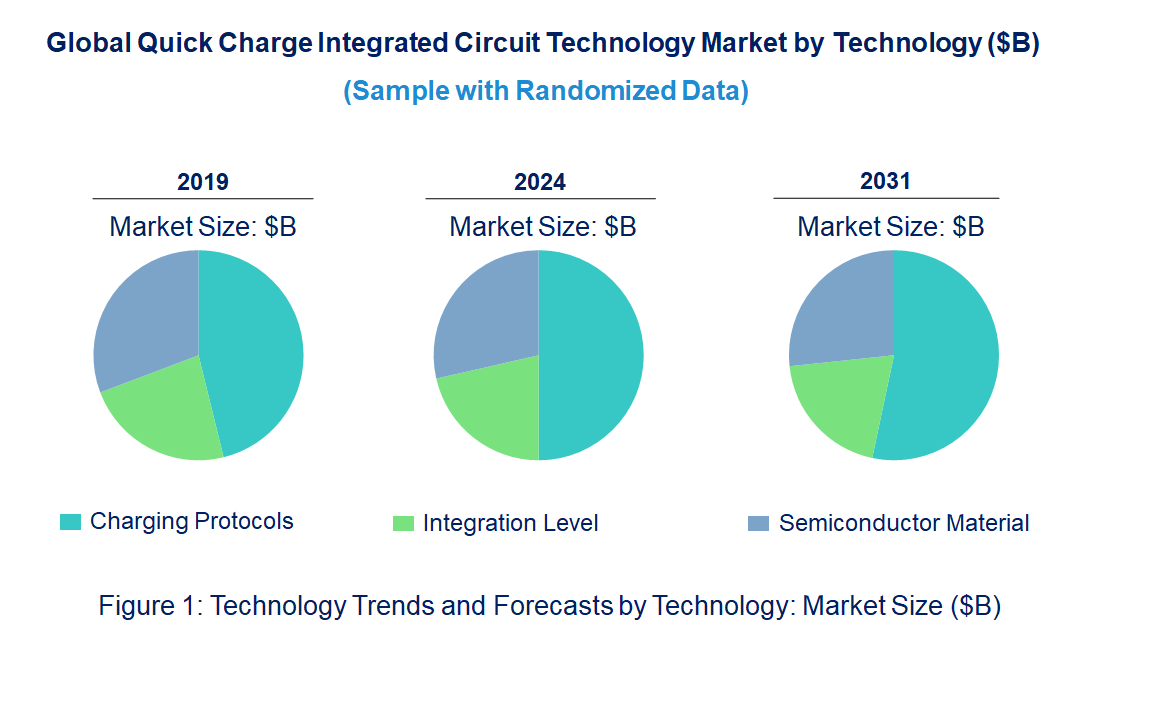
![Quick Charge Integrated Circuit Market Trend and Forecast by End Use Industry [Value from 2019 to 2031]:](https://lucintel.com/images/Quick-Charge-Integrated-Circuit-Technology-Market-Segment.png "Quick Charge Integrated Circuit Market Trend and Forecast by End Use Industry [Value from 2019 to 2031]:")
• Wide Bandgap Semiconductors: The most significant trend is the shift from traditional silicon-based semiconductors to wide bandgap semiconductors, such as Gallium Nitride (GaN). These materials provide faster charging speeds, higher power densities, and better heat management, thus improving the performance of charging circuits.
• Multi-Port Charging Solutions Integration: Multi-port charging solutions are fast becoming the most sought-after consumer requirement because of their efficiency and versatility. These integrated circuits can charge several devices at the same time, including smartphones, laptops, and electric vehicles, making them suitable for both commercial and domestic applications.
• Emergence of USB Power Delivery (USB-PD) Protocol: USB Power Delivery is gaining prominence as a standard for fast charging as it allows the delivery of higher power levels across different types of devices. This protocol is rapidly gaining popularity in consumer electronics, especially among laptops, smartphones, and tablets.
• Improved Thermal Management and Efficiency: As devices increase in power, effective heat management becomes a key factor. New ICs are designed with enhanced thermal management to ensure efficiency without overheating during fast charging. This is important to boost both the performance and longevity of devices.
• Electric Vehicle Charging Solutions: The demand for advanced quick charge ICs is being driven by the electric vehicle market. Manufacturers are developing specialized charging solutions that can handle the higher power requirements of electric vehicles, promoting faster and more efficient charging for these applications. New developments are transforming the quick charge integrated circuit market, with innovations such as wide bandgap semiconductors, multi-port charging solutions, and enhanced thermal management technologies. These advancements are enabling faster, more efficient, and flexible charging solutions, driving growth and expansion in multiple industries.
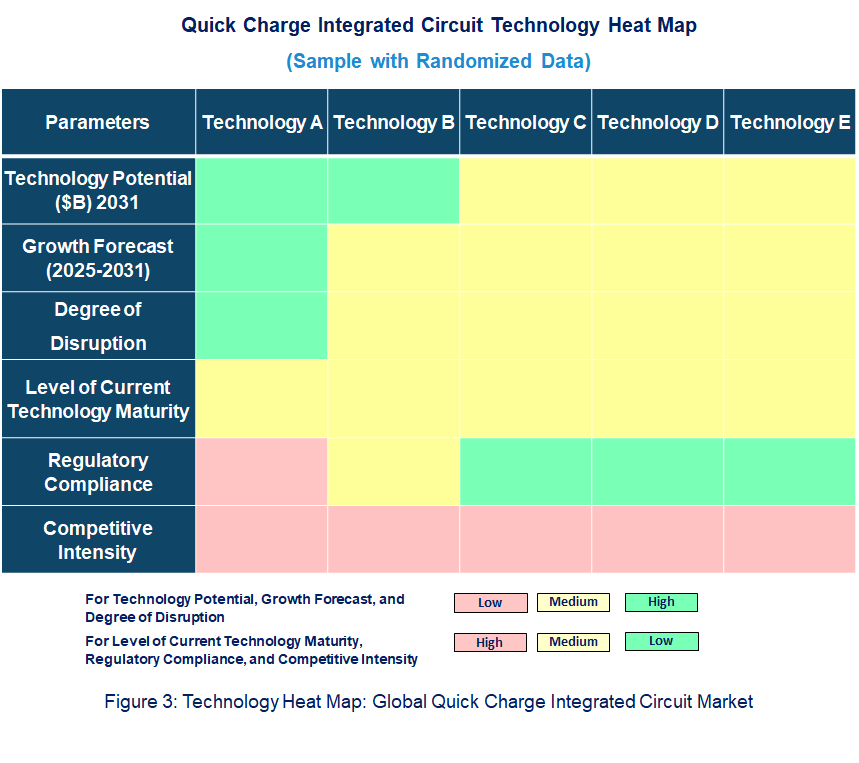
• Technology Potential: The potential of quick charge IC technology is significant, with ongoing improvements in semiconductor materials, such as the shift from silicon to wide bandgap semiconductors like gallium nitride (GaN). These innovations enable faster charging, higher power densities, and improved thermal management, supporting a wide range of applications.
• Degree of Disruption: Quick charge IC technologies have disrupted traditional charging solutions, providing fast, high-efficiency charging options for various devices, including smartphones, laptops, and electric vehicles. The adoption of new protocols, such as USB power delivery (USB-PD), has further accelerated the shift toward faster and more versatile charging solutions.
• Level of Current Technology Maturity: The technology is in a highly advanced stage, with widespread integration of fast-charging protocols and multi-port solutions. The market is maturing as the ICs continue to be optimized for better performance, energy efficiency, and compatibility across a variety of devices.
• Regulatory Compliance: Quick charge IC technologies must comply with industry standards like USB-PD and energy efficiency guidelines. As the market grows, regulatory bodies continue to establish rules regarding safety, energy consumption, and electromagnetic compatibility to ensure the sustainability and safety of these charging solutions.
• Cypress Semiconductor Corporation: Cypress has developed advanced USB Power Delivery (USB-PD) solutions that enable faster charging of smartphones, laptops, and other portable devices. Their technology allows for higher power delivery while maintaining safety standards, ensuring high-speed charging without overheating.
• Diodes Incorporated: Diodes Incorporated has designed new integrated circuits with high efficiency and fast charging capabilities. Their ICs focus on improving thermal management, enabling users to charge multiple devices simultaneously without compromising safety or efficiency. This positions the company as a leader in the consumer electronics market.
• Infineon Technologies AG: Infineon has introduced innovative, high-end power management ICs using wide bandgap semiconductors, such as Gallium Nitride (GaN). These products support the high power requirements of automotive and industrial applications, such as electric vehicles and their charging stations.
• Maxim Integrated: Maxim Integrated provides multi-port charging solutions that support the simultaneous charging of multiple devices. Maxim's technologies are making quick-charge systems more popular across various consumer electronics and mobile devices by improving thermal management and enhancing energy efficiency.
• MediaTek Inc.: MediaTek has incorporated fast-charging capabilities into its mobile chipsets, utilizing the USB Power Delivery protocol for quicker charging of both smartphones and tablets. Their technology minimizes charging time for users while ensuring cross-device compatibility. These developments illustrate how key players in the quick charge IC market are shaping the future of fast-charging solutions, enhancing performance, versatility, and safety across various industries.
• Increasing Demand for Rapid Charging: With the growing adoption of mobile devices and electric vehicles, consumers are seeking faster charging solutions. As a result, demand for IC technology continues to drive innovations aimed at providing faster and more efficient power delivery. This has led companies to focus on improving charging speeds and reducing device downtime.
• Advances in Semiconductor Materials: The shift from traditional silicon-based semiconductors to wide bandgap materials, such as Gallium Nitride (GaN), has been a key driver. GaN semiconductors enable faster charging speeds, better power efficiency, and improved thermal management, all of which support the increasing demand for high-speed charging solutions in various devices and industries.
• Electric Vehicles: The sharp increase in electric vehicle (EV) adoption presents a significant opportunity for the Quick Charge IC market. As the power demand of electric vehicles increases, manufacturers are adopting high-end charging technologies to meet these needs, thus driving growth in the fast-charging IC market for automotive applications. Challenges in the quick charge integrated circuit market are:
• High Production Costs: A major challenge in the market is the high production costs associated with advanced ICs. The use of high-end technologies and materials, such as GaN, leads to higher manufacturing expenses, which may limit the adoption of these solutions in cost-sensitive markets.
• Compatibility and Standardization Problems: As the market for rapid charging technologies expands, incompatibilities between charging systems and protocols can create barriers to implementation. The need for interoperability between devices and technologies presents challenges for both consumers and manufacturers, hindering widespread adoption. The quick charge integrated circuit (IC) market is driven by increasing demand for faster charging, advancements in semiconductor materials, and the growth of electric vehicles. However, challenges such as high production costs and compatibility issues remain. Despite these challenges, continuous improvements in IC technology are driving innovation, making charging solutions faster, more efficient, and suitable for a wider range of industries.
• Cypress Semiconductor Corporation
• Diodes Incorporated
• Infineon Technologies AG
• Maxim Integrated
• MediaTek Inc.
• Technology Readiness by Technology Type in the Quick Charge Integrated Circuit Market: In the quick charge integrated circuit (IC) market, different technologies exhibit varying levels of readiness. Charging protocols such as USB Power Delivery (USB-PD) and Qualcomm Quick Charge are highly mature, with widespread adoption in smartphones, laptops, and other consumer electronics. These technologies are ready for mass deployment and have become industry standards. In terms of integration levels, multi-port and multi-device solutions are rapidly gaining traction and are increasingly integrated into new products, especially for consumer electronics and electric vehicles, though some solutions are still in development phases. Wide bandgap semiconductor materials like Gallium Nitride (GaN) are at a slightly earlier stage but are becoming increasingly adopted due to their superior performance in terms of efficiency, thermal management, and power delivery. The competitive level for each of these technologies is high, with established players competing to lead in innovation. Regulatory compliance is an essential factor, especially with safety and environmental regulations that govern the electronics and automotive sectors. These technologies are key for applications in consumer electronics, automotive sectors, and renewable energy, driving the ongoing development and adoption of fast-charging solutions.
• Competitive Intensity and Regulatory Compliance in the Quick Charge Integrated Circuit Market: The quick charge integrated circuit (IC) market faces moderate to high competitive intensity as key players like Qualcomm, Cypress, Infineon, and MediaTek race to dominate the fast-charging segment. Innovations in charging protocols, integration levels, and semiconductor materials are driving this intense competition. Charging protocols such as USB-PD and Qualcomm Quick Charge are critical, and companies invest heavily in maintaining competitive advantages by offering superior performance. The transition to wide bandgap semiconductors like GaN adds further competition, as it promises better performance. Regulatory compliance, particularly in terms of safety standards and environmental guidelines, is becoming increasingly important, as governments enforce stricter rules for the electronics and automotive industries. Companies must comply with various global standards, such as RoHS (Restriction of Hazardous Substances) and CE certifications, to ensure their products are market-ready. Regulatory frameworks are thus shaping the product development and market entry strategies of firms. These competitive dynamics, combined with the need for compliance, make the market challenging for new entrants but open up growth opportunities for established players with robust technological capabilities.
• Disruption Potential of Different Technologies in the Quick Charge Integrated Circuit Market: The quick charge integrated circuit (IC) market is experiencing significant disruption due to advancements in charging protocols, integration levels, and semiconductor materials. The introduction of USB Power Delivery (USB-PD) and Qualcomm Quick Charge protocols has greatly enhanced charging speeds and efficiency, setting new industry standards. Integration levels are shifting from basic single-chip solutions to multi-port and multi-device charging systems, offering versatility and convenience. Wide bandgap semiconductors, such as Gallium Nitride (GaN), are replacing traditional silicon, providing faster charging speeds, better efficiency, and improved thermal management. This disruption has led to more efficient power management, a critical factor for electric vehicles, smartphones, and laptops. As these technologies mature, they will continue to challenge traditional charging systems, pushing the industry towards smarter, faster, and more sustainable solutions. Ultimately, these disruptions are driving the evolution of the Quick Charge IC market, benefiting both consumers and manufacturers by offering faster, safer, and more reliable charging experiences.
• Charging Protocols
• Integration Level
• Semiconductor Material
• Aftermarket Parts & Services
• OEMs
• North America
• Europe
• Asia Pacific
• The Rest of the World
• Latest Developments and Innovations in the Quick Charge Integrated Circuit Technologies
• Companies / Ecosystems
• Strategic Opportunities by Technology Type


Choose a license that fits your team. Instant PDF delivery.
Prices exclude taxes. Instant delivery. Custom licensing available on request.
Market Report · May 18, 2026
Market Report · May 18, 2026
Market Report · May 18, 2026
Trusted partner for strategic intelligence and business growth


Receive a complimentary market analysis tailored to your industry. Our analysts will identify key growth opportunities and competitive dynamics specific to your business.

Market size, growth rate, and key trend analysis for your specific sector.

Top competitor positioning and market share analysis.

Strategic recommendations backed by data-driven insights.
Get curated market intelligence and competitive moves straight to your inbox.
By subscribing, you agree to receive our monthly insights. Unsubscribe anytime.
Receive a complimentary market analysis tailored to your industry. Our analysts will identify key growth opportunities and competitive dynamics specific to your business.
Market size, growth rate, and key trend analysis for your specific sector.
Top competitor positioning and market share analysis.
Strategic recommendations backed by data-driven insights.
Get curated market intelligence, emerging trends, and competitive moves straight to your inbox each month.
By subscribing, you agree to receive our monthly insights. Unsubscribe anytime.
We'll send your sample report shortly.