
Market Report · July 20, 2026

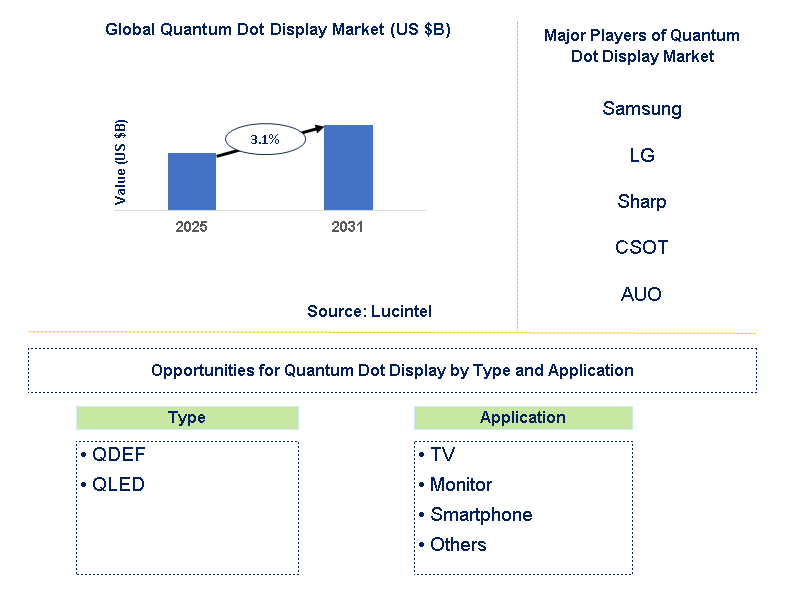
Key data points: The growth forecast = 3.1% annually for the next 7 years. Scroll below to get more insights. This market report covers trends, opportunities and forecasts in quantum dot display market to 2031 by type (QDEF and QLED), application (TV, monitor, smartphone, and others), and region (North America, Europe, Asia Pacific, and the Rest of the World)
We'll send your sample report shortly.
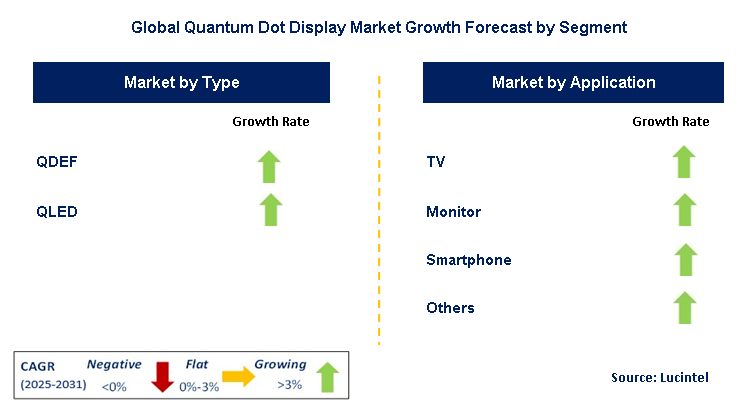
• Lucintel forecasts that, within the type category, QDEF is expected to witness higher growth over the forecast period.
• Within the application category, TV is expected to witness the highest growth.
• In terms of region, APAC is expected to witness the highest growth over the forecast period. Gain valuable insights for your business decisions with our comprehensive 150+ page report. Sample figures with some insights are shown below.
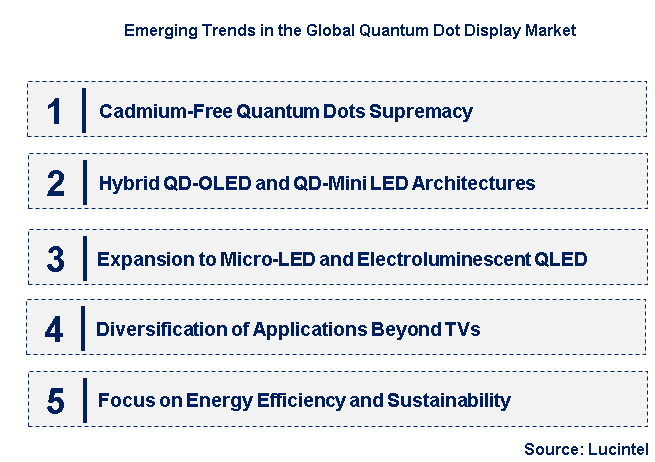
• Cadmium-Free Quantum Dots Supremacy: This is an imperative emerging trend, powered by environmental legislation (such as RoHS in the EU) and increasing consumer demand for safer products. Companies are progressively moving away from cadmium-containing quantum dots to cadmium-free options, mainly indium phosphide (In) or silicon-based QDs, with initial delays in matching performance. The effect is a more sustainable and eco-friendly display sector, receiving broader industry acceptance and regulatory approval, while maintaining ongoing innovation in non-toxic materials for high-performance displays.
• Hybrid QD-OLED and QD-Mini LED Architectures: One of the key upcoming trends is the combination of quantum dots with other cutting-edge display technologies. QD-OLED brings together the ideal blacks and contrast of OLED and the increased color purity of quantum dots, while QD-Mini LED couples Mini-LED backlighting with quantum dot films for higher brightness, contrast, and color on an LCD panel. The effect is the development of high-end display classes that provide unprecedented visual quality, filling the space between current technologies and propelling high-end television and monitor innovations.
• Expansion to Micro-LED and Electroluminescent QLED: This is the way of the future for quantum dot displays. Scientists are in active research on the integration of quantum dots with Micro-LED technology, where QDs are used as color converters for very small Micro-LED sub-pixels, which offer ultra-high brightness, ideal blacks, and outstanding efficiency. Beyond that, pure electroluminescent QLED, in which quantum dots emit light directly when current is supplied, is a long-term aim. The deal is the promise of revolutionary display types that will outpace existing technologies in performance, power efficiency, and form factor flexibility.
• Diversification of Applications Beyond TVs: Though TVs are still a dominant market, a growing trend is the diversified expansion of quantum dot display applications at a rapid pace. This encompasses their growing use in smartphones, tablets, high-end computer monitors (particularly for gaming and professional applications), and in-vehicle infotainment systems. There is also increased interest in incorporating QDs in augmented reality (AR) and virtual reality (VR) headsets and even in commercial displays. The effect is expanded market coverage and more revenue streams for quantum dot technology providers due to the need for better visual quality across multiple device categories.
• Focus on Energy Efficiency and Sustainability: With growing international attention on energy usage and eco-friendliness, more energy-efficient quantum dot displays are being developed. This is done by optimizing the material properties of QD, streamlining integration processes to reduce light loss, and making the overall production process greener. Quantum dots naturally have high energy efficiency in comparison to conventional color filters. The effect is a decrease in energy consumption for display devices, which is consistent with green efforts and friendly to environment-conscious consumers, thus providing lower operating costs and a smaller carbon footprint for electronics. These new trends are all combined to redefine the quantum dot display market by propelling it toward improved performance, environmental friendliness, and flexibility. The demand for cadmium-free materials is taking a step toward addressing ecologic concerns, while hybrid architectures and investigation of Micro-LED integration offer unparalleled image quality. In addition, diversification of application and major emphasis on energy efficiency are ensuring quantum dot technology is at the forefront, driving its impact throughout the entire display ecosystem.
• General Use of Cadmium-Free Quantum Dots: One of the key recent trends is the rapid transition towards cadmium-free quantum dots, mainly Indium Phosphide (In) based QDs. This is spurred mainly by more stringent environmental legislation, including RoHS directives, as well as increasing consumer demand for non-toxic material. Although at first, it was difficult to obtain equivalent performance, advances in the synthesis of In QDs have produced high color purity and efficiency. The effect is a notable improvement of the market’s sustainability profile, meeting regulatory requirements and growing global market acceptance, particularly in markets with high environmental standards.
• Quantum Dot Integration with Mini-LED Backlighting: Another key recent trend is the wide and successful application of quantum dots with Mini-LED backlighting technology in high-end LCD TVs and monitors. Mini-LEDs enable thousands of local dimming zones, which create much better contrast, blacks deeper than the last, and peak brightness that is higher. When integrated with quantum dot films, these panels have an unparalleled color gamut. The effect is the production of high-end LCD TVs with contrast levels as good as OLED at much better brightness, providing a strong alternative in the high-end display market.
• Commercialization of QD-OLED Displays: The recent commercial availability and growing penetration of QD-OLED displays are a noteworthy recent development. Developed by Samsung Display, QD-OLED technology employs blue OLEDs as the light source, which in turn pass through quantum dot color converters (red and green) to produce the entire color spectrum. This does away with the use of legacy color filters in OLEDs, resulting in cleaner colors, greater brightness, and broader viewing angles than regular white-OLEDs. The effect is the launch of a new, high-end display technology that brings the best features of OLED and quantum dot color enhancement together, creating a new standard for high-end displays.
• Growth into Computer Monitors and Laptops: Aside from television sets, another significant recent trend is the swift growth of quantum dot display technology into high-end computer monitors and high-end laptops. Gaming monitors, professional design displays, and high-performance notebooks are starting to incorporate QLED or QD-OLED panels to deliver outstanding color accuracy, brightness, and refresh rates. This involves key industry players such as Apple embracing QD technology in a number of its high-end laptop screens. The effect is a broadening of the market’s application base, stimulating demand for smaller-sized high-resolution QD panels and creating new growth opportunities.
• Developments Towards Electroluminescent QLED: Though still in the research and development stage, major recent breakthroughs are being achieved towards the realization of true electroluminescent Quantum Dot Light Emitting Diode (QLED) displays. This technology focuses on having quantum dots emit light directly when an electric current is supplied, without the use of a backlight. Breakthroughs have been observed in enhancing the efficiency and longevity of these emissive QDs. The effect is the potential of next-generation displays that might be thinner, more flexible, and more power-efficient than existing OLED or QD-LCD technologies, heralding a revolutionary step for the display industry. These recent advances are collectively influencing the quantum dot display market by making it more sustainable with cadmium-free technology, boosting visual performance through hybrid technologies such as QD-Mini LED and QD-OLED, and extending its scope into new product categories such as monitors and laptops. Also, the underlying research into actual emissive QLED is setting the market up for future advances that could transform display technology.
• High-End Televisions: This is still the most substantial and largest near-term strategic growth opportunity. As consumers continue to call for higher definition and improved picture quality, quantum dots have the wide color gamut and high brightness required for deeply immersive 4K and 8K Ultra High Definition experiences. Opportunities include further combining QDs with Mini-LED and OLED technologies to deliver uncompromising contrast and color volume in high-end TV models. The effect is long-term high-volume sales in the profitable premium space, with resulting brand differentiation and ongoing innovation in display performance.
• High-End Computer Displays and Gaming Displays: The exploding gaming market and increasing demand from creative professionals for color-accurate displays constitute a major strategic growth opportunity. Gamers want monitors with rich colors, high frame rates, and low response times, which can be increased by QD technology. Opportunities are in creating QD-facilitated monitors that offer HDR, wide color gamut, and adaptive sync technologies. The effect is access to a fast-growing and tech-savvy customer base ready to spend on better visual performance, driving innovation in display specifications and aggressive pricing.
• Automotive Infotainment Systems and Digital Dashboards: The automotive market is a strong strategic growth opportunity. New cars are equipping with more advanced infotainment systems, digital instrument panels, and heads-up displays, which demand high-brightness displays for legibility under changing lighting conditions, wide operating temperatures, and superb color reproduction. Quantum dots provide these accurate color and brightness features. The effect is a high-value, long-lifecycle market segment propelled by automotive technology trends, demanding strong, rugged, and extremely reliable QD display solutions for challenging in-vehicle environments.
• Augmented Reality and Virtual Reality Devices: The new but fast-emerging AR/VR segment is a long-term strategic growth prospect for quantum dot displays. AR/VR headsets require very high pixel density, large color gamut, and rapid response to provide realistic and immersive virtual environments with no motion sickness. Micro-displays utilized in these products can be improved by using quantum dots. The influence is the possibility of being an enabling technology for future immersive computing, necessitating tiny, ultra-high-resolution, and energy-efficient QD-based displays to facilitate next-gen AR/VR experiences.
• Flexible, Foldable, and Rollable Displays: The push towards ever-bolder form factors in consumer electronics presents a futuristic strategic growth opportunity. As display technology advances towards flexible, foldable, and eventually rollable screens for smartphones, tablets, and larger devices, quantum dots offer unique advantages due to their solution processability and inherent flexibility. Opportunities lie in developing QD materials and integration methods that can withstand bending and rolling without compromising performance. The effect is to make completely new product classes and user experiences possible, stimulated by demand for highly flexible and robust display solutions. All of these strategic growth opportunities put their impact into the quantum dot display market in terms of a diversified revenue base and targeted innovation. The market will not only focus on the critical segments like premium televisions, gaming monitors, and automotive displays but also remain focused on high-potential areas like AR/VR and flexible displays, ensuring quantum dot technology is put at the forefront of visual innovation across a broad spectrum of electronic devices.
• Samsung
• LG
• Sharp
• CSOT
• AUO
• QDEF
• QLED
• TV
• Monitor
• Smartphone
• Others
• North America
• Europe
• Asia Pacific
• The Rest of the World
• United States: In the US, the quantum dot display market is witnessing robust uptake in high-end consumer electronics, especially 4K and 8K TVs and gaming monitors. Recent trends include greater research activity on cadmium-free quantum dots to handle environmental issues and fulfill changing regulations. Integration of quantum dot technology with Mini-LED backlighting is also gaining momentum in high-end LCDs, providing improved contrast and luminosity. Firms such as Apple incorporating QD technology in products such as MacBook Pro further entrench its place in the high-end segment.
• China: China’s quantum dot display market is marked by robust growth and extensive domestic production capacity. Recent trends have seen enormous investment in quantum dot film production lines and the growing popularity of QLED TVs from indigenous players such as TCL and Hisense. Although cost efficiency is critical, there is a decided trend towards developing high-resolution, wide-color-gamut displays for the high-growth consumer electronics market. China is also actively investigating cadmium-free quantum dots as a result of changing environmental legislation.
• Germany: Germany’s quantum dot display market, while not as expansive in production compared to Asian rivals, targets high-quality, energy-efficient display solutions. New developments involve rising demand for QD displays for professional purposes and niche consumer electronics, with a motivation for enhanced image quality and eco-friendliness. Development of new quantum dot materials and integration techniques continues, in line with European Union directives for hazardous substances, which promotes cadmium-free materials.
• India: India quantum dot display market is witnessing a boom in demand, driven by increasing disposable incomes and an escalating consumer interest in newer display technologies in televisions and smartphones. Some of the recent trends that are visible include top consumer electronics manufacturers releasing QLED TVs with specifications such as 4K and Mini-LED backlighting for the premium category. The growth of online retail channels is bringing these high-end displays within reach of a larger population, spurring market growth in urban regions.
• Japan: Japan’s quantum dot display market focuses on accuracy, innovation, and premium visual performance. Recent trends involve ongoing optimization of quantum dot materials and integration processes for further improved color accuracy and energy efficiency, especially in high-definition TVs and professional monitors. Japanese companies are also leading the way in developing next-generation display technologies based on quantum dots, like QD-OLED, and are concentrating on creating eco-friendly, cadmium-free technology.


• Samsung
• LG
• Sharp
• CSOT
• AUO Q5. Which quantum dot display market segment will be the largest in future? Answer: Lucintel forecasts that, within the type category, QDEF is expected to witness higher growth over the forecast period. Q6. In quantum dot display market, which region is expected to be the largest in next 5 years? Answer: In terms of region, APAC is expected to witness the highest growth over the forecast period. Q7. Do we receive customization in this report? Answer: Yes, Lucintel provides 10% customization without any additional cost.


Choose a license that fits your team. Instant PDF delivery.
Prices exclude taxes. Instant delivery. Custom licensing available on request.
Market Report · July 20, 2026
Market Report · July 16, 2026
Market Report · July 15, 2026
Trusted partner for strategic intelligence and business growth


Receive a complimentary market analysis tailored to your industry. Our analysts will identify key growth opportunities and competitive dynamics specific to your business.

Market size, growth rate, and key trend analysis for your specific sector.

Top competitor positioning and market share analysis.

Strategic recommendations backed by data-driven insights.
Get curated market intelligence and competitive moves straight to your inbox.
By subscribing, you agree to receive our monthly insights. Unsubscribe anytime.
Receive a complimentary market analysis tailored to your industry. Our analysts will identify key growth opportunities and competitive dynamics specific to your business.
Market size, growth rate, and key trend analysis for your specific sector.
Top competitor positioning and market share analysis.
Strategic recommendations backed by data-driven insights.
Get curated market intelligence, emerging trends, and competitive moves straight to your inbox each month.
By subscribing, you agree to receive our monthly insights. Unsubscribe anytime.
We'll send your sample report shortly.