Digital Advertising Display Market Report: Trends, Forecast and Competitive Analysis to 2035

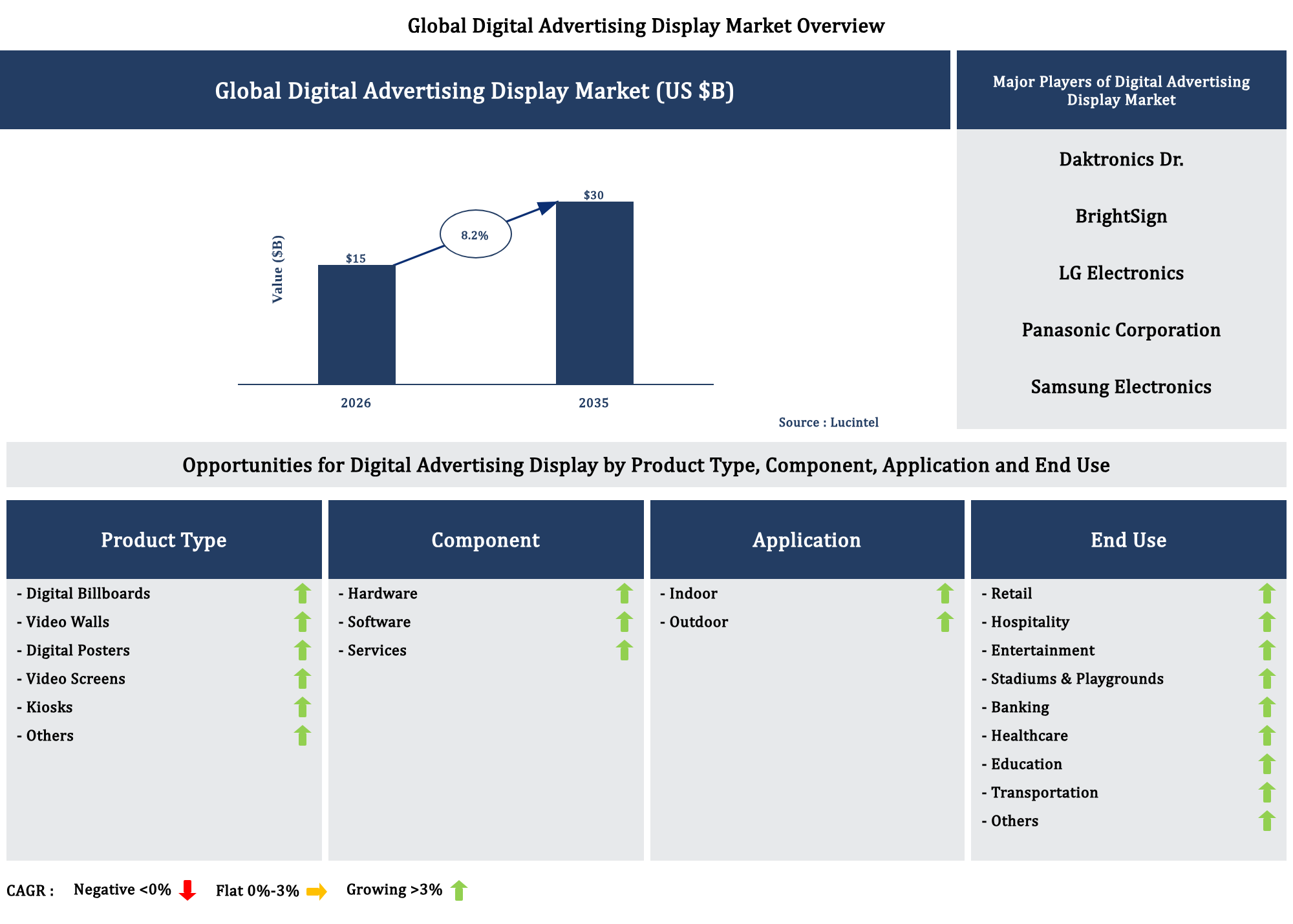
Key data points: The market size in 2035 = $30 billion, growth forecast = 8.2% annually for the next 9 years. Scroll below to get more insights. This market report covers trends, opportunities and forecasts in digital advertising display market to 2035 by product type (digital billboards, video walls, digital posters, video screens, kiosks, and others), component (hardware, software, and services), application (indoor and outdoor), end use (retail, hospitality, entertainment, stadiums & playgrounds, banking, healthcare, education, transportation, and others), and region (North America, Europe, Asia Pacific, and the Rest of the World)

Publisher: Lucintel Last Updated: July 2026
See Pricing

Download Sample Report

| ✨ New Download Sample report — Get instant insights! | ✨ New Download Sample report — Get instant insights!

Digital Advertising Display Market Report: Trends, Forecast and Competitive Analysis to 2035

Digital Advertising Display Market

The future of the global digital advertising display market looks promising with opportunities in the retail, hospitality, entertainment, stadium & playground, banking, healthcare, education, and transportation markets. The global digital advertising display market is expected to reach an estimated $30 billion by 2035 with a CAGR of 8.2% from 2026 to 2035. The major drivers for this market are the increasing adoption of interactive display technologies, the rising demand for retail digital signage, and the growing use of programmatic advertising platforms.

  • Lucintel forecasts that, within the product type category, digital billboard will remain the largest segment over the forecast period due to the increasing demand for dynamic outdoor advertising.
  • Within the end use category, retail will remain the largest segment due to the rising retail spending on digital displays.
  • In terms of regions, APAC will remain the largest region over the forecast period due to the growing adoption of digital advertising solutions.

Gain valuable insights for your business decisions with our comprehensive 150+ page report. Sample figures with some insights are shown below.
Digital Advertising Display Market

Emerging Trends in the Digital Advertising Display Market

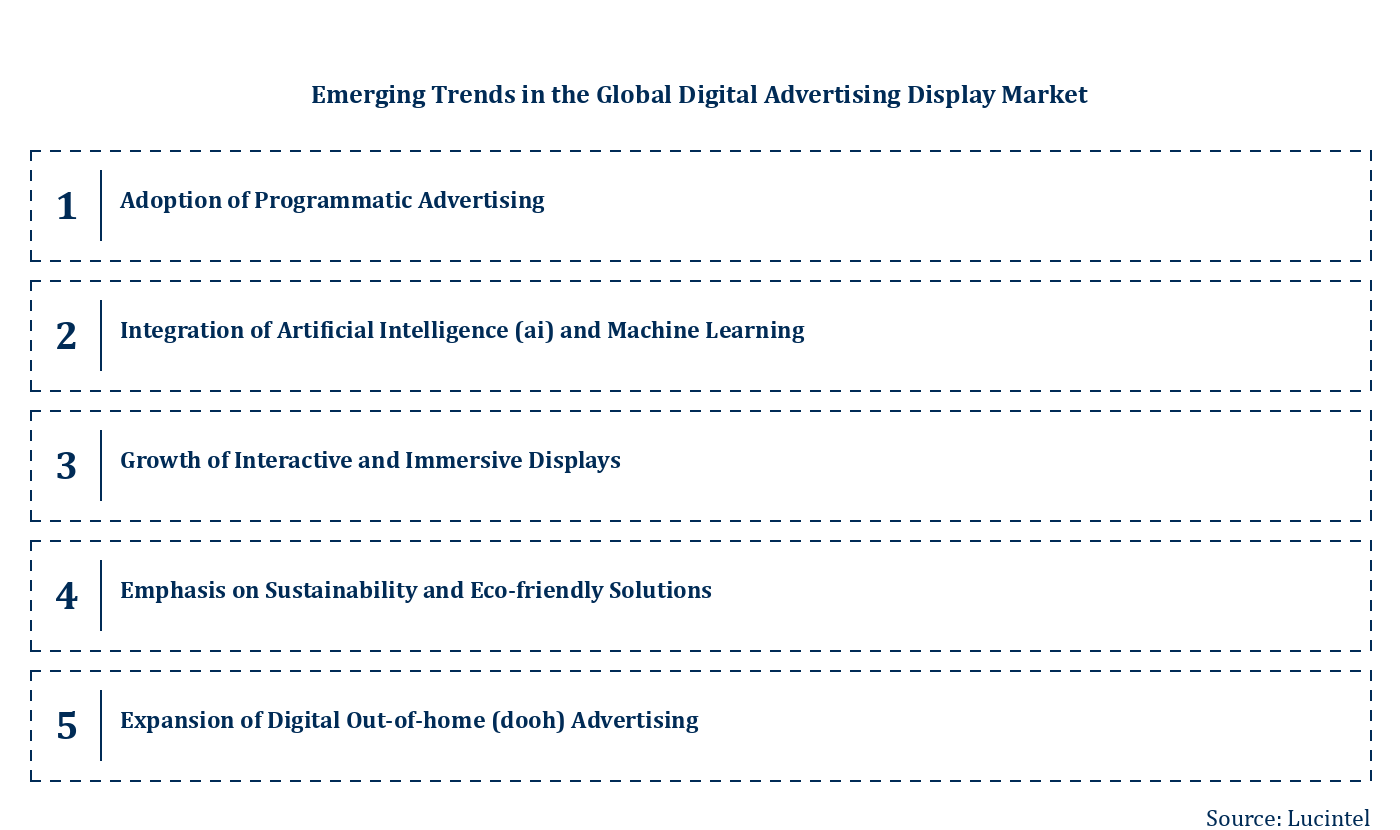
The digital advertising display market is experiencing rapid evolution driven by technological advancements, changing consumer behaviors, and the increasing demand for dynamic, engaging content. As brands seek more effective ways to reach their audiences, innovative display solutions are emerging to meet these needs. These developments are not only transforming how advertisements are delivered but also influencing market strategies, consumer engagement, and overall industry growth. The following key trends highlight the major shifts shaping this dynamic landscape, offering insights into future opportunities and challenges.

  • Adoption of Programmatic Advertising: This trend involves the automated buying and selling of ad space in real-time, enabling more precise targeting and efficient ad placements. Programmatic advertising enhances campaign performance by leveraging data analytics and machine learning, allowing advertisers to reach specific audiences at optimal times. It reduces manual effort and increases ROI, making it a preferred approach for brands seeking scalable and personalized advertising solutions. As programmatic technology advances, its integration with digital displays is expected to deepen, further optimizing ad delivery.
  • Integration of Artificial Intelligence (AI) and Machine Learning: AI-driven solutions are revolutionizing digital advertising displays by enabling smarter content personalization, predictive analytics, and real-time optimization. AI algorithms analyze consumer data to deliver tailored content that resonates with individual preferences, increasing engagement rates. Additionally, AI-powered analytics help marketers understand campaign performance and adjust strategies promptly. This integration results in more relevant advertising experiences, improved conversion rates, and a competitive edge for brands. As AI technology becomes more sophisticated, its role in creating immersive and interactive display content will expand significantly.
  • Growth of Interactive and Immersive Displays: Interactive displays, including touchscreens, augmented reality (AR), and virtual reality (VR), are gaining popularity for their ability to engage consumers actively. These displays create immersive experiences that foster deeper brand connections and enhance customer engagement. Retail environments, events, and public spaces are increasingly adopting such solutions to attract attention and provide memorable interactions. The impact includes higher dwell times, increased brand recall, and valuable consumer data collection. As technology becomes more affordable and accessible, the adoption of immersive displays is expected to accelerate across various sectors.
  • Emphasis on Sustainability and Eco-Friendly Solutions: Sustainability is becoming a critical factor in the digital advertising display market. Manufacturers are developing energy-efficient displays, such as LED and OLED screens, and incorporating eco-friendly materials to reduce environmental impact. Brands are also prioritizing sustainable advertising practices to align with corporate social responsibility goals. This trend influences product design, manufacturing processes, and overall market offerings, encouraging innovation in low-power, recyclable, and biodegradable display solutions. The shift towards sustainability not only benefits the environment but also enhances brand reputation and consumer trust.
  • Expansion of Digital Out-of-Home (DOOH) Advertising: DOOH advertising, which includes digital billboards, transit displays, and digital signage in public spaces, is experiencing significant growth. The integration of data-driven targeting and real-time content updates makes DOOH highly effective for localized and contextually relevant advertising. The proliferation of smart city infrastructure and 5G connectivity further amplifies its reach and capabilities. This expansion allows advertisers to deliver dynamic, targeted messages to large audiences across urban environments, increasing visibility and engagement. The trend is reshaping outdoor advertising by making it more flexible, measurable, and impactful.

These trends are collectively transforming the digital advertising display market by enhancing targeting precision, personalization, consumer engagement, sustainability, and reach. As technological innovations continue to evolve, the market is poised for substantial growth, offering new opportunities for brands and advertisers to connect with audiences in more meaningful and innovative ways.
Digital Advertising Display Market by country

Recent Developments in the Digital Advertising Display Market

The digital advertising display market is experiencing rapid growth driven by technological advancements, increased consumer engagement, and the shift towards digital media. Businesses are investing heavily in innovative display solutions to capture audience attention and improve brand visibility. The integration of AI, data analytics, and high-resolution screens is transforming advertising strategies. As consumer preferences evolve, market players are focusing on immersive and personalized advertising experiences. These developments are shaping the future landscape of digital advertising displays, creating new opportunities and competitive dynamics.

  • Technological Innovations in Display Technology: Advancements in OLED, MicroLED, and 8K resolution screens are revolutionizing visual quality. These high-definition displays offer brighter, more vibrant images, enhancing viewer engagement. The adoption of flexible and transparent screens allows for creative advertising formats on unconventional surfaces. Such innovations enable brands to deliver immersive experiences, increase ad effectiveness, and stand out in crowded spaces. The market benefits from increased demand for premium displays across retail, entertainment, and transportation sectors.
  • Integration of Artificial Intelligence and Data Analytics: AI-driven algorithms enable targeted advertising based on consumer behavior and preferences. Data analytics facilitate real-time campaign adjustments, improving ROI. Personalized content delivery enhances user engagement and brand loyalty. AI-powered displays can adapt content dynamically, creating interactive experiences. This integration allows advertisers to optimize campaigns, reduce wastage, and measure effectiveness accurately. The market sees a shift towards smarter, data-driven advertising solutions that cater to individual consumer needs.
  • Growth of Digital Signage in Retail and Hospitality: Retailers and hospitality providers are increasingly adopting digital signage for dynamic promotions and customer engagement. Interactive kiosks, digital menu boards, and wayfinding displays improve customer experience and operational efficiency. These displays support omnichannel marketing strategies, enabling seamless brand messaging. The deployment of digital signage in these sectors drives sales, enhances brand recognition, and provides valuable consumer insights. The market benefits from expanding applications and increased investment in digital infrastructure.
  • Expansion of Smart Cities and Public Spaces: Governments and urban planners are integrating digital displays into smart city initiatives. These displays provide real-time information, advertising, and public service announcements. Their deployment enhances urban aesthetics and communication efficiency. The growth of smart cities accelerates demand for large-scale, durable, and energy-efficient displays. This trend opens new revenue streams for market players and fosters innovative advertising formats in public environments, contributing to a more connected and informed urban population.
  • Rise of Programmatic Advertising and Automated Buying: Programmatic platforms enable automated, real-time ad placement across digital displays. This technology improves targeting precision and campaign efficiency. Advertisers can reach specific audiences at optimal times, reducing costs and increasing effectiveness. The automation streamlines media buying processes, allowing for scalable and flexible campaigns. As programmatic advertising gains popularity, the market experiences increased demand for integrated solutions, fostering innovation and competition among display providers.

These developments are significantly transforming the digital advertising display market by enhancing visual quality, targeting capabilities, and application diversity. The integration of AI, data analytics, and automation is enabling more personalized, efficient, and impactful advertising campaigns. Growth in retail, smart cities, and public spaces broadens market reach and revenue opportunities. Overall, these innovations are driving market expansion, fostering competitive differentiation, and shaping a more dynamic, consumer-centric advertising landscape.

Strategic Growth Opportunities in the Digital Advertising Display Market

The digital advertising display market is experiencing rapid expansion driven by technological advancements, increased digital media consumption, and the need for targeted marketing solutions. Businesses are investing heavily in innovative display technologies to enhance consumer engagement and improve ROI. The growth is further supported by the proliferation of smart devices and the shift towards omnichannel advertising strategies. This environment presents numerous opportunities for market players to diversify offerings, expand geographically, and adopt emerging technologies to capture a larger share of the evolving digital advertising landscape.

  • Increasing Adoption of Smart Digital Signage Solutions: The integration of IoT and AI in digital signage enables real-time data analytics, personalized content, and remote management, making displays more interactive and effective. Retail, transportation, and hospitality sectors are rapidly adopting these smart solutions to enhance customer experience and operational efficiency. The demand for high-resolution, energy-efficient, and customizable displays is fueling growth, with sub-segments like outdoor digital billboards and interactive kiosks showing significant expansion potential.
  • Growing Demand for Programmatic Advertising on Digital Displays: Programmatic advertising automates the buying and placement of ads, allowing for highly targeted and data-driven campaigns. Digital displays are increasingly integrated with programmatic platforms, enabling advertisers to optimize ad delivery based on audience behavior, location, and time. This trend enhances ad relevance and effectiveness, attracting brands seeking measurable ROI. Sub-segments such as DOOH (Digital Out-of-Home) and mobile integration are expected to see substantial growth, driven by advancements in data analytics and ad tech.
  • Expansion of Digital Out-of-Home (DOOH) Advertising: DOOH advertising leverages digital displays in public spaces, offering high visibility and dynamic content capabilities. The segment is expanding due to urbanization, smart city initiatives, and the need for flexible advertising formats. High-traffic locations like transit stations, shopping malls, and airports are prime areas for growth. Innovations such as 3D displays and augmented reality are further enhancing engagement, making DOOH a key driver in the overall digital advertising display market.
  • Increasing Use of Interactive and Immersive Display Technologies: Interactive displays, including touchscreens and augmented reality (AR), are transforming consumer engagement by providing immersive experiences. Retailers, entertainment venues, and event organizers are adopting these technologies to create memorable brand interactions. The integration of AR and VR with digital displays offers innovative marketing avenues, boosting consumer participation and data collection. Sub-segments like virtual try-ons and interactive wayfinding are gaining traction, supporting the market’s shift toward experiential advertising.
  • Rising Investment in Digital Advertising Infrastructure in Emerging Markets: Emerging economies are witnessing increased investments in digital infrastructure, including high-speed internet and smart city projects, facilitating the deployment of digital advertising displays. These markets present untapped opportunities for growth due to rising urbanization and digital literacy. Local businesses and multinational corporations are expanding their advertising reach through digital displays in these regions. The development of affordable, scalable display solutions tailored to local needs is expected to accelerate market penetration and revenue generation.

The overall market growth is poised to accelerate as these opportunities converge, fostering innovation and expanding the reach of digital advertising displays globally. Companies that strategically leverage these trends will be well-positioned to capture new revenue streams and strengthen their market presence.

Digital Advertising Display Market Drivers and Challenges

The digital advertising display market is influenced by a variety of technological, economic, and regulatory factors that shape its growth trajectory. Rapid advancements in display technology, increasing internet penetration, and the shift towards digital marketing strategies are key drivers. However, the market also faces challenges such as regulatory restrictions, high implementation costs, and evolving consumer privacy concerns. These factors collectively impact market dynamics, influencing investment decisions, innovation, and competitive strategies. Understanding these drivers and challenges is essential for stakeholders aiming to capitalize on emerging opportunities while navigating potential risks in this rapidly evolving landscape.

The factors responsible for driving the digital advertising display market include:-

  • Technological Innovation: The continuous development of high-resolution, energy-efficient, and flexible display technologies such as OLED and LED has revolutionized digital advertising displays. These advancements enable more engaging, vibrant, and customizable content, attracting advertisers seeking impactful visual communication. Additionally, integration with IoT and AI allows for real-time data-driven advertising, enhancing targeting precision and campaign effectiveness. As technology becomes more affordable and scalable, businesses of all sizes can deploy sophisticated digital displays, fueling market expansion and innovation.
  • Growing Digital Penetration: The increasing adoption of smartphones, tablets, and high-speed internet worldwide has significantly expanded the reach of digital advertising. Consumers are spending more time online, creating a fertile environment for targeted advertising campaigns. This digital shift encourages brands to invest heavily in digital display advertising to connect with their audiences effectively. The proliferation of digital platforms and social media further amplifies this trend, making digital advertising displays a vital component of integrated marketing strategies across various industries.
  • Urbanization and Infrastructure Development: Rapid urbanization, especially in emerging economies, is driving the demand for digital advertising displays in public spaces, transportation hubs, retail outlets, and entertainment venues. As cities grow, there is an increased need for modern, eye-catching advertising solutions to capture consumer attention in crowded environments. Infrastructure projects and smart city initiatives also incorporate digital displays for information dissemination and advertising, creating new revenue streams and expanding market opportunities.
  • Shift Towards Programmatic Advertising: The adoption of programmatic advertising platforms allows for automated, data-driven ad placements in real-time. This shift enhances targeting accuracy, reduces wastage, and improves ROI for advertisers. Digital advertising displays integrated with programmatic systems can dynamically change content based on audience demographics, time of day, or location. This efficiency and personalization drive higher engagement rates and make digital displays more attractive to advertisers, thereby fueling market growth.
  • Increasing Focus on Sustainability: Environmental concerns and the push for sustainable practices influence the development of eco-friendly digital displays. Manufacturers are investing in energy-efficient LED and OLED technologies, recyclable materials, and low-power consumption solutions. This focus on sustainability not only reduces operational costs but also aligns with corporate social responsibility goals, appealing to environmentally conscious brands. As sustainability becomes a key purchasing criterion, the market is likely to see increased demand for green digital advertising displays.

The challenges facing the digital advertising display market include:-

  • Regulatory Restrictions: Governments and regulatory bodies are implementing stricter rules regarding digital advertising content, data privacy, and outdoor advertising permits. These regulations can limit the types of content displayed, restrict advertising in certain areas, or impose compliance costs on businesses. Navigating these legal frameworks requires significant effort and can delay deployment or increase operational expenses, potentially hindering market growth and innovation.
  • High Implementation and Maintenance Costs: Deploying digital advertising displays involves substantial capital investment in hardware, installation, and ongoing maintenance. The costs associated with high-quality displays, content management systems, and technical support can be prohibitive, especially for small and medium-sized enterprises. These financial barriers may slow down adoption rates and limit market penetration in price-sensitive regions, impacting overall growth.
  • Consumer Privacy and Data Security Concerns: As digital displays increasingly utilize data analytics and targeted advertising, concerns over consumer privacy and data security intensify. Regulations like GDPR and CCPA impose strict data handling requirements, and breaches can lead to legal penalties and reputational damage. Balancing personalized advertising with privacy compliance is complex, and failure to do so can restrict data-driven strategies, thereby challenging the effectiveness and expansion of digital advertising displays.

The digital advertising display market is driven by technological advancements, increasing digital engagement, urban infrastructure development, programmatic advertising, and sustainability initiatives. However, regulatory constraints, high costs, and privacy concerns pose significant challenges. These factors collectively influence market growth, requiring stakeholders to innovate, adapt, and strategize effectively. The interplay of these drivers and challenges will shape the future landscape, determining the pace and nature of market expansion in the coming years.

List of Digital Advertising Display Market Companies

Companies in the market compete on the basis of product quality offered. Major players in this market focus on expanding their manufacturing facilities, R&D investments, infrastructural development, and leverage integration opportunities across the value chain. Through these strategies digital advertising display market companies cater increasing demand, ensure competitive effectiveness, develop innovative products & technologies, reduce production costs, and expand their customer base. Some of the digital advertising display market companies profiled in this report include-

  • Daktronics Dr.
  • BrightSign
  • LG Electronics
  • Panasonic Corporation
  • Samsung Electronics
  • Scala
  • Barco
  • Lamar Advertising Company
  • Leyard Group
  • Adonmo-Acumen

Digital Advertising Display Market by Segment

The study includes a forecast for the global digital advertising display market by product type, component, application, end use, and region.

  • Digital Advertising Display Market by Product Type [Value from 2019 to 2035]:
    • Digital Billboards
    • Video Walls
    • Digital Posters
    • Video Screens
    • Kiosks
    • Others
  • Digital Advertising Display Market by Component [Value from 2019 to 2035]:
    • Hardware
    • Software
    • Services
  • Digital Advertising Display Market by Application [Value from 2019 to 2035]:
    • Indoor
    • Outdoor
  • Digital Advertising Display Market by End Use [Value from 2019 to 2035]:
    • Retail
    • Hospitality
    • Entertainment
    • Stadiums & Playgrounds
    • Banking
    • Healthcare
    • Education
    • Transportation
    • Others
  • Digital Advertising Display Market by Region [Value from 2019 to 2035]:
    • North America
    • Europe
    • Asia Pacific
    • The Rest of the World

Country Wise Outlook for the Digital Advertising Display Market

The digital advertising display market has experienced rapid growth driven by technological advancements, increased digital consumption, and evolving marketing strategies worldwide. As businesses seek more engaging and targeted advertising solutions, countries are adopting innovative display technologies to capture consumer attention and improve ROI. The market's evolution is influenced by factors such as the integration of AI, the rise of programmatic advertising, and the expansion of digital infrastructure. Each country’s unique economic landscape and technological adoption rate shape its specific developments in this sector, reflecting broader trends in digital transformation and marketing innovation.

  • United States: The US market has seen significant growth in programmatic advertising and the adoption of AI-powered digital displays. Major tech companies are investing heavily in large-format digital billboards and interactive displays, enhancing consumer engagement. The rise of omnichannel marketing strategies has further propelled demand for high-resolution, data-driven advertising screens. Additionally, regulations around data privacy are influencing targeted advertising practices, prompting innovations in privacy-compliant display solutions.
  • China: China continues to lead in digital display innovation with a focus on smart city projects and urban digital infrastructure. The integration of 5G technology has enabled real-time, high-quality digital advertising across various platforms. The market is characterized by rapid deployment of large LED screens in public spaces and shopping malls, driven by aggressive government initiatives and consumer demand. Local companies are also pioneering AI-driven personalized advertising, making campaigns more targeted and effective.
  • Germany: Germany’s digital advertising display market is marked by a focus on sustainability and energy efficiency. The adoption of eco-friendly display technologies, such as low-power LED screens, is gaining momentum. The country emphasizes regulatory compliance and data privacy, influencing the deployment of digital displays in public and commercial spaces. Innovations include the integration of IoT for smarter, more adaptive advertising solutions, aligning with Germany’s broader Industry 4.0 initiatives.
  • India: India’s market is rapidly expanding due to increasing urbanization and digital penetration. The adoption of digital displays in retail, transit, and outdoor advertising is accelerating, supported by affordable technology and infrastructure development. The rise of digital payment systems and e-commerce has also driven demand for digital signage in retail outlets. Local startups are innovating with cost-effective, portable digital display solutions, catering to small and medium-sized enterprises.
  • Japan: Japan’s digital advertising display market is characterized by high technological sophistication and a focus on interactive and immersive experiences. The integration of AR and VR into digital signage is becoming more prevalent, especially in retail and entertainment sectors. The country emphasizes high-quality, durable displays suitable for diverse environments, including outdoor and high-traffic areas. Additionally, Japan is exploring sustainable display technologies to align with its environmental goals, fostering innovation in energy-efficient solutions.

Features of the Digital Advertising Display Market

  • Market Size Estimates: Digital advertising display market size estimation in terms of value ($B).
  • Trend and Forecast Analysis: Market trends (2019 to 2025) and forecast (2026 to 2035) by various segments and regions.
  • Segmentation Analysis: Digital advertising display market size by various segments, such as by product type, component, application, end use, and region in terms of value ($B).
  • Regional Analysis: Digital advertising display market breakdown by North America, Europe, Asia Pacific, and Rest of the World.
  • Growth Opportunities: Analysis of growth opportunities in different product types, components, applications, end uses, and regions for the digital advertising display market.
  • Strategic Analysis: This includes M&A, new product development, and competitive landscape of the digital advertising display market.
  • Analysis of competitive intensity of the industry based on Porter’s Five Forces model.

Top 5 Companies

  • Daktronics Dr.
  • BrightSign
  • LG Electronics
  • Panasonic Corporation
  • Samsung Electronics

Table of Contents

1. Executive Summary
15.1 Competitive Analysis Overview

List of Figures

List of Tables

Table 7.1: Attractiveness Analysis for the Global Digital Advertising Display Market by End Use Table 7.2: Market Size and CAGR of Various End Use in the Global Digital Advertising Display Market (2019-2025) Table 7.3: Market Size and CAGR of Various End Use in the Global Digital Advertising Display Market (2026-2035) Table 7.4: Trends of Retail in the Global Digital Advertising Display Market (2019-2025) Table 7.5: Forecast for Retail in the Global Digital Advertising Display Market (2026-2035) Table 7.6: Trends of Hospitality in the Global Digital Advertising Display Market (2019-2025) Table 7.7: Forecast for Hospitality in the Global Digital Advertising Display Market (2026-2035) Table 7.8: Trends of Entertainment in the Global Digital Advertising Display Market (2019-2025) Table 7.9: Forecast for Entertainment in the Global Digital Advertising Display Market (2026-2035) Table 7.10: Trends of Stadiums & Playgrounds in the Global Digital Advertising Display Market (2019-2025) Table 7.11: Forecast for Stadiums & Playgrounds in the Global Digital Advertising Display Market (2026-2035) Table 7.12: Trends of Banking in the Global Digital Advertising Display Market (2019-2025) Table 7.13: Forecast for Banking in the Global Digital Advertising Display Market (2026-2035) Table 7.14: Trends of Healthcare in the Global Digital Advertising Display Market (2019-2025) Table 7.15: Forecast for Healthcare in the Global Digital Advertising Display Market (2026-2035) Table 7.16: Trends of Education in the Global Digital Advertising Display Market (2019-2025) Table 7.17: Forecast for Education in the Global Digital Advertising Display Market (2026-2035) Table 7.18: Trends of Transportation in the Global Digital Advertising Display Market (2019-2025) Table 7.19: Forecast for Transportation in the Global Digital Advertising Display Market (2026-2035) Table 7.20: Trends of Others in the Global Digital Advertising Display Market (2019-2025) Table 7.21: Forecast for Others in the Global Digital Advertising Display Market (2026-2035)

Methodology

Lucintel has been in the business of market research and management consulting since 2000 and has published over 1000 market intelligence reports in various markets / applications and served over 1,000 clients worldwide. This study is a culmination of four months of full-time effort performed by Lucintel's analyst team. The analysts used the following sources for the creation and completion of this valuable report:

  • In-depth interviews of the major players in this market
  • Detailed secondary research from competitors' financial statements and published data
  • Extensive searches of published works, market, and database information pertaining to industry news, company press releases, and customer intentions
  • A compilation of the experiences, judgments, and insights of Lucintel's professionals, who have analyzed and tracked this market over the years.

Extensive research and interviews are conducted across the supply chain of this market to estimate market share, market size, trends, drivers, challenges, and forecasts. Below is a brief summary of the primary interviews that were conducted by job function for this report.

Lucintel's methodology for market research

Thus, Lucintel compiles vast amounts of data from numerous sources, validates the integrity of that data, and performs a comprehensive analysis. Lucintel then organizes the data, its findings, and insights into a concise report designed to support the strategic decision-making process. The figure below is a graphical representation of Lucintel's research process.

Primary interviews by job function

Buy Now

Choose a license that fits your team. Instant PDF delivery.

Market Report

1 User PDF

$4,850
Buy Now

Market Report

2-5 Users PDF

$6,700
Buy Now

Market Report

Corporate PDF

$8,850
Buy Now

Market Report

Global PDF

$10,000
Buy Now

Prices exclude taxes. Instant delivery. Custom licensing available on request.

Frequently Asked Questions

What is the digital advertising display market size?
The global digital advertising display market is expected to reach an estimated $30 billion by 2035.
What is the growth forecast for digital advertising display market?
The global digital advertising display market is expected to grow with a CAGR of 8.2% from 2026 to 2035.
What are the major drivers influencing the growth of the digital advertising display market?
The major drivers for this market are the increasing adoption of interactive display technologies, the rising demand for retail digital signage, and the growing use of programmatic advertising platforms.
What are the major segments for digital advertising display market?
The future of the digital advertising display market looks promising with opportunities in the retail, hospitality, entertainment, stadium & playground, banking, healthcare, education, and transportation markets.
Who are the key digital advertising display market companies?

Some of the key digital advertising display companies are as follows:

  • Daktronics Dr.
  • BrightSign
  • LG Electronics
  • Panasonic Corporation
  • Samsung Electronics
  • Scala
  • Barco
  • Lamar Advertising Company
  • Leyard Group
  • Adonmo-Acumen
Which digital advertising display market segment will be the largest in future?
Lucintel forecasts that, within the product type category, digital billboard will remain the largest segment over the forecast period.
In digital advertising display market, which region is expected to be the largest in next 9 years?
In terms of region, APAC will remain the largest region over the forecast period.
Do we receive customization in this report?
Yes, Lucintel provides 10% customization without any additional cost.

Key Questions

  • What are some of the most promising, high-growth opportunities for the digital advertising display market by product type (digital billboards, video walls, digital posters, video screens, kiosks, and others), component (hardware, software, and services), application (indoor and outdoor), end use (retail, hospitality, entertainment, stadiums & playgrounds, banking, healthcare, education, transportation, and others), and region (North America, Europe, Asia Pacific, and the Rest of the World)?
  • Which segments will grow at a faster pace and why?
  • Which region will grow at a faster pace and why?
  • What are the key factors affecting market dynamics? What are the key challenges and business risks in this market?
  • What are the business risks and competitive threats in this market?
  • What are the emerging trends in this market and the reasons behind them?
  • What are some of the changing demands of customers in the market?
  • What are the new developments in the market? Which companies are leading these developments?
  • Who are the major players in this market? What strategic initiatives are key players pursuing for business growth?
  • What are some of the competing products in this market and how big of a threat do they pose for loss of market share by material or product substitution?
  • What M&A activity has occurred in the last 6 years and what has its impact been on the industry?
Why Choose Us

The Lucintel Advantage

Trusted partner for strategic intelligence and business growth

25+ Years Excellence

25+ Years Excellence

Quarter century of proven expertise in management consulting and market research across global markets.
Game-Changer Ideas

Game-Changer Ideas

Innovative strategies and actionable insights that help clients become the smartest in their industry.
Global Reach

Global Reach

Extensive coverage across 50+ industries and markets worldwide with localized expertise.
Start Your Growth Journey

Get Your Free
Market Intelligence
Briefing

Receive a complimentary market analysis tailored to your industry. Our analysts will identify key growth opportunities and competitive dynamics specific to your business.

Custom Market Snapshot

Market size, growth rate, and key trend analysis for your specific sector.

Competitive Landscape Overview

Top competitor positioning and market share analysis.

Growth Opportunity Identification

Strategic recommendations backed by data-driven insights.

Subscribe

Subscribe to our Newsletter

Get curated market intelligence and competitive moves straight to your inbox.

By subscribing, you agree to receive our monthly insights. Unsubscribe anytime.

Industry Trends Market Signals Opportunities Competitor Moves