
Market Report · July 22, 2026

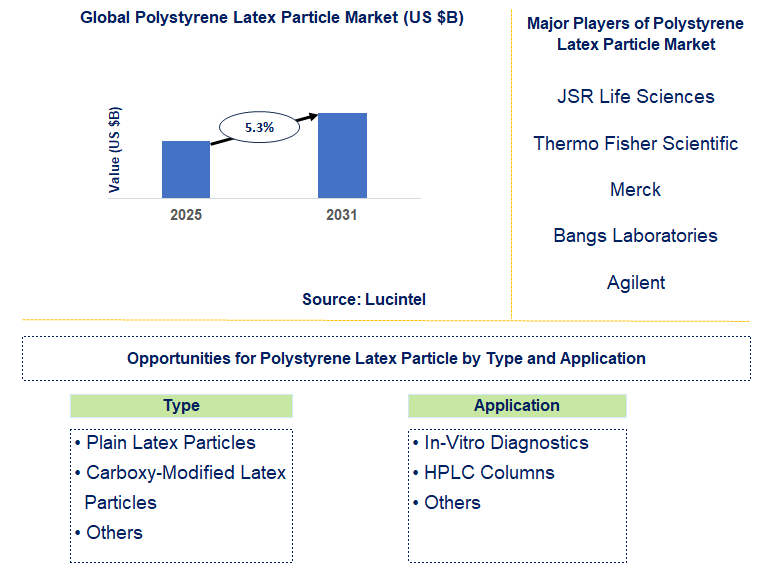
Key data points: The growth forecast = 5.3% annually for the next 7 years. Scroll below to get more insights. This market report covers trends, opportunities and forecasts in polystyrene latex particle market to 2031 by type (plain latex particles, carboxy-modified latex particles, and others), application (in-vitro diagnostics, HPLC columns, and others), and region (North America, Europe, Asia Pacific, and the Rest of the World)
We'll send your sample report shortly.
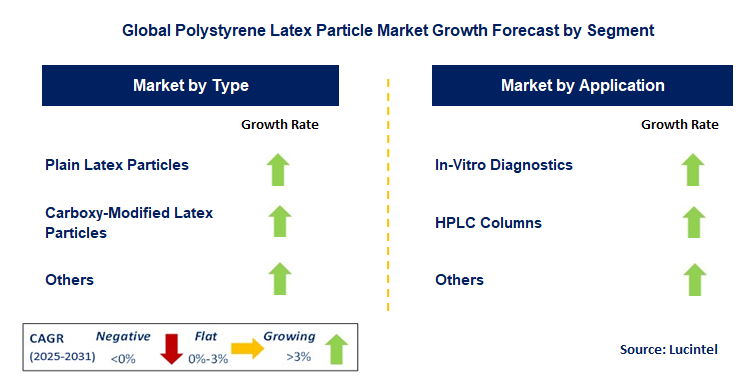
• Lucintel forecasts that, within the type category, carboxy-modified latex particle is expected to witness higher growth over the forecast period.
• Within the application category, in-vitro diagnostic is expected to witness higher growth.
• In terms of region, APAC is expected to witness the highest growth over the forecast period. Gain valuable insights for your business decisions with our comprehensive 150+ page report. Sample figures with some insights are shown below.
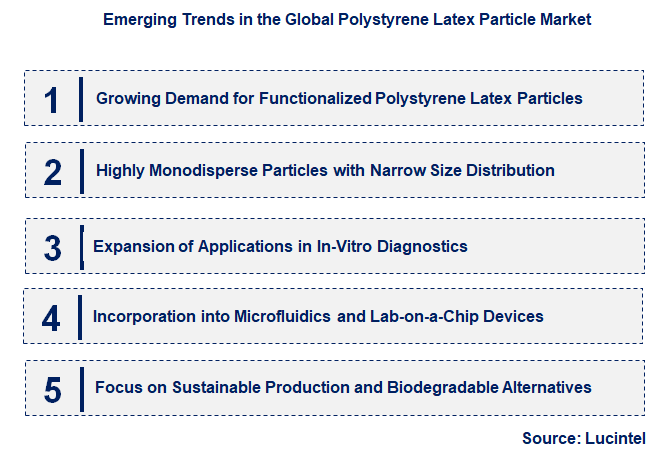
• Growing Demand for Functionalized Polystyrene Latex Particles: This movement emphasizes an evolution away from simple plain particles towards those with engineered surface chemistries. Functional groups such as carboxyl, amine, or hydroxyl are covalently attached to the particle surface, facilitating site-specific biomolecular conjugation for uses including immunoassays, drug delivery, and cell separation. This enables greater sensitivity, specificity, and efficiency in diagnostic assays and targeted therapy, enormously increasing the usefulness and potential of polystyrene latex particles in advanced biological and medical applications.
• Highly Monodisperse Particles with Narrow Size Distribution: This movement is directed toward obtaining unparalleled uniformity of particle size. Mono dispersity is essential for precise calibration, reproducibility of assay values, or uniform flow in microfluidic devices. Improved synthesis methods are enabling manufacturers to deliver particles with very tight size distributions, lowering variability and enhancing the consistency of diagnostic kits, calibration standards, and chromatographic media. This level of precision fosters performance improvements across an extensive array of scientific and industrial applications.
• Expansion of Applications in In-Vitro Diagnostics: This trend is one of the major drivers, as polystyrene latex particles are basic building blocks of numerous IVD methods such as lateral flow assays, turbidimetric assays, and bead-based immunoassays. The growing worldwide need for fast, precise, and cost-efficient diagnosis tests for infectious diseases, chronic diseases, and point-of-care testing is driving the market. Technological advancements aim at optimizing particles for higher sensitivity, stability, and ease of incorporating them into automated diagnostic platforms, rendering them essential in contemporary healthcare.
• Incorporation into Microfluidics and Lab-on-a-Chip Devices: This trend is a dramatic technological shift. Polystyrene latex particles are being used increasingly in miniaturized analytical systems to facilitate faster, more efficient, and frequently more sensitive diagnostic and research uses. Their regular size and ability to be modified on the surface make it possible to manipulate and interact with great accuracy within microchannels. This integration aids in developing portable, high-throughput, and automated diagnostic platforms, providing substantial benefits in point-of-care testing and high-throughput screening.
• Focus on Sustainable Production and Biodegradable Alternatives: This trend mirrors increased environmental pressure and regulation. Although polystyrene is not biodegradable, there is a developing emphasis in the marketplace to create more environmentally friendly production processes for polystyrene latex particles, such as waste reduction and energy efficiency. In addition, studies on alternative, biodegradable polymer particles that are able to mimic the characteristics of polystyrene latex are increasing in pace. This trend suggests a long-term shift in direction towards more environmentally friendly material science solutions. These new trends are essentially transforming the polystyrene latex particle market into one of increased performance, more accuracy, and wider versatility. The focus on highly monodisperse particles, as well as functionally modified ones, together with their incorporation within sophisticated diagnostic and microfluidic platforms, is leading the way toward innovative advancements. At the same time, the increasing emphasis on sustainability signifies a proactive mindset, keeping the market abreast of future environmental issues to ultimately further the value and potential of these multifaceted materials in multiple industries.
• Surface Functionalization Techniques have seen advancements: Recent advances have resulted in extremely advanced techniques to covalently attach diverse functional groups (e.g., carboxyl, amine, hydroxyl, streptavidin) onto the surface of polystyrene latex particles. This enables definitive tailoring of particle reactivity to specify attachment of biomolecules, antibodies, or DNA. This breakthrough greatly increases their usefulness in intricate immunoassays, molecular diagnostics, and targeted drug delivery systems, promoting increased sensitivity and specificity in diagnostic and therapeutic processes.
• Enhanced Manufacturing Processes for Better Mon dispersity: Great advances have been accomplished in polymerization methods for creating polystyrene latex particles with extremely narrow size distributions, or high mono dispersity. This level of particle size accuracy is important for uses needing precise calibration, reproducible assay performance, and predictable flow properties in microfluidic devices. These sophisticated production methods result in more consistent quality and more dependable products for demanding scientific and industrial applications, establishing new standards of particle uniformity.
• Development of Core-Shell and Composite Particles: A key development is the creation of polystyrene latex particles with core-shell structures or as composites with other materials. This allows for tailoring unique properties, such as magnetic responsiveness, fluorescence, or enhanced mechanical strength, while retaining the benefits of a polystyrene core. These hybrid particles open up new possibilities in advanced imaging, cell sorting, and multiplexed diagnostic assays, providing multifunctional capabilities that go beyond plain polystyrene particles.
• Broadening of Use in Point-of-Care Diagnostics: Recent advances reflect the growing incorporation of polystyrene latex particles in fast, handheld point-of-care diagnostic devices. Their stability and readiness to be functionalized for the detection of particular biomarkers render them suitable for use in lateral flow assays and other formats of rapid tests. The increase is spurred by the worldwide need for timely diagnostic information in various environments, ranging from clinics to rural communities, which has a direct impact on the market for highly sensitive and dependable particle components for POC systems.
• Introduction of GMP-Grade and Clinical-Grade Particles: With cell-based treatments and diagnostic tests emerging from research to clinical practice, a need for polystyrene latex beads produced under Good Manufacturing Practice (GMP) is increasing. New trends are the availability of GMP-grade beads with rigorous quality control, sterility, and traceability documentation from manufacturers. Such guarantees the integrity and reproducibility needed for in vitro diagnostics devices and in vivo biomedical uses, ensuring easier regulatory approval and speeding up the commercialization of new medical devices. These recent advances are having a profound influence on the polystyrene latex particle market by expanding the frontiers of particle performance, utility, and regulatory acceptability. The improvements in surface functionalization, monodispersed, composite architecture, and their pivotal role in point-of-care diagnostics, as well as ready access to GMP-grade materials, are converging to push the market towards manufacturing more advanced, dependable, and clinically significant products. This development guarantees the sustained progress and indispensability of polystyrene latex particles in an enormous range of high-tech and healthcare uses.
• Multiplexed Assays and High-Throughput Screening This application offers a big growth potential. The need for multiplexed diagnostic platforms to analyze multiple biomarkers from a single sample is growing. Polystyrene latex particles, particularly functionalized and barcoded particles, are the best suited for these assays and drug discovery high-throughput screening. Opportunities exist in designing particles tailored for such complex systems with increased sensitivity, minimal sample size, and accelerated results, thus speeding up disease diagnosis and therapeutic development.
• Targeted and Controlled Release: This application is a large, though early, growth area. Polystyrene latex particles can be designed as specific carriers for targeted drug delivery so that therapeutic agents are released with control to targeted cells or tissues. Strategic opportunities include the development of biodegradable or biocompatible polystyrene particles with optimized surface properties for drug loading and release kinetic profiles. This would transform cancer, infectious disease, and inflammatory disease therapies by reducing side effects and improving therapeutic efficacy.
• Nanoscale Metrology and Quality Control: The growing demand for accurate calibration and quality control across a variety of fields, ranging from electron microscopy to advanced manufacturing, is a compelling growth opportunity. Polystyrene latex beads, with their excellent uniformity of size and spherical shape, are a critical requirement as particle size analysis, flow cytometry, and microscopy calibration standards. Opportunities lie in the creation of ultra-accurate, certified reference materials at the nanoscale to serve the rigorous requirements of next-generation metrology applications and high-tech industries.
• Environmental Monitoring and Remediation: This product is a growing growth opportunity fueled by environmental concerns and regulations. Polystyrene latex particles can be functionalized to serve as sensing platforms for detecting pollutants in water, air, and soil. They can also be used in next-generation filtration systems for the removal of microplastics or wastewater treatment plants. Strategic opportunities include building specialized particles for these environmental applications, leading to sustainable solutions and tackling key ecological challenges.
• Optical and Mechanical Properties: Polystyrene latex particles are increasingly being applied as building blocks for innovative materials and coatings owing to their optical, mechanical, and surface characteristics. Opportunities include creating particles for light-diffusing film, anti-reflective coating, and structural parts in lightweight composites. Manipulation of particle size, shape, and surface chemistry can generate new materials with improved performance in terms of energy efficiency, smart windows, and high-performance engineering plastics, broadening the market to beyond conventional use. These growth opportunities are essentially influencing the polystyrene latex particle market by expanding its applications and driving innovation into higher value segments. The emphasis on advanced IVD, targeted drug delivery, accurate calibration, environmental solutions, and new material development creates the need for more advanced, functionalized, and highly characterized particles. This growth into new and emerging markets will propel substantial market expansion, promoting ongoing research and development to realize the full potential of polystyrene latex particles in resolving intricate social and technological problems.
• JSR Life Sciences
• Thermo Fisher Scientific
• Merck
• Bangs Laboratories
• Agilent
• Magsphere
• CD Bioparticles
• Fujikura Kasei
• Spherotech
• IKERLAT Polymers
• Plain Latex Particles
• Carboxy-Modified Latex Particles
• Others
• In-Vitro Diagnostics
• HPLC Columns
• Others
• North America
• Europe
• Asia Pacific
• The Rest of the World
• United States: The US market is a front runner in high-value polystyrene latex particles, particularly for sophisticated biomedical use. Recent advances involve large-scale investment in research and development in the production of highly functionalized particles for new diagnostic assays, targeted drug delivery systems, and advanced imaging. The focus is strong on the preparation of monodisperse particles with controlled surface chemistries to increase assay sensitivity and specificity. The strong presence of large pharmaceutical and diagnostic firms necessitates ongoing innovation and demand for high-quality, specially tailored polystyrene latex particles.
• China: China is a very dynamic market for polystyrene latex particles, with rising domestic manufacturing capacity and demand from its fast-growing healthcare and electronics industries. Current trends include efforts at expanding production to address the high volume demands of in vitro diagnostics and industrial markets. Although cost-effectiveness continues to be an important consideration, there is a developing trend towards enhanced particle quality and uniformity. Chinese firms are increasingly placing investments in R&D to create functionalized particles competitive with global standards, especially for use in advanced diagnostics and coatings.
• Germany: Germany’s polystyrene latex particle industry is propelled by its significant focus on advanced materials science and high-precision production. Some of the recent advances involve new particle synthesis technologies to obtain better monodispersed and narrow size distribution, essential for calibration standards and high-performance chromatography. There is a strong emphasis as well on sustainable production technologies and the creation of more environmentally friendly formulations. German firms are making concerted efforts at research collaborations to investigate new uses in advanced filtration and specialty coating applications based on their strength in polymer science.
• India: The Indian polystyrene latex particles market is experiencing steady growth, driven mainly by the growth in the diagnostics industry and rising research activities. Some recent trends include a shift towards cost-effective yet quality particles for diagnostic kits as well as academic research. Although there is a high dependence on imports to fulfill the demand, local players are slowly developing capabilities to supply standard-grade particles. There is growing interest in production on a local scale in an effort to cut down dependence on imports and to meet the particular demands of the fast-growing Indian healthcare and manufacturing industries.
• Japan; Japan’s market for polystyrene latex particles is the epitome of technology and precision and innovation. Advances feature the development of highly uniform and fictionized particles towards state-of-the-art biomedical applications, such as sophisticated immunoassay development and drug encapsulation. Japanese industries are well known for their proficiency in particle size and surface property control at the nano level, which is instilling innovation in areas such as microfluidics and biosensors. The industry is also witnessing a drive towards creating novel core-shell structures in order to deliver improved performance and stability.


• JSR Life Sciences
• Thermo Fisher Scientific
• Merck
• Bangs Laboratories
• Agilent
• Magsphere
• CD Bioparticles
• Fujikura Kasei
• Spherotech
• IKERLAT Polymers Q5. Which polystyrene latex particle market segment will be the largest in future? Answer: Lucintel forecasts that, within the type category, carboxy-modified latex particle is expected to witness higher growth over the forecast period. Q6. In polystyrene latex particle market, which region is expected to be the largest in next 5 years? Answer: In terms of region, APAC is expected to witness the highest growth over the forecast period. Q7. Do we receive customization in this report? Answer: Yes, Lucintel provides 10% customization without any additional cost.


Choose a license that fits your team. Instant PDF delivery.
Prices exclude taxes. Instant delivery. Custom licensing available on request.
Market Report · July 22, 2026
Market Report · July 22, 2026
Market Report · July 22, 2026
Trusted partner for strategic intelligence and business growth


Receive a complimentary market analysis tailored to your industry. Our analysts will identify key growth opportunities and competitive dynamics specific to your business.

Market size, growth rate, and key trend analysis for your specific sector.

Top competitor positioning and market share analysis.

Strategic recommendations backed by data-driven insights.
Get curated market intelligence and competitive moves straight to your inbox.
By subscribing, you agree to receive our monthly insights. Unsubscribe anytime.
Receive a complimentary market analysis tailored to your industry. Our analysts will identify key growth opportunities and competitive dynamics specific to your business.
Market size, growth rate, and key trend analysis for your specific sector.
Top competitor positioning and market share analysis.
Strategic recommendations backed by data-driven insights.
Get curated market intelligence, emerging trends, and competitive moves straight to your inbox each month.
By subscribing, you agree to receive our monthly insights. Unsubscribe anytime.
We'll send your sample report shortly.