
Market Report · July 22, 2026

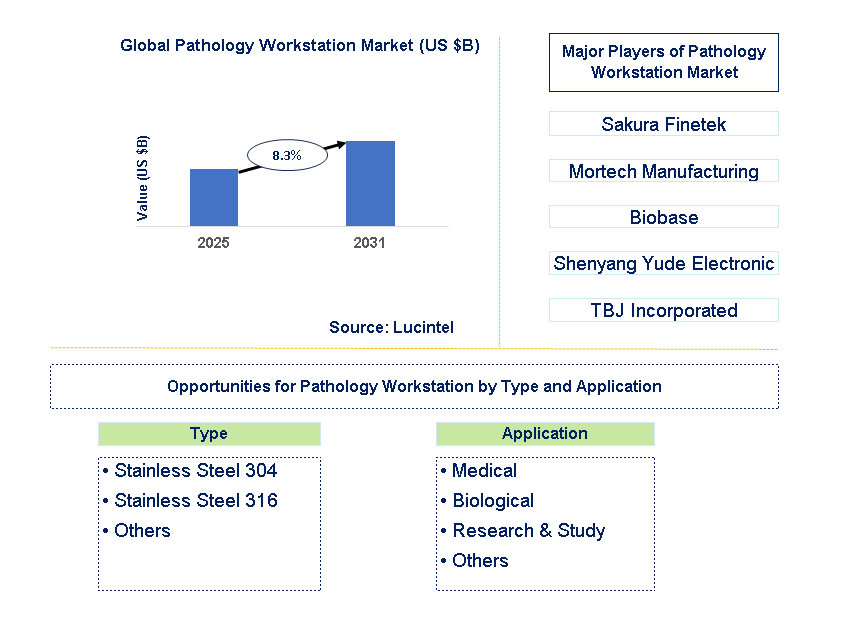
Key data points: The growth forecast = 8.3% annually for the next 7 years. Scroll below to get more insights. This market report covers Trends, opportunity and forecast in pathology workstation market to 2031 by type (stainless steel 304, stainless steel 316, and others), application (medical, biological, research & study, and others), and region (North America, Europe, Asia Pacific, and the Rest of the World)
We'll send your sample report shortly.
• Digital Pathology and Remote Diagnostics: Digital pathology is rapidly transforming how pathologists work by replacing traditional microscope-based analysis with high-resolution imaging and digital slides. Pathology workstations now allow pathologists to digitize, store, and analyze images remotely, making telepathology and remote diagnostics more accessible. This trend is particularly important in regions with limited access to pathology expertise, as it enables pathologists to consult remotely on complex cases. As digital pathology systems become more sophisticated, the integration of telepathology with pathology workstations is expected to grow, facilitating the exchange of diagnostic information across geographies.
• Automation for High-Throughput Workflows: As diagnostic workloads increase, particularly in busy hospitals and research institutions, there is a growing demand for automated pathology workstations that streamline sample processing. These systems automate tasks such as slide preparation, labeling, and image analysis, reducing the need for manual intervention and improving efficiency. Automation also leads to greater consistency in results, reduced human error, and faster turnaround times. High-throughput pathology workstations are expected to be in high demand as healthcare providers look to optimize lab workflows, especially in settings with a high volume of specimens.
• Integration with Electronic Health Records (EHR): The integration of pathology workstations with electronic health records (EHR) and laboratory information systems (LIS) is an emerging trend that enhances workflow efficiency and ensures better patient outcomes. By linking diagnostic results directly with a patient’s EHR, pathology workstations enable a seamless flow of data between healthcare providers, improving the speed and accuracy of diagnosis. This integration reduces the potential for errors caused by manual data entry and ensures that all patient information is up-to-date and accessible for further treatment planning.
• Cloud-Based Storage and Data Sharing: Cloud-based storage and data sharing are becoming increasingly important in the pathology workstation market. As pathology workstations generate large volumes of imaging data, storing this data in the cloud enables easy access and sharing across different healthcare facilities. Cloud-based systems also support AI-powered analysis and facilitate the storage of large datasets that are used for training AI algorithms. With cloud storage, pathologists can access patient data and images from anywhere, enabling better collaboration, especially in telepathology and remote diagnostics. The integration of AI, digital pathology, automation, EHR systems, and cloud-based solutions are driving major changes in the pathology workstation market. These technologies not only enhance the accuracy and efficiency of diagnostic processes but also improve the overall quality of patient care by enabling remote consultations and faster diagnosis. The future of pathology workstations will be increasingly centered around these innovations, reshaping how pathologists perform their work and collaborate with other healthcare providers." src="Emerging Trends in the Pathology Workstation Market" style="height: auto;width: auto;" title="The pathology workstation market is undergoing significant transformation as new technologies such as artificial intelligence (AI), machine learning, and automation become increasingly integrated into diagnostic workflows. These technologies are reshaping the role of pathology workstations by enhancing diagnostic accuracy, reducing turnaround times, and improving operational efficiency. As healthcare systems across the globe seek to improve outcomes while reducing costs, the following emerging trends are shaping the future of the pathology workstation market.
• Integration of AI: These systems use deep learning and machine learning algorithms to assist pathologists in analyzing tissue samples, recognizing patterns, and making more accurate diagnoses. AI integration enhances image recognition, helping to identify anomalies that may be difficult for human eyes to detect. This not only improves diagnostic precision but also reduces human error and speeds up the process. As AI technology continues to evolve, these workstations are becoming more intuitive and capable of providing pathologists with decision-support tools, thus increasing overall efficiency.
• Digital Pathology and Remote Diagnostics: Digital pathology is rapidly transforming how pathologists work by replacing traditional microscope-based analysis with high-resolution imaging and digital slides. Pathology workstations now allow pathologists to digitize, store, and analyze images remotely, making telepathology and remote diagnostics more accessible. This trend is particularly important in regions with limited access to pathology expertise, as it enables pathologists to consult remotely on complex cases. As digital pathology systems become more sophisticated, the integration of telepathology with pathology workstations is expected to grow, facilitating the exchange of diagnostic information across geographies.
• Automation for High-Throughput Workflows: As diagnostic workloads increase, particularly in busy hospitals and research institutions, there is a growing demand for automated pathology workstations that streamline sample processing. These systems automate tasks such as slide preparation, labeling, and image analysis, reducing the need for manual intervention and improving efficiency. Automation also leads to greater consistency in results, reduced human error, and faster turnaround times. High-throughput pathology workstations are expected to be in high demand as healthcare providers look to optimize lab workflows, especially in settings with a high volume of specimens.
• Integration with Electronic Health Records (EHR): The integration of pathology workstations with electronic health records (EHR) and laboratory information systems (LIS) is an emerging trend that enhances workflow efficiency and ensures better patient outcomes. By linking diagnostic results directly with a patient’s EHR, pathology workstations enable a seamless flow of data between healthcare providers, improving the speed and accuracy of diagnosis. This integration reduces the potential for errors caused by manual data entry and ensures that all patient information is up-to-date and accessible for further treatment planning.
• Cloud-Based Storage and Data Sharing: Cloud-based storage and data sharing are becoming increasingly important in the pathology workstation market. As pathology workstations generate large volumes of imaging data, storing this data in the cloud enables easy access and sharing across different healthcare facilities. Cloud-based systems also support AI-powered analysis and facilitate the storage of large datasets that are used for training AI algorithms. With cloud storage, pathologists can access patient data and images from anywhere, enabling better collaboration, especially in telepathology and remote diagnostics. The integration of AI, digital pathology, automation, EHR systems, and cloud-based solutions are driving major changes in the pathology workstation market. These technologies not only enhance the accuracy and efficiency of diagnostic processes but also improve the overall quality of patient care by enabling remote consultations and faster diagnosis. The future of pathology workstations will be increasingly centered around these innovations, reshaping how pathologists perform their work and collaborate with other healthcare providers." />
• AI-Enhanced Image Analysis and Diagnosis: One of the most significant developments in the pathology workstation market is the integration of AI and machine learning algorithms for image analysis. These systems assist pathologists by automating the process of detecting and diagnosing conditions such as cancer, enabling faster and more accurate assessments. AI-powered pathology workstations can analyze images in greater detail, helping to identify subtle patterns that may be missed by the human eye. This development is improving diagnostic precision and reducing the time pathologists need to spend on individual cases.
• Integration of Digital Pathology Systems: The shift from traditional microscopy to digital pathology is one of the most transformative changes in the pathology workstation market. Workstations are now designed to accommodate high-resolution imaging and support digital slides, allowing pathologists to store, share, and analyze tissue samples electronically. This advancement enables remote consultations, telepathology, and the integration of pathology images into broader health IT systems, improving collaboration and access to expertise. The integration of digital pathology with workstations is streamlining workflows and making diagnostic processes more efficient.
• Automation of Laboratory Processes: Automation continues to be a key development in the pathology workstation market. Automated workstations streamline various tasks such as slide preparation, labeling, and image processing, reducing the need for manual intervention. Automation improves workflow efficiency, consistency, and accuracy, enabling pathology labs to handle a higher volume of specimens with fewer resources. This development is particularly beneficial in high-throughput labs and hospitals, where speed and accuracy are crucial in managing large patient volumes.
• Cloud-Based Solutions for Data Storage and Sharing: Cloud-based pathology workstations have become increasingly popular, offering several advantages over traditional local storage systems. Cloud solutions enable easier data access and sharing, allowing pathologists and healthcare providers to collaborate on cases from different locations. Additionally, cloud platforms support AI-powered analysis, enabling the continuous improvement of diagnostic tools and algorithms. The use of cloud-based storage is improving the scalability of pathology operations and reducing the costs associated with on-premise infrastructure.
• Telepathology Integration: Telepathology has become a crucial component of modern pathology workstations, enabling pathologists to remotely review slides and collaborate with colleagues across the globe. Telepathology integration allows for faster diagnoses, particularly in areas with limited access to specialists. It also facilitates second opinions and expert consultations, improving the accuracy and quality of diagnoses. As healthcare systems embrace remote diagnostics, telepathology will continue to play a central role in the development of pathology workstation solutions. The developments in AI, digital pathology, automation, cloud-based solutions, and telepathology are revolutionizing the pathology workstation market. These innovations are improving diagnostic accuracy, streamlining workflows, and enhancing the ability to collaborate across geographic regions. As these trends continue, the pathology workstation market is expected to grow, offering more sophisticated and efficient tools for pathologists and healthcare providers.
• Oncology Diagnostics: The oncology sector is one of the largest growth areas for pathology workstations, as the need for early and accurate cancer detection is rising globally. Pathology workstations integrated with AI and digital pathology systems enable more precise identification of cancerous tissues, as well as the analysis of complex biomarkers and genetic data. This results in faster diagnoses and more personalized treatment plans. Moreover, with the increasing burden of cancer, especially in aging populations, pathologists are turning to workstations with advanced imaging capabilities to handle the growing volume of cancer-related cases. This trend is likely to continue as precision oncology grows in importance.
• Clinical Pathology: In clinical pathology, pathology workstations are evolving to support a wide range of diagnostic tests, from hematology and microbiology to immunohistochemistry and genetic testing. These workstations enable pathologists to manage and analyze large volumes of test results quickly and accurately, reducing turnaround times. The integration of automated systems and AI-driven analysis into clinical pathology workstations is significantly enhancing diagnostic workflows and helping to streamline lab operations.
• Telepathology and Remote Diagnostics: Telepathology represents a significant growth opportunity for pathology workstations, driven by the increasing adoption of remote diagnostic tools and telemedicine platforms. Workstations that enable the transmission of high-resolution digital slides to remote pathologists are allowing for faster consultations, second opinions, and diagnoses, particularly in underserved or rural regions where access to specialists is limited. The expansion of telemedicine, especially accelerated by the COVID-19 pandemic, is fueling the demand for pathology workstations equipped with telepathology capabilities. As healthcare systems continue to embrace remote care, telepathology will remain a crucial growth area for pathology workstations.
• Precision Medicine and Personalized Healthcare: The rise of precision medicine is driving the demand for pathology workstations capable of integrating genetic, molecular, and clinical data for highly personalized treatment strategies. Pathology workstations in this space must handle complex datasets, including genomic and proteomic information, to deliver tailored diagnostic insights. As the healthcare industry continues to shift towards individualized treatment plans, the need for advanced pathology workstations that support precision medicine is growing. This trend is especially important in oncology and rare diseases, where personalized approaches can significantly improve patient outcomes.
• Automation and High-Throughput Testing: The push for automation in laboratory settings is driving the demand for high-throughput pathology workstations that can manage a large number of samples simultaneously. Automated workstations can perform routine tasks like slide preparation, staining, and imaging with minimal human intervention, increasing efficiency and reducing errors. This trend is particularly relevant in high-volume labs and hospitals where time is a critical factor. Automated pathology workstations are also enhancing the standardization of results, ensuring greater consistency across different laboratories. Strategic growth opportunities in the pathology workstation market are centered around critical applications like oncology diagnostics, clinical pathology, telepathology, precision medicine, and automation. These applications are driving innovation and market demand by addressing key healthcare needs, such as faster diagnoses, more personalized treatments, and greater access to specialized care. As these trends continue to evolve, pathology workstations are becoming indispensable tools in modern diagnostics, fostering market growth across diverse healthcare sectors.
• Sakura Finetek
• Mortech Manufacturing
• Biobase
• Shenyang Yude Electronic Instrument
• TBJ Incorporated
• Stainless Steel 304
• Stainless Steel 316
• Others
• Medical
• Biological
• Research & Study
• Others
• North America
• Europe
• Asia Pacific
• The Rest of the World
• United States: In the United States, the pathology workstation market is evolving rapidly due to advances in digital pathology, AI-assisted diagnostics, and integration with telepathology systems. The U.S. market has seen strong adoption of AI-driven pathology workstations that assist pathologists in diagnosing diseases such as cancer, improving diagnostic accuracy, and reducing workloads. Key players in the U.S. are incorporating advanced features like high-resolution imaging, 3D visualization, and machine learning algorithms to enhance efficiency. Additionally, the push towards automation in labs is driving the growth of fully integrated pathology workstations that allow for seamless sample analysis, data management, and reporting.
• China: China is witnessing significant growth in the pathology workstation market, driven by the expansion of healthcare infrastructure and increased government support for technological advancements in medical devices. Pathology workstations with integrated AI for automated image analysis and data processing are being adopted at a rapid pace in hospitals and research institutions. The Chinese market is also seeing increased investment in digital pathology technologies to support early cancer detection and improve clinical decision-making. With healthcare reforms focusing on precision medicine, there is growing demand for workstations capable of handling complex diagnostics, contributing to the market’s expansion.
• Germany: Germany’s pathology workstation market is characterized by a high level of adoption of digital solutions, with a focus on enhancing diagnostic accuracy through AI and automation. The country’s robust healthcare system and emphasis on research and development have spurred growth in the market. German companies are leading the way in developing pathology workstations with integrated digital pathology systems that facilitate remote diagnosis and telepathology. Moreover, Germany’s regulatory environment supports innovation, allowing for the rapid deployment of cutting-edge technology in pathology workstations. With increasing collaboration between medical device manufacturers and academic institutions, Germany is at the forefront of advancing pathology workstation capabilities.
• India: India’s pathology workstation market is growing steadily, driven by the demand for efficient and affordable diagnostic tools to support the country’s large population. With a rising incidence of cancer and other chronic diseases, Indian healthcare providers are increasingly adopting pathology workstations equipped with automation features to streamline operations and reduce human error. However, the adoption rate is still limited by budget constraints in smaller labs and healthcare centers. There is also a growing interest in integrating pathology workstations with telemedicine platforms, especially in rural areas, to bridge the gap in access to specialized medical expertise.
• Japan: Japan’s pathology workstation market is experiencing rapid advancements in automation and integration with digital pathology systems. The country’s aging population and the focus on improving healthcare efficiency are major factors driving the adoption of advanced pathology workstations. In Japan, pathology workstations are being used to integrate AI-driven image analysis, which helps pathologists make faster and more accurate diagnoses, particularly in oncology. Additionally, Japan’s healthcare policies encourage the adoption of precision medicine, increasing the demand for advanced pathology workstations capable of handling high-resolution imaging and complex diagnostic workflows.


• Sakura Finetek
• Mortech Manufacturing
• Biobase
• Shenyang Yude Electronic Instrument
• TBJ Incorporated Q5. Which pathology workstation market segment will be the largest in future? Answer: Lucintel forecasts that stainless steel 304 will remain larger segment over the forecast period due to highly resistant to rust, staining, and oxidation. Q6. In pathology workstation market, which region is expected to be the largest in next 5 years? Answer: North America will remain the largest region over the forecast period due to well-established healthcare system. Q7. Do we receive customization in this report? Answer: Yes, Lucintel provides 10% customization without any additional cost.


Choose a license that fits your team. Instant PDF delivery.
Prices exclude taxes. Instant delivery. Custom licensing available on request.
Market Report · July 22, 2026
Market Report · July 22, 2026
Market Report · July 22, 2026
Trusted partner for strategic intelligence and business growth


Receive a complimentary market analysis tailored to your industry. Our analysts will identify key growth opportunities and competitive dynamics specific to your business.

Market size, growth rate, and key trend analysis for your specific sector.

Top competitor positioning and market share analysis.

Strategic recommendations backed by data-driven insights.
Get curated market intelligence and competitive moves straight to your inbox.
By subscribing, you agree to receive our monthly insights. Unsubscribe anytime.
Receive a complimentary market analysis tailored to your industry. Our analysts will identify key growth opportunities and competitive dynamics specific to your business.
Market size, growth rate, and key trend analysis for your specific sector.
Top competitor positioning and market share analysis.
Strategic recommendations backed by data-driven insights.
Get curated market intelligence, emerging trends, and competitive moves straight to your inbox each month.
By subscribing, you agree to receive our monthly insights. Unsubscribe anytime.
We'll send your sample report shortly.