
Market Report · July 22, 2026

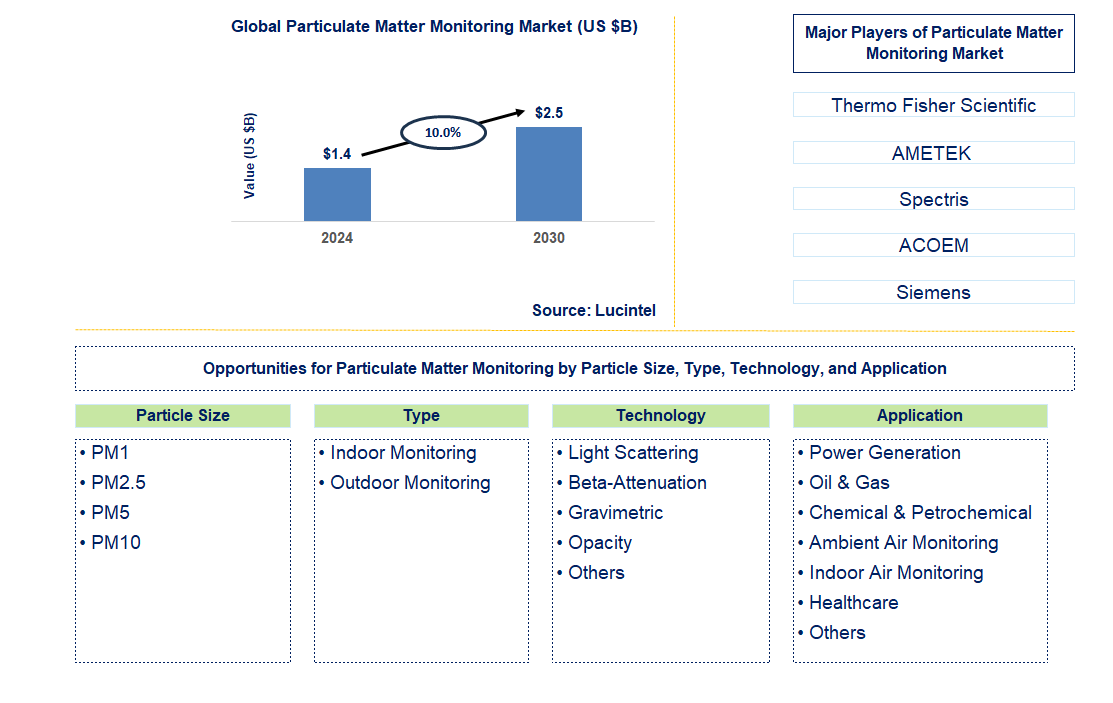
Key data points: The market size in 2030 = $2.5 billion, growth forecast = 10.0% annually for the next 6 years. Scroll below to get more insights. This market report covers trends, opportunities, and forecasts in the global particulate matter monitoring market to 2030 by particle size (PM1, PM2.5, PM5, and PM10), type (indoor monitoring and outdoor monitoring), technology (light scattering, beta-attenuation, gravimetric, opacity, and others), application (power generation, oil & gas, chemical & petrochemical, ambient air monitoring, indoor air monitoring, healthcare, and others), and region (North America, Europe, Asia Pacific, and the Rest of the World)
We'll send your sample report shortly.
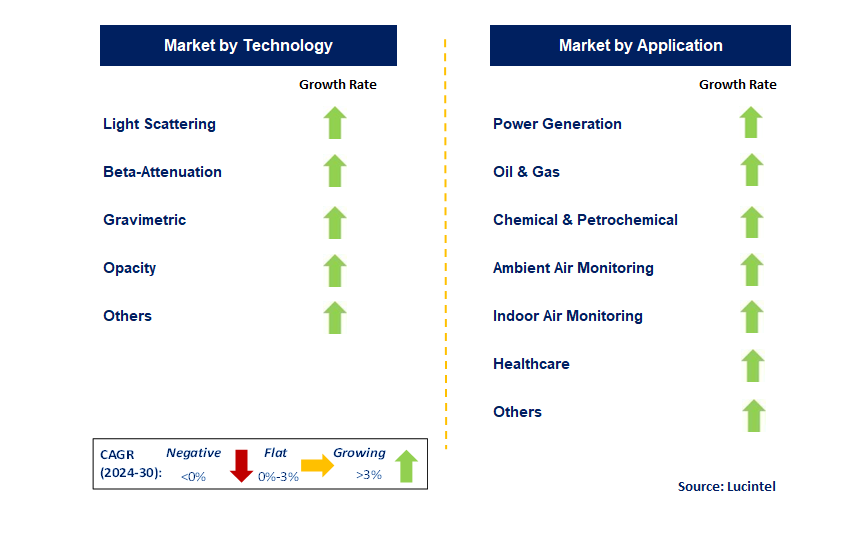
• Lucintel forecasts that, within the technology category, beta-attenuation segment is expected to witness the highest growth over the forecast period due to its widespread use, detecting PM2.5 and PM10, despite being costly, resulting in slower growth.
• Within the application category, oil & gas segment will remain the largest segment due to extensive production processes and diverse pollutant sources, necessitating precise particulate matter monitoring.
• In terms of regions, APAC is expected to witness the highest growth over the forecast period due to rapid economic growth, significant industrial activities, and increased demand for air quality solutions in developing countries like India and China. A more than 150-page report is developed to help in your business decisions.
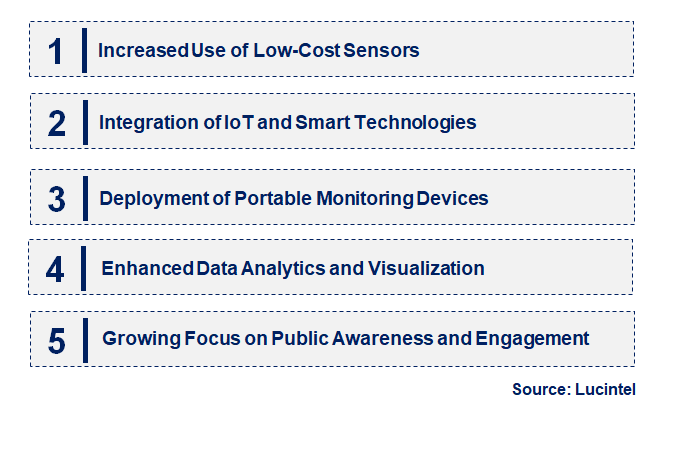
• Increased Use of Low-Cost Sensors: Affordable and highly accurate PM sensors are making real-time air pollution monitoring more accessible. These sensors are increasingly being deployed in both urban and rural areas to collect valuable air quality data and assist in pollution control efforts.
• Integration of IoT and Smart Technologies: The development of Internet of Things (IoT) devices and smart networks is enhancing PM monitoring systems. By leveraging IoT, sensors can communicate with smart networks to provide more efficient and real-time pollution control.
• Deployment of Portable Monitoring Devices: The growing use of portable PM monitors is increasing the convenience and flexibility of air pollution assessment. These devices are especially useful for personal use, and can be employed both indoors and outdoors, as well as in industrial environments.
• Enhanced Data Analytics and Visualization: The use of advanced data analytics and visualization tools is improving the interpretation of PM monitoring data. These tools help evaluate pollutant sources, patterns, and effects, and contribute to the formulation of air quality management strategies and regulatory measures.
• Growing Focus on Public Awareness and Engagement: There is a greater emphasis on using PM monitoring data to raise public awareness and encourage participation in air quality management. Efforts to make Air Quality Index (AQI) information more accessible through mobile apps and the internet are helping to engage the public in real-time pollution monitoring. These trends are shaping the future of the particulate matter monitoring industry by increasing its role in ecosystem management. Technological advancements and better data collection are improving the efficiency of air quality monitoring and advocacy.
• Advancements in Sensor Technology: New sensor technologies are more affordable and accurate, making real-time PM monitoring more feasible. These advancements are expanding coverage and enhancing data quality.
• Expansion of Monitoring Networks: Many countries are expanding their PM monitoring networks to cover more regions and provide comprehensive air quality data. This expansion aids in pollution control and public health protection.
• Integration of Remote Sensing: Satellite-based and remote monitoring systems are expected to extend the geographic scope of particulate matter monitoring and provide supplementary data that complements surface-level measurements.
• Development of Mobile Monitoring Units: Mobile PM monitoring units are being developed to allow users to assess air quality at any time and location. These units are particularly beneficial for monitoring air quality in different settings, from urban areas to industrial sites.
• Focus on Data Standardization: Efforts to standardize particulate matter monitoring data are underway, enabling better data integration across different regions and monitoring systems. This standardization will help facilitate data comparison and improve the formulation of air quality management strategies. These developments are enhancing the technological sophistication, geographical reach, and data accuracy of the particulate matter monitoring market. They are also improving air quality management practices and contributing to better public health outcomes.
• Urban Air Quality Monitoring: There is a growing opportunity to expand air quality monitoring networks in urban areas. As more cities install and upgrade monitoring systems, these efforts will improve both public health and pollution management by utilizing advanced sensors and data analytics.
• Industrial Emission Monitoring: In industrial settings, there is an increasing need for PM monitoring systems to ensure emissions comply with environmental standards while enhancing operational efficiency. Advanced monitoring systems are expected to help industries more effectively control emissions and improve compliance with regulations.
• Environmental Research: The application of high-performance PM monitoring tools in environmental research provides deeper insights into pollution sources and their impacts. This research is essential for shaping air quality policies and advancing technology development.
• Public Health Applications: Integrating PM monitoring data into public health systems offers valuable solutions for managing air quality-related health risks. Providing real-time data on particulate matter levels can help healthcare providers mitigate the impact of pollutants on vulnerable populations.
• Consumer Awareness Tools: Developing consumer-focused tools, such as mobile apps and personal air pollution sensors, presents an opportunity to engage the public in air quality management. These tools can raise awareness about pollution risks and provide individuals with actionable data to reduce exposure. These growth opportunities are transforming the particulate matter monitoring market by fostering innovation and expanding its applications across urban, industrial, and consumer sectors. Increased emphasis on monitoring in these areas is improving the overall management of air quality.
• Regulatory Pressures: Stricter air quality standards and regulations are pushing the demand for more advanced PM monitoring solutions. Governments are enacting policies that require more comprehensive air quality data, further boosting the market for monitoring systems.
• Technological Advancements: Advances in sensor technologies, data processing, and IoT infrastructure are enhancing the accuracy and operational efficiency of PM monitoring systems. These innovations make it easier to deploy and manage networks of monitoring systems, especially when integrated with cloud technologies.
• Greater Awareness of Air Quality Issues: Growing public concern about the health effects of air pollution is increasing the demand for accessible air quality data. This trend is driving investments in monitoring equipment and encouraging community engagement in air quality management.
• Urbanization and Industrial Growth: As more people move to urban areas and industrial activities increase, there is a greater demand for efficient PM monitoring systems to track pollution levels. These systems are critical for controlling pollution sources and minimizing their negative effects on public health and the environment.
• Investment in Environmental Programs: Increased investment in environmental monitoring and policy programs is accelerating the development of new PM monitoring technologies. Both public and private sector investments are expanding the scope and capacity of monitoring networks worldwide. Challenges in the particulate matter monitoring market are:
• High Costs of Advanced Technologies: The high cost of advanced PM monitoring technologies is a major barrier to adoption, particularly in developing countries or for smaller organizations. Cost-effective strategies must be implemented to make these technologies more accessible.
• Data Integration and Standardization Issues: Integrating and standardizing PM data from different monitoring devices and regions can be challenging. Efforts to standardize data formats and measurement methods are essential to improve data consistency and comparability.
• Maintenance and Calibration Requirements: Regular calibration and maintenance of PM monitoring systems are required to ensure the accuracy of collected data. This can be a complex and costly task, particularly for large-scale monitoring networks. Despite these challenges, the particulate matter monitoring market is growing rapidly due to technological advancements, regulatory support, and increasing public awareness. Overcoming these obstacles and capitalizing on emerging growth trends will define the future of the market.
• Thermo Fisher Scientific
• AMETEK
• Spectris
• ACOEM
• Siemens
• PM1
• PM2.5
• PM5
• PM10
• Indoor Monitoring
• Outdoor Monitoring
• Light Scattering
• Beta-Attenuation
• Gravimetric
• Opacity
• Others
• Power Generation
• Oil & Gas
• Chemical & Petrochemical
• Ambient Air Monitoring
• Indoor Air Monitoring
• Healthcare
• Others
• North America
• Europe
• Asia Pacific
• The Rest of the World
• United States: The U.S. has seen significant investment in sophisticated PM monitoring technologies, such as low-cost sensors and real-time data analytics. New state and federal regulations are driving the demand for more detailed and accurate monitoring solutions. Additionally, there is an increasing trend to combine PM data with policies related to public health and environmental protection.
• China: China is investing heavily in building extensive PM monitoring networks as part of its air quality management optimization initiatives. The use of satellite data, coupled with ground-based measurements, is improving the accuracy and coverage of PM monitoring. China is also focusing on developing affordable, easy-to-use monitoring systems suitable for both urban and industrial applications.
• Germany: Germany is prioritizing the installation of high-resolution sensors as part of its air quality monitoring efforts, including smart city projects. The country is working to improve the quantitative accuracy and transparency of air quality data, in compliance with stringent environmental laws. There is also a strong focus on innovation in science and technology to enhance monitoring system performance.
• India: India is focusing on expanding PM monitoring systems in cities to address severe air pollution challenges. New programs are deploying low-cost sensors and mobile units to provide real-time air quality data to the public and assist in regulatory enforcement.
• Japan: Japan is strengthening its PM monitoring network with the addition of remote sensing technologies and real-time data analytics. The aim is to improve the accuracy of monitoring systems and integrate them with disaster management frameworks to address air quality emergencies. Research is also underway to enhance detection capabilities and reliability.


• Thermo Fisher Scientific
• AMETEK
• Spectris
• ACOEM
• Siemens Q6. Which particulate matter monitoring market segment will be the largest in future? Answer: Lucintel forecasts that beta-attenuation segment is expected to witness the highest growth over the forecast period due to its widespread use, detecting PM2.5 and PM10, despite being costly, resulting in slower growth. Q7. In particulate matter monitoring market, which region is expected to be the largest in next 5 years? Answer: APAC is expected to witness the highest growth over the forecast period due to rapid economic growth, significant industrial activities, and increased demand for air quality solutions in developing countries like India and China. Q.8 Do we receive customization in this report? Answer: Yes, Lucintel provides 10% customization without any additional cost.


Choose a license that fits your team. Instant PDF delivery.
Prices exclude taxes. Instant delivery. Custom licensing available on request.
Market Report · July 22, 2026
Market Report · June 26, 2026
Market Report · May 18, 2026
Trusted partner for strategic intelligence and business growth


Receive a complimentary market analysis tailored to your industry. Our analysts will identify key growth opportunities and competitive dynamics specific to your business.

Market size, growth rate, and key trend analysis for your specific sector.

Top competitor positioning and market share analysis.

Strategic recommendations backed by data-driven insights.
Get curated market intelligence and competitive moves straight to your inbox.
By subscribing, you agree to receive our monthly insights. Unsubscribe anytime.
Receive a complimentary market analysis tailored to your industry. Our analysts will identify key growth opportunities and competitive dynamics specific to your business.
Market size, growth rate, and key trend analysis for your specific sector.
Top competitor positioning and market share analysis.
Strategic recommendations backed by data-driven insights.
Get curated market intelligence, emerging trends, and competitive moves straight to your inbox each month.
By subscribing, you agree to receive our monthly insights. Unsubscribe anytime.
We'll send your sample report shortly.