
Market Report · July 22, 2026

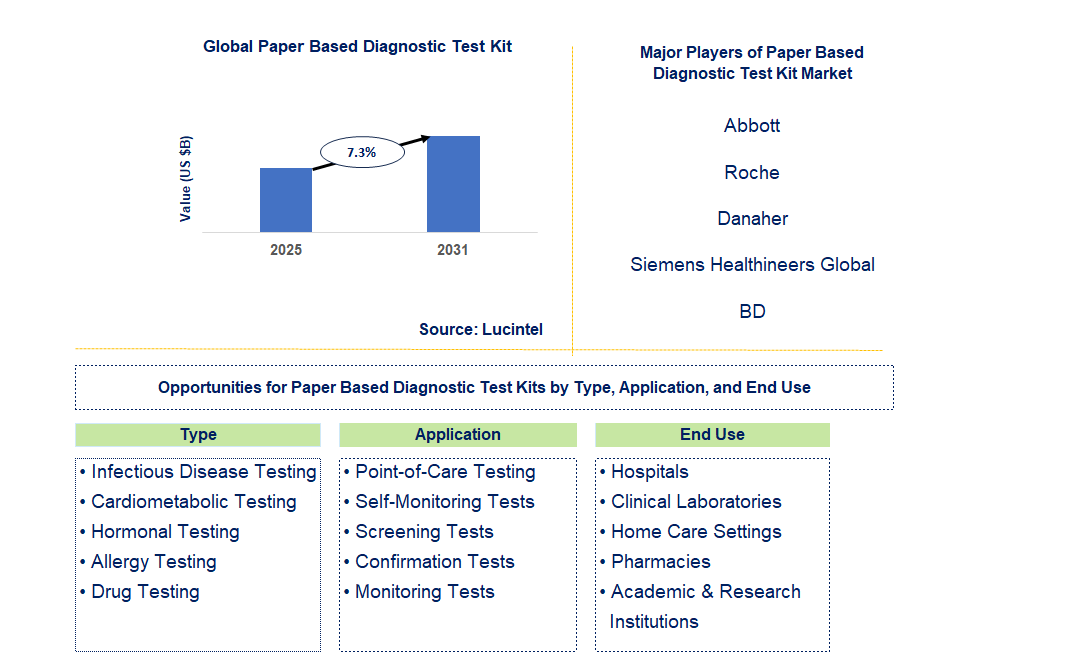
Key data points: The growth forecast = 7.3% annually for the next 7 years. Scroll below to get more insights. This market report covers trends, opportunities and forecasts in paper based diagnostic test kit market to 2031 by type (infectious disease testing, cardiometabolic testing, hormonal testing, allergy testing, and drug testing), application (point-of-care testing, self-monitoring tests, screening tests, confirmation tests, and monitoring tests), end use (hospitals, clinical laboratories, home care settings, pharmacies, and academic & research institutions), and region (North America, Europe, Asia Pacific, and the Rest of the World)
We'll send your sample report shortly.
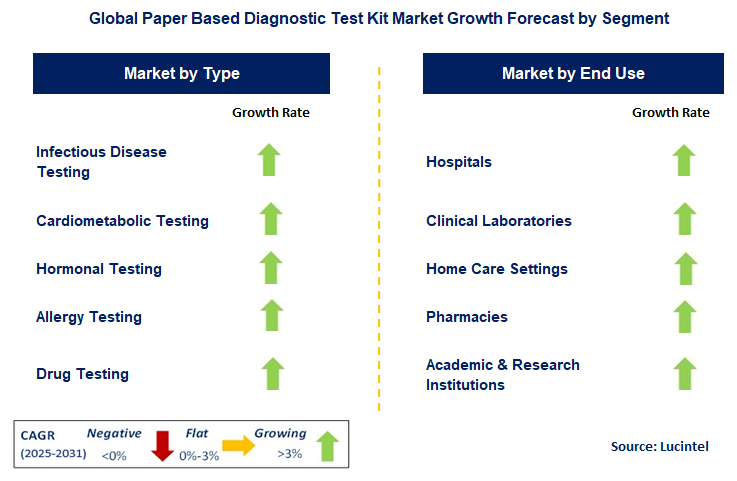
• Lucintel forecasts that, within the type category, infectious disease testing is expected to witness the highest growth over the forecast period.
• Within the end use category, home care setting is expected to witness the highest growth.
• In terms of region, APAC is expected to witness the highest growth over the forecast period. Gain valuable insights for your business decisions with our comprehensive 150+ page report. Sample figures with some insights are shown below.
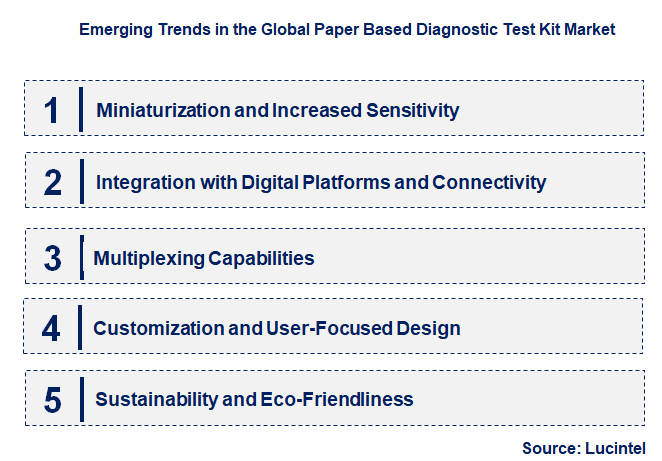
• Miniaturization and Increased Sensitivity: This trend involves creating paper-based diagnostic kits that are tiny, light in weight, and can identify very low levels of biomarkers. The advancements in paper microfluidics and nanotechnology permit better sample handling and signal amplification, resulting in greater sensitivity and specificity. The effect is profound since it allows for earlier and more precise disease detection, even using minute sample amounts, increasing the utility of such tests for many conditions, such as complicated diseases and infections at the early stages.
• Integration with Digital Platforms and Connectivity: An emerging trend is the combination of paper-based test kits with digital technology, typically via smartphone apps or specialized readers. Automated interpretation of results, storage, and remote reporting to healthcare professionals result from this combination. The effect is revolutionary, enhancing the accuracy of results by minimizing human error interpretation, enabling real-time disease surveillance, and allowing telemedicine and remote patient monitoring. This connectivity also enables the aggregation of data for epidemiological surveillance and public health management.
• Multiplexing Capabilities: The trend in the industry is shifting toward multiplexed paper-based diagnostic test kits that are capable of detecting multiple analytes or pathogens from one sample. This requires the development of complex paper channels and the use of multiple reagents for simultaneous detection. The result is a more integrated diagnostic output from a single test, reducing time and resources. For instance, one kit might be able to test for several respiratory viruses or a set of infectious disease markers, making the diagnosis more efficient and enabling better clinical decision-making.
• Customization and User-Focused Design: There is an increased focus on developing paper-based diagnostic kits that can be customized for particular uses or target groups, and are very user-friendly. This involves customizing tests for various sample types, target analytes, or even particular environmental conditions. User-centered design aims at intuitive interfaces, straightforward instructions, and fewer user steps. The effect is more widespread adoption by non-expert users, including home testing, and higher accuracy due to less user error, making diagnosis more convenient and effective for varied needs.
• Sustainability and Eco-Friendliness: Due to rising environmental consciousness, there is a strong tendency towards creating paper-based diagnostic kits that are more sustainable and environmentally friendly. This is achieved through the application of biodegradable materials, waste minimization, and investigation into different fabrication techniques that minimize the environmental impact. The effect is double: it contributes to the goal of worldwide sustainability, appealing to green consumers and health practitioners, and possibly lowers the total cost of waste disposal. This emphasis on green chemistry favors a sound diagnosis development approach. These new trends are essentially transforming the paper based diagnostic test kit market by pushing innovation toward more advanced, connected, and environmentally friendly solutions. Ongoing innovation in sensitivity, digitalization, multiplexing, user-design focus, and sustainability guarantees that paper-based diagnostics will be increasingly central to future healthcare systems, most importantly in increasing rapid and affordable access to testing across the world.
• Improved Sensitivity by Incorporating Nanomaterials: One of the most important advances is the incorporation of nanomaterials, including gold nanoparticles and quantum dots, into paper-based diagnostic kits. These nanomaterials dramatically boost the signal, resulting in significantly improved sensitivity and specificity, enabling the detection of biomarkers at much lower levels. The effect is a significant enhancement of diagnostic precision, allowing for earlier diagnosis of the disease and more consistent outcomes, especially for diseases where early diagnosis is essential, thus enhancing the clinical applicability of these low-cost tests.
• Smartphone Connectivity and Digital Readouts: The trend in the market is high towards the incorporation of digital readouts and smartphone connectivity into paper-based test sets. This is done through the utilization of compact, handheld readers or phone cameras to quantify test results objectively, removing the subjective visual interpretation. The effect is multi-dimensional: it minimizes human error, enables objective and accurate measurements, makes data logging and sharing with healthcare professionals easier, and allows remote monitoring of patients and telemedicine, making these tests stronger and more appropriate for professional as well as home applications.
• Development of Multi-Analyte Detection Platforms: Recent breakthroughs involve the creation of paper-based diagnostic kits that can detect multiple analytes from one sample at once. This multiplexing is made possible by advanced paper microfluidics and reagent patterning. The consequence is a more complete diagnostic test in one go, conserving time and resources. For example, one kit can detect a number of infectious agents or a set of biomarkers to manage chronic disease in one go, making diagnostic processes simpler and enhancing clinical efficiency.
• Self-Sustaining and Independent Devices: Market innovations involve the development of self-sustaining paper-based diagnostic devices based on electrochemical reactions triggered by the sample itself or the touch of the user. This does away with the necessity for an external power supply or heavy equipment, thereby making them more portable. The effect is revolutionary for point-of-care diagnostics in remote or resource-poor locations where electricity is not available. Standalone devices now bring diagnostics to everyone's fingertips, facilitating prompt testing anywhere, anytime, without having to invest in sophisticated infrastructure.
• Expansion to Non-Clinical Uses: In addition to conventional clinical diagnostics, the most significant development is the diversification of paper-based test kits to non-clinical use. Examples are environmental analysis (e.g., detection of contaminants in water, air purity), food safety analysis (e.g., detection of pathogens, pesticides), and even use in agriculture (e.g., detection of plant diseases). The effect is market diversification of opportunities, taking advantage of the intrinsic merits of paper-based tests for speedy on-site diagnosis in many industries, furthering public health and safety, aside from direct patient care. All these advances are contributing collectively to the paper based diagnostic test kit market by making such tests more precise, adaptable, and convenient. They are expanding the capabilities of low-cost, handheld diagnostics, thus providing greater access to essential health information in a wide range of environments and making significant contributions to global health programs.
• Point-of-Care Infectious Disease Testing: The strongest growth potential is in POC diagnosis of infectious diseases, particularly in resource-poor settings and during outbreaks. Paper-based kits provide rapid turnaround times, are simple to use, and have low infrastructure requirements, making them well-suited for diagnosing conditions such as malaria, dengue, HIV, and influenza directly at the patient point. The ongoing discovery of new pathogens and the necessity for prompt containment measures guarantee a consistent high demand for these inexpensive, yet portable diagnostic devices that minimize disease transmission and enhance patient care.
• Chronic Disease Monitoring: The increasing worldwide incidence of chronic conditions, including diabetes and cardiovascular disease, is a large growth market. Paper-based home testing kits can offer regular, easy checking of biomarkers such as blood sugar or heart enzymes in the home or community environment. This improves disease management, allows early intervention, and allows patients to take an active role in their treatment, lessening the load on healthcare centers. The trend towards preventive and personalized medicine also enhances demand here.
• Environmental and Food Safety Testing: Outside of clinical diagnostics, an enormous strategic expansion potential lies in using paper-based test kits for environmental and food safety monitoring. The kits quickly identify contaminants, pollutants, pesticides, and pathogens in water, soil, and food items in the field. They are easy to use and inexpensive, making them perfect for immediate screening in industrial, agricultural, and public health surveillance uses, guaranteeing safety requirements and avoiding mass outbreaks or ecological compromise. This also opens up the market to applications other than human health use.
• Veterinary Diagnostics and Animal Health: The increasing global livestock and pet population, combined with growing concern about animal health and zoonotic disease, presents a highly rewarding growth opportunity. Paper-based diagnostic kits have the potential for quick, on-site detection of animal diseases and can be employed to avoid outbreaks, provide assurance of food safety, and promote animal welfare. Their convenience and portability make them especially valuable for use in distant farm locations or for periodic screening, rendering them an effective tool for veterinarians and pet owners alike.
• Direct-to-Consumer Health and Wellness Testing: The rapidly developing direct-to-consumer market for personal health and wellness testing is a new growth prospect. Paper-based test kits can allow users to conduct quick tests for nutritional inadequacies, allergy, fertility, or overall wellness markers in their own homes. This is fueled by rising health awareness and a need for convenient, personal access to health data, allowing individuals to make informed choices regarding their lifestyle and consult professional medical opinion when required. These growth opportunities are strategically influencing the paper-based diagnostic test kit market by expanding its areas of application and facilitating innovation. The flexibility, cost-effectiveness, and ease of use of these kits establish them as essential instruments for tackling immediate and future diagnostic requirements in the realms of human health, animal health, and environmental protection, making them continue to grow and remain relevant.
• Abbott
• Roche
• Danaher
• Siemens Healthineers Global
• BD
• Bio-Rad Laboratories
• ACON Laboratories
• Abingdon Health
• Cytodiagnostics
• Chembio Diagnostic Systems
• Infectious Disease Testing
• Cardiometabolic Testing
• Hormonal Testing
• Allergy Testing
• Drug Testing
• Point-of-Care Testing
• Self-Monitoring Tests
• Screening Tests
• Confirmation Tests
• Monitoring Tests
• North America
• Europe
• Asia Pacific
• The Rest of the World
• United States: In the United States, new advancements in paper-based diagnostic test kit technology have emphasized improved sensitivity and digital readout integration for quantitative measurement. The market is growing beyond infectious disease into chronic disease management, including glucose testing, as well as environmental analysis. The COVID-19 pandemic greatly sped adoption, and continuing research from universities like MIT and the University of Washington continues to advance the limits of low-cost, self-sustaining devices and enhanced accuracy for at-home use and early detection.
• China: The Chinese paper-based diagnostic test kit market is expanding fast, driven by a huge population base, high demand for cost-effective diagnostics, and government encouragement of local healthcare solutions. There is much focus on developing inexpensive lateral flow assays for mass screening of infectious diseases and chronic ailments. The market is favored by extensive domestic manufacturing capacity and the impetus to decentralize healthcare, and therefore, these rapid and easy-to-use tests are essential for increased diagnostic access, especially for rural and under-resourced areas.
• Germany: The German paper-based diagnostic test kit market is shaped by the emphasis on quality, reliability, and often digitally connected solutions, especially for home testing. These are propelled by growing consumer awareness and the ease of self-testing for a host of conditions, ranging from overall health to pregnancy and infectious diseases. Accuracy continues to be a concern, but the easy availability of self-test kits in pharmacies and online, frequently off-prescription, is a strong driver of market growth and is persuading local medical firms to enter this market.
• India: The market for paper-based diagnostic test kits is experiencing significant growth, led by the imperative need for low-cost and widely available point-of-care diagnostics among the country's large and heterogeneous population. Recent breakthroughs, including locally manufactured cost-effective tests for genetic bleeding disorders such as hemophilia A and Von Willebrand Disease, speak to the attention being given to solving particular public health issues. The focus is on simple, quick, and visually interpretable card tests appropriate for use at primary health centers with the target of substantially enhancing early diagnosis and lowering healthcare expenditures in resource-constrained environments.
• Japan: The market for paper-based diagnostic test kits in Japan has experienced dramatic evolution, mainly in light of the COVID-19 pandemic, with a heavy focus on improving speed, accuracy, and availability of testing kits. There is also a move towards building up domestic supply chains and less dependence on international imports. Advances such as tests that yield results in less than 30 minutes are being sought. At-home testing is actively encouraged by the government, signifying a cultural transition towards proactive healthcare and integrating rapid testing as a normal component of health check-ups and prevention.


• Abbott
• Roche
• Danaher
• Siemens Healthineers Global
• BD
• Bio-Rad Laboratories
• ACON Laboratories
• Abingdon Health
• Cytodiagnostics
• Chembio Diagnostic Systems Q5. Which paper based diagnostic test kit market segment will be the largest in future? Answer: Lucintel forecasts that, within the type category, infectious disease testing is expected to witness the highest growth over the forecast period. Q6. In paper based diagnostic test kit market, which region is expected to be the largest in next 5 years? Answer: In terms of region, APAC is expected to witness the highest growth over the forecast period. Q7. Do we receive customization in this report? Answer: Yes, Lucintel provides 10% customization without any additional cost.


Choose a license that fits your team. Instant PDF delivery.
Prices exclude taxes. Instant delivery. Custom licensing available on request.
Market Report · July 22, 2026
Market Report · July 22, 2026
Market Report · July 22, 2026
Trusted partner for strategic intelligence and business growth


Receive a complimentary market analysis tailored to your industry. Our analysts will identify key growth opportunities and competitive dynamics specific to your business.

Market size, growth rate, and key trend analysis for your specific sector.

Top competitor positioning and market share analysis.

Strategic recommendations backed by data-driven insights.
Get curated market intelligence and competitive moves straight to your inbox.
By subscribing, you agree to receive our monthly insights. Unsubscribe anytime.
Receive a complimentary market analysis tailored to your industry. Our analysts will identify key growth opportunities and competitive dynamics specific to your business.
Market size, growth rate, and key trend analysis for your specific sector.
Top competitor positioning and market share analysis.
Strategic recommendations backed by data-driven insights.
Get curated market intelligence, emerging trends, and competitive moves straight to your inbox each month.
By subscribing, you agree to receive our monthly insights. Unsubscribe anytime.
We'll send your sample report shortly.