
Market Report · July 22, 2026

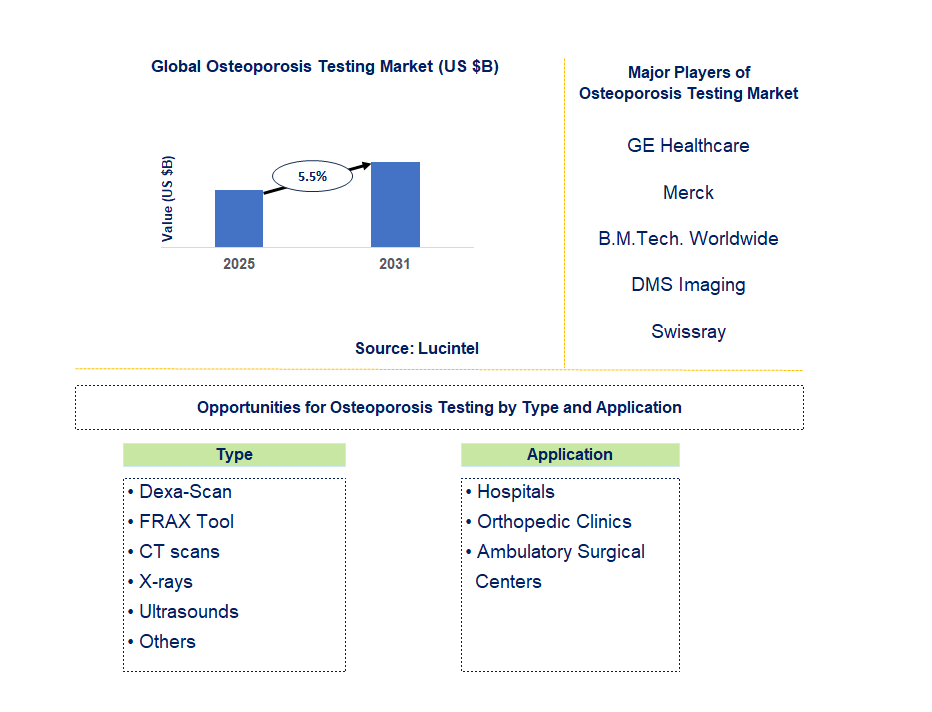
Key data points: The growth forecast = 5.5% annually for the next 7 years. Scroll below to get more insights. This market report covers trends, opportunities and forecasts in osteoporosis testing market to 2031 by type (dexa-scan, FRAX tool, CT scans, X-rays, ultrasounds, and others), application (hospitals, orthopedic clinics, and ambulatory surgical centers), and region (North America, Europe, Asia Pacific, and the Rest of the World)
We'll send your sample report shortly.
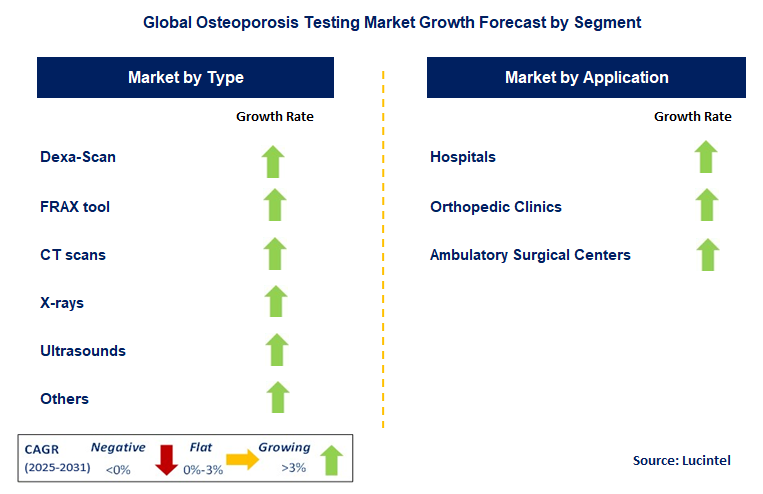
• Lucintel forecasts that, within the type category, dexa-scan is expected to witness the highest growth over the forecast period.
• Within the application category, ambulatory surgical center is expected to witness the highest growth.
• In terms of region, APAC is expected to witness the highest growth over the forecast period. Gain valuable insights for your business decisions with our comprehensive 150+ page report. Sample figures with some insights are shown below.
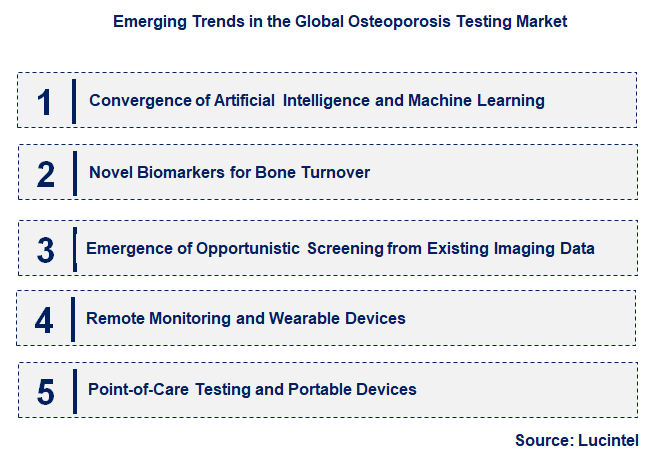
• Convergence of Artificial Intelligence and Machine Learning: This innovation entails the application of AI and ML algorithms to interpret medical images (such as X-rays, CT scans, and even current non-skeletal scans) to evaluate bone density, microarchitecture, and fracture risk more effectively and accurately. AI has the ability to recognize subtle changes that can frequently be overlooked by the human eye. Its effect is a huge improvement in diagnostic precision as well as the possibility of opportunistic screening. It makes it possible to pick up at-risk individuals during screening for other reasons during normal examinations, resulting in earlier diagnosis and treatment without increased patient burden or radiation exposure.
• Novel Biomarkers for Bone Turnover: This trend involves sophisticated blood and urine tests that quantify biochemical markers of bone formation and resorption. These biomarkers give real-time feedback of bone metabolic activity, adding to the structural assessment of DXA scans. The effect is a more complete evaluation of bone health. These markers can be used to track treatment efficacy, better forecast fracture risk dynamically, and detect persons who could benefit from intervention at an earlier stage, providing a less painful and possibly more intensive monitoring alternative.
• Emergence of Opportunistic Screening from Existing Imaging Data: This development entails using medical images already obtained for other clinical purposes (e.g., chest X-rays, abdominal CT scans) to opportunistically screen bone health without further radiation exposure or expense. AI and dedicated software scan these images for bone density or vertebral fractures. The effect is a significant surge in rates of screening, especially among groups where dedicated DXA availability can be low. Through this proactive method, many undiagnosed persons at risk can be identified so that intervention may be initiated in a timely manner to prevent fractures.
• Remote Monitoring and Wearable Devices: The trend here is the creation of wearable devices that can evaluate some aspect of bone health or forestall bone loss by applying calibrated vibrations. Although still in its infancy for explicit diagnosis, the general notion of remote monitoring of physiological parameters of interest to bone health is developing rapidly. The impact could be the ability to continuously monitor bone health indicators outside of traditional clinical settings, providing personalized feedback and potentially new avenues for non-pharmacological interventions or adherence tracking for treatment.
• Point-of-Care Testing and Portable Devices: This trend focuses on developing more compact, portable, and user-friendly devices for osteoporosis testing that can be used in diverse settings beyond specialized imaging centers. This encompasses hand-held quantitative ultrasound machines or even quicker, less complex tests for some biomarkers. The effect is increased access to osteoporosis screening, especially in primary care, rural settings, or even in pharmacies. This can significantly increase early detection rates by moving testing closer to the patient, making wider screening easier. These new trends are fundamentally transforming the osteoporosis testing space by rendering diagnostic solutions more intelligent, accessible, and integrated into standard healthcare. The transition toward AI-powered analysis, sophisticated biomarkers, opportunistic screening, and decentralized models of testing holds the potential to revamp the manner in which osteoporosis is diagnosed and addressed. This transition will result in earlier and more precise diagnoses, personalized treatment plans, and finally, the reduction of debilitating fractures, drastically enhancing public health results.
• Improvements in Dual-Energy X-ray Absorptiometry Technology: At the center of the development lies the improvement of DXA technology, which is still the gold standard for the measurement of bone mineral density (BMD). Recent innovation involves better software for bone microarchitecture analysis (e.g., Trabecular Bone Score, TBS), higher image resolution, and reduced scan times. Such evolution affects the market by offering more complete information beyond BMD alone, enabling better evaluation of bone quality and risk of fracture, resulting in more accurate diagnosis and personalized patient management.
• Emergence of Quantitative Computed Tomography and High-Resolution CT: While DXA is planar, QCT offers volumetric bone mineral density measurements and 3D assessment of bone structure, including cortical and trabecular bone. High-resolution peripheral QCT (HR-pacts) further provides detailed microarchitectural insights. This innovation affects the market by providing more accurate and thorough measures of bone strength and structure, particularly in the case of complicated cases or research applications, and offering useful complementary data to DXA as well as enhanced fracture risk prediction compared to conventional 2D DXA.
• Expansion of Bone Turnover Marker Testing: There has been considerable progress with the application of biochemical bone turnover markers in blood or urine, including P1NP (bone formation) and CT (bone resorption). These markers give information about dynamic bone remodeling processes. This innovation influences the market by providing a non-invasive way to measure bone metabolism, monitor response to therapy, and detect rapid bone loss, enabling clinicians to choose effective therapies and monitor their effectiveness more specifically than with periodic DXA measurements alone.
• Creation of AI-Fueled Diagnostic Tools: Revolutionary is the conjunction of Artificial Intelligence (AI) and Machine Learning (ML) in osteoporosis diagnostics. AI algorithms review current medical images (e.g., CT scans, X-rays of the chest) to identify vertebral compression fractures or estimate bone density opportunistically. This innovation affects the market by having the potential to revolutionize screening. It enables the identification of those at risk and who may otherwise not be diagnosed, resulting in earlier intervention and proactive management without the necessity for dedicated DXA scans for each instance.
• Fracture Risk Assessment Tool Expansion: In addition to mere BMD measurement, there is also increased progress in integrated fracture risk assessment tools, including FRAX (Fracture Risk Assessment Tool), which integrates clinical risk factors in addition to BMD. There has been a recent advancement in better integrating these tools into electronic health records (EHRs) and more dissemination. This innovation affects the market by facilitating a more integrated method of determining the high-risk patient, informing treatment choice by reference to global fracture probability, and improving the adoption of preventive measures in standard clinical practice. These significant advancements are significantly transforming the osteoporosis testing market by facilitating improved diagnostic performance, increasing accessibility, and encouraging a more integrated approach to bone health. The evolution of imaging technologies, biomarker screening, AI-based integration, and risk assessment instruments is cumulatively facilitating earlier and more precise diagnosis. This progress enables timely and personalized treatment, which is quintessential in preventing disabling osteoporotic fractures and enhancing patient outcomes globally.
• Screening of Postmenopausal Women: This application is the biggest and most significant growth opportunity. Postmenopausal women are at maximum risk for osteoporosis because of estrogen decline. Strategic expansion is through creating highly accessible and convenient screening techniques for this population, such as awareness campaigns, mobile screening centers, and the incorporation of opportunistic screening in regular health check-ups. The effect is a dramatic boost to early diagnosis rates, hence timely initiation of preventive intervention or treatment, and thus a notable decline in the incidence of fragility fractures in this high-risk group.
• Diabetic Bone Health Evaluation: Diabetes is considered a major risk factor for osteoporosis and fractures, usually resulting in bone quality impairment not entirely reflected by BMD itself. Growth opportunities lie in creating specialized testing protocols or devices to measure bone fragility in diabetic patients accurately, which involves sophisticated imaging or biomarker tests, taking into account the distinct pathophysiology of diabetic bone disease. The benefit is enhanced risk stratification and targeted management for diabetic patients, avoiding debilitating skeletal complications that fall through the cracks of routine osteoporosis screening.
• Geriatric Fracture Risk Stratification: For older adults, particularly those with an already established fragility fracture, it is important to identify those at high risk for future fractures. Strategic expansion is in providing next-generation testing technologies that are able to offer a finer measurement of fracture risk than a baseline DXA alone. This encompasses QCT, TBS, and integrated risk assessment tools linked with clinical information. The effect is better focusing on those at high risk for intensive treatment, lowering the frequency of recurrent fractures, and improving the quality of life among the elderly.
• Monitoring Adherence and Treatment Efficacy: After osteoporosis is diagnosed and treatment started, efficient monitoring of the patient's response and adherence is critical. Opportunities for strategic growth lie in creating repeatedly usable and low-cost monitoring tests, including bone turnover markers, and digital solutions for tracking adherence. The effect maximizes treatment outcomes. Through the delivery of open indicators of treatment efficacy, these instruments enable clinicians to modify therapies appropriately and promote patient adherence, which in turn results in improved long-term bone health.
• Opportunistic Screening in Varied Clinical Environments: Taking advantage of previously obtained medical imaging done for other indications (e.g., chest X-rays, abdominal CT scans for cancer screening) for opportunistic osteoporosis evaluation is a rapidly emerging growth opportunity. Strategic expansion is the creation of AI-based software that can be easily incorporated into radiology work practices to automatically detect vertebral fractures or estimate bone density. The effect is a profound extension of osteoporosis screening coverage, detecting undiagnosed patients at low incremental cost or radiation dose, thus facilitating broad proactive management in many clinical environments. These strategic expansion opportunities are having a profound effect on the market for osteoporosis testing by catalyzing innovation and broadening its clinical utility across a variety of patient groups and healthcare environments. By targeting key uses such as screening postmenopausal women, evaluating diabetic bone health, risk-stratifying geriatric fractures, monitoring therapy, and using opportunistic screening, the market is meeting major unmet needs. This diversification reflects the growing significance of thorough osteoporosis testing as a foundation for preventive medicine and fracture care.
• GE Healthcare
• Merck
• B.M.Tech. Worldwide
• DMS Imaging
• Swissray
• Hologic
• Pfizer
• Dexa-Scan
• FRAX Tool
• CT scans
• X-rays
• Ultrasounds
• Others
• Hospitals
• Orthopedic Clinics
• Ambulatory Surgical Centers
• North America
• Europe
• Asia Pacific
• The Rest of the World
• United States: The United States osteoporosis testing market is experiencing advancements in diagnostic technologies as well as proactive screening. Recent advances include FDA clearance of new wearable devices, such as Osteo Boost, for the prevention of bone loss in osteopenia. There is increasing attention toward the integration of AI into current imaging modalities, such as CT scans, to opportunistically detect those at risk. Additionally, advancements in biomarker testing for bone turnover are on the rise, offering complementary information to standard DXA scans and helping with personalized treatment options.
• China: The Chinese osteoporosis testing market is growing fast as a result of having a huge and aging population. Some recent trends are government-helmed initiatives to promote screening and raise awareness, and increased usage of DXA technology across prominent hospitals. There is considerable research into the potential of utilizing pre-existing medical imaging data, for example, low-dose CT scans done for other indications, for opportunistic screening of osteoporosis. This strategy seeks to increase diagnostic availability in a nation where committed DXA availability might be restricted to certain geographic areas.
• Germany: The German osteoporosis testing market features a high priority to adopt sophisticated technologies into practice. Some recent advances include the application of AI-based software, such as Spine Q by Bone screen, that processes available CT scans automatically and detects bone density alterations and fractures that would have otherwise gone unnoticed. This new approach is focused on early detection and the optimal use of available medical data. German healthcare professionals focus on accurate diagnostics to inform tailored treatment plans, driving the adoption of advanced testing techniques further.
• India: The Indian osteoporosis testing market is increasing steadily, driven by growing awareness of bone health and the elderly population. Recent trends have involved the increasing availability of DXA scanning in urban areas and the encouragement of screening programs by health authorities. Although expense remains an issue, increasing demand for low-cost diagnostic solutions exists. Government programs and rising healthcare spending are subsidizing greater access to bone mineral density testing, resulting in earlier diagnosis and treatment of osteoporosis.
• Japan: Japan's market for osteoporosis testing is characterized by early detection and overall bone health management. Some new trends include joint projects, i.e., Fujitsu and I Surgery’s "bone health promotion project," employing AI medical devices to examine chest radiographs for bone tests. This is opportunistic screening and early detection. In addition, emphasis is put on sophisticated diagnostic equipment and proactive measures to avoid osteoporotic fractures within its fast-ageing population.


• GE Healthcare
• Merck
• B.M.Tech. Worldwide
• DMS Imaging
• Swissray
• Hologic
• Pfizer Q5. Which osteoporosis testing market segment will be the largest in future? Answer: Lucintel forecasts that, within the type category, dexa-scan is expected to witness the highest growth over the forecast period. Q6. In osteoporosis testing market, which region is expected to be the largest in next 5 years? Answer: In terms of region, APAC is expected to witness the highest growth over the forecast period. Q7. Do we receive customization in this report? Answer: Yes, Lucintel provides 10% customization without any additional cost.


Choose a license that fits your team. Instant PDF delivery.
Prices exclude taxes. Instant delivery. Custom licensing available on request.
Market Report · July 22, 2026
Market Report · July 22, 2026
Market Report · July 22, 2026
Trusted partner for strategic intelligence and business growth


Receive a complimentary market analysis tailored to your industry. Our analysts will identify key growth opportunities and competitive dynamics specific to your business.

Market size, growth rate, and key trend analysis for your specific sector.

Top competitor positioning and market share analysis.

Strategic recommendations backed by data-driven insights.
Get curated market intelligence and competitive moves straight to your inbox.
By subscribing, you agree to receive our monthly insights. Unsubscribe anytime.
Receive a complimentary market analysis tailored to your industry. Our analysts will identify key growth opportunities and competitive dynamics specific to your business.
Market size, growth rate, and key trend analysis for your specific sector.
Top competitor positioning and market share analysis.
Strategic recommendations backed by data-driven insights.
Get curated market intelligence, emerging trends, and competitive moves straight to your inbox each month.
By subscribing, you agree to receive our monthly insights. Unsubscribe anytime.
We'll send your sample report shortly.