
Market Report · July 22, 2026

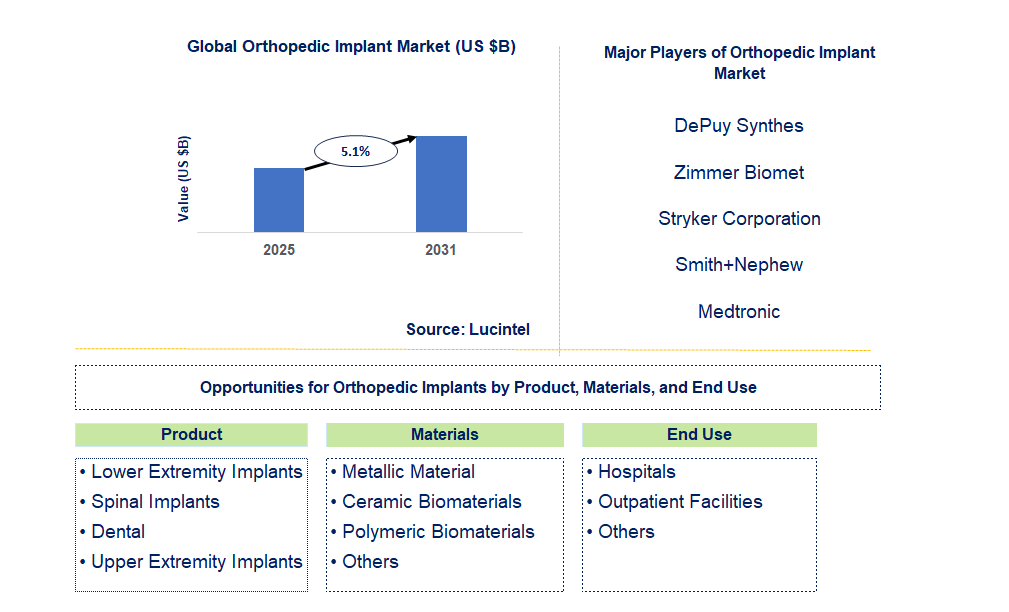
Key data points: The growth forecast = 5.1% annually for the next 7 years. Scroll below to get more insights. This market report covers trends, opportunities and forecasts in orthopedic implant market to 2031 by product (lower extremity implants, spinal implants, dental, and upper extremity implants), materials (metallic material, ceramic biomaterials, polymeric biomaterials, and others), end use (hospitals, outpatient facilities, and others), and region (North America, Europe, Asia Pacific, and the Rest of the World)
We'll send your sample report shortly.
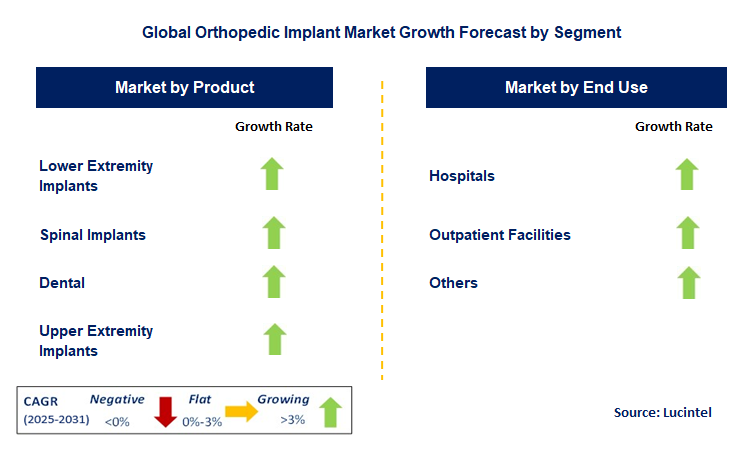
• Lucintel forecasts that, within the product category, the lower extremity implant will remain the largest segment over the forecast period.
• Within the end use category, hospital will remain a larger segment.
• In terms of region, North America will remain the largest region over the forecast period. Gain valuable insights for your business decisions with our comprehensive 150+ page report. Sample figures with some insights are shown below.
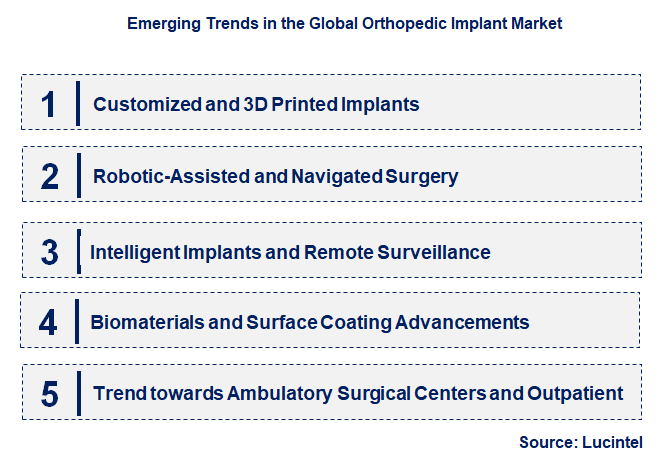
• Customized and 3D Printed Implants: This trend is the customization of orthopedic implants to exactly fit individual patient anatomy, commonly using 3D printing technology. Standardized implants are conventional, but patient-specific designs based on careful imaging enable an improved fit, enhanced biomechanical function, and possibly decreased surgical time and complications. The effect is improved patient outcomes, shorter recovery times, and a greater level of satisfaction because of the optimal integration of the implant with the patient’s individual bone architecture.
• Robotic-Assisted and Navigated Surgery: The use of robotic-assisted surgical systems and computerized navigation technologies is increasingly being adopted in orthopedic procedures, especially for joint replacement. These systems improve the precision of surgery, enabling more precise implant positioning, less soft tissue damage, and better alignment. The result is increased surgical accuracy, resulting in improved long-term functional outcomes, lower revision rates, and potentially shorter hospital stays, thus enhancing the overall cost-effectiveness of the procedures.
• Intelligent Implants and Remote Surveillance: New smart implants include embedded sensors to track different physiological parameters, including implant load, temperature, and even infection signs or loosening. This information can be sent wirelessly for remote monitoring by clinicians. The effect is proactive prevention of complications, tailor-made rehabilitation protocols, and early identification of complications, which can greatly enhance post-operative care, avoid implant failure, and minimize the necessity for follow-up operations.
• Biomaterials and Surface Coating Advancements: The creation of new biomaterials and higher-end surface coatings is a significant trend. This encompasses materials with increased biocompatibility, osteointegration functionality (favoring bone ingrowth onto the implant), and antimicrobial properties to limit infection risk. Techniques such as porous forms and bioactive coatings are enhancing the life and performance of implants. The effect is higher implant survival rates, decreased adverse reactions, and a lower rate of post-surgical infection, resulting in more long-lasting and safer orthopedic interventions.
• Trend towards Ambulatory Surgical Centers and Outpatient: A noticeable trend in orthopedic procedures, especially joint replacements, away from conventional inpatient hospital care towards outpatient and ambulatory surgery centers exists. The reason for this is technological advancement that enables less invasive procedures, enhanced pain control, and quicker recovery of patients. The effect is lower healthcare expenses for patients and health systems, added convenience to the patient, and more efficient procedures, making orthopedic procedures more accessible and affordable. These new trends are essentially remaking the orthopedic implant market by emphasizing patient-focused solutions, taking advantage of digital and material science breakthroughs, and streamlining healthcare delivery patterns. Emphasis on personalized, accurate, and intelligent implants, along with a shift towards more efficient surgical environments, is spelling a future where orthopedic treatments are not merely more effective and safer but also more accessible and economically viable. This development holds tremendous potential for improved quality of life for those with musculoskeletal disease.
• Emergence of Patient-Specific Implants through 3D Printing: One of the most significant advancements is the growing use of 3D printing technology for the production of patient-specific orthopedic implants. This enables highly personalized prostheses and fixation devices that are a perfect match for the patient’s individual anatomy, maximizing fit and biomechanical function. The effect is enhanced surgical accuracy, decreased operating time, increased implant integration, and better long-term results, as the implant is specifically designed for the individual, reducing complications and revision surgeries.
• Robotics and Navigation Integration in Orthopedic Surgery: The mass adoption of robotic-assisted surgical systems and sophisticated computer navigation systems is transforming orthopedic operations, especially joint replacement. The technologies offer surgeons more accuracy, real-time information, and increased control during advanced surgeries. The effect is better implant positioning and alignment, which translates to improved functional outcomes, quicker patient recovery, and minimized operating errors, ultimately boosting the effectiveness and safety of orthopedic interventions.
• Creation of Smart Implants with Sensory Functions: One of the most advanced recent developments is the introduction of smart orthopedic implants with built-in micro-sensors. These sensors are able to sense different parameters, including stress in the implant, temperature, pH, and even identify the early onset of infection or loosening after surgery. The result is a revolution in post-operative management with continuous, objective monitoring of implant functioning and patient healing so that proactive management is possible, tailored rehabilitation can be planned, and the risk of implant failure is greatly minimized.
• Emphasis on Advanced Biomaterials and Surface Modifications: There is an increasing focus on the creation of next-generation biomaterials and novel surface modifications for orthopedic devices. These include porous titanium, ceramic composites, and other bioactive coatings that encourage osseointegration (bone formation on the implant) and have antimicrobial properties. The effect is increased biocompatibility, improved implant survival, decreased risk of infection, and improved patient acceptance, resulting in more durable and safer orthopedic devices with better clinical results.
• Trend Towards Outpatient Joint Replacement Surgeries: More and more complex orthopedic surgeries, especially total joint replacement (hip and knee), are now being carried out in outpatient facilities or ambulatory surgical centers. This is made possible by improvements in surgical methods, anesthesiology, and pain control that make it possible for patients to recover more quickly. The result is less expense for healthcare, greater convenience to the patient, less likelihood of hospital-acquired infections, and greater efficiency in the healthcare system, making these surgeries more convenient and affordable. These recent developments are collectively impacting the orthopedic implant market by fostering a profound evolution in patient care. The emphasis on personalization, precision through robotics, smart monitoring, advanced materials, and efficient outpatient models is driving the market towards more innovative, effective, and patient-centric solutions. This trajectory promises significant improvements in the quality of life for individuals requiring orthopedic interventions.
• Joint Reconstruction: Joint reconstruction, most notably for knee and hip replacements, is the largest and most important growth area. Growing incidences of osteoarthritis and other degenerative joint diseases, plus a growing aging population wanting better mobility and quality of life, are sustaining demand. Advances in implant materials, design, and surgical techniques (including robotics) are also spreading this segment by enhancing long-term results and allowing less-invasive approaches.
• Spinal Implants and Fusion Devices: The spinal implant market has immense growth prospects with the growing incidence of spinal disorders such as degenerative disc disease, spinal deformities, and trauma. Improvements in spinal fusion methods, motion preservation systems, and minimally invasive spinal surgery are broadening the scope of treatment and enhancing outcomes. Increasing use of navigation and robotic systems in spinal surgeries also drives the growth in this segment, which provides more precision and safety.
• Trauma Implants and Fixation Devices: Trauma implants for fracture fixation and other acute musculoskeletal trauma are a consistent growth sector. Growing numbers of road accidents, sports injuries, and falls (particularly among the elderly) guarantee a steady demand for plates, screws, rods, and external fixation devices. Ongoing advances in biocompatible materials and specialty designs for multifragmentary fractures further fuel this market on the basis of rapid healing and functional recovery.
• Ortho Biologics: Ortho biologics such as bone graft substitutes, bone morphogenetic proteins (BMPs), and stem cell therapies form the fastest-growing segment. These devices will help augment the natural healing process of the body, decrease recovery times, and maximize the success rate of orthopedic procedures, especially bone fusion and cartilage repair. The growing research and development efforts in regenerative medicine present enormous future opportunities as these treatments get more sophisticated and gain widespread acceptance in clinical practice.
• Extremity Implants: Extremity implants (foot, ankle, shoulder, hand, and wrist) represent a growing growth opportunity. Although smaller in size compared to large joint reconstruction, the expanding knowledge of limb pathologies combined with the advancements of small, specialized implants and procedures is fueling demand. Injuries sustained in sports, active lifestyles, and the requirement for restoration of functional loss in these essential joints drive growth in this segment, with highly specialized growth opportunities for manufacturers. These strategic opportunities for growth are heavily influencing the orthopedic implant market by stimulating investment and innovation in high unmet patient needs and high growth potential areas. Emphasis on joint reconstruction, spinal, trauma, and emerging sectors of ortho biologics and extremity implants is providing ongoing product refinement and development. This application-driven strategy is creating a more diversified and healthy market that is providing a wider array of effective solutions for the global patient population.
• DePuy Synthes
• Zimmer Biomet
• Stryker Corporation
• Smith+Nephew
• Medtronic
• NuVasive
• Arthrex
• Acumed
• Paragon Medical
• Globus Medical
• Lower Extremity Implants
• Spinal Implants
• Dental
• Upper Extremity Implants
• Metallic Material
• Ceramic Biomaterials
• Polymeric Biomaterials
• Others
• North America
• Europe
• Asia Pacific
• The Rest of the World
• United States: In the United States, the orthopedic implant market is marked by high investment in research and development, resulting in state-of-the-art product advancements. The growing geriatric population and prevalence of diseases such as osteoarthritis and osteoporosis are major drivers. Key developments in recent times include higher acceptance of robotic-assisted surgery for joint replacements, a spurt in demand for patient-specific implants facilitated by 3D printing, and more emphasis on outpatient orthopedic surgeries to contain costs. Market leaders are continuing to fuel market growth by making inorganic expansions through mergers and acquisitions, as well as through the enlargement of product portfolios.
• China: The Chinese orthopedic implant market is growing at a fast pace, driven by a huge population, its aging, increasing disposable incomes, and enhancing healthcare infrastructure. Metallic implants continue to be the leading choice, but interest in ceramic and polymeric biomaterials is on the rise. Increasing domestic production and localization efforts to decrease imports, usually boosted by government initiatives, are recent trends. Technologies such as 3D printing and artificial intelligence-based design are catching up, looking to service the huge and varied need for orthopedic products.
• Germany: The German orthopedic implant industry is characterized by its strong healthcare system, strict quality requirements, and high priorities for technological advancement. The aging population has a major influence on the demand for hip and knee replacements. Some of the recent trends include deep research in advanced biomaterials for improved biocompatibility and longevity, a high adoption rate of minimally invasive surgical technologies, and growing interest in individualized implants. German industries are renowned for their precision manufacturing and high regulatory standards.
• India: The Indian orthopedic implant market is on a strong growth path with a large population base, growing healthcare consciousness, enhancing healthcare infrastructure, and rising per capita income. Foreign multinational companies dominated in the past, while domestic players are increasing their market share at a fast pace due to competitive pricing and participation in government-sponsored insurance schemes. The latest trends involve policy-driven price controls to increase affordability and an effort towards implant manufacturing self-reliance to lower import dependence.
• Japan: The Japanese orthopedic implant market is marked by an aging population, high prevalence of age-related musculoskeletal diseases, and strong adoption of new technology. Some of the recent trends include large investments in 3D printing for individualized implants, increased use of robotic surgery for enhanced accuracy, and increasing interest in smart implants with monitoring features. There is also a preference in the market for joint-preserving surgery, such as high tibial osteotomy, showing a focus on the patient and ongoing innovation in surgical methods and biomaterials.


• DePuy Synthes
• Zimmer Biomet
• Stryker Corporation
• Smith+Nephew
• Medtronic
• NuVasive
• Arthrex
• Acumed
• Paragon Medical
• Globus Medical Q5. Which orthopedic implant market segment will be the largest in future? Answer: Lucintel forecasts that, within the product category, the lower extremity implant will remain the largest segment over the forecast period. Q6. In orthopedic implant market, which region is expected to be the largest in next 5 years? Answer: In terms of region, North America will remain the largest region over the forecast period. Q7. Do we receive customization in this report? Answer: Yes, Lucintel provides 10% customization without any additional cost.


Choose a license that fits your team. Instant PDF delivery.
Prices exclude taxes. Instant delivery. Custom licensing available on request.
Market Report · July 22, 2026
Market Report · July 22, 2026
Market Report · July 22, 2026
Trusted partner for strategic intelligence and business growth


Receive a complimentary market analysis tailored to your industry. Our analysts will identify key growth opportunities and competitive dynamics specific to your business.

Market size, growth rate, and key trend analysis for your specific sector.

Top competitor positioning and market share analysis.

Strategic recommendations backed by data-driven insights.
Get curated market intelligence and competitive moves straight to your inbox.
By subscribing, you agree to receive our monthly insights. Unsubscribe anytime.
Receive a complimentary market analysis tailored to your industry. Our analysts will identify key growth opportunities and competitive dynamics specific to your business.
Market size, growth rate, and key trend analysis for your specific sector.
Top competitor positioning and market share analysis.
Strategic recommendations backed by data-driven insights.
Get curated market intelligence, emerging trends, and competitive moves straight to your inbox each month.
By subscribing, you agree to receive our monthly insights. Unsubscribe anytime.
We'll send your sample report shortly.