
Market Report · July 22, 2026

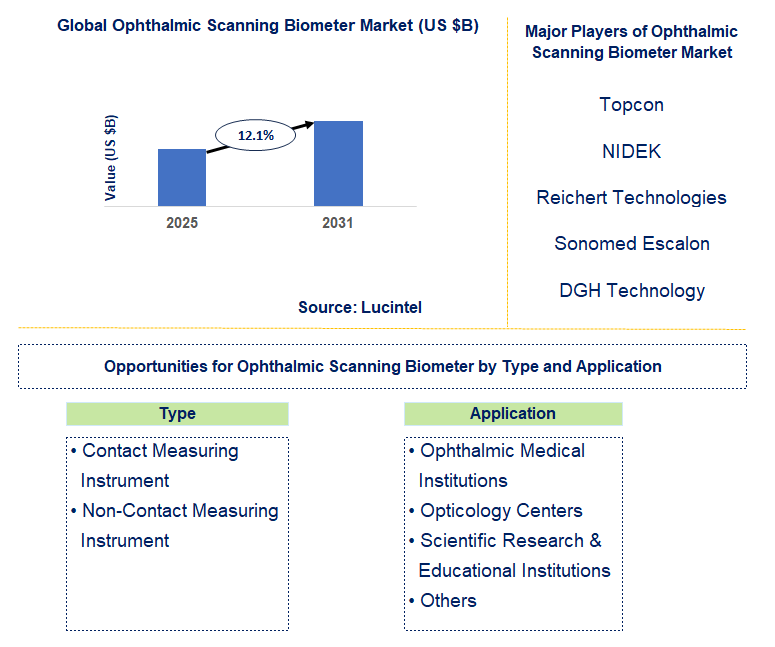
Key data points: The growth forecast = 12.1% annually for the next 7 years. Scroll below to get more insights. This market report covers trends, opportunities and forecasts in ophthalmic scanning biometer market to 2031 by type (contact measuring instrument and non-contact measuring instrument), application (ophthalmic medical institutions, opticology centers, scientific research & educational institutions, and others), and region (North America, Europe, Asia Pacific, and the Rest of the World)
We'll send your sample report shortly.
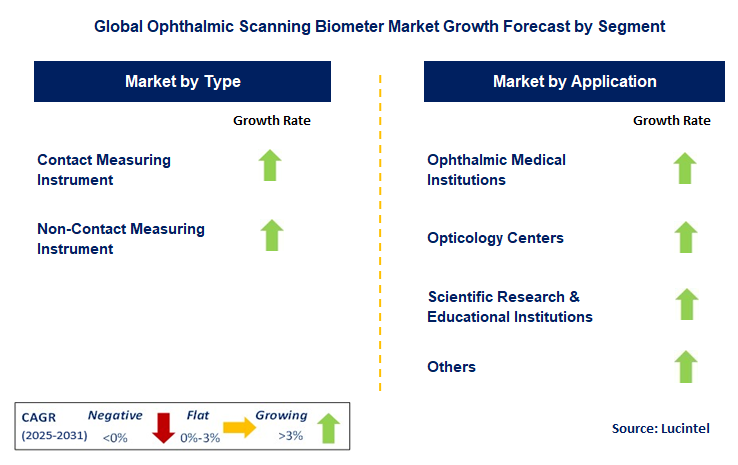
• Lucintel forecasts that, within the type category, non-contact measuring instrument is expected to witness higher growth over the forecast period.
• Within the application category, ophthalmic medical institution is expected to witness the highest growth.
• In terms of region, APAC is expected to witness the highest growth over the forecast period. Gain valuable insights for your business decisions with our comprehensive 150+ page report. Sample figures with some insights are shown below.
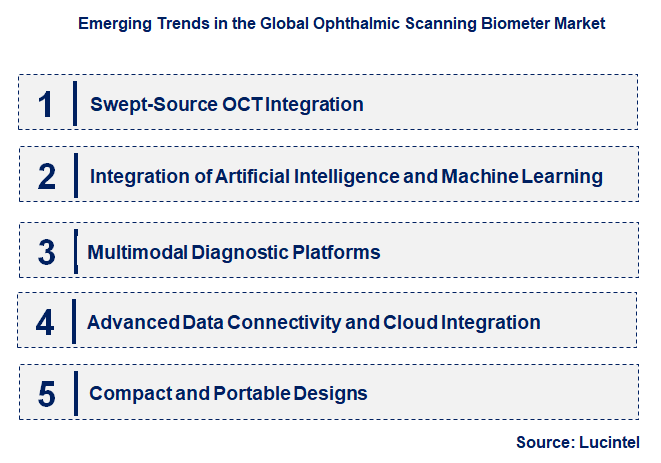
• Swept-Source OCT Integration: This trend is characterized by the universal adoption of swept-source Optical Coherence Tomography (SS-OCT) in ophthalmic biometers. SS-OCT provides higher scan rates and increased penetration, especially advantageous for eyes with dense cataracts or other opacities of the media where conventional biometers might falter. This greatly enhances axial length measurement accuracy, resulting in more accurate IOL power calculations and better post-cataract refractive outcomes.
• Integration of Artificial Intelligence and Machine Learning: Integration of AI and machine learning algorithms in biometers is a new trend. AI is capable of interpreting complicated biometric data, more precisely predicting refractive outcomes, and even providing recommendations for best IOL selection based on patient-specific parameters and large clinical databases. This improves diagnostic accuracy, minimizes human error, and customizes surgical planning, resulting in more predictable and better visual outcomes for patients.
• Multimodal Diagnostic Platforms: There is an emerging trend toward the creation of multimodal ophthalmic scanning biometers that combine multiple diagnostic functionalities into one device. In addition to standard biometry, these platforms can encompass corneal topography, wavefront analysis, and anterior segment OCT. This simplifies the diagnostic process, eliminates the need for several instruments, and gives one integrated dataset to use in planning surgery, especially important for premium IOL surgery and complicated refractive cases.
• Advanced Data Connectivity and Cloud Integration: Advanced ophthalmic biometers are increasingly equipped with advanced data connectivity features such as Wi-Fi, Bluetooth, and cloud integration. This enables effortless data transfer to electronic health records (EHRs), surgical planning programs, and remote consultation systems. The result is a smoother workflow, fewer errors in manual data entry, and greater access to patient data, making collaborative care and tele-ophthalmology programs easier.
• Compact and Portable Designs: Although high-end biometers are generally fixed in one location, newer trends are toward smaller and more portable designs, particularly for small space clinics or outreach programs. These instruments are as accurate as high-end machines but provide increased mobility. The result is more access to sophisticated biometry in a wide variety of clinical environments, including small practices and remote locations, thus broadening the availability of accurate diagnostic technology for cataract and refractive surgery. These new trends are basically redefining the ophthalmic scanning biometer market by making such devices more accurate, efficient, and integrated. The transformation to SS-OCT, AI-based analysis, multimodal platforms, increased connectivity, and small dimensions is contributing to increased surgical predictability, enhanced patient outcomes, and enhanced workflow for ophthalmologists, ultimately improving the level of eye care worldwide.
• Swept-Source OCT Dominance: The most important development is the increasing dominance of Swept-Source OCT technology in ophthalmic biometers. SS-OCT provides deeper penetration through thick cataracts and other ocular opacities and better axial length measurements than traditional optical biometers. This technological trend allows for precise biometry in more patients, minimizing the necessity for ultrasound biometry and enhancing the predictability of refractive results in difficult cases.
• Toric IOL Calculation Formula Integration: Newer biometer models now automatically incorporate sophisticated thoric IOL calculation formulas like the Barrett Universal II, Kane, and Hoffer QST into their programming. This integration simplifies the process of choosing the appropriate thoric IOL for astigmatism patients, reducing calculation error and enhancing astigmatism correction in the cornea. This provides improved uncorrected visual acuity and patient satisfaction following cataract surgery.
• Improved Fixation and Alignment Systems: Companies are constantly enhancing the patient alignment and fixation systems in biometers with added features such as auto-capture and auto-tracking functionalities. These improve reproducibility and accuracy by minimizing measurement variability due to patient movement or misalignment. This evolution results in more consistent data for IOL power calculation, which means more accurate refractive outcomes.
• Enhanced Anterior Segment Imaging Features: Most contemporary IOL Master or Version Platform-based biometers now integrate enhanced anterior segment imaging features like high-resolution tomography of the cornea and measurement of the anterior chamber depth. This enables a more thorough analysis of the anterior structures of the eye, important for the selection of premium IOLs and for detecting corneal irregularities that may influence refractive results. This holistic approach gives the surgeon a comprehensive eye for surgical planning.
• Enhanced Connectivity and Integration with Digital Workflow: The latest biometers feature strong connectivity options such as Wi-Fi, Ethernet, and USB, enabling effortless integration into digital ophthalmic practice. This provides effortless transfer of data to electronic medical records (EMR) and IOL calculation software. This ensures efficient clinical workflow, minimizes the risk of human error in data entry, and improves productivity in high-volume ophthalmic clinics. These new advances are deeply influencing the ophthalmic scanning biometer market by raising the level of preoperative diagnosis. The emphasis on SS-OCT, combined IOL equations, improved alignment, advanced imaging, and digital integration is having a direct impact of delivering more accurate and predictable refractive results in cataract and refractive surgery that ultimately benefits ophthalmologists as well as patients.
• Cataract Surgery: The greatest and most urgent growth opportunity is in the rapidly growing number of cataract surgeries globally. An aging population in the world is leading to an ever-increasing number of cataract procedures, and thus the demand for extremely accurate biometers required for IOL power calculation. Strategic expansion is through the creation of biometers specifically designed for difficult cataract cases, such as dense cataracts and those with a history of refractive surgery, in order to deliver better refractive outcomes.
• Refractive Surgery (Premium IOLs): The growth adoption of premium intraocular lenses, including multifocal, thoric, and extended depth of focus IOLs, in refractive cataract surgery is a profitable growth opportunity. These sophisticated IOLs demand extremely accurate preoperative biometry. Firms can leverage by providing biometers with improved ability to assess corneal astigmatism, higher-order aberrations, and effective lens position, supplying information critical to achieving optimized outcomes with these lenses.
• Myopia Management and Monitoring of Myopia Progression: With the worldwide myopia epidemic, especially in children, comes a huge emerging opportunity in myopia management. Biometers that can track axial length change precisely are essential for monitoring myopia progression and measuring the effectiveness of myopia control interventions. Strategic expansion is through the creation of easy-to-use biometers for optometrists and ophthalmologists specializing in children’s eye care and myopia control.
• Post-Refractive Surgery IOL Calculation: Estimating IOL power for patients who underwent pre-existing refractive surgery (e.g., LASIK, PRK) is notoriously difficult. This is a specialty but high-growth opportunity. The creation of biometers equipped with customized algorithms and sophisticated imaging features to precisely assess corneal power and effective lens position in these complicated cases will fill a profound unmet need for ophthalmologists and enhance post-operative refractive predictability.
• Remote Diagnostics and Tele-Ophthalmology: Growth in remote diagnostics and tele-ophthalmology, especially in remote regions, offers a compelling strategic chance. Creating small-sized, handheld, and simple-to-use ophthalmic scanning biometers with high-level telemedicine integration features can increase accessibility to accurate diagnostics. Remote consultation and initial evaluation are possible, circumventing geographical obstacles to high-level eye care and inducing market growth in emerging segments. These strategic opportunities for growth underscore the importance of the various uses of ophthalmic scanning biometers outside the context of conventional cataract surgery. By exploiting the increasing demand for premium IOL implantation, management of myopia, complex post-refractive cases, and the opportunities offered by telemedicine, companies can innovate and increase their market reach, ultimately leading to healthier vision outcomes worldwide.
• Topcon
• NIDEK
• Reichert Technologies
• Sonomed Escalon
• DGH Technology
• Optikon
• Appasamy Associates
• Micro Medical Devices
• Morestep
• Hangzhou Mocular Medical
• Contact Measuring Instrument
• Non-Contact Measuring Instrument
• Ophthalmic Medical Institutions
• Opticology Centers
• Scientific Research & Educational Institutions
• Others
• North America
• Europe
• Asia Pacific
• The Rest of the World
• United States: The United States market for ophthalmic scanning biometers is marked by high usage rates for advanced technology and intense clinical precision focus. Recent innovations include widespread adoption of swept-source Optical Coherence Tomography (OCT) biometers, providing better penetration of dense cataracts and quicker acquisition times. Integration with Electronic Health Records (EHR) and surgery planning software continues to be encouraged, reducing workflows and improving data management. New product release is also observed within the market to enhance refractive results with premium IOLs for a growing population desiring enhanced vision.
• China: China’s ophthalmic scanning biometer market is growing extensively driven by a vast and aging population, growing awareness of eye health, and strong investments in healthcare infrastructure. Recent trends point towards the rise of domestic manufacturers providing competitive and technologically sophisticated biometers. There is a strong trend of integrating biometry with other diagnostic modalities such as OCT, enabling holistic eye examinations. The government programs encouraging eye care and increasing numbers of private eye clinics using new diagnostic equipment to cope with rising demand for cataract and refractive surgery are in favor of the market.
• Germany: Germany is a leading innovator in the ophthalmic scanning biometer market with its reputation for precision engineering and high quality standards. Recent trends involve an intense focus on creating highly precise and trustworthy biometers with sophisticated algorithms for IOL power calculation, particularly in difficult cases. German companies are concentrating on easy-to-use interfaces, hardware durability, and seamless integration into ophthalmology workflows. The market is dominated by a need for high-end devices that provide repeatable, high-quality measurements to maximize surgical results, especially for demanding refractive surgeries and high-end IOL implantations.
• India: The market for Indian ophthalmic scanning biometers is growing quickly due to a vast patient pool with high rates of refractive errors and cataracts, along with rising medical tourism for eye treatment. Recent trends reveal growing demand for cost-effective yet precise biometers so that advanced diagnostics are made available to a wider number of eye clinics in the nation. A trend is apparent towards the adoption of small and handheld devices that are appropriate for both urban and rural environments. Investment in local production and strategic alliances are also influencing the market with the intent to serve the huge patient population.
• Japan: Japan’s ophthalmic scanning biometer market is characterized by a high focus on advanced technology, miniaturization, and accuracy. Recent innovations involve ongoing improvement in swept-source OCT biometers, delivering ultra-fast scanning and high-quality images for accurate ocular measurements. Japanese firms are preoccupied with creating highly integrated instruments that integrate biometry with topography and tomography for complete planning of surgery. The market lays emphasis on devices that provide better refractive results, especially with the growing demand for multifocal and thoric IOLs, meeting an advanced and quality-oriented ophthalmic fraternity.


• Topcon
• NIDEK
• Reichert Technologies
• Sonomed Escalon
• DGH Technology
• Optikon
• Appasamy Associates
• Micro Medical Devices
• Morestep
• Hangzhou Mocular Medical Q5. Which ophthalmic scanning biometer market segment will be the largest in future? Answer: Lucintel forecasts that, within the type category, non-contact measuring instrument is expected to witness higher growth over the forecast period. Q6. In ophthalmic scanning biometer market, which region is expected to be the largest in next 5 years? Answer: In terms of region, APAC is expected to witness the highest growth over the forecast period. Q7. Do we receive customization in this report? Answer: Yes, Lucintel provides 10% customization without any additional cost.


Choose a license that fits your team. Instant PDF delivery.
Prices exclude taxes. Instant delivery. Custom licensing available on request.
Market Report · July 22, 2026
Market Report · July 22, 2026
Market Report · July 22, 2026
Trusted partner for strategic intelligence and business growth


Receive a complimentary market analysis tailored to your industry. Our analysts will identify key growth opportunities and competitive dynamics specific to your business.

Market size, growth rate, and key trend analysis for your specific sector.

Top competitor positioning and market share analysis.

Strategic recommendations backed by data-driven insights.
Get curated market intelligence and competitive moves straight to your inbox.
By subscribing, you agree to receive our monthly insights. Unsubscribe anytime.
Receive a complimentary market analysis tailored to your industry. Our analysts will identify key growth opportunities and competitive dynamics specific to your business.
Market size, growth rate, and key trend analysis for your specific sector.
Top competitor positioning and market share analysis.
Strategic recommendations backed by data-driven insights.
Get curated market intelligence, emerging trends, and competitive moves straight to your inbox each month.
By subscribing, you agree to receive our monthly insights. Unsubscribe anytime.
We'll send your sample report shortly.