
Market Report · May 18, 2026

This market report covers trends, opportunities, and forecasts in the global network engineering services market to 2031 by technology (software-defined networking (sdn), network virtualization, network automation, cloud networking, and others), end use (bfsi, it & telecommunication, government, education, healthcare, manufacturing, media & entertainment, and others (energy & utility)), and region (North America, Europe, Asia Pacific, and the Rest of the World)
We'll send your sample report shortly.
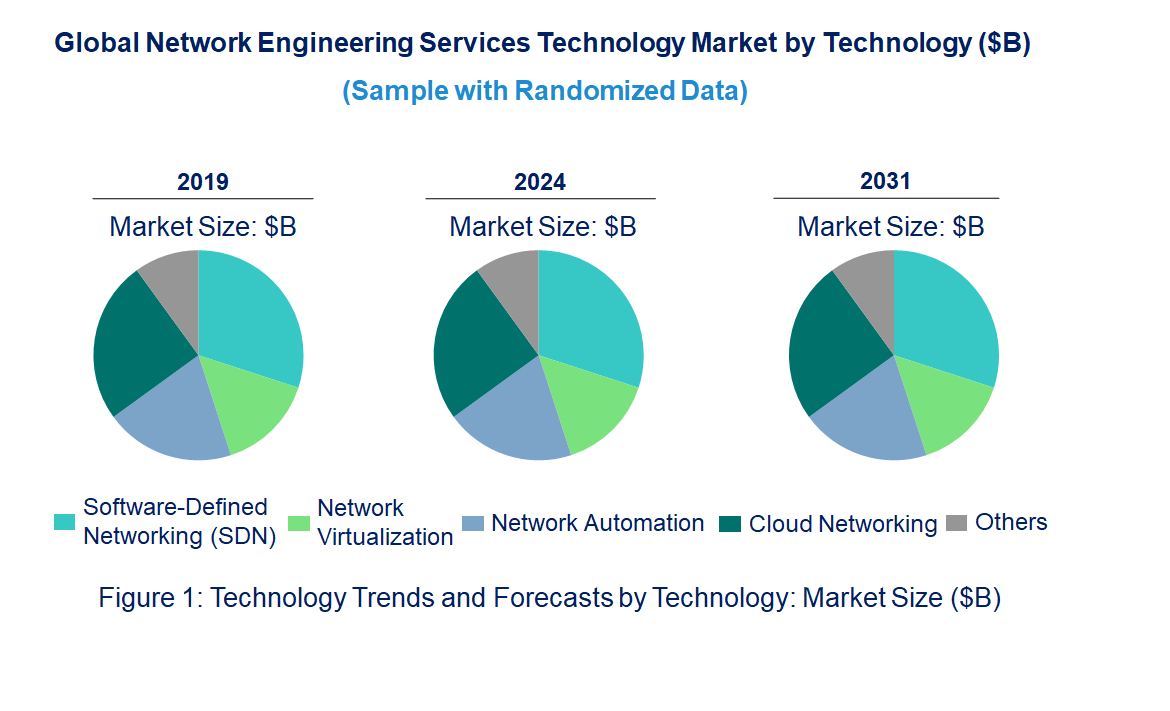
![Network Engineering Services Market Trend and Forecast by End Use [Value from 2019 to 2031]:](https://lucintel.com/images/Network-Engineering-Services-Technology-Market-Segment.png "Network Engineering Services Market Trend and Forecast by End Use [Value from 2019 to 2031]:")
• Deployment of Software-Defined Networking (SDN) is being pursued: SDN’s impact on the development of more versatile, scalable, and programmable network architectures is profound. It allows firms to control their networks with increased complexity, thus improving operational efficiency.
• Rise of Network Automation: There has been a shift in the depiction of networking and network platforms. Network automation, a reduction of human involvement through self-operating tools and operational platforms, helps explain the current transition.
• Network Virtualization for Scalability: The infrastructure for new virtual networks has already been created, and new build-outs can be easily performed around existing ones in a more cost-efficient and effective way.
• Cloud Networking Growth: Cloud-based networking is now pervasive. Cloud-based utilities enable rapid and comprehensive network provisioning, which enhances the delivery of services and applications based on the cloud.
• Increased Focus on Network Security: Network security is now the common focus. Given the rise of cyber warfare, there has been an increasing emphasis on security enablers in networking services, including encryption, firewall management, and threat detection technologies. These trends are driving changes in the network engineering services market by providing more agility, flexibility, and security. The transformation toward cloud-based, automated, and virtualized networking solutions is enabling enterprises to streamline operational tasks, and advanced security capabilities are meeting the increasing demands of information and cyberspace risks.
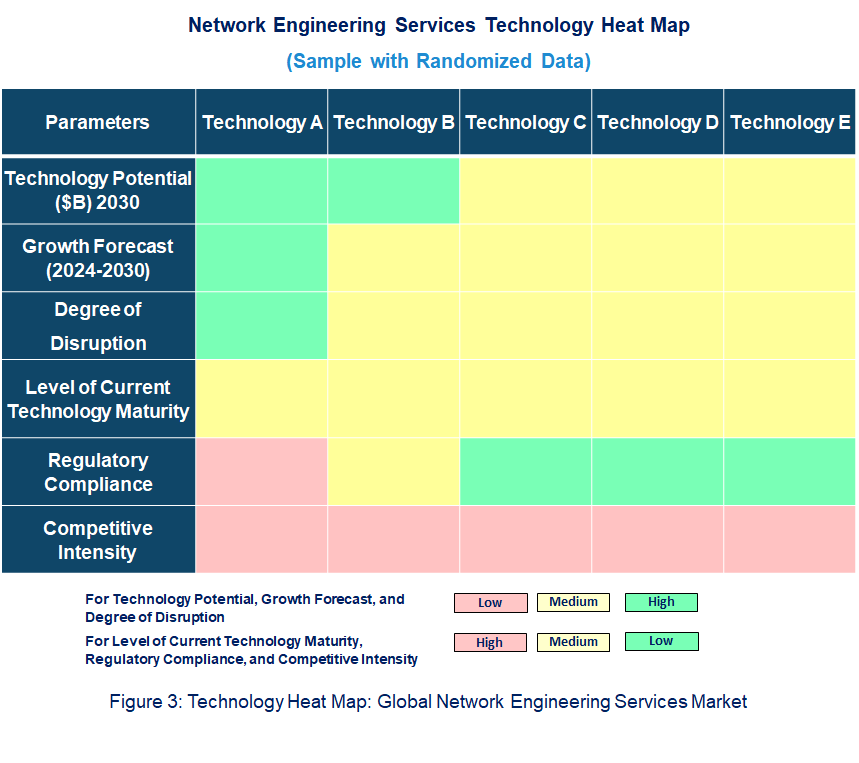
• Potential in Technology: The technology potential in the network engineering services market is significant, supported by advancements such as Software-Defined Networking (SDN), Network Virtualization, Cloud Networking, and Network Automation. These advanced technologies provide greater flexibility, faster scalability, and cost advantages, improving overall performance and accelerating digital transformations. They are particularly helpful in facilitating the migration to cloud-based services and integrating IoT and edge computing.
• Degree of Disruption: When measuring the magnitude of disruption, these technologies do not merely coexist with traditional networking approaches; they significantly change the game. Programmable SDN and network automation manage the orchestration of changes and updates instead of relying on manual configuration commands. These combined tools greatly improve operational capacity. The cloud-based networking model represents a fundamental shift in how organizations manage their IT infrastructure, as opposed to hardware-based models. The magnitude of disruption is substantial because these changes also alter what networks look like and how services are provided.
• Current Technology Maturity Level: At this stage, it can be stated that SDN, Network Automation, and Network Virtualization are in their mature stages and are widely practiced in the industry. Cloud Networking is also gaining maturity, though it still lacks integration with some older technologies..
• Regulatory Compliance: Thirdly, adherence to rules and regulations is crucial, especially in sectors like healthcare, BFSI, and government. The provision of network engineering services must meet the demands for compliance with data privacy regulations such as HIPAA, GDPR, or industry-specific standards, making it essential in the design and rollout of such technologies..
• Calsoft Inc. – Calsoft has advanced beyond its competitors by integrating the latest SDN and NFV advancements into its networking engineering offerings, increasing automation and efficiency, enabling clients to scale easily while reducing operational costs.
• Datavision, Inc. – Datavision focuses on the development of clouds and network virtualization, enabling businesses to create flexible and scalable infrastructure that incorporates networks for the modern age of cloud computing, resulting in increased efficiency and reduced hardware reliance.
• Movate – Through AI and network automation, Movate focuses on providing solutions for quicker network provisioning and fast issue resolution, enhancing customers’ overall network performance while minimizing downtime across various industries.
• Juniper Networks, Inc. – Juniper Networks’ advanced AI-driven network automation platform includes predictive analytics using machine learning for self-healing networks, enabling enterprise customers to manage network performance efficiently across dynamic environments.
• Sincera Technologies – Sincera Technologies is focused on edge computing, embedding it into their networking solutions to help companies support and process large amounts of data in shorter time frames, thus gaining advantages in IoT and real-time analytics.
• Greater Emphasis on the Adoption of Cloud Networking – Cloud networking eliminates rigid infrastructure and operational costs while enhancing network control and management, leading to greater efficiency in future data acceleration.
• Movement Towards Network Automation – Network automation reduces the degree of human involvement in network control, resulting in faster delivery, greater reliability, fewer errors, and improved operational performance, minimizing downtime.
• Push Towards 5G Adoption – The adoption of 5G technology makes it essential to provide cutting-edge network engineering services to ensure high-speed, low-latency communication, creating a market for new network solutions across industries.
• Continued Investment in Security and Compliance – As vulnerabilities to data leaks and cyber threats increase, more organizations are adopting more secure systems, creating opportunities for network engineering companies to provide secure and compliant systems.
• Growth of Edge Computing – Revolutions in Industrial IoT are changing the pace at which enterprises scale, increasing the adoption of edge computing for real-time data processing while improving network performance, creating growth opportunities in industries like IoT and manufacturing. Challenges:
• Difficulties in Integrating New Emerging Ideologies – Integrating advanced SDN, cloud networking, and 5G technologies with legacy systems is challenging, requiring significant resources and expertise to facilitate changes seamlessly.
• High Operational Expense – Despite network automation reducing operating costs, the initial investment in new technologies like edge computing and 5G is substantial, posing constraints for low-budget organizations.
• Cybersecurity Threats – The increasing potential for cyber evasion and the growing complexity of networks create security issues that require frequent updates to network security and supervision.
• Regulatory Compliance – Network engineering service providers operate in regions with distinct data privacy laws and industry guidelines that network solutions must comply with, adding to the operational burden.
• Talent Shortage – The demand for skilled network engineers capable of deploying and supporting sophisticated network solutions is limited, hindering the industry’s ability to meet growing demand. The rapid growth of cloud networking, automation, 5G adoption, and edge computing technologies opens immense opportunities for the network engineering services market, enhancing the scalability, efficiency, and security of network infrastructure. However, challenges such as integration complexities, costs, cybersecurity, and a shortage of resources must be addressed to maximize opportunities and ensure sustainable growth.
• Calsoft Inc.
• Datavision, Inc.
• Movate
• Juniper Networks, Inc.
• Sincera Technologies
• Software-Defined Networking (SDN) is in a good state, with enterprises in the process of transitioning to the technology to achieve increased channel flexibility and dynamism.
• Network Virtualization technology is also robust, allowing organizations to reduce expenditure by utilizing resources efficiently through a software-based approach.
• The development of Network Automation is advancing rapidly, with AI technologies being integrated to facilitate automation. However, the rate of utilization may differ across regions and industries.
• Cloud Networking is highly ready, with organizations adopting a cloud-centric approach to network management for better control and cost reduction, though still facing issues related to security and data compliance.
• Technologies like edge computing and 5G are mature, with advanced development, offering great potential for latency-focused applications in certain industries.
• The competitive level of SDN and Network Virtualization outpaces other technologies, as both platforms already have mature products available in the market. Network Automation remains a niche domain with uneven growth in utilization rates.
• Compliance with regulatory provisions is crucial for all technologies, but even more so in the context of cloud networking and SDN due to data protection regulations and privacy issues.
• SDN is primarily used for large-scale enterprise networks, while Network Virtualization is applied in data centers and telecom industries to enhance resource usage efficiency.
• Network Automation has become crucial for industries aiming to optimize networks and automate processes, with AI leading its expansion.
• The readiness of these technologies demonstrates how they are being embraced to meet the growing demand for secure, automated, and flexible networking environments. Competitive Intensity and Regulatory Compliance:
• In SDN, competition is fierce as several technology providers strive to develop a solution that can scale, secure, and be more efficient than traditional network management.
• Network Virtualization is becoming increasingly competitive, with many vendors racing to gain a competitive edge in speed, flexibility, and resource allocation.
• Network Automation has many providers competing to use AI and AI applications to enhance efficiency across more intelligent managed networks.
• The Cloud Networking space is highly competitive, with service providers offering various cloud services to build more effective network topologies.
• Other advanced technologies, such as 5G and edge computing, also introduce competition as organizations seek to adopt the latest technologies for networking.
• Compliance with regulations is critical, especially in SDN and Cloud Networking, as these technologies deal with sensitive information and must adhere to data protection and cybersecurity mandates.
• Network Virtualization also presents compliance issues in strict data protection industries, including but not limited to healthcare and finance.
• Network Automation is also important and must always comply with security measures to ensure automated channels are not exposed to cyberattacks.
• The changing regulatory environment applies to all technologies, and organizations must stay informed about compliance to avoid legal issues.
• Competitive constraints and regulatory requirements are driving how these technologies are designed, built, and maintained by companies. Disruption Potential by Technology Type:
• Software-Defined Networking (SDN) is changing the conventional model of networking by relying more on software, which transforms traditional models like hardware networking.
• Network Virtualization improves resource efficiency by increasing infrastructure usage while reducing reliance on physical hardware, a core aspect of traditional networks.
• Network Automation decreases manual work, increasing efficiency and improving the speed at which networks are deployed and monitored, thereby reducing time-to-market and turning conventional network management on its head.
• Cloud Networking utilizes cloud infrastructure, enhancing network efficiency and scalability, allowing organizations to deploy networks that are more flexible and can scale at a lower cost.
• High-speed, low-latency networking options offered by edge computing and 5G disrupt the network engineering services industry by meeting futuristic requirements and catering to new-age clientele.
• Collectively, these technologies will alter how networking is done, focusing on increased speed, more capabilities, and automation.
• Such breakthroughs, if they come to fruition, would displace traditional methods based on hardware infrastructure and manual labor.
• They are likely to introduce new streams of revenue and service models, reshaping the market landscape.
• The combination of various technologies will create better and simpler networks and their management.
• The potential disruption lies in the operational simplicity that these networks can achieve at a lower cost while still performing well and offering more.
• Software-Defined Networking (SDN)
• Network Virtualization
• Network Automation
• Cloud Networking
• Others
• BFSI
• IT & Telecommunication
• Government
• Education
• Healthcare
• Manufacturing
• Media & Entertainment
• Others (Energy & Utility)
• North America
• Europe
• Asia Pacific
• The Rest of the World
• Latest Developments and Innovations in the Network Engineering Services Technologies
• Companies / Ecosystems
• Strategic Opportunities by Technology Type


Choose a license that fits your team. Instant PDF delivery.
Prices exclude taxes. Instant delivery. Custom licensing available on request.
Market Report · May 18, 2026
Market Report · May 18, 2026
Market Report · May 18, 2026
Trusted partner for strategic intelligence and business growth


Receive a complimentary market analysis tailored to your industry. Our analysts will identify key growth opportunities and competitive dynamics specific to your business.

Market size, growth rate, and key trend analysis for your specific sector.

Top competitor positioning and market share analysis.

Strategic recommendations backed by data-driven insights.
Get curated market intelligence and competitive moves straight to your inbox.
By subscribing, you agree to receive our monthly insights. Unsubscribe anytime.
Receive a complimentary market analysis tailored to your industry. Our analysts will identify key growth opportunities and competitive dynamics specific to your business.
Market size, growth rate, and key trend analysis for your specific sector.
Top competitor positioning and market share analysis.
Strategic recommendations backed by data-driven insights.
Get curated market intelligence, emerging trends, and competitive moves straight to your inbox each month.
By subscribing, you agree to receive our monthly insights. Unsubscribe anytime.
We'll send your sample report shortly.