
Market Report · July 31, 2026

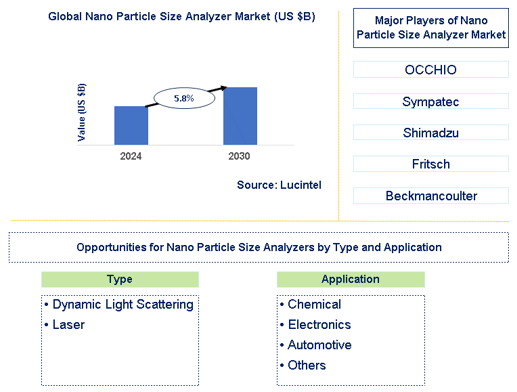
Key data points: The growth forecast = 5.8% annually for the next 6 years. Scroll below to get more insights. This market report covers trends, opportunities, and forecasts in the global nano particle size analyzer market to 2030 by type (dynamic light scattering and laser), application (chemical, electronics, automotive, and others), and region (North America, Europe, Asia Pacific, and the Rest of the World)
We'll send your sample report shortly.
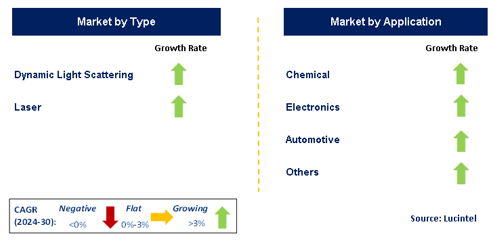
• Lucintel forecasts that, within the type category, the dynamic light scattering is expected to witness a higher growth over the forecast period.
• Within the application category, chemical is expected to witness the highest growth.
• In terms of regions, APAC is expected to witness the highest growth over the forecast period. Gain valuable insights for your business decisions with our comprehensive 150+ page report.
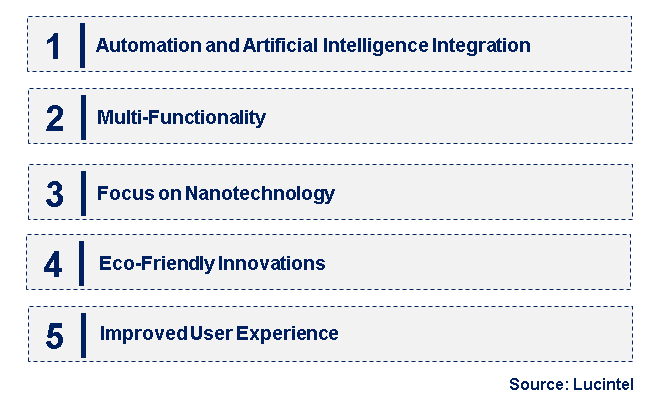
• Automation and artificial intelligence integration: Automation of particle size analysis has streamlined workflow and minimized human error. AI integration in analyzers enhances data processing and predictive modeling, significantly improving research and development decisions. This trend is increasing the efficiency and user-friendliness of analyzers and upgrading laboratory productivity.
• Multi-functionality: Manufacturers are now able to produce multi-functional particle size analyzers that can perform several analyses, including zeta potential and morphology assessments, in addition to sizing. This offers an advantage for researchers to obtain all the information from one device, thereby saving time and costs related to multiple instruments. Versatility has enhanced the appeal of these analyzers in various applications.
• Focus on nanotechnology: A surge in the quest for accurate particle size analyzers finds momentum from growing interest in nanotechnology among different industries. Innovation in this field requires accurate measurement to achieve product efficacy and safety. As industries increasingly adopt nanomaterials, the need for advanced analytical equipment to characterize these particles will continue to grow.
• Eco-friendly innovations: Environmental sustainability is now at the forefront of developing new nanoparticle size analyzers. Organizations are investing more in greener technology and materials to align their products with worldwide sustainability goals. Such a trend attracts those interested in green initiatives and ensures compliance with constantly implemented environmental regulations.
• Improved user experience: Manufacturers' focus on user experience translates into intuitive interface designs and better software capabilities. The devices come with easier operation and interpretation, making them accessible to more users. This phenomenon is important for the adoption of instruments in different labs with varying skill levels. Such emerging trends are remodeling the nanoparticle size analyzer market in terms of functionality, efficiency, and user engagement. As manufacturers respond to these changes, they will be well-positioned for future growth in a competitive landscape.
• Introduction of real-time monitoring: New analyzer models are fitted to measure changes in particle sizes during an experiment in real time. This allows for greater precision, enabling formulation changes based on this information, especially in pharmaceutical applications where detail is critical.
• Advancements in measurement techniques: Integration of advanced measurement technologies such as NTA and laser diffraction is increasingly being adopted. These technologies provide more information about particle behavior, enabling researchers to obtain detailed data on particle size distribution and concentration, leading to better quality products.
• Development of portable analyzers: Companies now offer portable nanoparticle size analyzers that can be used on-site for required measurements. This device is crucial for industries where location plays a vital role, such as field research or quality control management in manufacturing environments. Therefore, portability is promoting adoption across sectors.
• Cooperative research programs: Collaboration between manufacturers and research centers is bringing innovation to the market. Collaborative research includes developments for future analyzers that maximize measurement capabilities and increase the understanding of nanoscale materials. Initiatives like this drive scientific research progress.
• Expansion into emerging markets: Companies are expanding their presence in emerging markets where they see greater demand for sophisticated analytical technologies. This investment in localized manufacturing and distribution capabilities accelerates the response to regional needs and encourages the adoption of technologies, particularly in pharmaceuticals and materials science. Recent developments have significantly driven the nanoparticle size analyzer market, enhancing measurement capabilities and expanding accessibility. This creates better opportunities for continued growth and competitive development of the market for manufacturers.
• The pharmaceutical sector is a high-growth area for nanoparticle size analyzers. As drug formulations become more complex, the analytical requirement for precise particle size analysis related to bioavailability and efficacy is increasing. Companies can engineer specific analyzers to meet stringent regulatory requirements for this sector.
• Materials science is another area advancing in research, particularly in nanomaterials. In this respect, particle-size analyzers have become essential because precise measurement tools are needed to assess new material properties. This allows manufacturers to focus on higher-performance devices built for this specific application.
• Cosmetics and personal care: The use of nanoparticles promises improved performance for cosmetic products, opening doors for particle size analysis in new product formulations and quality control. Some companies have already introduced noteworthy specialty solutions in this market segment.
• Food and beverage: The food and beverage industry is now realizing the role of particle size in product quality and stability. As manufacturers aim to optimize their formulations, accurate particle size analysis becomes necessary. Companies can develop analyzers that meet specific requirements for this industry, tapping into a new market.
• Environmental monitoring: Environmental monitoring is a growing activity and will increase further with pollutants introduced by nanoparticles in air and water. Companies will develop portable analyzers designed for real-time monitoring of particle size and concentration in environmental applications. This represents a growth opportunity aligned with global sustainability efforts. In summary, these strategic growth opportunities indicate different applications for businesses in the nanoparticle size analyzer market. If manufacturers focus on these areas, they can improve their market position and move toward long-term growth.
• Increased research and development: Industries, particularly in pharmaceuticals and nanotechnology, are raising research and development activities, motivating the need for accurate particle size analyzers. As new materials and formulations require advanced analytical tools, this activity is prioritized by researchers.
• Regulatory compliance: Stringent regulatory requirements in industries, including pharmaceuticals and food safety, necessitate precise particle size measurement. Compliance with these regulatory requisites increases the demand for analytical equipment, giving manufacturers a competitive advantage.
• Growing nanotechnology applications: Expanding applications of nanotechnology in electronics, healthcare, and materials science create a growing demand for particle sizing analyzers. Nanomaterials have become integral to various industries, further driving the need for precise measurement tools.
• Consumer awareness: There is significant consumer awareness regarding product quality and safety, prompting manufacturers to invest more in quality control measures, including particle size analysis. To meet high consumer expectations, sophisticated analytical tools are being adopted. Challenges in the nanoparticle size analyzer market include:
• Market competition: The nanoparticle size analyzer market is highly competitive, with various manufacturers vying for market share. Companies must continuously innovate and differentiate their products to gain a competitive edge, placing a strain on resources.
• High upfront costs: Advanced particle size analyzers are capital-intensive, limiting entry and participation by smaller companies and laboratory establishments. These costs may hinder access and adoption in emerging markets with more limited budgets.
• User-friendliness: High-tech particle size analyzers can be difficult to use without proper training, which may impede high penetration. Producers need to develop user-friendly designs along with comprehensive training facilities. These drivers and challenges will define the future of the nanoparticle size analyzer market. Companies that can address challenges while fully utilizing drivers will be well-positioned to navigate this changing landscape.
• OCCHIO
• Sympatec
• Shimadzu
• Fritsch
• Beckmancoulter
• Malvern
• PSS Particle Sizing Systems
• ATS
• Horiba Scientific
• IST
• Dynamic Light Scattering
• Laser
• Chemical
• Electronics
• Automotive
• Others
• North America
• Europe
• Asia Pacific
• The Rest of the World
• United States: A significant driving force in the U.S. is the development of high-throughput particle size analyzers that can make quicker determinations. New models feature advances in imaging and real-time data processing capabilities, enabling faster decision-making. This emphasis helps drive innovation in pharmaceutical formulation and ensures compliance with regulations.
• China: In the world's most populous country, there is a high demand for nanoparticle size analyzers as nanotechnology expands across multiple sectors. Local manufacturers are increasingly utilizing advanced technologies such as laser diffraction and dynamic light scattering to improve measurement. Government-supported research and development also contribute to growth in the analytical instruments market.
• Germany: Germany is at the forefront of integrating smart technology into particle size analyzers. Manufacturers are acquiring devices that provide remote monitoring and automated calibration, thereby improving lab efficiency. There is also an emphasis on sustainability; companies are seeking to integrate green materials and processes into their portfolios.
• India: The nanoparticle size analyzer market in India is rapidly developing, with increased local production capabilities. Indian manufacturers are working to achieve cost-effective solutions without sacrificing quality. The focus on quality control in the pharmaceutical and chemical sectors raises demand for user-friendly analyzers catering to various applications.
• Japan: Particle size analysis in Japan has seen advancements in precision engineering. Companies are integrating artificial intelligence and machine learning into their analyzers for easier data interpretation and predictive analytics. This is expected to yield fruitful research outcomes in nanotechnology and materials science.


• OCCHIO
• Sympatec
• Shimadzu
• Fritsch
• Beckmancoulter
• Malvern
• PSS Particle Sizing Systems
• ATS
• Horiba Scientific
• IST Q5. Which nano particle size analyzer market segment will be the largest in future? Answer: Lucintel forecasts that dynamic light scattering is expected to witness a higher growth over the forecast period. Q6. In nano particle size analyzer market, which region is expected to be the largest in next 5 years? Answer: APAC is expected to witness the highest growth over the forecast period. Q.7 Do we receive customization in this report? Answer: Yes, Lucintel provides 10% customization without any additional cost.


Choose a license that fits your team. Instant PDF delivery.
Prices exclude taxes. Instant delivery. Custom licensing available on request.
Market Report · July 31, 2026
Market Report · July 22, 2026
Market Report · July 20, 2026
Trusted partner for strategic intelligence and business growth


Receive a complimentary market analysis tailored to your industry. Our analysts will identify key growth opportunities and competitive dynamics specific to your business.

Market size, growth rate, and key trend analysis for your specific sector.

Top competitor positioning and market share analysis.

Strategic recommendations backed by data-driven insights.
Get curated market intelligence and competitive moves straight to your inbox.
By subscribing, you agree to receive our monthly insights. Unsubscribe anytime.
Receive a complimentary market analysis tailored to your industry. Our analysts will identify key growth opportunities and competitive dynamics specific to your business.
Market size, growth rate, and key trend analysis for your specific sector.
Top competitor positioning and market share analysis.
Strategic recommendations backed by data-driven insights.
Get curated market intelligence, emerging trends, and competitive moves straight to your inbox each month.
By subscribing, you agree to receive our monthly insights. Unsubscribe anytime.
We'll send your sample report shortly.