
Market Report · July 22, 2026

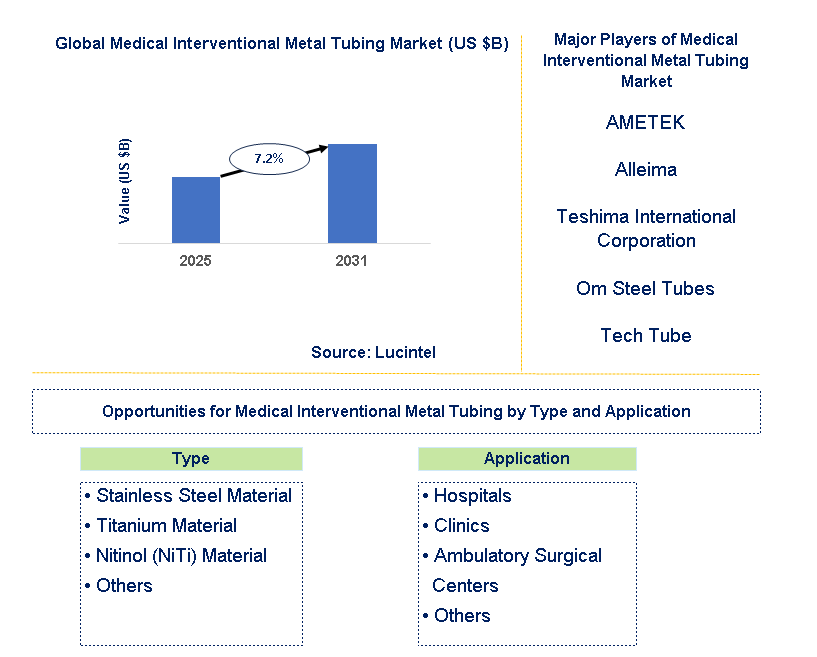
Key data points: The growth forecast = 7.2% annually for the next 7 years. Scroll below to get more insights. This market report covers trends, opportunities and forecasts in medical interventional metal tubing market to 2031 by type (stainless steel material, titanium material, nitinol (NiTi) material, and others), application (hospitals, clinics, ambulatory surgical centers, and others), and region (North America, Europe, Asia Pacific, and the Rest of the World)
We'll send your sample report shortly.
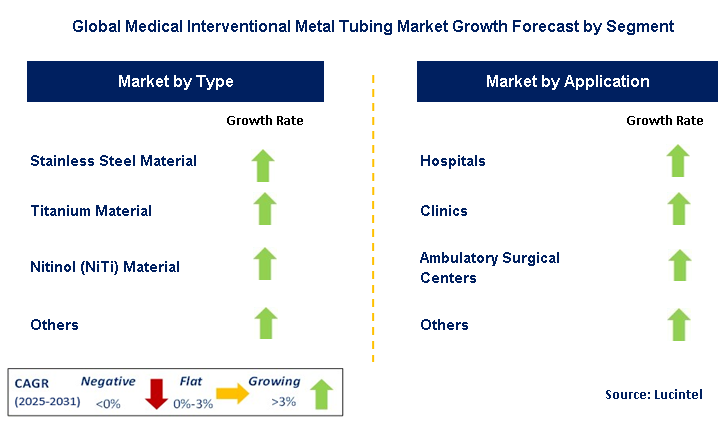
• Lucintel forecasts that, within the type category, stainless steel material is expected to witness the highest growth over the forecast period.
• Within the application category, hospital is expected to witness the highest growth.
• In terms of region, North America is expected to witness the highest growth over the forecast period. Gain valuable insights for your business decisions with our comprehensive 150+ page report. Sample figures with some insights are shown below.
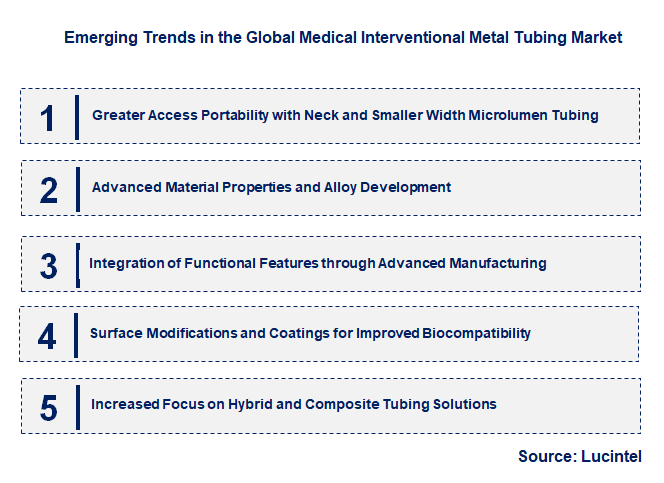
• Greater Access Portability with Neck and Smaller Width Microlumen Tubing: It is also noted that these days the smallest diameter tubing is being sought with thinner walls, allowing even more remote anatomical locations access during minimally invasive surgery interventional techniques. This leads to improved tools for delicate neurovascular and peripheral vascular procedures which result in better recovery, lesser invasiveness and better results for the patients.
• Advanced Material Properties and Alloy Development: The focus is always on construction and use of metal alloys with better biological compatibility, lower corrosion, more torque and greater kink resistance. This allows the making of interventional instruments that are stronger, easier to move, and more reliable which increases the success rate of procedural and longevity of the device within the body. Eventually cobalt chromium alloys, advanced stainless steel, and other alloys with better capabilities are emerging.
• Integration of Functional Features through Advanced Manufacturing: Modern techniques like laser cutting, electrochemical machining, and micro machining are now being used to intricately manipulate metal tubing components, like drug delivery ports, markers, and ports, often referred to as variable flexibility zones. The use of these techniques results in the development of more advanced and complex multi functional interventional devices which improve performance and therapeutic capabilities.
• Surface Modifications and Coatings for Improved Biocompatibility: Biocompatibility of interventional metal tubing using specialized surface modifications and coatings is aimed at increasing compatibility, lubricity, thrombosis, and drug elution while reducing. There is a tendency to apply these modifications and coatings more frequently. With these changes, adverse tissue reactions from the device and vasculature are improved, as well as device navigation and potential at the targeted site for localized drug delivery.
• Increased Focus on Hybrid and Composite Tubing Solutions: An increase of hybrid tubing that includes metal and polymer materials along with composites, is noted in the market in order to achieve the best biocompatibility, mechanical properties, and imaging features. Using these materials improves intervene devices, enabling customized performance specific for clinical applications. The emerging trends, through the development of advanced tubing structures that are smaller, stronger, more functional, undergo complex and less invasive procedures, and are biocompatible, are improving the patient care standards relevant to the Medical Interventional Metal Tubing industry.
• New Initiatives in the Medical Interventional Metal Tubing Industry: Stirling performed research on the invention of metal coils having variable pitch and density over their length. The benefit is increased flexibility and improved torque control in the guidewires and catheters, making for effortless movement amid complex anatomies and increased precision at interventional procedures.
• Further progress is being made in laser ablative and chemical etching methods which make it possible to add exceedingly tiny features on metal tubing surfaces, microchannels for drug delivery, or textured surfaces for better gripping. These actions are aimed at improving advanced interventional tools with more precise aimed functionalities.
• Development of Biodegradable Mg Alloys: There is an alarming rate of research and development into biodegradable metals and alloys which include modifying magnesium alloys to fabricate temporary interventional devices such as stents. This impact results in the potential for devices which can be implanted in the body and after some time, would be able to dissolve on its own thereby eliminating the permanence and complications of implants.
• Development of Imaging Markers and Sensors Integration within the Tubing Wall: Recently there is progress in integrating small but osteoclastic ally active sensors and radiopaque imaging markers within the wall of metal tubing. This is bound to have a positive scope with improved visualization under fluoroscopy or other imaging modalities and the possibility for real time physiological monitoring during interventional procedures.
• Development of Multi-Lumen and Coaxial Tubing Design: There is an increasing focus on the design of multi lumen and coaxial metal tubing to enable the multiple injection of fluids, drugs or devices through a single port. This will have the impact of more complex and efficient interventional procedures with reduced need for multiple catheterizations. Medial Biocompatible Image Guided Interventional Device is a new word as its translation to English is Latent Biomed Device and is an emerging field of technology along with British medicine that involves dental surgery and cardiology. These are new devices intended for use in the arms, hands and head for more accurate and efficient guided surgery. The level of precision, functionality and versatility afforded with these interventions improves, diagnostic and therapeutic outcomes.
• Neurovascular Interventions: The widening scope of treatment for stroke and aneurysms and other neurosurgical conditions which can be addressed with minimally invasive techniques is a lucrative growth opportunity for ultra fine and highly flexible metal tubing utilized in microcatheters and guidewires for neurovascular procedures.
• Peripheral Vascular Interventions: More cases of peripheral artery disease and growing demand for less invasive treatment approaches are forcing the requirement for specialized metal tubing with excellent torque ability and push ability for complex peripheral vascular navigation.
• Electrophysiology and Cardiac Rhythm Management: An increasing market for cardiac ablation catheters and leads is a growth opportunity for metal tubing with certain specifications of conductivity and insulation for electrophysiology procedures.
• Endoscopy and Bronchoscopy: Increased use of minimally invasive endoscopic and bronchoscopy procedures for diagnostic and therapeutic purposes creates a demand for flexibly designed small diameter metal tubing used in biopsy devices, drug delivery catheters, and other endoscopic accessories.
• Medication Surgical Heart Procedures: Within the rapidly advancing area of structural heart diseases, which include TAVR procedures and mitral valve repair, there is a distinct area of opportunity for growth, as delivery systems and prosthetic heart valves require specialized metal tubing. This strategic intervention illustrates the potential for developing the medical interventional metal tubing market by addressing the design needs of neurovascular, peripheral vascular, electrophysiology, endoscopy, and structural heart interventions, including custom-made tubing for these fields, which focus on providing less invasive treatment.
• AMETEK
• Alleima
• Teshima International Corporation
• Om Steel Tubes
• Tech Tube
• Bison Stainless Tube
• Vita Needle Company
• M&M International
• Fuji Seiko
• Accu-Tube
• Stainless Steel Material
• Titanium Material
• Nitinol (NiTi) Material
• Others
• Hospitals
• Clinics
• Ambulatory Surgical Centers
• Others
• North America
• Europe
• Asia Pacific
• The Rest of the World
• United States: US medical interventional metal tubing market is characterized as mature and innovation driven focusing on high performance advanced materials and manufacturing. Some recent trends include more application of nitinol due to its shape memory and super elastic features in catheters and guidewires. There is also an increasing demand for proprietary designed tubing with stringent limits and specialized characteristics for elaborated cardiovascular and neurovascular interventions. Policy encourages competition among manufacturers by proving safety and efficacy.
• China: The growth in healthcare spending, along with rising adoption of minimally invasive surgeries, is propelling growth in China’s medical interventional metal tubing market. Recent developments include an increase in domestic manufacturing capabilities with better quality and technology. Additionally, there is a growing emphasis on cost effective strategies to serve the expanding healthcare system. Medical devices innovations at the local level are being supported more actively by government policies.
• Germany: Germany has a developed medical device industry which focuses on precision engineering and the use of high-quality materials. The most recent developments in the medical interventional metal tubing market include new stainless steel alloys which are more biocompatible with less susceptibility to corrosion. Attention is also being paid to advanced surface treatments and coatings for greater lubricity and lower thrombosis. Collaborative research between research institutions and manufacturers fosters innovation.
• India: Increased access to healthcare and a greater demand for minimally invasive procedures are driving growth in the medical interventional metal tubing market in India. Recent trends include a gradual shift toward higher quality metal tubing to enhance device performance and optimize patient outcomes. There remains great cost sensitivity, which leads to a hybrid of domestic production and imported goods. There is growing knowledge of regulatory compliances pertaining to material specifications and the safety of the device.
• Japan: Japan has one of the highest quality standards alongside medical technological advancements. Some recent trends of the medical interventional metal tubing market in the country include the development of smaller diameter tubing for neurovascular procedures and the addition of tantalum to enhance radiopacity. Other developments include precision laser cutting and advanced surface alteration to create more complex forms that serve additional purposes. Collaborative work between universities and industries is the norm.


• AMETEK
• Alleima
• Teshima International Corporation
• Om Steel Tubes
• Tech Tube
• Bison Stainless Tube
• Vita Needle Company
• M&M International
• Fuji Seiko
• Accu-Tube Q5. Which medical interventional metal tubing market segment will be the largest in future? Answer: Lucintel forecasts that, within the type category, stainless steel material is expected to witness the highest growth over the forecast period. Q6. In medical interventional metal tubing market, which region is expected to be the largest in next 5 years? Answer: In terms of region, North America is expected to witness the highest growth over the forecast period. Q7. Do we receive customization in this report? Answer: Yes, Lucintel provides 10% customization without any additional cost.


Choose a license that fits your team. Instant PDF delivery.
Prices exclude taxes. Instant delivery. Custom licensing available on request.
Market Report · July 22, 2026
Market Report · July 22, 2026
Market Report · July 22, 2026
Trusted partner for strategic intelligence and business growth


Receive a complimentary market analysis tailored to your industry. Our analysts will identify key growth opportunities and competitive dynamics specific to your business.

Market size, growth rate, and key trend analysis for your specific sector.

Top competitor positioning and market share analysis.

Strategic recommendations backed by data-driven insights.
Get curated market intelligence and competitive moves straight to your inbox.
By subscribing, you agree to receive our monthly insights. Unsubscribe anytime.
Receive a complimentary market analysis tailored to your industry. Our analysts will identify key growth opportunities and competitive dynamics specific to your business.
Market size, growth rate, and key trend analysis for your specific sector.
Top competitor positioning and market share analysis.
Strategic recommendations backed by data-driven insights.
Get curated market intelligence, emerging trends, and competitive moves straight to your inbox each month.
By subscribing, you agree to receive our monthly insights. Unsubscribe anytime.
We'll send your sample report shortly.