
Market Report · July 22, 2026

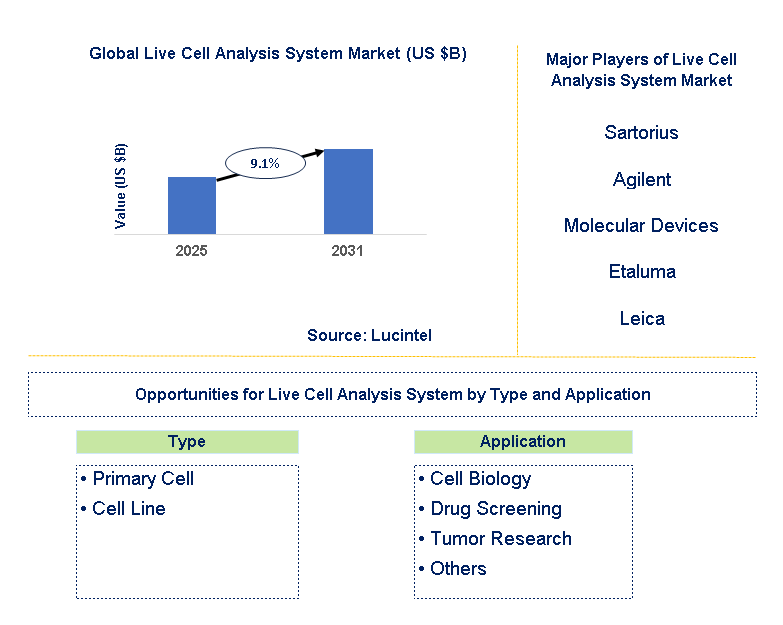
Key data points: The growth forecast = 9.1% annually for the next 7 years. Scroll below to get more insights. This market report covers trends, opportunities and forecasts in live cell analysis system market to 2031 by type (primary cell and cell line), application (cell biology, drug screening, tumor research, and others), and region (North America, Europe, Asia Pacific, and the Rest of the World)
We'll send your sample report shortly.
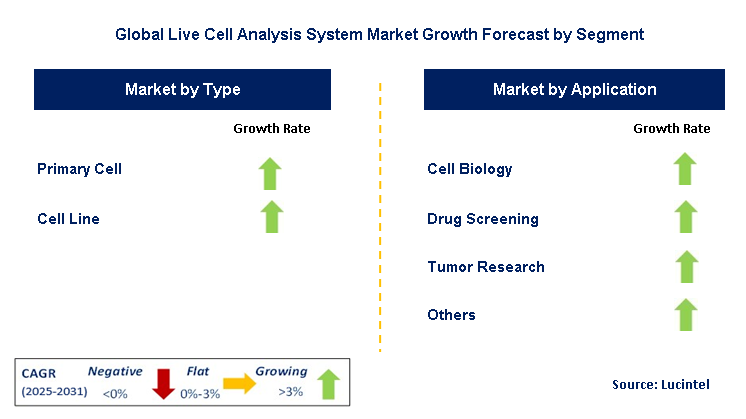
• Lucintel forecasts that, within the type category, cell line is expected to witness higher growth over the forecast period.
• Within the application category, drug screening is expected to witness the highest growth.
• In terms of region, North America is expected to witness the highest growth over the forecast period. Gain valuable insights for your business decisions with our comprehensive 150+ page report. Sample figures with some insights are shown below.
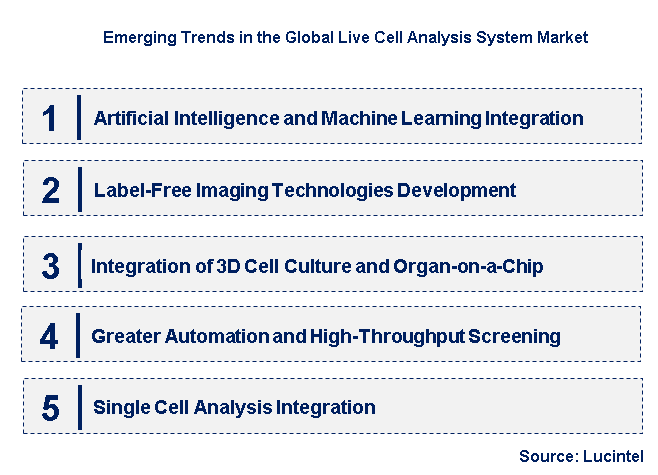
• Artificial Intelligence and Machine Learning Integration: The use of AI and machine learning algorithms is significantly influencing live cell analysis. These technologies provide automated image capture, real-time image analysis, sophisticated cell tracking, and unbiased quantitative measurement of intricate cellular phenotypes. The effect is strongly promoting data interpretation, enhancing the reproducibility and accuracy of results, and enabling the detection of subtle cellular behavior that would be easily overlooked by human observation. Artificial intelligence systems boost throughput and minimize the effort and time needed for extensive experimental analysis.
• Label-Free Imaging Technologies Development: Increased focus on label-free live cell imaging methods, including quantitative phase imaging (QPI), digital holographic microscopy, and AI-amplified bright-field imaging. These approaches circumvent the use of fluorescent probes or labels that can disrupt cellular physiology or produce phototoxicity. The influence is offering a more physiologically relevant and less invasive means of viewing cells such that longer-term studies may be performed and cellular behavior is better represented in its natural state. This method lessens artifacts and maintains cell viability over long periods.
• Integration of 3D Cell Culture and Organ-on-a-Chip: The market is witnessing growing acceptance of live cell analysis systems tailored for 3D cell culture models such as spheroids, organoids, and organ-on-a-chip platforms. Such models represent the in vivo condition more accurately than conventional 2D cultures. The result is allowing researchers to investigate cell-to-cell interactions, tissue formation, and drug response in more physiologically relevant settings. This convergence is key to enhancing the predictability of preclinical drug discovery and driving regenerative medicine, with more realistic disease models.
• Greater Automation and High-Throughput Screening: The move towards higher levels of automation and high-throughput capacity for live cell analysis systems is gaining momentum. This encompasses robot plate handling, automated microscopy, and integrated environmental control systems. The effect is drastically expanding the throughput of experiments that are conducted in parallel, enabling fast screening of large compound libraries in drug research and high-content analysis of cellular responses. Automation minimizes labor, maximizes reproducibility, and simplifies workflows, thus rendering live cell analysis more cost-effective for large-scale investigations.
• Single Cell Analysis Integration: Live cell analysis is becoming more and more integrated with single cell analysis technologies, allowing real-time observation and manipulation of individual cells in a heterogeneous population. This involves advanced microfluidic platforms and advanced image analysis algorithms for tracing individual cell lineages and responses. The impact is granting unparalleled insights into cellular heterogeneity, rare cell events, and personalized medicine. Understanding individual cell behavior is critical for areas like cancer research, immunology, and stem cell differentiation, leading to more targeted therapeutic approaches. These new trends are together redefining the live cell analysis system market by improving the technology to be more powerful, efficient, and biologically relevant. The infusion of AI, the shift towards label-free techniques, emphasis on 3D models, increased automation, and adoption of single cell analysis are all leading to a more advanced and knowledgeable research environment. This change has the potential to speed up drug discovery, enhance our knowledge about disease, and fuel cell-based therapy innovations.
• Imaging Technology Advances: Recent advances have seen major improvements in fundamental imaging technologies like advanced confocal microscopy, light-sheet microscopy, and super-resolution methods specifically designed for live cells. Such developments provide higher spatial and temporal resolution with less phototoxicity, being essential for long-term observation. The effect is allowing scientists to observe subcellular ultrastructure and dynamic events such as protein transport, organelle migration, and cell division with unprecedented precision and minimal disturbance of the living cells, yielding deeper biological information.
• Convergence of Artificial Intelligence and Machine Learning: A revolutionary aspect is the ubiquitous convergence of AI and machine learning algorithms into live cell analysis hardware and software. These platforms are employed for automated image acquisition optimization, real-time image processing, smart cell tracking, and objective quantitative data retrieval from intricate experiments. The influence is profoundly speeding up data analysis pipelines, enhancing the accuracy and reproducibility of outcomes, and allowing for the detection of subtle cellular phenotypes and patterns difficult to identify manually, therefore enhancing research productivity.
• Expansion of 3D Cell Culture and Organoid Analysis: Most recent trends indicate a significant spike in the systems of live cell analysis meant to efficiently analyze 3D cell culture models, such as spheroids, organoids, and tissue engineering constructs. These models provide a more physiological relevant environment compared to conventional 2D cultures. The effect is giving a better picture of cell-to-cell interaction, drug penetration, and tissue formation in a more physiologically correct environment that is important for drug screening and regenerative medicine. Platforms with special features are arising to handle and image these intricate 3D structures in the long term.
• Increased Automation and High-Throughput Ability: There has been a strong effort to create completely automated systems for analyzing live cells with high-throughput screening (HTS) capability. Some of these technologies include automated liquid handling, robotic plate transfer, environmental control chambers integrated into the instrument, and automated image acquisition sequences. The effect is enabling researchers to screen vast libraries of compounds or genetic perturbations with speed and efficiency, speeding up drug discovery and target validation. Automation lessens manual effort, improves experimental reproducibility, and facilitates larger-scale studies important for industrial research.
• Rise of Label-Free Analysis Methods: Novel advancements highlight label-free live cell imaging technologies to minimize the risk of artifacts and phototoxicity with fluorescent probes. Strategies like quantitative phase imaging (QPI), bright-field microscopy coupled with AI for contrast enhancement, and digital holographic microscopy are on the rise. The effect is to facilitate long-term, non-invasive monitoring of cellular behavior without disrupting cell physiology, giving a closer representation of the natural cell function and reducing experimental perturbation, of utmost importance in sensitive biological research. These advances collectively are influencing the system market for live cell analysis by increasing the power, efficiency, and biological information provided by the technology. The developments in imaging, the use of AI, the emphasis on label-free 3D models, increased automation, and the adoption of label-free approaches are all helping create a more advanced and stable platform for comprehending life at the cellular level. This is crucial for speeding up research in life science fields and for drug development in the future.
• Drug Discovery and Development: The biotechnology and pharmaceutical industries are a prime strategic growth opportunity. Live cell analysis platforms are essential for high-content screening, toxicology assays, target validation, and mechanism-of-action understanding of drugs in real-time. The effect is to speed up the drug discovery pipeline by gaining early, dynamic information on the efficacy and toxicity of compounds, minimizing expensive failures downstream. Monitoring cellular drug responses over time in the context of physiology is inestimable in finding good drug candidates.
• Basic Research and Cell Biology: Basic cell biology research is a foundation application and one of the main drivers of growth. Live cell analysis systems allow investigators to examine intricate processes like cell proliferation, migration, apoptosis, cell cycle dynamics, and intercellular communication. The effect is probing basic biological mechanisms in greater depth, which provides the basis for biomedical advances of all kinds. Ongoing innovation in this field maintains a regular need for advanced live cell imaging technology from universities and research organizations across the world.
• Stem Cell Studies and Regenerative Medicine: The emerging stem cell research and regenerative medicine industries hold enormous growth prospects. Live cell analysis is critical for monitoring stem cell differentiation, lineage tracking, cell viability assessment, and determining the quality of cell-based therapies for transplantation. The effect is essential for the creation of safe and potent cell therapies, refining differentiation protocols, and clarifying the stem cell behavior in many applications of regenerative medicine. The accuracy delivered by these systems is essential for the rigorous regulatory needs of regenerative medicine.
• Oncology and Cancer Research: The worldwide cancer battle is a key driver of the live cell analysis market. These technologies are applied to investigate cancer cell proliferation, metastasis, angiogenesis, and chemotherapy or immunotherapy resistance in real-time. The influence is offering essential information on cancer biology, enabling the creation of new anti-cancer drugs, and evaluating the effectiveness of personalized cancer therapies. The capability to view cancer cell behavior following different interventions is key to moving forward in oncology.
• Safety Pharmacology and Toxicology: Live cell analysis systems are being increasingly used in safety pharmacology and toxicology research to evaluate cytocompatibility and possible adverse effects of new compounds on living cells. It enables early toxicity detection and gives a more precise reflection of cellular responses compared to endpoint assays. The effect is minimizing the use of animal testing, speeding up the safety evaluation of drug candidates, and generating better predictive models of human toxicity. This ensures that drugs are developed with greater safety and regulatory compliance. These strategic growth prospects are greatly influencing the live cell analysis system market by broadening its application base, promoting technological innovation, and accelerating market adoption. By concentrating on these high-demand markets, manufacturers are in a position to capitalize on the exclusive strengths of live cell analysis in order to address key research and development requirements, thus creating tremendous market growth and long-term commercial success. The broadening of applications also ensures the long-term relevance and development of the live cell analysis business.
• Sartorius
• Agilent
• Molecular Devices
• Etaluma
• Leica
• PerkinElmer
• Axion BioSystems
• CytoSMART
• OMNI Life Science
• Live Cell Instrument
• Primary Cell
• Cell Line
• Cell Biology
• Drug Screening
• Tumor Research
• Others
• North America
• Europe
• Asia Pacific
• The Rest of the World
• United States: The U.S. live cell analysis system market is the leading one globally, driven by high research funding, a robust biotechnology industry, and a well-developed academic research base. Recent advances involve major enhancements in high-content screening systems combining advanced automation and artificial intelligence for high-speed drug discovery. There is a keen interest in creating label-free imaging methods to reduce cellular perturbation and enhance physiological relevance. In addition, the market witnesses ongoing innovation in super-resolution microscopy and multi-omics integration, which allows for greater insight into intricate cellular pathways, especially in cancer and neuroscience studies.
• China: China is aggressively expanding its presence in the live cell analysis system market due to growing government investment in life sciences research, an expanding pharmaceutical sector, and increased demand for sophisticated drug screening technology. Recent advances include the general acceptance of automated live cell imaging platforms for high-throughput drug discovery and cell line development. Chinese companies are concentrating on creating cost-effective but high-performance systems. There is also a major trend towards incorporating artificial intelligence for image analysis and data management, to improve efficiency and speed up research results, such as in cell therapy and regenerative medicine.
• Germany: Germany's live cell analysis system market is dominated by a strong focus on precision engineering, solid instrument building, and advanced optical microscopy. New developments involve advancements in confocal and light-sheet microscopy for high image quality and minimal phototoxicity during long-term live cell monitoring. German firms also are concentrating on creating integrated solutions that bring together environmental control chambers and advanced imaging in order to ensure the best physiological conditions for cells. The market is spurred by high-quality academic research, pharma R&D, and increasing demand for 3D cell culture models, for which live cell analysis is essential.
• India: The live cell analysis system market in India is showing promising growth, driven by rising investment in biomedical research and an increasing number of biotechnology startups and CROs. Recent growth has involved increasing adoption of time-lapse microscopy and simple live cell imaging solutions in academic research institutions and small biotech companies. The market continues to depend on imports for high-end, advanced systems, though there is a slowly increasing local development of affordable solutions and emphasis on developing infrastructure for cell-based assays. The need is specifically stimulated by infectious disease research, cancer research, and drug screening programs.
• Japan: Japan's live cell analysis system market is characterized by state-of-the-art technological advancements and a keen emphasis on high-precision and automated systems. Some recent advances include the introduction of pioneering techniques in advanced super-resolution microscopy methods for observing subcellular dynamics in real-time. Japanese firms are also aggressively invested in creating advanced image analysis software, frequently coupled with machine learning, to quantify data from live cell experiments. There is high focus on coupling live cell analysis with stem cell biology, regenerative medicine, and drug discovery platforms to better understand cellular processes and facilitate rapid therapeutic development, particularly for application in personalized medicine.


• Sartorius
• Agilent
• Molecular Devices
• Etaluma
• Leica
• PerkinElmer
• Axion BioSystems
• CytoSMART
• OMNI Life Science
• Live Cell Instrument Q5. Which live cell analysis system market segment will be the largest in future? Answer: Lucintel forecasts that, within the type category, cell line is expected to witness higher growth over the forecast period. Q6. In live cell analysis system market, which region is expected to be the largest in next 5 years? Answer: In terms of region, North America is expected to witness the highest growth over the forecast period. Q7. Do we receive customization in this report? Answer: Yes, Lucintel provides 10% customization without any additional cost.


Choose a license that fits your team. Instant PDF delivery.
Prices exclude taxes. Instant delivery. Custom licensing available on request.
Market Report · July 22, 2026
Market Report · July 22, 2026
Market Report · July 22, 2026
Trusted partner for strategic intelligence and business growth


Receive a complimentary market analysis tailored to your industry. Our analysts will identify key growth opportunities and competitive dynamics specific to your business.

Market size, growth rate, and key trend analysis for your specific sector.

Top competitor positioning and market share analysis.

Strategic recommendations backed by data-driven insights.
Get curated market intelligence and competitive moves straight to your inbox.
By subscribing, you agree to receive our monthly insights. Unsubscribe anytime.
Receive a complimentary market analysis tailored to your industry. Our analysts will identify key growth opportunities and competitive dynamics specific to your business.
Market size, growth rate, and key trend analysis for your specific sector.
Top competitor positioning and market share analysis.
Strategic recommendations backed by data-driven insights.
Get curated market intelligence, emerging trends, and competitive moves straight to your inbox each month.
By subscribing, you agree to receive our monthly insights. Unsubscribe anytime.
We'll send your sample report shortly.