
Market Report · July 22, 2026

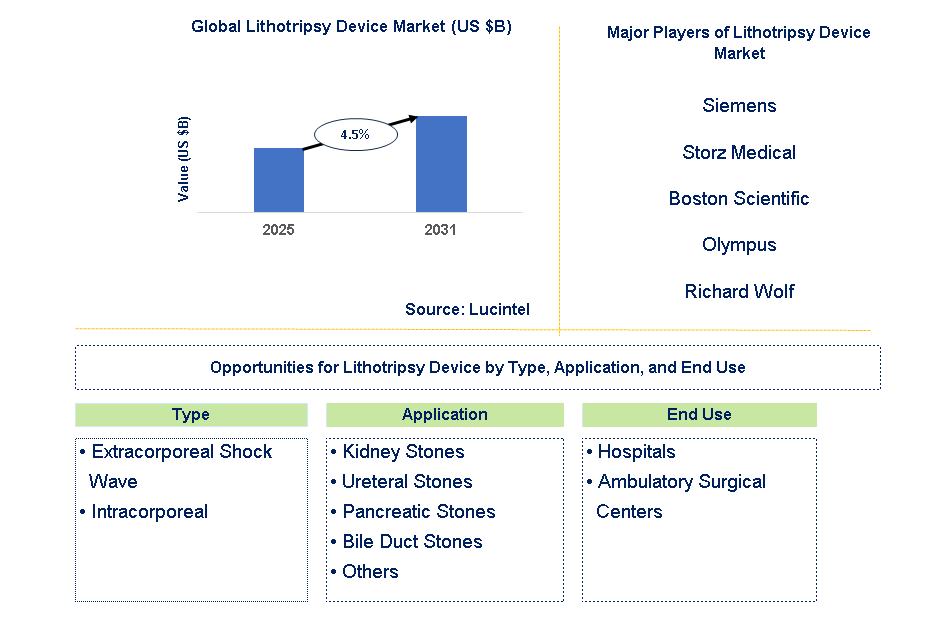
Key data points: The growth forecast = 4.5% annually for the next 7 years. Scroll below to get more insights. This market report covers trends, opportunities and forecasts in lithotripsy device market to 2031 by type (extracorporeal shock wave and intracorporeal), application (kidney stones, ureteral stones, pancreatic stones, bile duct stones, and others), end use (hospitals and ambulatory surgical centers), and region (North America, Europe, Asia Pacific, and the Rest of the World)
We'll send your sample report shortly.
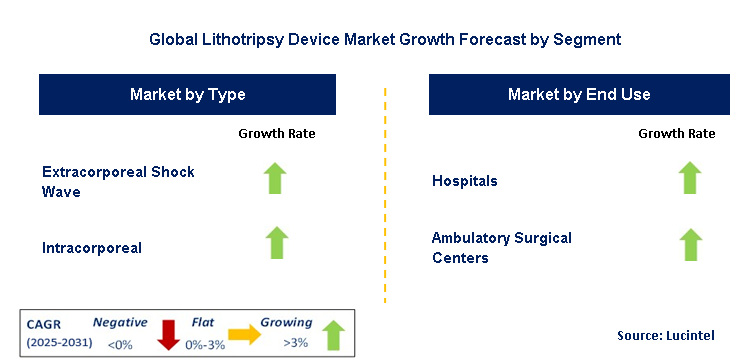
• Lucintel forecasts that, within the type category, extracorporeal shock wave is expected to witness higher growth over the forecast period.
• Within the end use category, hospital is expected to witness higher growth.
• In terms of region, APAC is expected to witness the highest growth over the forecast period. Gain valuable insights for your business decisions with our comprehensive 150+ page report. Sample figures with some insights are shown below.
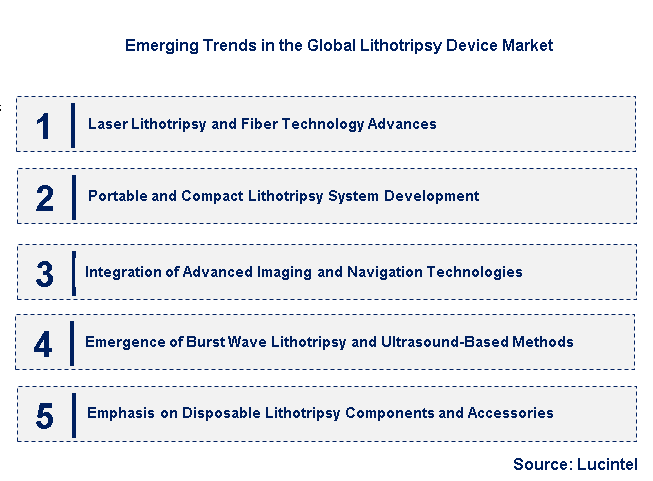
• Laser Lithotripsy and Fiber Technology Advances: This trend entails ongoing advancement in laser technology, specifically the growing use of Thulium fiber lasers. They provide better cutting and ablating capabilities, resulting in more effective stone fragmentation, particularly for larger or harder stones, and lower retropulsion. The effect is increased procedural effectiveness, reduced operating times, and better stone-free rates. This enables more accurate and efficient management of complicated urinary calculi, leading to improved patient outcomes and making laser lithotripsy an attractive option for an expanding variety of stone compositions.
• Portable and Compact Lithotripsy System Development: More compact and portable lithotripsy instruments, such as tabletop and mobile equipment, are increasingly being designed and produced. They take up less dedicated space and can be readily transferred between operating rooms or even to ambulatory surgical centers and smaller clinics. The effect is greater access to lithotripsy treatments, especially in locations with limited infrastructure or tight budget. This decentralizes stone treatment, decreasing patient travel burden, possibly reducing healthcare costs, and increasing access to minimally invasive stone management.
• Integration of Advanced Imaging and Navigation Technologies: This trend is directed towards adding advanced imaging modalities like real-time ultrasound, CT fusion, and augmented reality to lithotripsy machines. These technologies deliver better visualization and more accurate targeting of stones, enhancing procedure accuracy. The effect is enhanced stone fragmentation success rates, lower radiation exposure (particularly with ultrasound guidance), and less harm to the surrounding tissues. This enables more reliable and accurate stone treatment, with less risk of adverse effects and better patient outcomes.
• Emergence of Burst Wave Lithotripsy and Ultrasound-Based Methods: The thrilling new trend involves the innovation of non-invasive burst wave lithotripsy (BWL) and other sophisticated ultrasound-based methods. BWL employs bursts of short pulse ultrasound waves to break up stones, with the promise of anesthesia-free treatment in a more reliable form. The effect is a possible paradigm shift towards more patient-comfortable, non-invasive, and sedation-free stone fracture. This would significantly increase the availability of lithotripsy, decrease procedural risk, and render the procedure more patient-friendly, extending its use in outpatient facilities and emergency rooms.
• Emphasis on Disposable Lithotripsy Components and Accessories: There is a growing focus on creating disposable or single-use lithotripsy parts and accessories, including laser fibers, ureteroscopes, and stone retrieval baskets. This is motivated by the desire to improve infection control, provide consistent performance, and lower reprocessing expenses. The result is better patient safety through reduced cross-contamination risk and availability of sterile instruments per procedure. This also simplifies clinical procedures, eases maintenance requirements for health facilities, and accommodates changing standards of hygiene in the practice of medicine. These nascent trends are significantly transforming the lithotripsy device market by pushing it towards more precision, accessibility, and patient-focused treatment. The technology advances in lasers as well as the innovations in novel ultrasound-based modalities are boosting the effectiveness as well as comfort of the treatments. At the same time, an emphasis on portability, advanced imaging, and disposable elements is increasing operation efficiency, broadening market access, and enhancing patient safety. All of these developments set lithotripsy as an increasingly advanced and sought-after technology for the management of stones.
• Commercialization of Intravascular Lithotripsy for Cardiovascular Disease: One important recent development is the commercial success and growing adoption of Intravascular Lithotripsy (IVL) to treat calcified cardiovascular disease. This technology, originally applied to urological stones, is now utilized to shatter calcified plaque within arteries to allow stent placement in complex coronary and peripheral arterial disease. The effect is a massive advancement of lithotripsy technology beyond its conventional urological application, creating new streams of revenue and providing a minimally invasive treatment option for an onerous cardiovascular condition, thus enhancing patient outcomes in cardiology.
• Launch of Next-Generation Thulium Fiber Lasers: There has also been a significant recent advancement with the availability and growing clinical use of next-generation Thulium fiber lasers for the treatment of urolithiasis. The lasers provide increased water absorption with resulting more effective fragmentation of stone, accurate cutting, and less retropulsion than conventional holmium lasers. The effect is enhanced stone-free rates, decreased procedural times, and less collateral tissue damage with ureteroscopy and percutaneous nephrolithotomy (PCNL) procedures, with the result being more effective and safer removal of stone for patients.
• Developments in Real-Time Imaging for Better Stone Localization: Recent advances have seen important progress in real-time imaging technologies incorporated within lithotripsy machines. These are the use of higher end ultrasound, fluoroscopy, and even optical coherence tomography (OCT) for better and quicker visualization of stones during treatment. The benefit is enhanced precision targeting of calculi, particularly for hard-to-target stones, shortening the number of shock waves or laser pulses and lowering exposure to radiation. This results in increased success rates, fewer complications, and greater patient safety with lithotripsy procedures.
• Greater Anesthesia-Free Lithotripsy Research and Development: One significant innovation is the increased research and development into new, non-invasive lithotripsy methods with the potential for being carried out without general anesthesia. A notable example is Burst Wave Lithotripsy (BWL), which delivers focused ultrasound pulses to break up stones. The effect is the ability to greatly enhance patient comfort and safety through the avoidance of risks and recovery time from anesthesia. This may increase the availability of lithotripsy to more patients, including those with co-morbidities, and translate procedures to the outpatient environment or even emergency rooms, providing increased access to stone treatment.
• Strategic Partnerships and Acquisitions Between Market Leaders: Current developments indicate a surge in strategic partnerships, mergers, and acquisitions between top lithotripsy device companies. The collaborations have the purpose to integrate market share, take advantage of complementary technologies, and increase global presence. For example, they are purchasing smaller innovators in order to incorporate new imaging or laser technologies. The result is faster product innovation, supply chains maximized, and wider market reach for advanced lithotripsy solutions. It also stimulates competitive dynamics, compelling companies to improve their products and increase their geographical reach. These advancements are significantly affecting the lithotripsy device market by increasing its technological innovation, expanding its clinical indications, and enhancing patient outcomes. The diversification into cardiovascular uses, the emergence of new-generation lasers, and improved real-time imaging are making interventions more efficient and accurate. At the same time, the emphasis on anesthesia-free treatments and strategic partnerships are promoting accessibility and market consolidation, establishing lithotripsy as a cornerstone in minimally invasive medical therapy.
• Management of Kidney Stones: This application continues to be the largest and most prominent growth opportunity. With the global prevalence of kidney stones increasing due to lifestyle habits, dietary, and demographic aging factors, the demand for lithotripsy units for fragmentation of renal calculi is strong. The challenge is creating better, more accurate, and patient-friendly machines for Extracorporeal Shockwave Lithotripsy (ESWL) and other intracorporeal laser/ultrasound lithotripsy methods. Impact: This solves a common urological disorder, decreases invasive surgery demand, enhances patient quality of life, and offers a stable and growing market for the manufacturers of lithotripsy devices worldwide.
• Treatment of Ureteral and Bladder Stones: This submission targets stone treatment within the ureter (the tube from the kidney to the bladder) and bladder. These stones tend to need specially designed intracorporeal lithotripters, such as flexible ureteroscopes with built-in laser fibers. The challenge is to advance miniaturization, flexibility, and imaging capability of these devices to treat tortuous anatomy and efficiently stone fragment in these difficult locations. Impact: This provides effective and less invasive options for urological conditions that are prevalent, reducing patient discomfort and recovery time and increasing the role of lithotripsy beyond kidney stones.
• Choledocholithiasis and Pancreatic Stones Management: One of the next stages of growth is in the management of pancreatic duct stones and bile duct stones. Endoscopic retrograde cholangiopancreatography (ERCP) in conjunction with electrohydraulic or laser lithotripsy is applied for such conditions. The potential is to create highly maneuverable, specialized endoscopes and energy delivery equipment tailored to the fragile anatomy of such ducts. Impact: It offers an important minimally invasive option to surgery for the management of obstructive jaundice and pancreatitis due to stones, with better patient outcomes and decreased surgical morbidity. It creates a new, high-value market for manufacturers of lithotripsy devices.
• Removal of Salivary Gland Stones: This niche but increasing application is the removal of salivary gland and duct stones, usually endoscopically with miniature lithotripters. The challenge is to create extremely small, flexible endoscopes and lithotripters that can reach the minute salivary ducts without harm. Impact: This provides a minimally invasive treatment for a painful and recurrent condition, obviating conventional surgical removal of salivary glands. It is designed for a niche patient group, offering a less traumatic treatment and an untapped market for specialized device manufacturers.
• Intravascular Calcification Treatment: A paradigm-shifting strategic growth area is the use of intravascular lithotripsy (IVL) for the treatment of highly calcified peripheral and coronary artery lesions. This uses balloon-mounted shockwave emitters to fracture calcifications in arteries, making the artery more amenable to angioplasty and stent placement. The opportunity is in optimizing IVL technology for vascular use. Impact: This changes the treatment of advanced cardiovascular disease, providing a safer and more efficient way to condition calcified vessels for revascularization, dramatically enhancing patient care in interventional cardiology and opening up a vast new market sector for lithotripsy technology. These opportunities are profoundly affecting the lithotripsy device market by encouraging it to diversify and increase its clinical application beyond its standard urology. With its emphasis on kidney, ureteral, and bladder stones, the market is fulfilling its fundamental requirement. At the same time, the increasing usage in biliary, pancreatic, and salivary duct stones and the groundbreaking application in intravascular calcification are creating new, high-value markets. This strategic diversification across various anatomical sites guarantees long-term market growth and solidifies lithotripsy’s position as a broad-based and indispensable medical technology.
• Siemens
• Storz Medical
• Boston Scientific
• Olympus
• Richard Wolf
• Direxgroup
• Novamedtek
• Dornier Medtech
• Medispec
• Walz Elektronik
• Extracorporeal Shock Wave
• Intracorporeal
• Kidney Stones
• Ureteral Stones
• Pancreatic Stones
• Bile Duct Stones
• Others
• North America
• Europe
• Asia Pacific
• The Rest of the World
• United States: The US lithotripsy device market is marked by high innovation and robust uptake of next-generation technologies, mainly fueled by high rates of kidney stone prevalence and positive reimbursement policies. New additions have come through the recent commercialization of new intravascular lithotripsy (IVL) catheters to treat calcified cardiovascular disease, which provides evidence of the non-urology applicability of lithotripsy technology. The market also is experiencing more integration of advanced imaging and AI to improve stone targeting and treatment accuracy, resulting in enhanced patient outcomes and lower procedure times in ambulatory surgical centers.
• China: The market for lithotripsy devices in China is growing rapidly, driven by its huge and aging population, rising prevalence of urolithiasis, and growing healthcare infrastructure. Recent trends involve sizeable investments in local manufacturing and research and development in order to make affordable and advanced lithotripsy machines. Chinese companies are driving strategic cross-border acquisitions of overseas companies, which are reinforcing local capability and market position. The emphasis is on increasing access to minimally invasive treatment in urban as well as rural regions, with increasing demand for advanced extracorporeal shockwave lithotripsy (ESWL) systems.
• Germany: Germany’s market for lithotripsy equipment is a leading player in Europe for high-end medical device manufacturing and strict regulatory practices. Key developments have been ongoing technological upgradation in extracorporeal as well as intracorporeal lithotripters, focusing on accuracy, efficiency, and patient comfort. German firms are leading the way in the creation of powerful ESWL units as well as sophisticated laser lithotripsy systems. The market is supported by a well-developed healthcare setup and a strong focus on clinical research, ensuring the hospitalization and urology clinics’ uptake of advanced lithotripsy technologies.
• India: The lithotripsy device market in India is set to witness substantial growth, supported by high and growing prevalence of kidney stones, enhanced healthcare infrastructure, and rising disposable incomes. Recent trends show an ever-growing inclination of patients towards minimal invasion techniques. Government policies to improve public healthcare centers and encourage medical tourism are also driving market growth. Domestic players and overseas competitors are stressing affordable yet efficient lithotripsy devices to serve the various economic classes in the population, particularly for treating kidney stones.
• Japan: The Japanese lithotripsy device market is marked by its sophisticated healthcare system, an aging population, and the high concern for precision and patient safety. Recent advances involve ongoing integration of advanced imaging technologies with lithotripsy systems to improve stone localization and fragmentation. The market is witnessing consistent demand for high-performance extracorporeal and intracorporeal lithotripters, fueled by the growing prevalence of kidney stones among the older population. Compact and easy-to-use devices are also being developed in order to enhance clinical efficiency and minimize procedure times in different healthcare environments.


• Siemens
• Storz Medical
• Boston Scientific
• Olympus
• Richard Wolf
• Direxgroup
• Novamedtek
• Dornier Medtech
• Medispec
• Walz Elektronik Q5. Which lithotripsy device market segment will be the largest in future? Answer: Lucintel forecasts that, within the type category, extracorporeal shock wave is expected to witness higher growth over the forecast period. Q6. In lithotripsy device market, which region is expected to be the largest in next 5 years? Answer: In terms of region, APAC is expected to witness the highest growth over the forecast period. Q7. Do we receive customization in this report? Answer: Yes, Lucintel provides 10% customization without any additional cost.


Choose a license that fits your team. Instant PDF delivery.
Prices exclude taxes. Instant delivery. Custom licensing available on request.
Market Report · July 22, 2026
Market Report · July 22, 2026
Market Report · July 22, 2026
Trusted partner for strategic intelligence and business growth


Receive a complimentary market analysis tailored to your industry. Our analysts will identify key growth opportunities and competitive dynamics specific to your business.

Market size, growth rate, and key trend analysis for your specific sector.

Top competitor positioning and market share analysis.

Strategic recommendations backed by data-driven insights.
Get curated market intelligence and competitive moves straight to your inbox.
By subscribing, you agree to receive our monthly insights. Unsubscribe anytime.
Receive a complimentary market analysis tailored to your industry. Our analysts will identify key growth opportunities and competitive dynamics specific to your business.
Market size, growth rate, and key trend analysis for your specific sector.
Top competitor positioning and market share analysis.
Strategic recommendations backed by data-driven insights.
Get curated market intelligence, emerging trends, and competitive moves straight to your inbox each month.
By subscribing, you agree to receive our monthly insights. Unsubscribe anytime.
We'll send your sample report shortly.