
Market Report · July 20, 2026

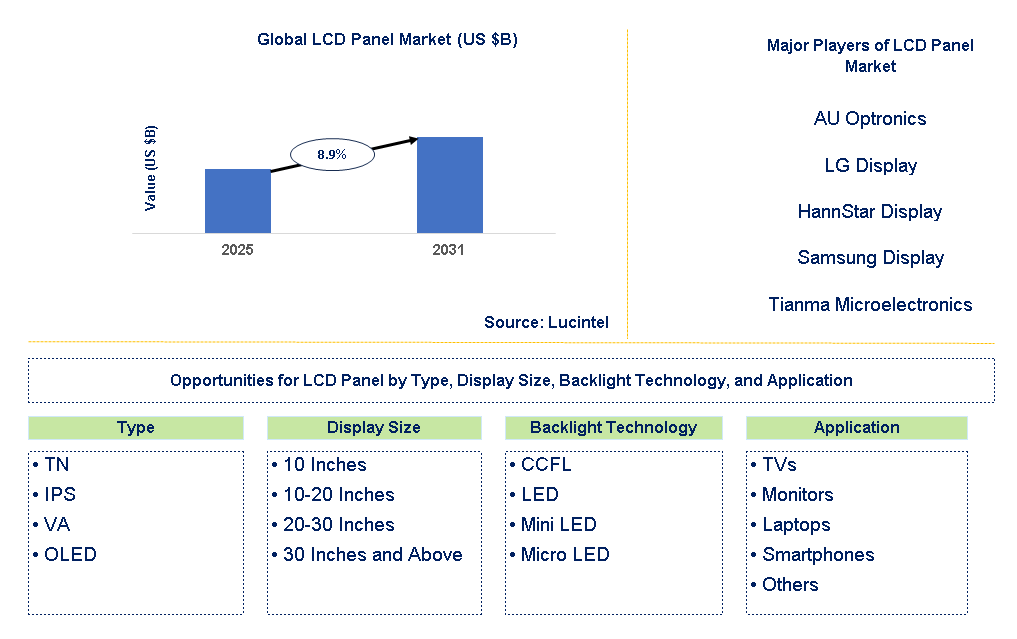
Key data points: The growth forecast = 8.9% annually for the next 7 years. Scroll below to get more insights. This market report covers trends, opportunities and forecasts in LCD panel market to 2031 by type (TN, IPS, VA, and OLED), display size (10 inches, 10-20 inches, 20-30 inches, and 30 inches and above), backlight technology (CCFL, LED, mini LED, and micro LED), application (TVs, monitors, laptops, smartphones, and others), and region (North America, Europe, Asia Pacific, and the Rest of the World)
We'll send your sample report shortly.
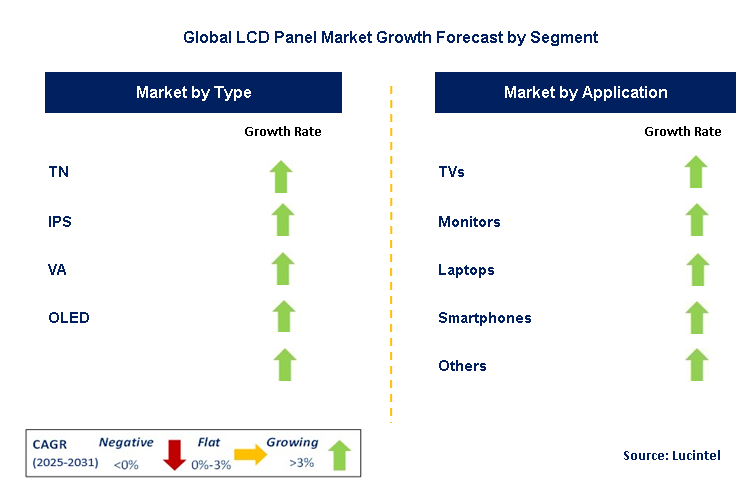
• Lucintel forecasts that, within the type category, ips is expected to witness the highest growth over the forecast period.
• Within the application category, smartphon is expected to witness the highest growth.
• In terms of region, APAC is expected to witness the highest growth over the forecast period. Gain valuable insights for your business decisions with our comprehensive 150+ page report. Sample figures with some insights are shown below.
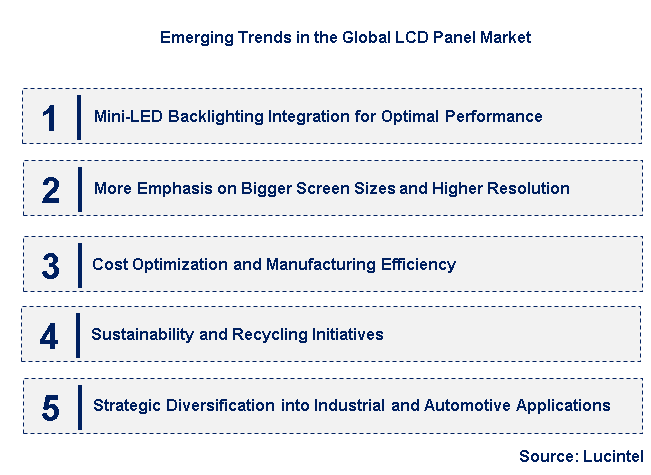
• Mini-LED Backlighting Integration for Optimal Performance: A key upcoming trend is the mass adoption of Mini-LED backlighting technology in LCD panels across high-end consumer electronics and professional monitors. Mini-LEDs are much smaller compared to conventional LEDs, making it possible to have more local dimming zones. The result is an extreme boost in contrast ratios, enhanced blacks, increased peak brightness, and improved HDR (High Dynamic Range) performance, closing the visual difference with OLED displays while retaining LCD’s cost benefit.
• More Emphasis on Bigger Screen Sizes and Higher Resolution: The market is experiencing a sharp emerging trend towards higher screen sizes (e.g., 75 inches and more for TVs) and higher resolutions (4K and 8K) in all LCD applications. This is fueled by the demand from consumers for larger-than-life viewing experiences in home entertainment and the requirement for more detail in commercial and industrial displays. The effect is a transition of manufacturing emphasis to larger generation fabs, maximizing production for these larger panels, and repeatedly expanding the limits of pixel density and picture clarity in LCD technology.
• Cost Optimization and Manufacturing Efficiency: The industry is witnessing an ongoing emerging trend towards cost reduction and manufacturing efficiency. This includes optimizing the process of manufacturing, enhancing yield levels, and working with new materials to lower the overall cost of manufacturing LCD panels. The effect is that LCD can sustain its price competitiveness against OLED and Micro LED, particularly in price-sensitive markets such as mainstream TVs and monitors. This emphasis on efficiency makes LCD a sustainable and viable choice for mass-market adoption.
• Sustainability and Recycling Initiatives: One of the emerging trends on the rise in the LCD panel industry is a greater emphasis on sustainability and recycling programs. This encompasses more energy-efficient LCDs, minimizing hazardous content in manufacturing, and instituting recycling programs for discarded panels. For example, the development of automated LCD recycling facilities. The effect is a lighter environmental impact for display manufacturing and disposal, meeting expanding green concerns and international green building standards as well as corporate social responsibility objectives.
• Strategic Diversification into Industrial and Automotive Applications: A key trend on the rise for LCD panel producers is strategic diversification into industrial and automotive display markets. These markets value ruggedness, reliability, broad operating temperatures, and long-term supply dependability over leading-edge consumer functionality. The result is a more stable revenue source for LCD manufacturers, decreasing dependence on the intensely competitive consumer electronics sector, and taking advantage of LCD’s ruggedness and low cost for specialized, high-value industrial and vehicle applications. These nascent trends are deeply transforming the LCD panel market by advancing technology frontiers, broadening application scope, and focusing on eco-friendly practices. The combined result is a market that survives not merely but thrives by suitably evolving, reinforcing its core competencies, and discovering new areas of expansion in a fiercely competitive display market.
• Evolution of Mini-LED Backlighting for LCDs: One of the most important recent advancements is the rapid progress and expanding use of Mini-LED backlighting technology for LCD panels. This breakthrough involves positioning thousands of small LEDs behind the LCD sheet, enabling much finer local dimming areas. The effect is a stunning enhancement in contrast ratios, deeper blacks, and greater peak brightness, making LCD displays more competitive with OLED displays on picture quality, especially for HDR material.
• Emphasis on Ultra-Large Screen Sizes and 8K Resolution: Developments in recent times reflect a keen industry interest in making ultra-large LCD panels (e.g., 75 inches, 85 inches, and 100+ inches) and expanding the supply of 8K resolution LCD TVs. Companies are gearing their production lines (particularly Gen 10.5 fabs) to accommodate these larger sizes. The result is a consumer shift toward more engaging home entertainment, propelling higher mean panel sizes and the limits of visual acuity in mass-market display technology.
• Enhanced Energy Efficiency and Environmental Initiatives: The industry has seen considerable recent innovations in enhancing the energy efficiency of LCD panels, spurred by regulatory forces and customer demand for more environmentally friendly products. This encompasses more power-efficient LED backlights, sophisticated power management ICs, and new panel structures. The result is lower power consumption for end-user devices, resulting in lower operating expenses and a reduced environmental impact, making LCDs a more environmentally friendly option for most uses.
• Major Manufacturer Strategic Capacity Management: Major LCD panel makers, especially Chinese ones, have carried out strategic capacity management strategies in recent times. This constitutes a more cautious strategy for growing LCD TV display shipments for stabilization and avoiding price destruction. The effect is drifting towards healthier panel maker profitability, without flipping into the cycles of excess and price collapse, and creating a healthier market environment for the long term.
• Growth into Specialized Automotive and Industrial Displays: A notable recent trend is the collaborative push by LCD panel manufacturers to grow their share of specialized industrial and automotive display markets. These uses require high reliability, extended product lifespan, and customization. The effect is diversification of sources of revenue for LCD producers, taking advantage of the proven ruggedness and cost-effectiveness of LCD for uses such as factory automation interfaces, medical imaging, and in-vehicle infotainment systems, where particular performance requirements are most important. These latest developments are deeply affecting the LCD panel market in amplifying its key strengths, boosting profitability via strategic manufacturing, and extending its presence into fresh, high-value segments. The current effect is a market that innovates and evolves even further, cementing itself as an efficient and economically sound display technology amid a highly competitive environment.
• Large-Screen TVs: A leading strategic growth opportunity is in the large-screen TV segment, especially those 65 inches and larger. Demand for home entertainment with high-end consumers for immersive experiences fuels the desire for larger screens. Opportunities include leveraging production in Gen 10.5+ fabs to reduce cost for these large panels, adding Mini-LED backlighting for better picture quality, and featuring enhanced smart TV capabilities for improved user experience. This segment leverages LCD’s cost leadership for the large format.
• Commercial Displays and Digital Signage: The commercial display and digital signage segment is a huge strategic growth opportunity for LCD panels. It involves uses in retail, corporate settings, public transport, and outdoor advertising. Opportunities include creating high-brightness, rugged, and long-life LCD panels for 24/7 applications, providing multi-panel video wall solutions, and adding interactive touch functionality. LCD’s price-effectiveness and durability make it well-suited for such high-visibility, large-scale applications.
• Automotive Displays: The automotive market presents a solid strategic growth opportunity. New cars, particularly electric and connected vehicles, are incorporating multiple LCD panels for heads-up displays, digital instrument clusters, and infotainment systems. Opportunities include creating extremely reliable, wide-temperature range, and glare-resistant LCDs with innovative optical bonding for safety and performance. This market appreciates LCD’s established durability and capability to endure extreme environmental conditions.
• Industrial Displays and Human-Machine Interfaces: The industrial display market, including uses in factory automation, medical devices, and control panels, is a solid strategic growth opportunity. They demand highly reliable, long-lifecycle LCD displays with specialized characteristics such as wide viewing angles, high brightness for outdoor application, and non-standard sizes/shapes. Opportunities include delivering custom solutions, providing long-term supply chain reliability, and ruggedized displays that can accommodate tough operating environments.
• Gaming Monitors and High-Refresh-Rate Displays: The thriving gaming industry offers a critical strategic growth opportunity for LCD panels. Gamers require high refresh rates (120Hz, 144Hz, and above) and low response times for a seamless visual experience. Opportunities include the creation of specialized IPS and VA LCD panels that support high refresh rates, low input lag, and adaptive sync technologies. LCDs can provide an affordable solution for high-performance gaming monitors over OLED, appealing to a wide range of the gaming populace. These strategic growth prospects will greatly contribute to the LCD panel market by promoting product specialization and market penetration in a wide variety of, high-demanding sectors. With an emphasis on big-format consumer electronics, strong commercial and industrial uses, and high-performance automotive and gaming screens, the market can establish itself as a wide-ranging and economically sound display technology that will remain relevant and expanding.
• AU Optronics
• LG Display
• HannStar Display
• Samsung Display
• Tianma Microelectronics
• Epson
• Innolux Corporation
• Sharp
• BOE Technology
• Wistron
• TN
• IPS
• VA
• OLED
• 10 Inches
• 10-20 Inches
• 20-30 Inches
• 30 Inches and Above
• CCFL
• LED
• Miniled
• Microled
• TVs
• Monitors
• Laptops
• Smartphones
• Others
• North America
• Europe
• Asia Pacific
• The Rest of the World
• United States: The United States LCD panel market exists mainly as a large consumer and integrator of panels, and not as a production center for mass-scale LCDs. Recent trends indicate a continued demand for large-sized LCD TVs and monitors, particularly those with Mini-LED backlighting for better picture quality. Specialized industrial and automotive LCD use, where robustness, customizability, and supply over the long term are priorities, instead of consumer electronics in which OLED is picking up steam.
• China: China’s LCD panel market is still the world’s manufacturing powerhouse, fueled by tremendous investment by players such as BOE Technology and TCL CSOT in Gen 10.5+ fabs. Recent trends show a strategic move towards panel price control through capacity management to achieve profitability. China remains in the front in the export of large-size LCD TV panels, with a keen interest in increasing production capacity of extra-large screen sizes (75 inches and larger) and growing market share in mobile PC screens.
• Germany: Germany’s LCD panel market is defined by robust demand for energy-efficient, high-quality LCDs for use in industrial, automotive, and medical applications. Current trends demonstrate specialization in LCD solutions that provide high reliability, wide temperature operations, and customized capabilities to be built into complex systems. Not a leading panel manufacturer, German industries are leading the way in embedding advanced LCD technologies into high-value products, with emphasis on performance and longevity over volume.
• India: India’s LCD panel market is witnessing unprecedented growth, led by high disposable incomes, growing demand for consumer electronics such as smartphones and televisions, and government-led "Make in India" initiatives. Recent trends indicate a boost in the indigenous assembly of LCD TVs and components, with firms looking to source locally manufactured panels to cut dependence on imports. The market also witnesses higher adoption of LCD displays in public sector projects such as smart classrooms and digital signage.
• Japan: Japan’s LCD panel market is recognized for its tech innovation, albeit its mass production capabilities have undergone changes. Recent trends involve Japanese companies tactically targeting specialty, high-value LCD applications that need superior performance, including specialized display solutions for professional monitors, automotive dashboards, and industrial machines. There is also a focus on creating more energy-efficient and high-contrast LCDs, usually utilizing Mini-LED backlighting technology, to compete with other display technologies.


• AU Optronics
• LG Display
• HannStar Display
• Samsung Display
• Tianma Microelectronics
• Epson
• Innolux Corporation
• Sharp
• BOE Technology
• Wistron Q5. Which LCD panel market segment will be the largest in future? Answer: Lucintel forecasts that, within the type category, ips is expected to witness the highest growth over the forecast period. Q6. In LCD panel market, which region is expected to be the largest in next 5 years? Answer: In terms of region, APAC is expected to witness the highest growth over the forecast period. Q7. Do we receive customization in this report? Answer: Yes, Lucintel provides 10% customization without any additional cost.


Choose a license that fits your team. Instant PDF delivery.
Prices exclude taxes. Instant delivery. Custom licensing available on request.
Market Report · July 20, 2026
Market Report · July 16, 2026
Market Report · July 15, 2026
Trusted partner for strategic intelligence and business growth


Receive a complimentary market analysis tailored to your industry. Our analysts will identify key growth opportunities and competitive dynamics specific to your business.

Market size, growth rate, and key trend analysis for your specific sector.

Top competitor positioning and market share analysis.

Strategic recommendations backed by data-driven insights.
Get curated market intelligence and competitive moves straight to your inbox.
By subscribing, you agree to receive our monthly insights. Unsubscribe anytime.
Receive a complimentary market analysis tailored to your industry. Our analysts will identify key growth opportunities and competitive dynamics specific to your business.
Market size, growth rate, and key trend analysis for your specific sector.
Top competitor positioning and market share analysis.
Strategic recommendations backed by data-driven insights.
Get curated market intelligence, emerging trends, and competitive moves straight to your inbox each month.
By subscribing, you agree to receive our monthly insights. Unsubscribe anytime.
We'll send your sample report shortly.