
Market Report · July 20, 2026

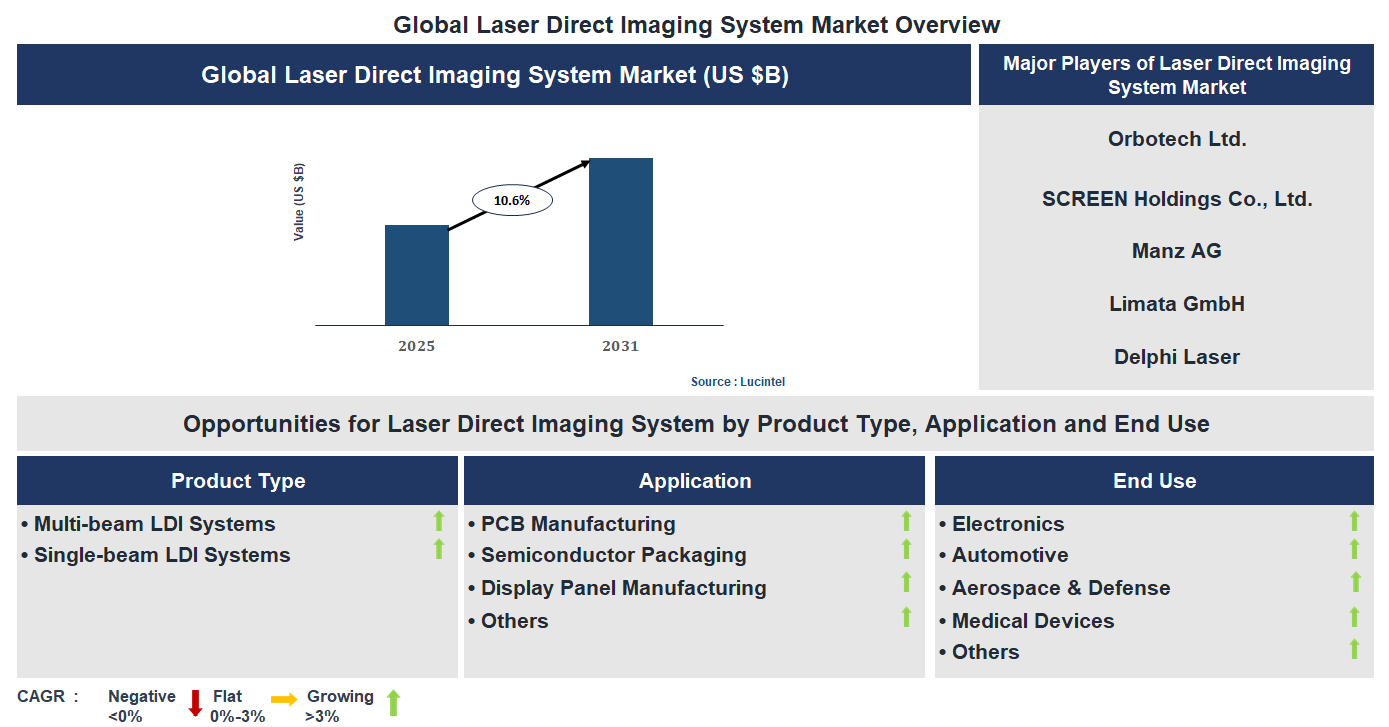
Key data points: The growth forecast = 10.6% annually for the next 7 years. Scroll below to get more insights. This market report covers trends, opportunities and forecasts in laser direct imaging system market to 2031 by product type (multi-beam LDI systems and single-beam LDI systems), application (PCB manufacturing, semiconductor packaging, display panel manufacturing, and others), end use (electronics, automotive, aerospace & defense, medical devices, and others), and region (North America, Europe, Asia Pacific, and the Rest of the World)
We'll send your sample report shortly.
• Lucintel forecasts that, within the product type category, multi-beam LDI system is expected to witness higher growth over the forecast period.
• Within the end use category, electronics is expected to witness the highest growth.
• In terms of region, APAC is expected to witness the highest growth over the forecast period. Gain valuable insights for your business decisions with our comprehensive 150+ page report. Sample figures with some insights are shown below.
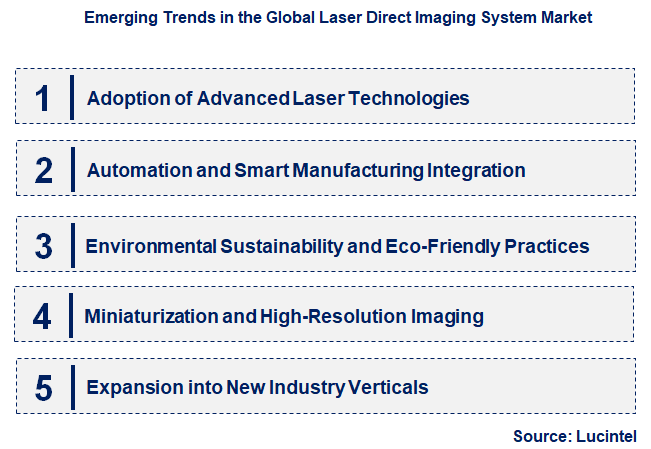
• Adoption of Advanced Laser Technologies: The integration of ultrafast lasers and high-power laser systems is improving imaging resolution and speed. These advancements enable finer detail capture and faster processing times, which are crucial for high-precision applications like semiconductor manufacturing and printed circuit board (PCB) production. As laser technology continues to evolve, the market benefits from increased efficiency, reduced operational costs, and expanded application scope, making it a key driver of growth.
• Automation and Smart Manufacturing Integration: The incorporation of automation, robotics, and AI-driven systems into LDI processes is enhancing productivity and consistency. Automated systems reduce human error, streamline workflows, and enable real-time quality control. This trend supports Industry 4.0 initiatives, allowing manufacturers to achieve higher throughput and flexibility. The impact is a more agile, cost-effective production environment that meets the demands of complex, customized products.
• Environmental Sustainability and Eco-Friendly Practices: Growing environmental concerns are prompting market players to adopt greener solutions. This includes using energy-efficient lasers, reducing hazardous chemicals, and implementing waste reduction strategies. Eco-friendly LDI systems not only comply with stringent regulations but also appeal to environmentally conscious customers. This shift is fostering innovation in sustainable materials and processes, ultimately contributing to a more sustainable manufacturing ecosystem.
• Miniaturization and High-Resolution Imaging: The demand for smaller, more intricate electronic components is fueling the development of miniaturized LDI systems with higher resolution capabilities. These systems enable precise patterning on micro and nanoscale levels, essential for advanced electronics, medical devices, and MEMS. The trend enhances product performance and enables the creation of cutting-edge devices, positioning the market at the forefront of technological innovation.
• Expansion into New Industry Verticals: The versatility of LDI technology is leading to its adoption in emerging sectors such as biotechnology, aerospace, and renewable energy. For instance, in biotech, it is used for microfabrication; in aerospace, for lightweight component manufacturing; and in renewable energy, for solar cell patterning. This diversification broadens market opportunities, stimulates innovation, and drives growth across multiple sectors, making the LDI market more resilient and dynamic. In summary, these trends are collectively transforming the laser direct imaging system market by enhancing technological capabilities, promoting sustainability, and expanding application horizons. They are fostering a more efficient, innovative, and environmentally responsible industry landscape, ultimately reshaping how manufacturers approach precision imaging and patterning tasks.
• Technological Innovation: Introduction of high-speed, high-resolution LDI systems has improved imaging accuracy and reduced processing time, enabling manufacturers to meet tight production schedules and quality standards more effectively.
• Integration with Automation: The adoption of automated LDI systems has increased, allowing for seamless integration into existing manufacturing lines, reducing labor costs, and enhancing overall efficiency.
• Environmental Sustainability: Development of eco-friendly laser sources and energy-efficient systems has minimized environmental impact, aligning with global sustainability goals and attracting environmentally conscious customers.
• Expansion into New Sectors: The market has seen a surge in applications beyond electronics, including medical device manufacturing, automotive components, and aerospace, broadening the market scope and revenue streams.
• Cost Reduction Strategies: Manufacturers are focusing on cost-effective system designs and scalable solutions, making LDI technology more accessible to small and medium-sized enterprises and fostering market growth. These recent developments are collectively transforming the laser direct imaging system market by improving system performance, expanding application areas, and promoting sustainability. As a result, the market is experiencing accelerated growth, increased competitiveness, and broader adoption across diverse industries, positioning it for continued innovation and expansion in the coming years.
• Enhanced Precision and Miniaturization : The demand for high-resolution imaging in electronics manufacturing is rising, enabling the production of smaller, more complex circuit boards with greater accuracy. This growth improves product performance and reduces defects, boosting overall efficiency in the electronics sector.
• Rapid Prototyping and Customization : The automotive sector is adopting LDI systems for rapid prototyping and customized component production. This accelerates development cycles, reduces costs, and allows for more innovative vehicle designs, supporting the shift toward electric and autonomous vehicles.
• High-Resolution Imaging for Complex Components : The aerospace industry benefits from LDIs ability to produce intricate, high-precision parts. This enhances safety, performance, and reliability of aerospace components, meeting stringent industry standards and reducing manufacturing lead times.
• Precision Manufacturing of Medical Components : The healthcare sector is leveraging LDI for manufacturing detailed medical devices and implants. This ensures higher quality, biocompatibility, and customization, ultimately improving patient outcomes and expanding market opportunities.
• Automation and Scalability : The integration of LDI systems into automated production lines enhances scalability and consistency. This growth supports large-scale manufacturing with reduced labor costs and increased throughput, meeting global demand efficiently. In summary, these growth opportunities are significantly impacting the laser direct imaging system market by driving innovation, improving manufacturing precision, and expanding application scope. As industries increasingly adopt advanced imaging solutions, the market is poised for sustained growth, offering new avenues for technological development and competitive advantage.
• Technological Innovation: The continuous development of high-precision laser sources and advanced imaging software enhances system capabilities, enabling manufacturers to achieve finer resolutions and faster processing times. This technological progress attracts new customers and expands application areas, including electronics, PCB manufacturing, and microfabrication. As laser technology becomes more sophisticated and cost-effective, market penetration deepens, fostering overall growth. Moreover, integration with automation and Industry 4.0 solutions further boosts efficiency and productivity, making laser direct imaging systems indispensable in modern manufacturing.
• Growing Electronics Industry: The surge in demand for miniaturized and high-performance electronic devices drives the need for precise imaging solutions. Laser direct imaging systems are critical in PCB manufacturing, enabling high-resolution patterning with minimal defects. As consumer electronics, automotive electronics, and IoT devices proliferate, the electronics sectors expansion directly correlates with increased adoption of laser direct imaging technology. This trend is supported by the increasing complexity of electronic circuits, requiring advanced imaging techniques to meet quality standards, thereby fueling market growth.
• Environmental and Regulatory Pressures: Stricter environmental regulations concerning hazardous chemicals and waste management compel manufacturers to adopt cleaner, more sustainable imaging solutions. Laser direct imaging systems offer eco-friendly alternatives to traditional photolithography processes, reducing chemical usage and waste. Compliance with international standards enhances market credibility and opens up new opportunities in regions with stringent environmental policies. These regulatory pressures incentivize innovation towards greener technologies, which can provide a competitive edge and promote sustainable growth within the market.
• Cost Reduction and Efficiency Improvements: Advances in laser technology and system design have led to significant reductions in operational costs and cycle times. Increased automation capabilities minimize manual intervention, reducing labor costs and errors. These efficiencies enable manufacturers to produce high-quality images at lower costs, making laser direct imaging systems more accessible to small and medium-sized enterprises. As cost barriers decrease, adoption widens across various industries, supporting market expansion and encouraging further technological investments.
• Rising Demand for Miniaturization: The trend toward miniaturized electronic components and devices necessitates highly precise imaging techniques. Laser direct imaging systems facilitate the production of intricate, small-scale patterns with exceptional accuracy, essential for modern electronics and microfabrication. This demand for miniaturization is driven by consumer preferences for compact devices and the need for high-density circuit boards. As industries continue to push the boundaries of size and performance, the market for laser direct imaging systems is expected to grow substantially, driven by the need for precision and scalability. The challenges facing this Laser Direct Imaging System Market include:-
• High Initial Investment Costs: Implementing laser direct imaging systems requires substantial capital expenditure on equipment, training, and maintenance. These high upfront costs can be prohibitive for small and medium-sized enterprises, limiting market accessibility. Additionally, the return on investment may take time to realize, especially in markets with fluctuating demand. This financial barrier can slow down adoption rates and restrict market growth, particularly in developing regions where budget constraints are more pronounced.
• Technological Complexity and Skill Gap: The sophisticated nature of laser direct imaging technology demands specialized knowledge for operation, calibration, and maintenance. A significant skill gap exists among technicians and engineers, which can lead to operational inefficiencies and increased downtime. The complexity of integrating these systems into existing manufacturing processes also poses challenges, requiring extensive training and expertise. Overcoming this barrier is essential for widespread adoption and maximizing system performance.
• Regulatory and Standards Compliance: Navigating the complex landscape of international standards and regulations related to safety, environmental impact, and product quality can be challenging. Non-compliance can result in legal penalties, product recalls, and damage to brand reputation. As regulations evolve, manufacturers must continuously update their systems and processes, incurring additional costs and operational adjustments. Ensuring compliance while maintaining competitiveness remains a critical challenge for market participants. In summary, the laser direct imaging system market is driven by technological advancements, industry growth, environmental considerations, cost efficiencies, and miniaturization trends. However, high initial costs, technological complexity, and regulatory hurdles pose significant challenges. These factors collectively influence the pace and direction of market development. While opportunities for innovation and expansion are substantial, addressing these challenges is crucial for sustainable growth. Stakeholders must focus on cost reduction, skill development, and regulatory compliance to capitalize on emerging trends and maintain competitive advantage in this evolving landscape.
• Orbotech Ltd.
• SCREEN Holdings Co., Ltd.
• Manz AG
• Limata GmbH
• Delphi Laser
• Miva Technologies GmbH
• Altix
• Besi
• Via Mechanics, Ltd.
• Hans Laser Technology Industry Group Co., Ltd.
• Multi-beam LDI Systems
• Single-beam LDI Systems
• PCB Manufacturing
• Semiconductor Packaging
• Display Panel Manufacturing
• Others
• Electronics
• Automotive
• Aerospace & Defense
• Medical Devices
• Others
• North America
• Europe
• Asia Pacific
• The Rest of the World
• United States: The US market has seen substantial R&D investments, leading to the development of high-speed, high-resolution LDI systems. Major players are focusing on integrating AI and automation to improve precision and productivity. The adoption of LDI in semiconductor manufacturing and printed circuit board (PCB) production is expanding rapidly, driven by the demand for miniaturized and complex electronic devices. Government initiatives supporting technological innovation and Industry 4.0 are further propelling market growth. Additionally, collaborations between tech firms and research institutions are fostering new product innovations.
• China: China is rapidly advancing in the LDI system market, with a focus on domestic manufacturing capabilities and reducing reliance on imports. The government’s strategic policies aim to boost the electronics and semiconductor sectors, fueling demand for advanced imaging systems. Chinese companies are investing heavily in developing cost-effective, high-performance LDI solutions tailored for local industries. The market is also benefiting from increased exports and international collaborations. The emphasis on innovation and infrastructure development is positioning China as a key player in the global LDI landscape.
• Germany: Germany’s market is characterized by a strong emphasis on precision engineering and high-quality manufacturing. Leading firms are integrating cutting-edge laser technologies with automation to enhance system accuracy and efficiency. The automotive and industrial sectors are primary consumers of LDI systems, especially for complex component fabrication. Germany’s focus on sustainability and energy efficiency is driving innovations in system design. The country’s robust R&D ecosystem and collaborations with European institutions are fostering technological advancements, ensuring Germany remains a significant contributor to the global market.
• India: India is witnessing rapid growth in the LDI system market, driven by expanding electronics manufacturing and increasing investments in infrastructure. The government’s Make in India initiative is encouraging local production and adoption of advanced imaging systems. Indian companies are focusing on developing affordable, scalable solutions to cater to domestic needs and export markets. The rise of startups and increased R&D activities are contributing to technological innovation. The expanding semiconductor and PCB industries are key drivers, with a growing emphasis on skill development and industry standards to support market expansion.
• Japan: Japan continues to be a leader in laser technology and precision manufacturing. The market is characterized by high-end, innovative LDI systems used in semiconductor fabrication, aerospace, and medical device manufacturing. Japanese firms are investing in next-generation laser sources and automation to improve system performance. The country’s focus on quality, reliability, and technological excellence sustains its competitive edge. Collaborations with global tech companies and ongoing R&D efforts are fostering breakthroughs in system miniaturization and energy efficiency. Japan’s strategic emphasis on innovation ensures its prominent position in the evolving LDI system market.


• Orbotech Ltd.
• SCREEN Holdings Co., Ltd.
• Manz AG
• Limata GmbH
• Delphi Laser
• Miva Technologies GmbH
• Altix
• Besi
• Via Mechanics, Ltd.
• Hans Laser Technology Industry Group Co., Ltd. Q5. Which laser direct imaging system market segment will be the largest in future? Answer: Lucintel forecasts that, within the product type category, multi-beam LDI system is expected to witness higher growth over the forecast period. Q6. In laser direct imaging system market, which region is expected to be the largest in next 5 years? Answer: In terms of region, APAC is expected to witness the highest growth over the forecast period. Q7. Do we receive customization in this report? Answer: Yes, Lucintel provides 10% customization without any additional cost.


Choose a license that fits your team. Instant PDF delivery.
Prices exclude taxes. Instant delivery. Custom licensing available on request.
Market Report · July 20, 2026
Market Report · July 16, 2026
Market Report · July 15, 2026
Trusted partner for strategic intelligence and business growth


Receive a complimentary market analysis tailored to your industry. Our analysts will identify key growth opportunities and competitive dynamics specific to your business.

Market size, growth rate, and key trend analysis for your specific sector.

Top competitor positioning and market share analysis.

Strategic recommendations backed by data-driven insights.
Get curated market intelligence and competitive moves straight to your inbox.
By subscribing, you agree to receive our monthly insights. Unsubscribe anytime.
Receive a complimentary market analysis tailored to your industry. Our analysts will identify key growth opportunities and competitive dynamics specific to your business.
Market size, growth rate, and key trend analysis for your specific sector.
Top competitor positioning and market share analysis.
Strategic recommendations backed by data-driven insights.
Get curated market intelligence, emerging trends, and competitive moves straight to your inbox each month.
By subscribing, you agree to receive our monthly insights. Unsubscribe anytime.
We'll send your sample report shortly.