
Market Report · July 20, 2026

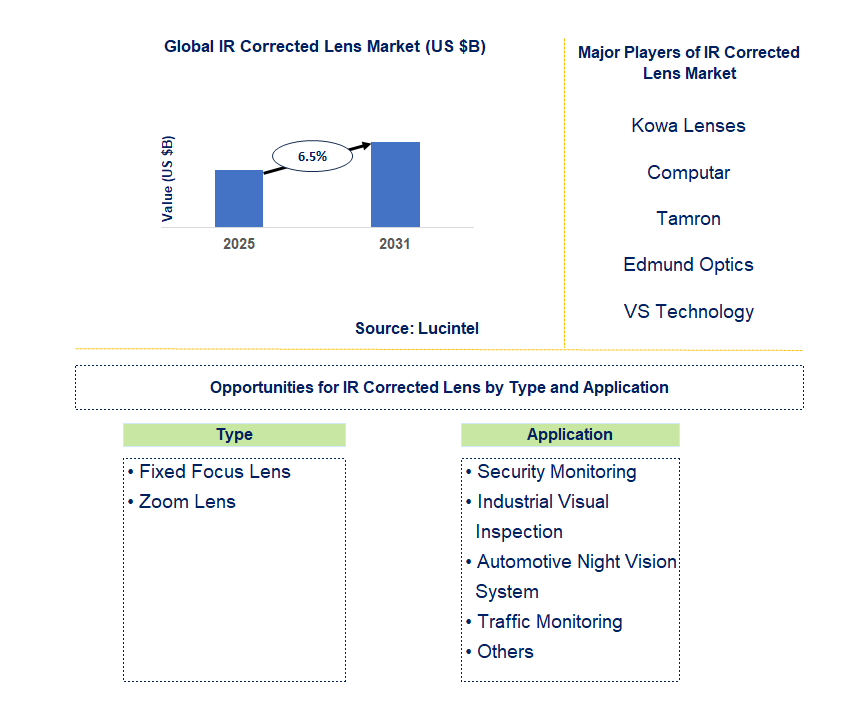
Key data points: The growth forecast = 6.5% annually for the next 7 years. Scroll below to get more insights. This market report covers trends, opportunities and forecasts in IR corrected lens market to 2031 by type (fixed focus lens and zoom lens), application (security monitoring, industrial visual inspection, automotive night vision system, traffic monitoring, and others), and region (North America, Europe, Asia Pacific, and the Rest of the World)
We'll send your sample report shortly.
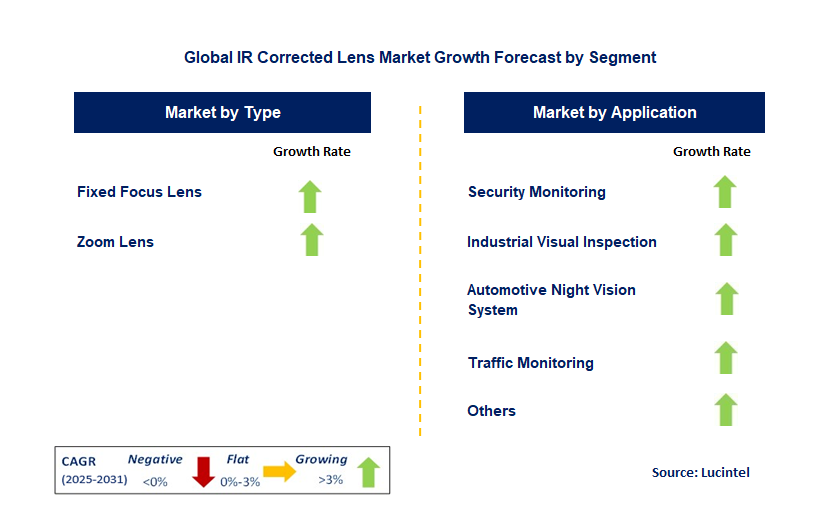
• Lucintel forecasts that, within the type category, zoom lens is expected to witness higher growth over the forecast period.
• Within the application category, automotive night vision system is expected to witness the highest growth.
• In terms of region, APAC is expected to witness the highest growth over the forecast period. Gain valuable insights for your business decisions with our comprehensive 150+ page report. Sample figures with some insights are shown below.
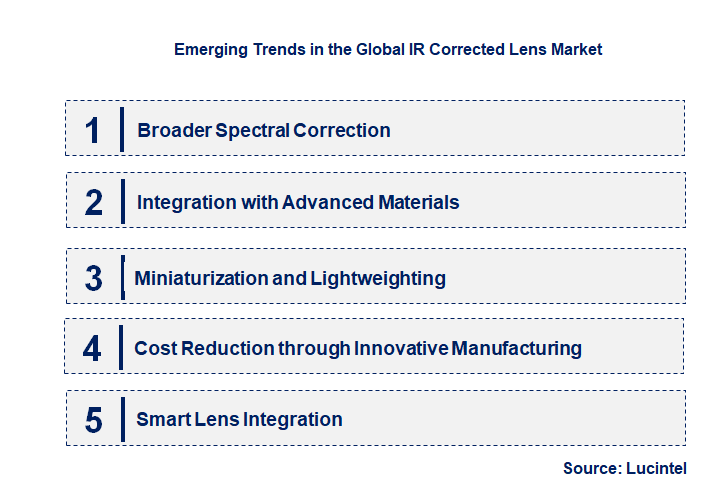
• Broader Spectral Correction: There's a growing trend towards IR corrected lenses that offer accurate focus across a wider range of the electromagnetic spectrum, beyond just visible and near-IR. This enables applications in multispectral and hyperspectral imaging for advanced analysis in agriculture and environmental monitoring.
• Integration with Advanced Materials: The use of novel optical materials with specific refractive index and transmission properties in IR corrected lenses is increasing. This allows for better aberration correction, lighter designs, and enhanced performance across the spectrum, improving overall image quality.
• Miniaturization and Lightweighting: Demand for smaller and lighter IR corrected lenses is rising, driven by applications in drones, wearable technology, and compact camera systems. This requires advanced optical designs and manufacturing techniques to maintain performance in a reduced form factor.
• Cost Reduction through Innovative Manufacturing: Efforts are underway to develop more cost-effective manufacturing processes for IR corrected lenses. This includes advancements in molding and coating technologies to make these lenses more accessible for high-volume applications like automotive and security.
• Smart Lens Integration: The trend of integrating lenses with electronic components for autofocus, image stabilization, and communication is extending to IR corrected lenses. This enables more intelligent imaging systems with enhanced functionality and automated adjustments. These emerging trends are pushing the boundaries of IR corrected lens technology, leading to more versatile, compact, and cost-effective solutions. This evolution is expanding their use in a wider array of applications, enhancing imaging capabilities across industries.
• Improved Chromatic Aberration Correction: Advancements in optical design and materials science have led to IR corrected lenses with significantly reduced chromatic aberration across the visible and infrared spectrum. This results in sharper images with better color fidelity in both spectral ranges, crucial for accurate multispectral analysis.
• Enhanced Coating Technologies: Development of advanced anti-reflective coatings optimized for both visible and IR wavelengths is improving the transmission efficiency and reducing glare and ghosting in IR corrected lenses. This leads to clearer and higher contrast images, especially in challenging lighting conditions.
• Integration with Aspheric Elements: The incorporation of aspheric lens elements in IR corrected lens designs allows for better correction of spherical aberrations and a reduction in the number of elements required. This results in more compact, lighter, and higher-performing lenses.
• Development for Longer Wavelength IR: While traditionally focused on near-IR, there's an increasing development of lenses corrected for mid-wave and long-wave infrared regions as well. This expands their use in thermal imaging and specialized sensing applications.
• Custom Optical Solutions: There's a growing trend towards manufacturers offering highly customized IR corrected lens designs to meet the specific and often demanding requirements of niche applications, such as scientific research and specialized industrial equipment. These recent developments are making IR corrected lenses more versatile and effective, driving their adoption in advanced imaging systems where simultaneous high-quality performance across visible and infrared wavelengths is essential.
• Advanced Driver-Assistance Systems: The increasing integration of multispectral cameras in vehicles for enhanced perception in various driving conditions (fog, night) offers a substantial growth area for IR corrected lenses. These lenses enable fusion of visible and thermal imaging for improved safety.
• Security and Surveillance: The demand for 24/7 surveillance systems that provide clear imagery in both day and night is rising. IR corrected lenses are crucial for cameras that switch between visible and IR modes, ensuring continuous and effective monitoring.
• Industrial Inspection and Quality Control: Multispectral imaging using IR corrected lenses is becoming more prevalent for non-destructive testing and quality checks in manufacturing, identifying defects not visible in the standard spectrum.
• Agricultural Monitoring: The use of multispectral imaging in agriculture for assessing crop health and identifying diseases is growing. IR corrected lenses enable cameras to capture vital information across visible and near-IR bands for plant analysis.
• Medical Imaging: Certain medical diagnostic techniques benefit from the combined information provided by visible and infrared imaging. IR corrected lenses can be used in specialized medical devices for enhanced diagnostics and monitoring. These strategic growth opportunities across diverse applications highlight the increasing value of IR corrected lenses in systems requiring comprehensive visual information. By focusing on these sectors, the market can capitalize on the expanding need for multispectral imaging capabilities.
• Kowa Lenses
• Computar
• Tamron
• Edmund Optics
• VS Technology
• Ricoh
• Myutron
• Kenko Tokina
• Schneider
• OPT
• Fixed Focus Lens
• Zoom Lens
• Security Monitoring
• Industrial Visual Inspection
• Automotive Night Vision System
• Traffic Monitoring
• Others
• North America
• Europe
• Asia Pacific
• The Rest of the World
• United States: The US market is characterized by demand for high-performance IR corrected lenses in defense, aerospace, and advanced surveillance systems. Recent developments emphasize ruggedization, wider spectral correction ranges, and integration with sophisticated imaging platforms. Customization for specific military and research applications is also prominent.
• China: China is rapidly increasing its manufacturing capabilities in IR corrected lenses, focusing on cost-effective solutions for security, automotive, and industrial applications. There's a growing trend towards improving the quality and performance of domestically produced lenses to reduce reliance on imports and cater to its expanding technology sectors.
• Germany: Known for its optical precision, Germany focuses on high-quality IR corrected lenses for industrial metrology, automotive (especially ADAS), and specialized medical imaging. Recent advancements include lenses with superior optical performance and durability, often tailored for demanding industrial environments and automotive safety systems.
• India: The Indian market is witnessing a growing adoption of IR corrected lenses, primarily driven by increasing investments in security and surveillance infrastructure, as well as the automotive sector. Developments are geared towards cost-effective yet reliable solutions suitable for the local market needs and gradual technological advancements.
• Japan: Japan's focus is on miniaturization and high-precision IR corrected lenses for consumer electronics, advanced automotive systems, and compact security cameras. Recent developments include lenses with improved image quality in both visible and IR, along with smaller form factors for integration into compact devices.


• Kowa Lenses
• Computar
• Tamron
• Edmund Optics
• VS Technology
• Ricoh
• Myutron
• Kenko Tokina
• Schneider
• OPT Q5. Which IR corrected lens market segment will be the largest in future? Answer: Lucintel forecasts that, within the type category, zoom lens is expected to witness higher growth over the forecast period. Q6. In IR corrected lens market, which region is expected to be the largest in next 5 years? Answer: In terms of region, APAC is expected to witness the highest growth over the forecast period. Q7. Do we receive customization in this report? Answer: Yes, Lucintel provides 10% customization without any additional cost.


Choose a license that fits your team. Instant PDF delivery.
Prices exclude taxes. Instant delivery. Custom licensing available on request.
Market Report · July 20, 2026
Market Report · July 16, 2026
Market Report · July 15, 2026
Trusted partner for strategic intelligence and business growth


Receive a complimentary market analysis tailored to your industry. Our analysts will identify key growth opportunities and competitive dynamics specific to your business.

Market size, growth rate, and key trend analysis for your specific sector.

Top competitor positioning and market share analysis.

Strategic recommendations backed by data-driven insights.
Get curated market intelligence and competitive moves straight to your inbox.
By subscribing, you agree to receive our monthly insights. Unsubscribe anytime.
Receive a complimentary market analysis tailored to your industry. Our analysts will identify key growth opportunities and competitive dynamics specific to your business.
Market size, growth rate, and key trend analysis for your specific sector.
Top competitor positioning and market share analysis.
Strategic recommendations backed by data-driven insights.
Get curated market intelligence, emerging trends, and competitive moves straight to your inbox each month.
By subscribing, you agree to receive our monthly insights. Unsubscribe anytime.
We'll send your sample report shortly.