
Market Report · July 20, 2026

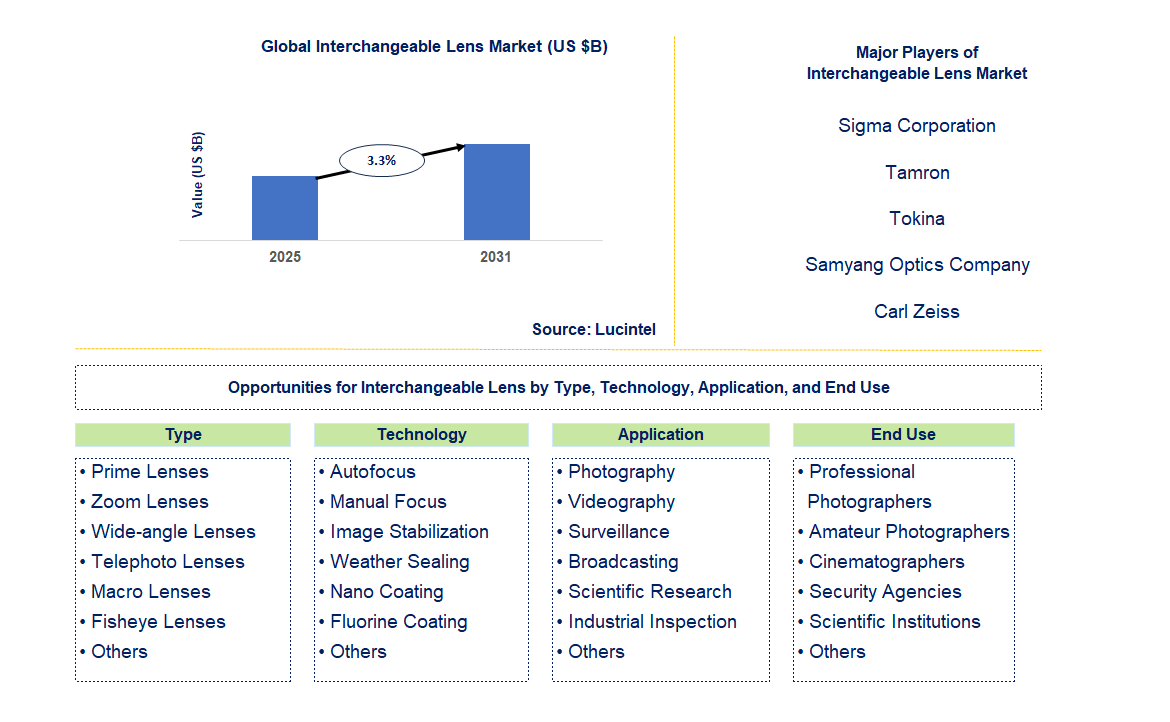
Key data points: The growth forecast = 3.3% annually for the next 7 years. Scroll below to get more insights. This market report covers trends, opportunities and forecasts in interchangeable lens market to 2031 by type (prime lenses, zoom lenses, wide-angle lenses, telephoto lenses, macro lenses, fisheye lenses, and others), technology (autofocus, manual focus, image stabilization, weather sealing, nano coating, fluorine coating, and others), application (photography, videography, surveillance, broadcasting, scientific research, industrial inspection, and others), end use (professional photographers, amateur photographers, cinematographers, security agencies, scientific institutions, and others), and region (North America, Europe, Asia Pacific, and the Rest of the World)
We'll send your sample report shortly.
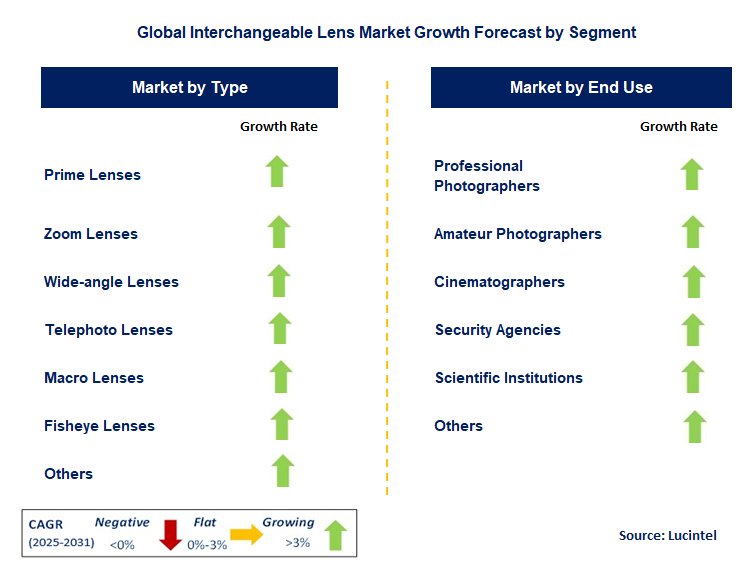
• Lucintel forecasts that, within the type category, the zoom lens is expected to witness the highest growth over the forecast period.
• Within the end use category, professional photographer is expected to witness the highest growth.
• In terms of region, APAC is expected to witness the highest growth over the forecast period. Gain valuable insights for your business decisions with our comprehensive 150+ page report. Sample figures with some insights are shown below.
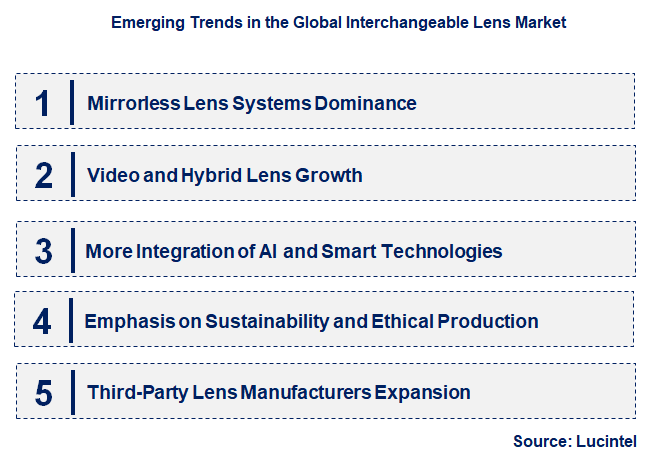
• Mirrorless Lens Systems Dominance: The most important trend is the rapid shift away from conventional DSLR cameras to mirrorless camera systems. This is fueling a gigantic wave of innovation for new lens mounts and ecosystems. Mirrorless lenses are made to be smaller, lighter, and more advanced technologically, with many coming equipped with better autofocus and image stabilization. Manufacturers are quickly building up their mirrorless lineups, and this is greatly influencing market share and product planning for all the top camera manufacturers.
• Video and Hybrid Lens Growth: As social media and video-sharing platforms such as YouTube and TikTok experience explosive growth, demand for video-specific lenses has grown sharply. The direction is shifting toward hybrid lenses that excel both in still photography and video. Such lenses have silent autofocus, minimized focus breathing, and silky-smooth aperture control, which are perfect for creators and cinematographers. This trend is creating a new and profitable market segment, and manufacturers are positioning themselves on features that address the videographer's unique requirements.
• More Integration of AI and Smart Technologies: The lens market for interchangeable lenses is experiencing an increasing trend toward integration of artificial intelligence and smart technologies. Lenses are designed with powerful processors that improve autofocus speed and tracking of the subject. Artificial intelligence-enabled software can aid in composition and automatic settings control, offering photography to the masses through ease of use while offering tremendous tools to professionals. Such a trend is erasing the distinction between optical and computational photography, with software-based enhancements being a major selling feature.
• Emphasis on Sustainability and Ethical Production: With growing consumer awareness of environmental and ethical concerns, there is a developing trend towards sustainable practices within the interchangeable lens market. Producers are pushing back with the help of more sustainable materials, less carbon-intensive production processes, and the design of modular lenses that are simpler to repair and maintain. This movement appeals to a new generation of green consumers and is becoming a major brand differentiator. It is also fostering a more sustainable way of producing and managing products.
• Third-Party Lens Manufacturers Expansion: The industry is experiencing a strong trend of third-party lens manufacturers like Tamron and Sigma extending their lines to include primary mirrorless camera systems. This competition is good for consumers in that it offers a broader number of high-quality lenses at more affordable prices. This movement is threatening the reign of first-party manufacturers and pushing them to innovate faster to keep their market dominance. It is making the market more inclusive and diversified for photographers at all levels. These movements are together transforming the interchangeable lens market into one of rapid innovation and competition. The emphasis on mirrorless technology is driving a new product cycle, and the growth of video and AI is expanding the uses and capabilities of lenses. Increasing focus on sustainability and the growth of third-party choices are opening up the market to more accessibility and consumer focus. The outcome is a market that is more dynamic, diverse, and attuned to the needs of today's visual storytellers.
• Full-Frame Mirrorless Systems and Lenses: One of the significant developments is the aggressive move by top brands such as Canon, Nikon, and Sony to grow their full-frame mirrorless camera and lens offerings. This is a strategic move away from DSLR technology. The new lenses are engineered to fully leverage the mirrorless mount's wider diameter and shorter flange distance, resulting in better optical performance and more compact, lighter designs. This is driving considerable investment in R&D and creating a new product cycle for manufacturers.
• Expansion of Third-Party Lens Ecosystems: Expansion of strong third-party lens ecosystems for mainstream mirrorless mounts is a significant new trend. Firms like Sigma and Tamron are now providing an extensive number of excellent-quality lenses for Sony E-mount, Canon RF-mount, and Nikon Z-mount systems. This is opening up choices to consumers and competitive pricing, which is highly attractive to amateur and semi-professional photography communities, who want high-quality lenses within their budget. This innovation is increasing competition and innovation in the market.
• Integration of Advanced Autofocus Technology: Advances in recent times have been driven by integrating more advanced and complex autofocus systems in camera bodies and lenses. Lenses with faster and more precise autofocus motors, combined with AI-powered subject detection in cameras, are now a common feature. This facilitates better tracking of objects, be it an individual, an animal, or a vehicle. This innovation is vital for experts, particularly in such domains as sport and wildlife photography, and it is also simplifying the process for enthusiasts to take clear photographs.
• Focus on Lenses for Video Production: The industry has witnessed a significant evolution of lens design tailored for video. These lenses have minimal breathing during focus, a quiet autofocus motor, and effortless aperture control. This is a straight result of the exponential increase in online video content. Companies are not only producing new lenses but also selling them based on their video performance. This innovation is drawing a new crop of artists who are employing changeable lenses to create high-end video content for platforms such as Instagram and YouTube.
• Introduction of Niche and Specialized Lenses: There has been an immense advancement in the development and introduction of highly specialized lenses for niche applications. Examples include ultra-fast prime lenses, macro lenses with distinctive characteristics, and tilt-shift lenses for architectural applications. This trend represents an effort by manufacturers to reach out to advanced hobbyists and professionals seeking exclusive creative tools. This trend reflects a market diversification away from the typical zoom lens and broadens the appeal of the interchange system. These trends are reshaping the interchangeable lens market. The mirrorless technology supremacy is creating a new product cycle, and the emphasis on video and specialist lenses is broadening the applications and appeal of the market. The growing competition from third parties is favoring consumers, and the incorporation of AI is making photography more accessible and more powerful. Generally, these trends are building a more dynamic, innovative, and consumer-centric market.
• Content Creators and social media: The greatest opportunity for growth exists in serving the emerging market of content creators and social media influencers. This market needs lenses that are compact, portable, and can capture high-quality images and video. The strategic potential is to create and sell vlogging and internet content-optimized lenses, like wide-angle zooms and high-speed prime lenses with great low-light capability. Creating informative content and a following around these lenses can also be an important component of the growth strategy.
• Professional and Niche Photography: Although the consumer market is huge, there is a high-margin growth potential in the professional and niche photography segments. These are wildlife, sports, and architectural photography. The strategic emphasis here is the development of specialty, high-performance lenses with high build quality and high-end features. These include super-telephoto lenses with rapid autofocus and high-end stabilization, or tilt-shift lenses with tight movement. This approach appeals to a loyal set of photographers who are willing to pay top dollar for top-of-the-line equipment.
• Third-Party Lenses that are both Affordable and High-Quality: Expansion among third-party lens makers is a huge opportunity. The plan is to compete in the holes in the market by selling high-quality, high-feature lenses at a lower price point than original equipment manufacturers. This is especially attractive to first-time mirrorless camera buyers who want to establish their lens library without a huge upfront cost. This approach serves to reduce the entry barrier for hobbyist photographers and can greatly increase the total market.
• Video-First Lens Design: As hybrid shooters who shoot both photos and videos become more common, there is a strategic expansion opportunity in video-first lens design. These lenses must be designed to reduce focus breathing and have de-clicked aperture rings for quiet operation. Selling these lenses directly to filmmakers and videographers will establish a robust market presence. The play is to look beyond the legacy photograph lens design and produce instruments that are actually optimized for motion picture acquisition.
• Industrial and Commercial Uses: Apart from consumer photography, there is a strategic growth area in industrial and commercial uses. This involves machine vision lenses, security camera lenses, and medical imaging lenses. These use highly specialized lenses with tight optical specifications and long lifespan. The opportunity lies in collaboration with businesses in these sectors and creating specially designed lenses that suit their requirements. This diversification of the business can offer a stable and high-value revenue stream in addition to the conventional consumer market. These opportunities for growth are affecting the interchangeable lens market by pushing specialization and segmentation of the market. Rather than a single approach for all, firms are now emphasizing developing a range of products that serve particular user groups. This is creating an increasingly competitive and innovative market where value is created not only by the technology itself but by its application to fulfill a particular purpose.
• Sigma Corporation
• Tamron
• Tokina
• Samyang Optics Company
• Carl Zeiss
• Voigtlander
• Schneider Kreuznach
• Leica Camera
• Rokinon
• Fujifilm Holdings Corporation
• Prime Lenses
• Zoom Lenses
• Wide-angle Lenses
• Telephoto Lenses
• Macro Lenses
• Fisheye Lenses
• Others
• Autofocus
• Manual Focus
• Image Stabilization
• Weather Sealing
• Nano Coating
• Fluorine Coating
• Others
• Photography
• Videography
• Surveillance
• Broadcasting
• Scientific Research
• Industrial Inspection
• Others
• Professional Photographers
• Amateur Photographers
• Cinematographers
• Security Agencies
• Scientific Institutions
• Others
• North America
• Europe
• Asia Pacific
• The Rest of the World
• United States: The United States market is led by a high demand from professional photographers and an emerging population of content creators. The shift from DSLR to mirrorless camera systems has been critical, with industry leaders such as Canon, Nikon, and Sony centralizing their research and development activities in their mirrorless lens ecosystems. There is a solid consumer base that appreciates high-end, high-tech lenses with advanced features such as better autofocus and image stabilization. The market is also being impacted by internet retail channels, which provide consumers with increased accessibility and competitive pricing for a broad array of products.
• China: China is a vast and fast-growing market for interchangeable lenses. The market is fueled by a growing middle class with an increasing interest in photography as a pastime and a vast and powerful content-creation industry. There is a high demand for professional-quality and value-for-money entry-level lenses. One of the most important developments is that local manufacturers are making a serious push into research and development, and this is creating more competition and providing consumers with an expanded array of options. The market also has a high exposure to e-commerce, with web-based platforms being a major outlet for sales and product discovery.
• Germany: The German interchangeable lens market is dominated by a high emphasis on quality, precision, and a long tradition of high-quality camera production. Recent trends involve a high take-up of high-end mirrorless systems and attention on specialized lenses for specific applications. Optical quality and high-quality build are valued by the German brands and customers. The industry is also being influenced by sustainability drives, with producers putting money into sustainable materials and manufacturing processes. This aligns with environmentally aware customers and influences a preference for companies with robust corporate sustainability practices.
• India: India is a growing market for exchangeable lenses, with a growth driven by rising tourism, growing disposable incomes, and a content creation boom. A major trend is the increasing popularity of mirrorless cameras, which are viewed as a step up from smartphones for professional-grade travel and social media photography. The rise of e-commerce platforms has also widened access to high-end cameras and lenses to a larger section of the population in the country. The market is further driven by local influencers and photographers who are becoming popular for using sophisticated camera equipment.
• Japan: Japan is still a world leader in the interchangeable lens business, both as a leading manufacturer and as a market. A significant development is the continuing and near-total migration away from DSLR camera systems to mirrorless, with Japan leading the migration. Japanese manufacturers are at the forefront of technological advancement, first bringing innovations like AI-based autofocus, enhanced image stabilization, and quicker processors. The market is also marked by high demand for high-resolution sensors and intense focus on ongoing innovation to address the rigorous requirements of professional and prosumer photographers.


• Sigma Corporation
• Tamron
• Tokina
• Samyang Optics Company
• Carl Zeiss
• Voigtlander
• Schneider Kreuznach
• Leica Camera
• Rokinon
• Fujifilm Holdings Corporation Q5. Which interchangeable lens market segment will be the largest in future? Answer: Lucintel forecasts that, within the type category, the zoom lens is expected to witness the highest growth over the forecast period. Q6. In interchangeable lens market, which region is expected to be the largest in next 5 years? Answer: In terms of region, APAC is expected to witness the highest growth over the forecast period. Q7. Do we receive customization in this report? Answer: Yes, Lucintel provides 10% customization without any additional cost.


Choose a license that fits your team. Instant PDF delivery.
Prices exclude taxes. Instant delivery. Custom licensing available on request.
Market Report · July 20, 2026
Market Report · July 16, 2026
Market Report · July 15, 2026
Trusted partner for strategic intelligence and business growth


Receive a complimentary market analysis tailored to your industry. Our analysts will identify key growth opportunities and competitive dynamics specific to your business.

Market size, growth rate, and key trend analysis for your specific sector.

Top competitor positioning and market share analysis.

Strategic recommendations backed by data-driven insights.
Get curated market intelligence and competitive moves straight to your inbox.
By subscribing, you agree to receive our monthly insights. Unsubscribe anytime.
Receive a complimentary market analysis tailored to your industry. Our analysts will identify key growth opportunities and competitive dynamics specific to your business.
Market size, growth rate, and key trend analysis for your specific sector.
Top competitor positioning and market share analysis.
Strategic recommendations backed by data-driven insights.
Get curated market intelligence, emerging trends, and competitive moves straight to your inbox each month.
By subscribing, you agree to receive our monthly insights. Unsubscribe anytime.
We'll send your sample report shortly.