
Market Report · July 22, 2026

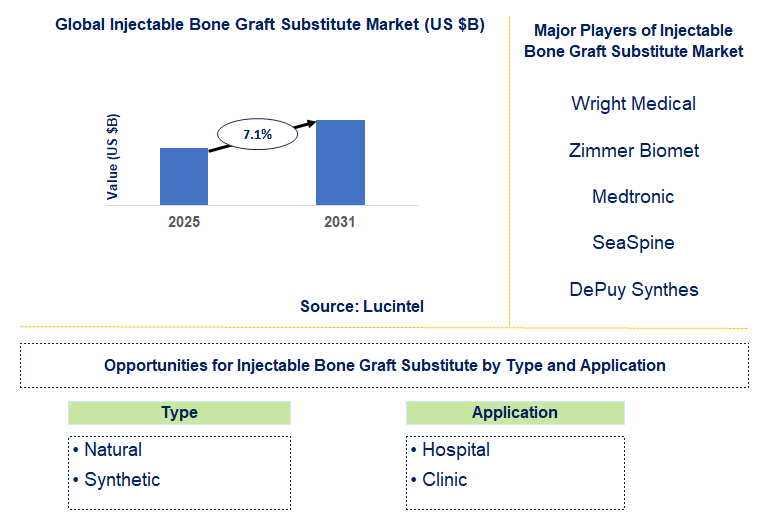
Key data points: The growth forecast = 7.1% annually for the next 7 years. Scroll below to get more insights. This market report covers trends, opportunities and forecasts in injectable bone graft substitute market to 2031 by type (natural and synthetic), application (hospital and clinic), and region (North America, Europe, Asia Pacific, and the Rest of the World)
We'll send your sample report shortly.
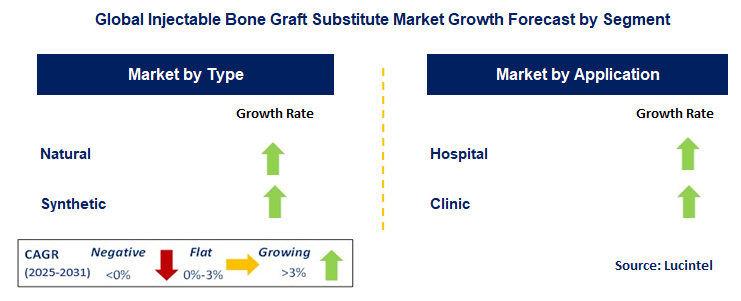
• Lucintel forecasts that, within the type category, synthetic is expected to witness higher growth over the forecast period.
• Within the application category, the hospital is expected to witness higher growth.
• In terms of region, APAC is expected to witness the highest growth over the forecast period. Gain valuable insights for your business decisions with our comprehensive 150+ page report. Sample figures with some insights are shown below.
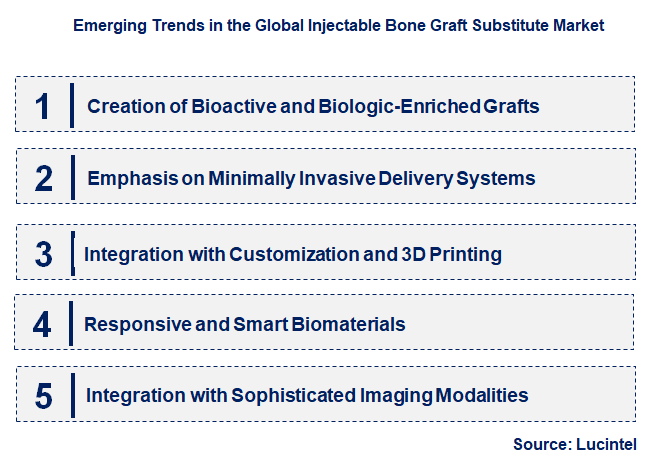
• Creation of Bioactive and Biologic-Enriched Grafts: There is a notable trend towards the development of injectable bone graft substitutes that are not just osteoconductive (offering a scaffold) but osteoinductive (actively stimulating bone growth). This includes the addition of growth factors, including bone morphogenetic proteins (BMPs), or even mesenchymal stem cells (MSCs) into the injectable matrix. The effect is a dramatic advancement in bone regeneration efficacy, especially in difficult cases or extensive bone defects, resulting in more rapid healing, stronger bone formation, and perhaps eliminating the necessity for additional procedures.
• Emphasis on Minimally Invasive Delivery Systems: The market is now focusing more on injectable bone graft substitutes that are equipped with ready-to-use, pre-filled syringes or cartridges to facilitate precise and minimally invasive delivery into bone defects. It minimizes surgical trauma, decreases the duration of surgery, and in many cases, makes outpatient surgeries possible. The effect is improved procedural efficiency, lower patient morbidity, and quicker recovery. This trend also broadens the potential for use of these grafts to more diverse clinical environments and surgical methods, fueling market uptake.
• Integration with Customization and 3D Printing: One of the trends advancing is the application of 3D printing and sophisticated manufacturing processes in developing adjustable injectable bone graft alternatives. This enables patient-specific treatments that exactly simulate the bone defect's morphology, ensuring maximum contact and integration. The effect is extremely personalized medicine, resulting in better anatomical fit, improved bone regeneration in intricate geometries, and potentially improved long-term functional results. This is a major step toward precision regenerative medicine in the orthopedic and dental fields.
• Responsive and Smart Biomaterials: Development is advancing toward "smart" injectable bone graft replacements that are capable of responding to the physiological environment or delivering therapeutic compounds in a controlled fashion. This involves materials that may degrade at a controlled rate synchronized with new bone regeneration or those that may deliver anti-inflammatory medication or antibiotics. The effect is improved control over healing, fewer complications such as infection or inflammation, and a more predictable regeneration environment, resulting in increased safety and efficacy.
• Integration with Sophisticated Imaging Modalities: There has been an increasing practice of applying injectable bone graft substitutes together with sophisticated intraoperative imaging (e.g., fluoroscopy, intraoperative CT) to enable accurate placement and check initial fill. Such integration permits real-time confirmation of graft delivery and distribution. The effect is improved surgical accuracy, fewer procedural errors, and maximal graft placement for enhanced bone healing. This union of biomaterial and imaging technologies guarantees the optimal beginning for the regenerative process. These new trends are radically transforming the injectable bone graft substitute market by moving these devices from passive fillers to active contributors in the process of bone regeneration. The focus on bioactivity, convenient delivery, patient-specific customization, smart features, and compatibility with advanced imaging is leading to a new age of precision regenerative medicine. This revolution is offering better and more predictable clinical results, and injectable bone graft substitutes are becoming ever more indispensable instruments in orthopedic, spinal, and dental surgeries.
• Advanced Synthetic Compositions Development: One development is the development of new synthetic injectable bone graft substitutes with advanced compositions, including biphasic calcium phosphates (combinations of hydroxyapatite and tricalcium phosphate), bioactive glasses, and ceramic-polymer composites. These are designed with optimal osteoconductive and regulated resorption rates. This advancement affects the market by offering easily available, uniform, and safe substitutes for autografts and allografts, reducing risks of disease transmission and donor site morbidity, thereby fueling their use in different surgical specialties.
• Addition of Biological Augmentation: There has been considerable advancement in the addition of biological components to injectable bone graft substitutes. These products involve those that are pre-mixed with or specifically formulated to mix with bone marrow aspirate (containing growth factors and mesenchymal stem cells), platelet-rich plasma (PRP), or recombinant human bone morphogenetic proteins. This innovation affects the market by enormously improving the osteoinductive capacity of the grafts, which means stronger and faster bone generation, especially in difficult non-union fractures or large bone defects.
• Enhanced Delivery and Handling Systems: New developments aim to maximize the rheological characteristics of injectable bone graft substitutes to provide them with good handling properties. These include products which are moldable, cohesive, but injectable, and which set in place. Most of these products are now available pre-filled in syringes or cartridges to facilitate handling and lessen preparation time. This advancement affects the market by making surgery easier, enhancing placement precision at difficult anatomical locations, and decreasing the time for operation, which makes them extremely appealing to surgeons.
• Broadening Applications Beyond Spinal Fusion: Although spinal fusion has traditionally been a dominant application, an important advancement is the growing use of injectable bone graft substitutes for a broader array of orthopedic and dental procedures. Some of these are trauma applications (fracture fixation), joint reconstruction, dental implant surgery (sinus augmentation, ridge augmentation), and overall orthopedic defect filling. All this growth affects the market by expanding the addressable patient population and overall demand for these flexible biomaterials across various surgical specialties.
• Emphasize Restorability and Remodeling: An important evolution is the creation of injectable bone graft substitutes that are not only osteoconductive but also resorbable at a rate that enables optimal new bone generation, followed by remodeling. The desire is for the graft material to be progressively replaced by healthy, vascularized host bone. This innovation is affecting the market by providing long-term structural stability and biological incorporation, reducing the level of foreign material present, and creating a more natural and permanent bone regeneration result. These critical innovations are deeply influencing the injectable bone graft substitute market by enhancing the efficacy, usability, and versatility of these products. Advances in material science, biological augmentation, handling characteristics, and broader applications are propelling their growing use across many surgical specialties. This revolution is taking injectable bone graft substitutes to the forefront of contemporary regenerative medicine, greatly enhancing patient outcomes in bone reconstruction and repair.
• Spinal Fusion Surgeries: This application is a pillar of the injectable bone graft substitute business. Strategic expansion is in creating and marketing injectable grafts that increase fusion rates, decrease pseudoarthrosis, and enhance patient outcomes with both open and minimally invasive spinal procedures. Opportunities include specific formulations optimized for interbody fusion devices and posterolateral gutter applications. The impact is improved success rates for spinal fusions, leading to better patient mobility and reduced chronic back pain, which is a major healthcare burden.
• Dental and Oral Maxillofacial Uses: Increasing demand for dental implants, periodontal regeneration, sinus lifting, and ridge augmentation procedures presents big growth opportunities. Injectable bone graft alternatives are best suited to fill extraction sockets, augment alveolar deficiency ridges, and enhance bone growth around implants. The effect is increased success rates in dental implant placements, enhanced aesthetic results, and successful treatment of periodontal defects, answering a major and increasing need in dental practices across the globe.
• Fracture and Trauma Repair: Bone graft substitutes injected are becoming more widely utilized in the repair of complex fractures, especially comminuted fractures or non-unions, and in the filling of bone voids caused by trauma. Growth opportunities lie in creating grafts that impart real-time structural support while fostering immediate bone healing within acute applications. The effect is faster fracture healing, lower non-union rates, and enhanced patient functional recovery due to traumatic bone injury, thus improving orthopedic surgical outcomes.
• Joint Reconstruction and Arthroplasty: In hip and knee total joint replacement procedures, injectable bone graft substitutes may be employed to fill peri-prosthetic bone defects, repair weakened surrounding bone around implants, or enhance bone stock in revision cases. Future opportunities are in the development of grafts that are well integrated with prosthetic components and ensure long-term implant stability. The effect is increased longevity of joint implants, decreased need for revision procedures, and enhanced functional results for patients having joint reconstruction, enhancing their quality of life.
• Pediatric Orthopedics and Craniofacial Reconstruction: This specialized but vital application includes treating bone deficits in children, commonly because of congenital malformations, trauma, or tumor resections. Strategic expansion targets the construction of biocompatible, resorbable, and osteoinductive injectable grafts that can accommodate growing bone, with great concern for safety and long-term integration in children. The effect is an effective and less invasive treatment for complicated bone reconstruction in children, reducing complications and facilitating normal growth and development. These strategic growth opportunities are actually changing the injectable bone graft substitute market by broadening its clinical use and pushing innovation across a wide range of surgical specialties. By targeting key applications such as spinal fusion, dental work, trauma fixation, joint reconstruction, and pediatric orthopedics, the market is filling major unmet needs. This diversification of applications highlights the utility and adaptability of injectable bone graft substitutes as critical vehicles for optimal bone regeneration and patient outcomes across a broad range of medical procedures.
• Wright Medical
• Zimmer Biomet
• Medtronic
• SeaSpine
• DePuy Synthes
• Stryker
• Xtant Medical
• Graftys
• Arthrex
• Biomatlante
• Natural
• Synthetic
• Hospital
• Clinic
• North America
• Europe
• Asia Pacific
• The Rest of the World
• United States: In the United States, the injectable bone graft substitute market is robust, characterized by significant research and development investment. Advances in recent times have involved the commercialization of new synthetic bone graft substitutes with better osteoconductive and osteoinducible properties, frequently with the inclusion of bioactive glass or calcium phosphate materials. There is an increasing inclination toward the use of combination products involving growth factors or stem cell elements to promote faster bone healing. New approvals of formulations by regulatory bodies continue to improve treatment options available for orthopedic and spinal procedures.
• China: The Chinese market for injectable bone graft substitutes is growing at a rapid pace, driven by rising healthcare spending, a vast patient population, and a growing number of orthopedic and dental surgeries. The recent developments have witnessed a proliferation of local producers interested in creating inexpensive synthetic and ceramic-based injectable grafts. There is also increased interest in combining the principles of traditional Chinese medicine with advanced biomaterials science to develop new bone regenerative solutions, along with an intensifying push for technological self-reliance in medical devices.
• Germany: The German injectable bone graft substitute market is fueled by a strong focus on quality medical devices and surgical precision. Current developments involve concentrating on the creation of highly biocompatible and resorbable injectable bone graft substitutes, most commonly with sophisticated porous structures that simulate natural bone. German firms focus highly on exhaustive clinical testing and regulatory approval, which results in products that provide predictable and consistent bone regeneration results, especially in complicated orthopedic and spinal fusion surgery.
• India: The Indian market for injectable bone graft substitutes is expanding steadily due to expanding awareness of high-tech orthopedic therapy, enhanced healthcare facilities, and expanding numbers of reconstructive and trauma surgeries. Some of the recent trends include an improving demand for cost-effective synthetic injectable bone graft substitutes. Whereas the market witnesses a blend of foreign and locally produced items, there is also a growing trend of local enterprises investing in research aimed at creating new biomaterials specifically designed for the Indian healthcare environment's unique needs and economic realities.
• Japan: Japan's injectable bone graft substitute market is dominated by a strong focus on cutting-edge biomaterials science and careful clinical use. Developments in recent times have involved the discovery and marketing of injectable bone graft substitutes with advanced hydrogel technologies, controlled delivery systems, and possible encapsulation of stem cells or growth factors for improved regenerative potential. Japanese firms tend to concentrate on creating highly specialized products for difficult-to-treat orthopedic and dental conditions, based on long-term efficacy, as well as patient safety.


• Wright Medical
• Zimmer Biomet
• Medtronic
• SeaSpine
• DePuy Synthes
• Stryker
• Xtant Medical
• Graftys
• Arthrex
• Biomatlante Q5. Which injectable bone graft substitute market segment will be the largest in future? Answer: Lucintel forecasts that, within the type category, synthetic is expected to witness higher growth over the forecast period. Q6. In injectable bone graft substitute market, which region is expected to be the largest in next 5 years? Answer: In terms of region, APAC is expected to witness the highest growth over the forecast period. Q7. Do we receive customization in this report? Answer: Yes, Lucintel provides 10% customization without any additional cost.


Choose a license that fits your team. Instant PDF delivery.
Prices exclude taxes. Instant delivery. Custom licensing available on request.
Market Report · July 22, 2026
Market Report · July 22, 2026
Market Report · July 22, 2026
Trusted partner for strategic intelligence and business growth


Receive a complimentary market analysis tailored to your industry. Our analysts will identify key growth opportunities and competitive dynamics specific to your business.

Market size, growth rate, and key trend analysis for your specific sector.

Top competitor positioning and market share analysis.

Strategic recommendations backed by data-driven insights.
Get curated market intelligence and competitive moves straight to your inbox.
By subscribing, you agree to receive our monthly insights. Unsubscribe anytime.
Receive a complimentary market analysis tailored to your industry. Our analysts will identify key growth opportunities and competitive dynamics specific to your business.
Market size, growth rate, and key trend analysis for your specific sector.
Top competitor positioning and market share analysis.
Strategic recommendations backed by data-driven insights.
Get curated market intelligence, emerging trends, and competitive moves straight to your inbox each month.
By subscribing, you agree to receive our monthly insights. Unsubscribe anytime.
We'll send your sample report shortly.