
Market Report · May 18, 2026

This market report covers trends, opportunities, and forecasts in the global in-building wireless market to 2031 by technology (distributed antenna system (das), small cells, wi-fi, hybrid systems, and cellular/3g/4g/5g), end use industry (government, manufacturing, transportation and logistics, education, retail, hospitality, healthcare, and others), and region (North America, Europe, Asia Pacific, and the Rest of the World)
We'll send your sample report shortly.
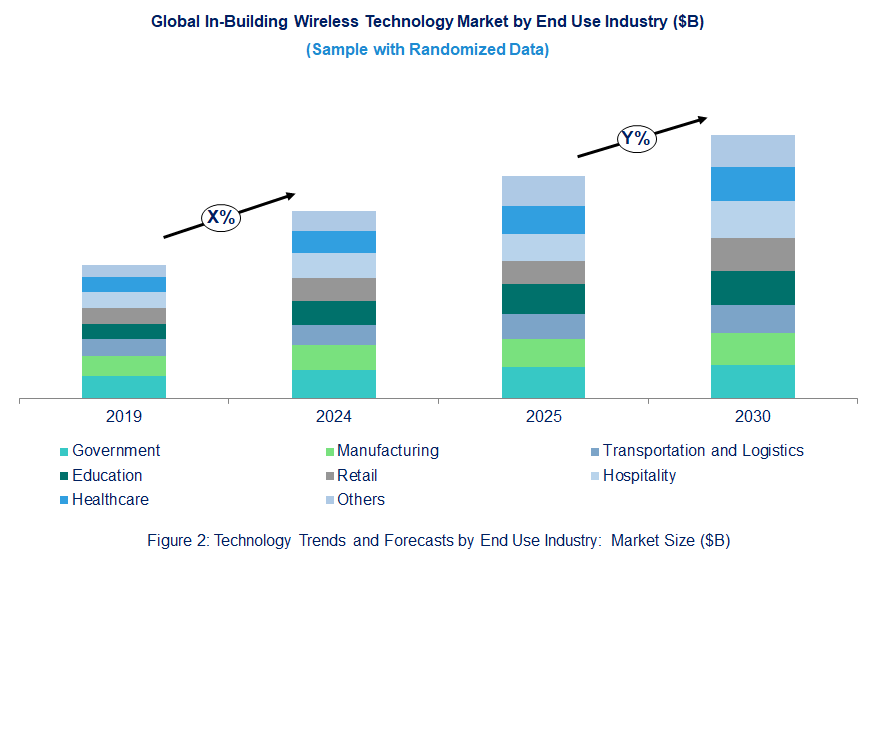
• Shift to 5G Integration: With 5G technology, there is a significant shift toward integrating 5G networks into buildings for faster data transfer, lower latency, and higher capacity. This is a transformation key for the healthcare and education industries, which require high-speed data and real-time communication.
• Small Cells Deployment: Small cells have gained popularity as a cost-effective and efficient solution for enhancing wireless coverage in large buildings. The small cells are deployed to increase the strength and capacity of signals in areas of high data demand, such as stadiums, malls, and office buildings, hence increasing user experience.
• Adoption of Wi-Fi 6: Wi-Fi 6 or 802.11ax is being adopted by various buildings due to faster speeds, improved efficiency, and greater capacity, especially in environments plagued by crowds. It becomes indispensable for enterprises and public spaces that require high-performance connectivity for multiple users and devices.
• Hybrid Wireless Systems: Hybrid deployment - hybrid systems combine both DAS and small cells, emphasizing better coverage and capacity. As such, it is applied in large facilities, such as airports and shopping malls. In such environments, wireless coverage should be seamless among different technologies.
• Intelligent Building Integration: Integrated wireless networks are now the heart and soul of smart building development. Advanced wireless technologies can better enable communication from one IoT device to another, and improve energy management, security, and operational efficiency. It's transforming commercial real estate through smarter, more intelligent, and interconnected buildings. These trends are altering the face of the In-building wireless market integration with 5G, adoption of small cells, adoption of Wi-Fi 6, adoption of hybrid systems, and integration of smart buildings into their respective solutions. Increasing demand for seamless, high-speed, and efficient connectivity calls for reliable, scalable solutions across various industries toward ensuring smarter, more connected environments.
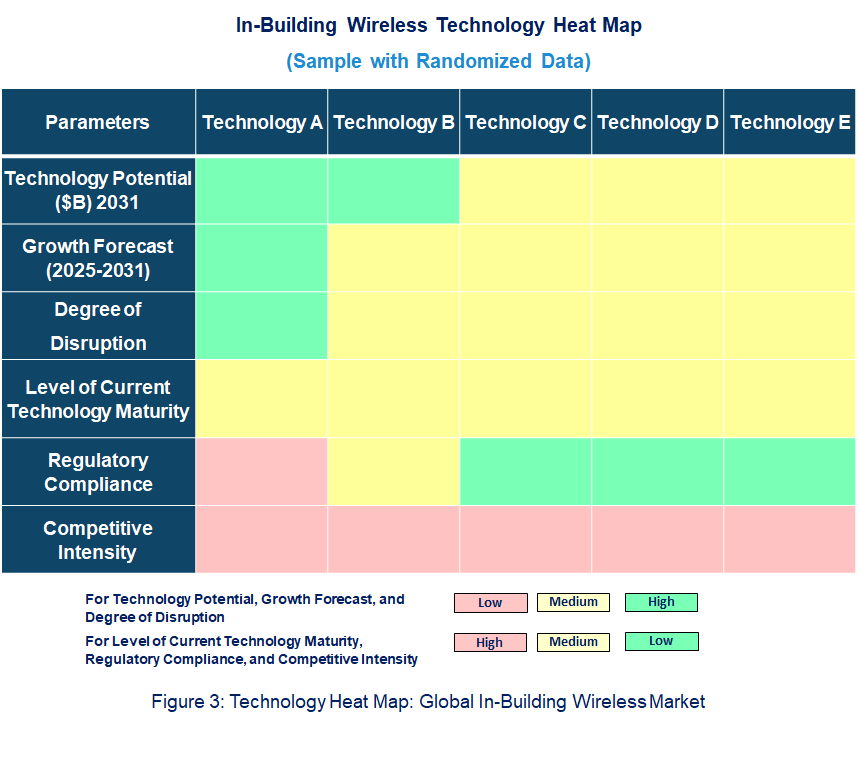
• Technology Potential: The potential of technologies like 5G and Wi-Fi 6 in the in-building wireless market is significant. 5G offers ultra-low latency, high-speed data transfer, and improved capacity, revolutionizing sectors like healthcare, education, and retail. Wi-Fi 6 enhances capacity and speed, allowing more devices to connect simultaneously with minimal congestion.
• Degree of Disruption: It is quite profound with the advent of 5G and small cells. 5G enables a leap forward in connectivity, changing how businesses operate and opening up applications like augmented reality and virtual reality. Small cells improve coverage and capacity, especially in dense urban environments.
• Current Technology Maturity Level Wi-Fi 6 and small cells are already in use in most commercial buildings. 5G is rapidly being adopted in selected areas, though still in its early stages. Hybrid systems are also becoming popular, integrating various technologies for better performance.
• Regulatory Compliance: The regulatory framework for wireless technology is changing, as governments set standards for 5G deployment, spectrum allocation, and data privacy to ensure compliance in industries such as healthcare and education.
• Nokia: Nokia has gone through major progress in the in-building wireless market by offering its advanced 5G solutions for enterprises. Its "AirScale" solution is a scalable, high-performance network that improves in-building connectivity and facilitates a smooth transition into 5G. The solutions by Nokia support industries like manufacturing, retail, and healthcare to deliver high-speed data and ultra-low latency.
• Ericsson: Ericsson developed the latest technologies on in-building connectivity, with high priority placed on 5G integration in already existing systems. Ericsson's "Radio Dot System" is designed for densifying coverage in challenging and densely populated environments such as malls or airports. The in-building solutions provided by Ericsson are highly optimized for providing an excellent user experience based on improved coverage, capacity, and speed.
• Huawei: Huawei has expanded its in-building wireless portfolio with advanced 5G and small cell technologies. Huawei’s "5G LampSite" is an innovative solution for enterprise and commercial building deployments, enhancing coverage and network capacity. Its technology allows seamless integration with 4G and 5G, ensuring future-proof solutions for indoor wireless needs.
• ZTE: ZTE has launched sophisticated DAS solutions and small cell technologies for in-building wireless connectivity. With the "ZTE Small Cell," the company has been targeting to enable ultra-fast, reliable indoor connectivity for enterprises and service providers. With the technology from ZTE, congestion in networks is eased and consistent coverage is provided, even in very crowded spaces.
• NEC: NEC's in-building wireless solutions focus on delivering seamless connectivity using DAS and small cells, which enhance the overall user experience in indoor spaces. The company has been able to make significant strides in integrating its solutions with next-generation wireless networks like 5G, which are required to deliver higher data speeds and better coverage.
• Commscope: Commscope has been at the top of scalable DAS solutions and optimizing indoor wireless coverage and capacity. With the help of 5G and small cell technologies, Commscope ensures that commercial buildings, airports, and stadiums benefit from a reliable high-performing wireless experience.
• Corning: It introduced the "Small Cell" and DAS solutions for indoor coverage and capacity improvements for enterprise buildings. Its technologies enable efficient energy usage while increasing wireless performance. Corning's solutions are ideal for large-scale buildings and venues, ensuring reliable coverage on 4G and 5G networks.
• Axell Wireless: Axell Wireless is one among the significant companies in the DAS market, which has reached major milestones in providing customer-tailored in-building wireless solutions. Its DAS technology is deployed in places such as airports and large venues with wide coverage and minimal interference for high-speed wireless service. Comba Telecom has been committed to expanding its portfolio of DAS and small cell solutions for improved in-building connectivity. Its solutions are built to support existing 4G and emerging 5G technologies, with scalability and flexibility for enterprise and service providers seeking reliable indoor wireless coverage.
• Samsung: Samsung has brought out innovative 5G small cell solutions for in-building wireless connectivity. The company's solutions are optimized for high-speed, low-latency connections and are being adopted in various sectors, including commercial buildings and smart cities. Samsung's technology ensures high-performance wireless experiences in dense urban environments. It thus demonstrates how the in-building wireless market continues to evolve rapidly with an integration of 5G, small cells, and DAS technologies that enable leading players to meet the evolving demand for improved coverage, high-speed connectivity, and seamless user experiences in both commercial and enterprise environments.
• Demand for Seamless Connectivity: With the growth of smart cities, connected devices, and IoT technologies, there is a growing demand for reliable, high-speed connectivity in buildings. This drives investments in advanced wireless infrastructure such as DAS and small cells, which help improve network coverage and performance in dense environments such as malls, stadiums, and offices.
• Rise of 5G Networks: The demand for advanced in-building wireless systems is on the rise with 5G technology. With ultra-low latency, increased bandwidth, and network density, companies are implementing more scalable and robust wireless solutions such as DAS and small cells to achieve effective coverage in both urban and commercial environments.
• IoT and Smart Buildings Integration: As the number of connected devices and IoT applications grows in smart buildings, the demand for high-performance in-building wireless networks increases. DAS and small cells are capable of managing vast amounts of connected devices to ensure enhanced performance and low-latency communication necessary for IoT-based applications like smart lighting, HVAC, and security systems. Challenges in the in-building wireless market are:
• Implementation and Maintenance Cost: Installation cost of in-building wireless systems, mainly DAS and small cells, is the biggest problem, as it comes with high upfront costs. Small and medium-sized businesses would find it difficult to install these systems; therefore, a high maintenance cost can hold them back from implementing new wireless technology solutions.
• Regulatory Obstacles and Spectrum Availability: The regulatory environment and spectrum allocation for in-building wireless technologies create barriers to their adoption. Compliance with local and national regulations, including interference management and rights for spectrum use, often complicates the implementation of these systems, especially in densely populated urban areas. Although there are multiple opportunities in the in-building wireless market driven by the requirement for seamless connectivity, the adoption of 5G, and IoT applications, challenges in the implementation process, regulatory compliance, and infrastructure complexity are some challenges that need to be mitigated for wider-scale deployment. As these obstacles are bridged, the market is expected to keep growing and evolving, hence changing connectivity within buildings from different industry sectors.
• Nokia
• Ericsson
• Huawei
• ZTE
• NEC
• Commscope
• Technology Readiness by Technology Type for In-Building Wireless Market: The readiness level varies for DAS, Small Cells, Wi-Fi, Hybrid Systems, and Cellular/3G/4G/5G based on their development stage and usage in the market. DAS and Small Cells are very mature technologies with wide deployment in large commercial, industrial, and public areas; They deliver reliable coverage. Wi-Fi is mature but is continuously upgrading to meet increasing demands for bandwidth. Hybrid Systems tend to emerge these days, combining different technologies with flexible and cost-effective solutions. Cellular technologies are rapidly advancing, especially 4G and 5G, where 5G is already being introduced into some areas with transformative potential on high-speed connectivity. The regulations are different for each technology; however, for 5G spectrum allocation and interference management remain key concerns. These technologies are being applied across all sectors, such as healthcare, retail, manufacturing, and hospitality, due to requirements for greater data throughput, better user experience, and smart building integration.
• Competitive Intensity and Regulatory Compliance for In-Building Wireless Market: In the in-building wireless market, competitive intensity is driven by the need for companies to provide reliable, scalable, and cost-effective solutions. In competition are alternative solutions, where technology innovations like DAS, Small Cells, and Hybrid Systems will see further growth through continuous innovations by the company itself. Another factor that matters in the system, especially concerning cellular and wireless systems, is the requirement of regulatory compliance in the handling of interference management in a frequency spectrum allocated to different providers. It can hinder or affect deployment and efficiency for in-building systems. For that reason, governments have to evolve more regulations for managing the rollout of 5G and advanced wireless technologies. Companies have to face such challenges to maintain competitiveness and network quality.
• Disruption Potential of Different Technologies for In-Building Wireless Market: Total disruption potential of the different technologies that might be incorporated into the in-building wireless market encompasses Distributed Antenna Systems (DAS), Small Cells, Wi-Fi, Hybrid Systems, and Cellular/3G/4G/5G technology as it would bring about smooth, high-performance connectivity in complex, high-density environments. DAS and Small Cells are much more impactful in large buildings, ensuring stronger coverage and network optimization by offloading traffic from the primary network. Wi-Fi continues to be a cost-effective solution for high-traffic environments, while Hybrid Systems combine different technologies to optimize connectivity and reduce operational costs. Cellular technologies like 3G/4G/5G offer faster data speeds, low latency, and improved capacity, making them key players in meeting the demands of modern, smart buildings. Collective Statement: These technologies, on the whole, disrupt traditional wireless communication by enhancing indoor network capabilities, enabling efficient operation, and facilitating the growth of IoT devices.
• Distributed Antenna System (DAS)
• Small Cells
• Wi-Fi
• Hybrid Systems
• Cellular/3G/4G/5G
• Government
• Manufacturing
• Transportation and Logistics
• Education
• Retail
• Hospitality
• Healthcare
• Others
• North America
• Europe
• Asia Pacific
• The Rest of the World
• Latest Developments and Innovations in the In-Building Wireless Technologies
• Companies / Ecosystems
• Strategic Opportunities by Technology Type


Choose a license that fits your team. Instant PDF delivery.
Prices exclude taxes. Instant delivery. Custom licensing available on request.
Market Report · May 18, 2026
Market Report · May 18, 2026
Market Report · May 18, 2026
Trusted partner for strategic intelligence and business growth


Receive a complimentary market analysis tailored to your industry. Our analysts will identify key growth opportunities and competitive dynamics specific to your business.

Market size, growth rate, and key trend analysis for your specific sector.

Top competitor positioning and market share analysis.

Strategic recommendations backed by data-driven insights.
Get curated market intelligence and competitive moves straight to your inbox.
By subscribing, you agree to receive our monthly insights. Unsubscribe anytime.
Receive a complimentary market analysis tailored to your industry. Our analysts will identify key growth opportunities and competitive dynamics specific to your business.
Market size, growth rate, and key trend analysis for your specific sector.
Top competitor positioning and market share analysis.
Strategic recommendations backed by data-driven insights.
Get curated market intelligence, emerging trends, and competitive moves straight to your inbox each month.
By subscribing, you agree to receive our monthly insights. Unsubscribe anytime.
We'll send your sample report shortly.