
Market Report · May 18, 2026

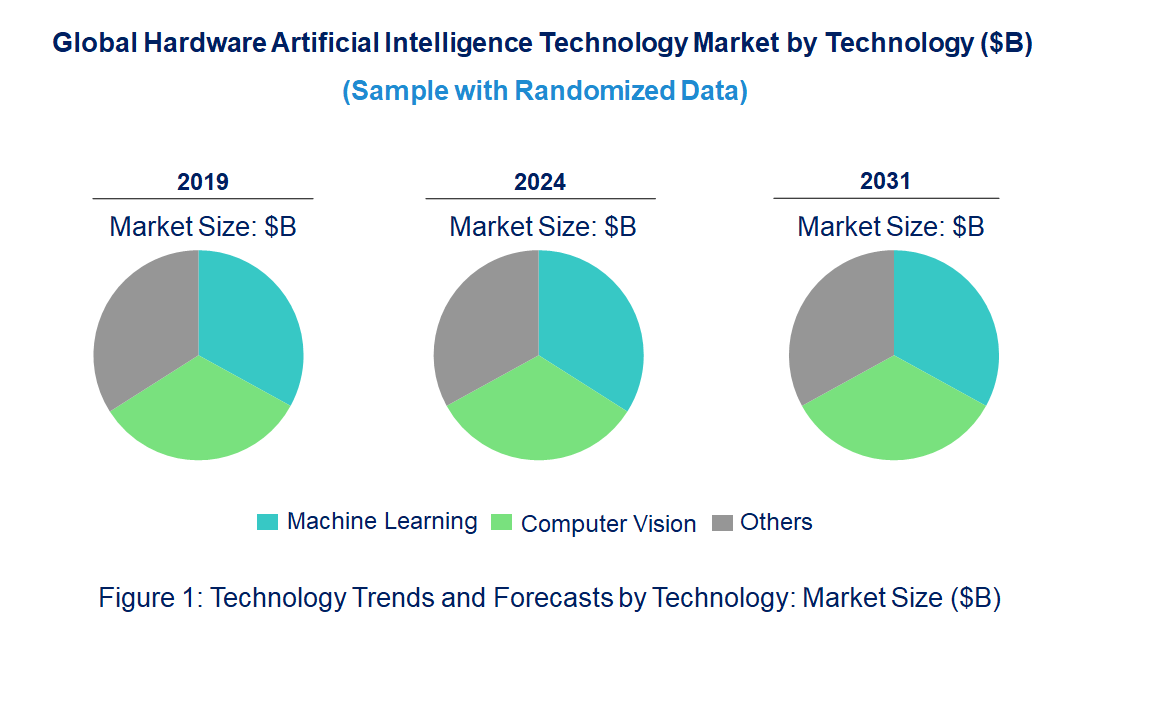
This market report covers trends, opportunities, and forecasts in the global hardware artificial intelligence technology market to 2031 by technology (machine learning, computer vision, and others), end use industry (banking, financial services and insurance (bfsi), it and telecommunication, healthcare, media and entertainment, aerospace and defense, manufacturing, automotive, agriculture, retail, and others), and region (North America, Europe, Asia Pacific, and the Rest of the World)
We'll send your sample report shortly.
![Hardware Artificial Intelligence Technology Market Trend and Forecast by End Use Industry [Value from 2019 to 2031]:](https://lucintel.com/images/Hardware-Artificial-Intelligence-Technology-Market-Segment.png "Hardware Artificial Intelligence Technology Market Trend and Forecast by End Use Industry [Value from 2019 to 2031]:")
• Specialized AI Processors: The development and deployment of specialized processors such as Graphics Processing Units (GPUs), Tensor Processing Units (TPUs), and Field-Programmable Gate Arrays (FPGAs) are revolutionizing AI workloads. These processors optimize parallel processing, improving the performance of deep learning and machine learning algorithms and enabling real-time data analysis.
• Edge AI Devices: The shift towards edge computing has led to the growth of edge AI hardware. Devices equipped with AI chips and sensors can process data locally, minimizing latency and reducing the dependency on cloud-based servers. This trend is crucial for real-time applications like autonomous vehicles, smart cameras, and wearable devices.
• Energy Efficiency Improvements: Energy consumption has become a significant focus for AI hardware design. Innovations such as neuromorphic chips and optimized AI accelerators are addressing the demand for more energy-efficient solutions. These developments help reduce the carbon footprint of AI technologies and enhance the sustainability of large-scale AI deployments.
• Integration of AI with IoT: The synergy between AI and the Internet of Things (IoT) is leading to smarter devices and systems. AI-powered IoT devices that can make decisions and adapt to changing environments are becoming commonplace in sectors such as healthcare, agriculture, and smart cities, driving efficiency and improving outcomes.
• Advancements in Quantum Computing: While still in its early stages, quantum computing holds the potential to transform the AI landscape. Quantum processors can perform calculations at unprecedented speeds, enabling complex machine-learning tasks that were previously impossible or highly time-consuming. This trend is laying the groundwork for future breakthroughs in AI research and development. These trends are reshaping the hardware AI technology landscape by improving processing power, reducing energy use, and expanding AI applications. The integration of specialized hardware, edge devices, and quantum technologies is making AI more efficient, scalable, and adaptable to a range of industries, driving further innovation and growth in the field.

• Potential in Technology: The technology potential is immense, as AI hardware can significantly speed up processing times, enhance machine learning models, and enable real-time decision-making. In industries like autonomous vehicles, healthcare (e.g., medical diagnostics), robotics, and manufacturing, AI hardware can enable more efficient and accurate operations. With the demand for AI-driven applications growing, specialized hardware can revolutionize sectors by improving performance, energy efficiency, and scalability.
• Degree of Disruption: The degree of disruption is high, particularly in sectors that require large-scale data processing and real-time AI applications. By moving AI processing from the cloud to edge devices, such as smartphones, IoT devices, and robots, hardware AI could reduce latency and dependency on cloud infrastructure. This shift will allow for more intelligent, autonomous systems in areas such as smart cities, healthcare, and manufacturing.
• Current Technology Maturity Level: Current technology maturity is progressing rapidly, with companies like NVIDIA, Intel, and AMD leading the development of AI chips and accelerators. However, challenges remain, such as optimizing hardware for energy efficiency and overcoming scalability barriers in certain applications.
• Regulatory Compliance: Regulatory compliance for hardware AI often involves safety standards (e.g., ISO), data protection regulations (e.g., GDPR), and certifications to ensure these technologies function safely and ethically, particularly in sensitive applications.
• Intel Corporation: It has launched its latest AI-centric processors, including the Xeon Max series, which are optimized for high-performance computing and AI workloads. The chips support increased parallel processing and faster data handling, enabling more complex AI models to be run efficiently in data centers. Dell Technologies: It has extended its portfolio with AI-driven solutions based on high-performance GPUs and optimized storage systems to upgrade data processing and analytics for the enterprise; deployed workloads of machine learning and data analytics to businesses with increased scalability.
• IBM: It has made its inroads with PowerAI and Watson AI systems, which help integrate AI into hybrid cloud infrastructures. It is helping enterprises apply AI for predictive analytics and cognitive computing to enhance decision-making and operational efficiency.
• Hewlett-Packard Enterprise (HPE): It has launched AI solutions specifically designed for edge computing, enabling organizations to process and analyze data at the point of creation. Their systems include AI-powered infrastructure that supports faster insights and reduced latency, ideal for IoT and smart device applications.
• Rockwell Automation: It has focused on applying AI to industrial settings, developing hardware that integrates machine learning with robotics and automation. These advancements improve predictive maintenance, process optimization, and safety in manufacturing environments.
• Google: Further pushes forward its Tensor Processing Units (TPUs), custom-designed chips optimized for machine learning. This development strengthens Google Cloud’s AI services, allowing the rapid training of machine learning models and making AI accessible to developers and researchers.
• Microsoft: It has even developed AI-specific hardware, in the shape of the Azure AI supercomputing platform, for instance. These machines were designed with large-scale deep learning and AI projects in mind, advancing areas such as natural language processing and computer vision.
• NVIDIA: GPUs specifically made for deep learning, like the NVIDIA A100 Tensor Core GPU, are leading the field. The company’s focus on developing AI-focused processors has accelerated the adoption of AI in industries ranging from automotive and healthcare to entertainment and finance. These developments underscore the commitment of major players to push forward the capabilities of AI hardware. The continued evolution of specialized processors, cloud integration, and edge computing solutions is paving the way for more advanced, efficient, and widespread use of AI technologies.
• High-Performance Computing Requirement: The growth of AI adoption in healthcare, automotive, and finance has raised a demand for hardware capable of processing complex algorithms and significant data volumes. The rising demand is fueling research into specialized processors, including the development of GPUs and TPUs, which are optimized to streamline deep learning and machine learning jobs.
• Edge Computing Integration: With the move towards edge computing, where data is processed close to where it is generated, comes opportunities for more distributed AI systems. Innovations in hardware that make it possible to analyze data in real-time and make decisions at the edge are critical for applications such as IoT and autonomous vehicles, providing faster response times and greater operational efficiency.
• Energy Efficiency and Sustainability: With the increasing use of AI hardware, energy-efficient designs are critical. Innovations such as energy-optimized AI chips contribute to reducing the carbon footprint of data centers and AI-powered systems, making the technology more sustainable and economically viable.
• Advances in AI-Specific Chips: Custom-designed AI chips, including GPUs and ASICs (Application-Specific Integrated Circuits), are advancing the processing speed and efficiency of machine learning. The development of these models leads to the possibility of more complex and accurate AI models that may further open the realms for applications such as natural language processing and computer vision. Challenges
• Cost and Accessibility Barriers: The high cost of developing and implementing advanced AI hardware remains a challenge for widespread adoption. Companies must balance performance with affordability to ensure AI technology can be accessed by a broader range of industries, especially smaller businesses and developing economies. The growth opportunities in the Hardware AI market are shaping the future of technology with more sophisticated and efficient AI solutions. Chalk up persistent issues like high cost and high energy usage, while innovational chip design for AI, efficiency of power design, and edge computing will move the market toward even more sustainable and capable solutions. It is driving increasing adoption and a much broader scope for applications and reshaping industries.
• Intel Corporation
• Dell Technologies
• IBM
• Hewlett Packard Enterprise
• Rockwell Automation
• Technology Readiness by Technology Type: Machine learning is at a high level of readiness, widely used in sectors like finance for algorithmic trading, healthcare for diagnostics, and marketing for customer personalization. Computer vision is also well-established and integrated into applications such as autonomous vehicles, smart cameras, and augmented reality. Other technologies like NLP power virtual assistants, enabling smoother human-computer interactions. Robotics is evolving with advances in AI for manufacturing automation and logistics. These technologies collectively enhance productivity, safety, and innovation, opening doors to previously unattainable efficiencies and capabilities.
• Competitive Intensity and Regulatory Compliance: The hardware artificial intelligence market for machine learning, computer vision, and similar technologies is highly competitive, with numerous startups and tech giants vying for leadership. Companies are racing to develop the most powerful algorithms and specialized hardware to gain a competitive edge. However, regulatory compliance poses challenges, especially in privacy-sensitive areas like facial recognition and data handling. Stringent data protection laws and ethical concerns about AI’s impact on jobs and society require companies to adapt and implement responsible practices, influencing how technology is developed and deployed.
• Disruption Potential by Technology Type: Machine learning and computer vision have enormous disruption potential, reshaping industries by enabling automation, improved data analysis, and enhanced user experiences. Machine learning can revolutionize sectors like finance, healthcare, and manufacturing with predictive analytics and decision-making, while computer vision has transformed fields such as automotive (autonomous driving), retail (checkout-free stores), and security (facial recognition). Other technologies like natural language processing (NLP) and robotics are also contributing significantly to advancements, creating more interactive and intelligent systems. These technologies are driving innovations that improve efficiency, personalize services, and open up new business opportunities.
• Machine Learning
• Computer Vision
• Others
• Banking, Financial Services and Insurance (BFSI)
• IT and Telecommunication
• Healthcare
• Media and Entertainment
• Aerospace and Defense
• Manufacturing
• Automotive
• Agriculture
• Retail
• Others
• North America
• Europe
• Asia Pacific
• The Rest of the World
• Latest Developments and Innovations in the Hardware Artificial Intelligence Technology
• Companies / Ecosystems
• Strategic Opportunities by Technology Type


Choose a license that fits your team. Instant PDF delivery.
Prices exclude taxes. Instant delivery. Custom licensing available on request.
Market Report · May 18, 2026
Market Report · May 18, 2026
Market Report · May 18, 2026
Trusted partner for strategic intelligence and business growth


Receive a complimentary market analysis tailored to your industry. Our analysts will identify key growth opportunities and competitive dynamics specific to your business.

Market size, growth rate, and key trend analysis for your specific sector.

Top competitor positioning and market share analysis.

Strategic recommendations backed by data-driven insights.
Get curated market intelligence and competitive moves straight to your inbox.
By subscribing, you agree to receive our monthly insights. Unsubscribe anytime.
Receive a complimentary market analysis tailored to your industry. Our analysts will identify key growth opportunities and competitive dynamics specific to your business.
Market size, growth rate, and key trend analysis for your specific sector.
Top competitor positioning and market share analysis.
Strategic recommendations backed by data-driven insights.
Get curated market intelligence, emerging trends, and competitive moves straight to your inbox each month.
By subscribing, you agree to receive our monthly insights. Unsubscribe anytime.
We'll send your sample report shortly.