
Market Report · July 22, 2026

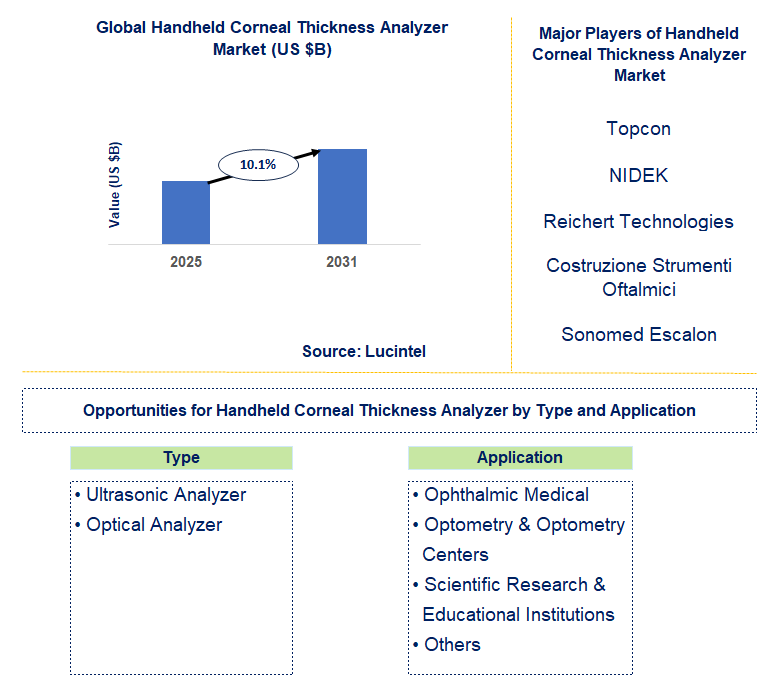
Key data points: The growth forecast = 10.1% annually for the next 7 years. Scroll below to get more insights. This market report covers trends, opportunities and forecasts in handheld corneal thickness analyzer market to 2031 by type (ultrasonic analyzer and optical analyzer), application (ophthalmic medical, optometry & optometry centers, scientific research & educational institutions, and others), and region (North America, Europe, Asia Pacific, and the Rest of the World)
We'll send your sample report shortly.
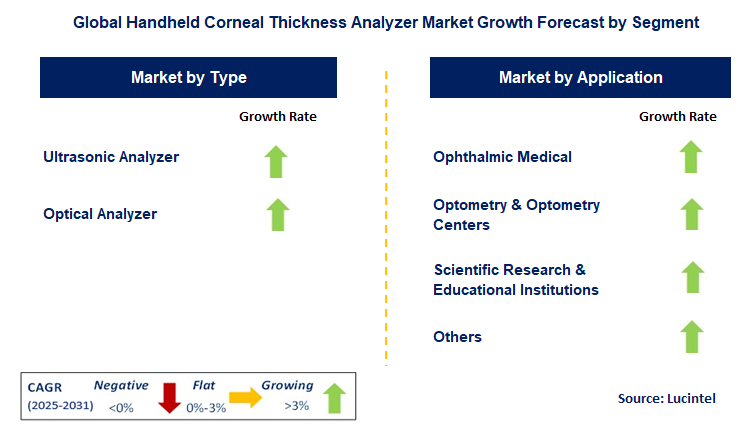
• Lucintel forecasts that, within the type category, ultrasonic analyzer is expected to witness higher growth over the forecast period.
• Within the application category, ophthalmic medical is expected to witness the highest growth.
• In terms of region, APAC is expected to witness the highest growth over the forecast period. Gain valuable insights for your business decisions with our comprehensive 150+ page report. Sample figures with some insights are shown below.
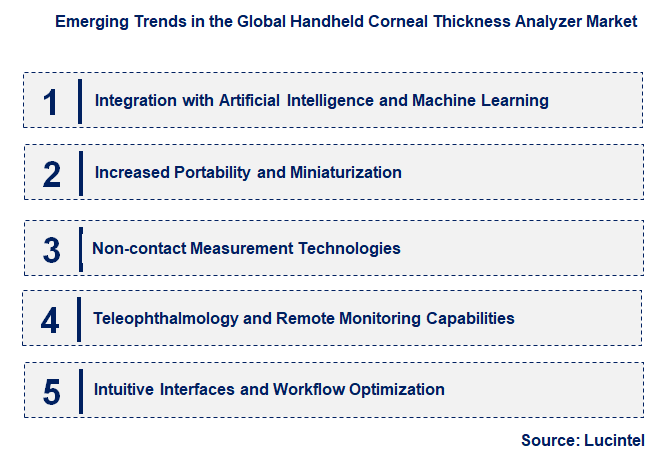
• Integration with Artificial Intelligence and Machine Learning: AI and ML are transforming the market for handheld corneal thickness analyzers by facilitating automated analysis and enhanced diagnostic accuracy. Both these technologies are capable of analyzing large amounts of data, detecting subtle patterns, and helping in the early detection of diseases such as keratoconus and glaucoma. This convergence brings more accurate measurements, minimizes inter-operator variability, and provides predictive analytics for disease progression, enabling ophthalmologists to make more intelligent treatment decisions and tailor patient care.
• Increased Portability and Miniaturization: Key to making handheld corneal thickness analyzers more universally available for all clinical environments, including rural and remote locations and mobile eye care, is the trend towards greater portability and miniaturization. The more portable, lighter, and more compact the devices, the less cumbersome they are to transport and the fewer hospital staff are required, all of which puts less burden on the patient. This provides increased convenience to both patients and professionals alike, eventually making advanced corneal diagnostics available to underserved communities and enhancing early screening rates.
• Non-contact Measurement Technologies: The move toward non-contact measurement technology is an important trend, enhancing patient comfort and minimizing the risk of infection. Older contact-based technology can be invasive and necessitates topical anesthesia. More recent handheld optical coherence tomography (OCT) and Chemiflux imaging-based devices give highly accurate and detailed maps of corneal thickness without any contact with the eye. This not only improves the patient experience but also optimizes the process of diagnosis, which becomes quicker and safer.
• Teleophthalmology and Remote Monitoring Capabilities: The incorporation of teleophthalmology and remote monitoring functions into portable corneal thickness analyzers is broadening access to specialty eye care, particularly in remote and geographically isolated areas. The devices are able to securely send data to ophthalmologists for off-site interpretation and consultation, allowing for timely diagnosis and follow-up without necessarily having to make an office visit. This development is very important in the case of chronic eye diseases, lessening healthcare disparities, and enhancing compliance of patients with monitoring intervals.
• Intuitive Interfaces and Workflow Optimization: Manufacturers are now placing more emphasis on creating easy-to-use handheld corneal thickness analyzers with clear, intuitive interfaces to streamline operation and improve clinical workflows. This encompasses touchscreen screens, easy navigation, and automated measurement routines minimizing training time and user errors. By making the devices easier to operate, healthcare practitioners can take measurements more quickly, spend more time with patients, and fully incorporate the analyzers into daily practice, maximizing overall productivity. These emerging trends are coming together to collectively transform the handheld corneal thickness analyzer market by facilitating innovation, making it more accessible, enhancing diagnostic accuracy, and maximizing clinical efficiency. The convergence of AI and teleophthalmology with improved portability and user-friendly form factors is revolutionizing the future of corneal care by making advanced diagnostics more prevalent and effective.
• Incorporating Advanced Imaging Technologies: One of the most significant developments is the common integration of advanced imaging devices such as Optical Coherence Tomography (OCT) and Chemiflux imaging into handpieces. This makes it possible for high-resolution cross-sectional views and fine topographical mapping of the cornea, offering more extensive information than mere thickness readings. The effect is immense, making possible the earlier and more precise diagnosis of advanced conditions such as keratoconus, accurate surgical planning for refractive surgeries, and enhanced monitoring of corneal status, resulting in improved patient care.
• Increased Portability and Wireless Connectivity: Advances have resulted in much more compact and handheld miniaturized corneal thickness analyzers, frequently with wireless connectivity. This enables smooth transfer of data to electronic health records (EHR) or other diagnostic systems. The effect is greater flexibility for practitioners, allowing measurements to be taken in many different environments from small clinics to mobile eye care units, even in rural areas. Wireless features make workflows more efficient, eliminate manual entry errors, and enable quicker consultations.
• Artificial Intelligence and Machine Learning Capabilities: Inclusion of AI and ML algorithms is a revolutionary innovation. These features enable handheld analyzers to execute automatic image analysis, identify faint abnormalities, and provide predictive information based on high-volume datasets. The effect is a dramatic boost in diagnostic precision and speed. AI is able to help detect early symptoms of disease, minimize the role of subjective interpretation, and aid clinicians in making more accurate decisions, which finally culminates in more individualized and successful patient outcomes.
• Non-Contact and User Friendly Device Development: A powerful trend is the creation of non-contact handheld systems that are becoming more user-friendly. They do not involve direct contact with the eye, enhancing patient comfort and reducing the possibility of contamination. The effect is increased patient compliance and lower chair time. In developing products, manufacturers are concentrating on user-friendly interfaces and easier operation, rendering these advanced instruments accessible to more healthcare providers and facilitating faster and more effective examinations.
• Telemedicine and Remote Diagnostic Expansion: The market for handheld corneal thickness analyzers is more and more aligning with telemedicine and remote diagnostic programs. Handheld devices are being made to support remote monitoring and virtual consultations, especially important in underserved regions with insufficient access to specialized eye care. The effect is enhanced access to essential diagnostic services, where the patient is screened and monitored in their home or nearby clinic. This plays an important role in the management of chronic eye diseases and increasing ophthalmic practice worldwide. All these advances are collectively affecting handheld corneal thickness analyzer market by setting new standards for what can be done by these portable instruments. They are improving corneal diagnosis to be more accurate, available, and efficient and, in turn, benefiting patients and increasing the scope of ophthalmic practice.
• Glaucoma Management and Diagnosis: Glaucoma management and diagnosis are an important area of growth. Measurement of intraocular pressure (IOP) is a prime indicator for glaucoma, and corneal thickness is a major determinant in the measurement process. Handheld analyzers deliver precise, reproducible measurements, enabling clinicians to correct IOP readings for corneal thickness and more accurately judge glaucoma risk and disease progression. The effect is enhanced diagnostic accuracy for glaucoma, especially in screening programs and routine examinations, and more accurate monitoring of treatment response, resulting in improved vision preservation for patients.
• Refractive Surgery Pre- and Post-operative Assessment: The lucrative refractive surgery market, comprising technologies such as LASIK and PRK, promises high growth. Handheld corneal thickness analyzers are critical for pre-operative screening to identify suitability for surgery and post-operative monitoring to evaluate corneal healing and stability. The effect is improved patient safety and enhanced surgical outcomes. Portable analyzers enable flexible pre-screening at different sites and easy post-operative follow-ups, extending the accessibility of refractive surgery consultations.
• Keratoconus Diagnosis and Monitoring: Keratoconus, a progressive disorder of corneal thinning, offers a critical use. Proper and early diagnosis, followed by regular follow-up of corneal thickness changes, is essential for the control of the condition and avoiding visual impairment. Handheld analyzers offer non-invasive, accurate measurements, allowing periodic follow-up check-ups. The effect is earlier treatment with methods such as corneal cross-linking, which can stabilize the disease process, and optimal long-term management measures, enhancing the quality of life in patients.
• Contact Lens Fitting and Management: The enormous market for contact lenses is a source of ongoing growth. The measurement of corneal thickness accurately helps fit advanced contact lenses, particularly for irregular corneas or therapeutic lenses. Portable instruments allow easy measurement at the standard contact lens checkup visit. The benefit is enhanced comfort, vision, and eye health for contact lens users, as accurate measurements allow optimal lens fit, minimize complications, and facilitate better long-term care of contact lens-related problems.
• General Ophthalmology and Primary Eye Care Screening: Broad growth potential comes from extending the use of handheld corneal thickness analyzers to general ophthalmology and primary eye care screening programs. Handheld analyzers can be readily incorporated into routine eye exams to screen for most corneal anomalies and as a baseline reading for overall ocular health. The effect is enhanced early recognition of a broad spectrum of corneal disease, enhanced preventative treatment, and enhanced patient referral patterns, resulting in more appropriate and timely intervention throughout the population. These strategic growth prospects, through the utilization of portability and accuracy of handheld corneal thickness analyzers in a wide range of applications, are collectively influencing the market by stimulating higher adoption, broadening the range of their applicability, and eventually leading to better eye care outcomes everywhere.
• Topcon
• NIDEK
• Reichert Technologies
• Costruzione Strumenti Oftalmici
• Sonomed Escalon
• DGH Technology
• Accutome
• Optikon
• Micro Medical Devices
• Appasamy Associates
• Ultrasonic Analyzer
• Optical Analyzer
• Ophthalmic Medical
• Optometry & Optometry Centers
• Scientific Research & Educational Institutions
• Others
• North America
• Europe
• Asia Pacific
• The Rest of the World
• United States: The handheld corneal thickness analyzer market in the United States is growing on account of sophisticated healthcare infrastructure and high incidence of eye ailments. There is a high emphasis on connecting these devices with electronic health records to manage patient data seamlessly. Advances in non-contact measuring technologies and increased portability are major drivers, reflecting a need for effective and accurate diagnostic products in clinical and ambulatory environments. Regulatory clearances have a major influence on market adoption and new product release.
• China: China handheld corneal thickness analyzer market is growing fast, driven by high patient population, rising healthcare spending, and greater focus on preventive eye care and early diagnosis. Domestic firms are investing in research and development to develop cost-effective and high-technology products. Growth in ophthalmic clinics, especially in rural regions, also leads to increased use of portable and affordable diagnostic devices, embodying the nation's efforts to increase eye health accessibility.
• Germany: Germany, the hub of medical technology, is experiencing consistent growth in the handheld corneal thickness analyzer market, marked by emphasis on accuracy, reliability, and compatibility with high-end diagnostic platforms. German companies are giving importance to machines with higher accuracy and high-end data analysis features, addressing a state-of-the-art healthcare system with exacting standards for quality. Cooperation between R&D institutions and industry stakeholders is stimulating sensor technology and software innovations.
• India: India's handheld corneal thickness analyzers market size is witnessing a major growth with growing awareness of eye health, increasing disposable incomes, and government programs to enhance access to healthcare. The wide incidence of eye conditions and increased numbers of ophthalmic practices, even in rural areas, are enhancing demand for affordable and portable diagnostic tools. There is also the development of local manufacturing capacity, supporting an easier access to these vital devices.
• Japan: Japan's market for handheld corneal thickness analyzer is dominated by an intense focus on technology improvement and miniaturization. Japanese manufacturers are in the vanguard of creating small, precision instruments with high-performance features such as enhanced measurement algorithms and easy-to-use interfaces. The growing population of elderly citizens and an intense focus on preventive medicine are fueling demand for accurate and efficient diagnostic devices in hospital and private clinics alike, reinforcing Japan's image as a supplier of high-performance medical devices.


• Topcon
• NIDEK
• Reichert Technologies
• Costruzione Strumenti Oftalmici
• Sonomed Escalon
• DGH Technology
• Accutome
• Optikon
• Micro Medical Devices
• Appasamy Associates Q5. Which handheld corneal thickness analyzer market segment will be the largest in future? Answer: Lucintel forecasts that, within the type category, ultrasonic analyzer is expected to witness higher growth over the forecast period. Q6. In handheld corneal thickness analyzer market, which region is expected to be the largest in next 5 years? Answer: In terms of region, APAC is expected to witness the highest growth over the forecast period. Q7. Do we receive customization in this report? Answer: Yes, Lucintel provides 10% customization without any additional cost.


Choose a license that fits your team. Instant PDF delivery.
Prices exclude taxes. Instant delivery. Custom licensing available on request.
Market Report · July 22, 2026
Market Report · July 22, 2026
Market Report · July 22, 2026
Trusted partner for strategic intelligence and business growth


Receive a complimentary market analysis tailored to your industry. Our analysts will identify key growth opportunities and competitive dynamics specific to your business.

Market size, growth rate, and key trend analysis for your specific sector.

Top competitor positioning and market share analysis.

Strategic recommendations backed by data-driven insights.
Get curated market intelligence and competitive moves straight to your inbox.
By subscribing, you agree to receive our monthly insights. Unsubscribe anytime.
Receive a complimentary market analysis tailored to your industry. Our analysts will identify key growth opportunities and competitive dynamics specific to your business.
Market size, growth rate, and key trend analysis for your specific sector.
Top competitor positioning and market share analysis.
Strategic recommendations backed by data-driven insights.
Get curated market intelligence, emerging trends, and competitive moves straight to your inbox each month.
By subscribing, you agree to receive our monthly insights. Unsubscribe anytime.
We'll send your sample report shortly.