
Market Report · July 20, 2026

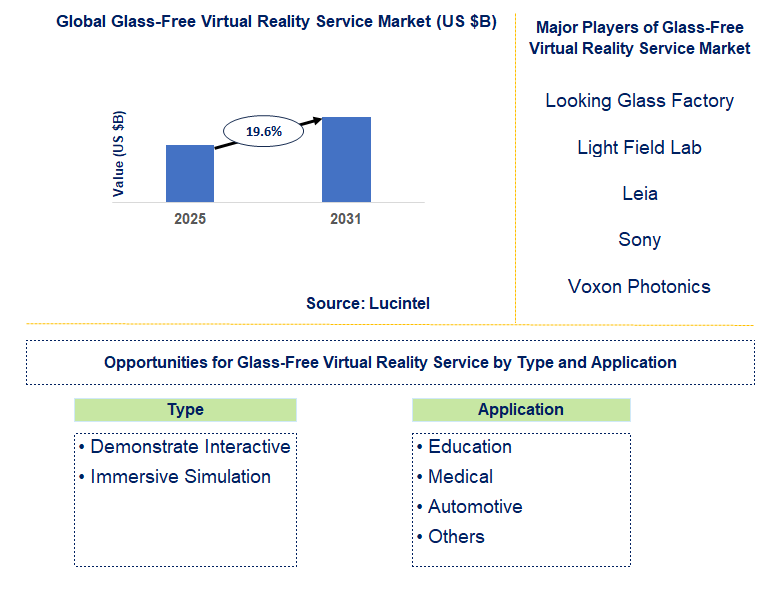
Key data points: The growth forecast = 19.6% annually for the next 7 years. Scroll below to get more insights. This market report covers trends, opportunities and forecasts in glass-free virtual reality service market to 2031 by type (demonstrate interactive and immersive simulation), application (education, medical, automotive, and others), and region (North America, Europe, Asia Pacific, and the Rest of the World)
We'll send your sample report shortly.
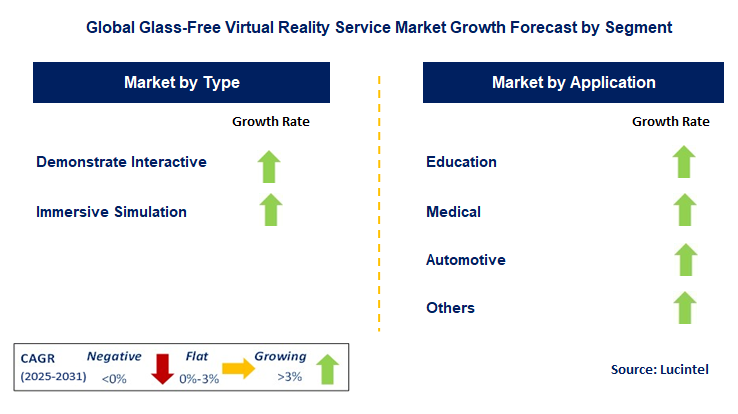
• Lucintel forecasts that, within the type category, demonstrate interactive is expected to witness higher growth over the forecast period.
• Within the application category, medical is expected to witness the highest growth.
• In terms of region, APAC is expected to witness the highest growth over the forecast period. Gain valuable insights for your business decisions with our comprehensive 150+ page report. Sample figures with some insights are shown below.
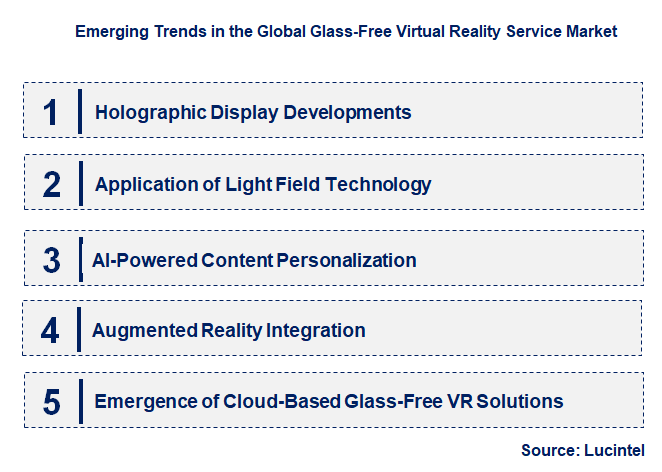
• Holographic Display Developments: One of the most important developments pushing the glass-free VR industry forward is holographic displays. They employ light field technology to project 3D images that do not require the use of headsets or glasses. Holographic displays are enhancing VR experiences and making them more immersive and accessible, especially in industries such as healthcare, education, and entertainment. The emergence of consumer-grade holographic displays is likely to accelerate the uptake of Glass-Free VR, offering natural and immersive experience without the strain of conventional headsets.
• Application of Light Field Technology: Light field technology allows for the generation of three-dimensional scenes and images that can be observed without the use of special glasses. The technology is central in the development of natural and realistic virtual experiences. Light field displays can present more advanced images with greater depth and resolution, which provides for a more immersive experience. In sectors such as gaming, design, and healthcare, light field technology is powering the next generation of virtual interactions and displays, driving the surge in glass-free VR services.
• AI-Powered Content Personalization: Artificial intelligence is taking the lead in shaping personalized virtual experiences in glassless VR environments. AI-powered algorithms are able to understand user habits and preferences in order to customize content in real-time, increasing the level of engagement and personalized nature of virtual interactions. From gaming and entertainment to training-based applications, AI-powered content generation and personalization are raising the bar for overall experience. As AI technologies get better, consumers can look forward to more sophisticated, personalized VR environments without wearing glasses or headsets.
• Augmented Reality Integration: Combining Glass-Free VR and augmented reality (AR) is proving to be an influential trend, allowing more interactive and dynamic experiences. AR provides an enriched experience to Glass-Free VR through superimposition of virtual objects upon the actual environment, bringing together hybrid spaces which can be applied to learning processes, shopping experiences, or product development. The combination of AR with Glass-Free VR enables more real-world applications, including virtual product testing, collaborative design, and improved learning experiences.
• Emergence of Cloud-Based Glass-Free VR Solutions: Cloud computing is making Glass-Free VR more viable by enabling content to be streamed in real-time to devices, without the need for high-powered hardware. Cloud-based Glass-Free VR offerings support the option of executing immersive experiences across numerous different devices such as smartphones, tablets, and smart TVs with outlays associated with expensive setups required. Cloud-based Glass-Free VR reduces consumers' and enterprises' barriers to market, with applications aiding speed-of- adoption by driving user behaviors to grow revenues faster through broader customer accessibility to technologies. New trends like holographic displays, light field technology, AI-based content, AR integration, and cloud-based solutions are transforming the glass-free VR industry. These trends are pushing accessibility, interactivity, and realism in virtual experiences, increasing the appeal of Glass-Free VR across gaming, healthcare, education, and entertainment industries. As these trends advance, they will redefine the way virtual environments are experienced and implemented in daily applications.
• Holographic Display Development: Advances in holographic display technology have enabled the provision of glass-free VR experiences with unmatched realism. Firms have achieved progress in creating 3D holograms that can be accessed without any special headsets or glasses. The displays are being incorporated into consumer electronics, entertainment, and healthcare solutions. The development in this field is likely to result in broader commercial usage, offering users more convenient and immersive virtual experiences.
• Developments in Light Field Technology: Light field technology, which produces images with depth and natural 3D views, is the core of most new glass-free VR services. This technology enables the production of images that vary depending on the viewer's point of view, giving an interactive and immersive experience. In sectors like gaming and education, light field technology is providing more immersive and dynamic virtual environments. These technologies are contributing towards Glass-Free VR becoming mainstream.
• AI Integration Expansion for Content Personalization: AI is increasingly being employed to personalize glass-free VR experiences based on analyzing user behavior and adapting content in line with it. AI-based systems enable real-time adjustment of content to present users with personalized and relevant experiences in VR settings. This is especially applicable in scenarios such as gaming and interactive entertainment, where personalized content can be a major driver of user experience and satisfaction.
• Cloud-Based VR Services: Cloud computing has created new windows of opportunity for glass-free VR services, enabling content to be streamed directly into devices. This innovation minimizes the requirement for high-cost VR hardware, making the technology accessible and more affordable. Cloud-based VR services are making more devices like smartphones and tablets provide immersive virtual reality experiences without necessitating heavy computing hardware. This growth of cloud-based VR systems is speeding up the world-wide use of glass-free technologies.
• More Investment in AR/VR Convergence: The convergence of Augmented Reality (AR) with glass-free VR is giving rise to hybrid experiences that provide even more interactive and immersive content. This is especially useful in sectors like retail, healthcare, and education, where the merging of virtual and real-world elements can improve learning, shopping, and training experiences. Businesses are investing more in AR/VR hybrid technologies, which are likely to be a dominant market trend in the next few years. Recent advances in the glass-free VR market, such as breakthroughs in holographic displays, light field technology, AI integration, cloud-based services, and AR/VR hybrid technologies, are greatly expanding the potential applications of this immersive technology. These advances are bringing Glass-Free VR closer to consumers, making it more realistic and engaging, opening the door to its widespread adoption in many industries.
• Entertainment and Gaming Applications: Entertainment and gaming industries offer tremendous growth prospects for glass-free VR technologies. With growing demand for more immersive, realistic experiences, entertainment and gaming businesses are looking to provide virtual worlds that do not involve headsets or glasses. Glass-Free VR can offer a more inclusive and accessible experience for a broader base of users, opening up possibilities for content creators to innovate and engage users differently.
• Medical and Healthcare Training: Glass-free VR holds vast potential in healthcare, especially for medical training and patient education. Medical training can be upgraded by enabling medical staff to visualize 3D anatomical details without glasses or headsets. Virtual surgical or rehabilitation simulations can also be made more possible with greater accessibility, providing a secure and immersive learning experience. Growth in the sector is being fueled by the growing investment in healthcare VR technologies.
• Education and E-Learning: The education industry is adopting glass-free VR as a platform for interactive learning experiences. Virtual class trips, engaging historical simulations, and interactive science labs can be simulated in the classroom without requiring special hardware. This technology enables deeper engagement and better learning results. With the increasing demand for online learning, Glass-free VR will be an essential component in contemporary education systems.
• Retail and E-Commerce: Glass-free VR is transforming retail and e-commerce by enabling customers to experience products virtually without having to go through physical stores or VR headsets. Consumers can imagine how things appear in their homes or view them in 3D. The technology gives retailers new avenues to interact with customers and make their shopping experiences better, raising sales and satisfaction levels.
• Corporate Simulation and Training: Glass-free VR is becoming increasingly popular in corporate simulation and training, where real-world virtual environments can be employed for skill training, team-building activities, and emergency training. By removing the requirement for headsets, companies can make such training solutions more scalable and accessible to more employees. The adaptability of Glass-Free VR solutions improves workplace training across different industries. Strategic expansion prospects in glass-free VR exist across a wide range of applications, from entertainment, healthcare, education, retail, and corporate training. These prospects are propelling the mass adoption of glass-free VR services, which provide new means of connecting with users and extending experiences. With advances in technology, these applications will further spread, unlocking new horizons in the glass-free VR space.
• Looking Glass Factory
• Light Field Lab
• Leia
• Sony
• Voxon Photonics
• Holoxica
• Realfiction
• SeeReal Technologies
• Lontium
• Toshiba
• Demonstrate Interactive
• Immersive Simulation
• Education
• Medical
• Automotive
• Others
• North America
• Europe
• Asia Pacific
• The Rest of the World
• United States: The United States has been a leader in the glass-free VR space, with companies like Meta and Microsoft making significant strides in mixed reality and holographic technologies. Innovations in light field displays and spatial computing have enabled immersive, glass-free experiences. Additionally, Silicon Valley startups are pushing the boundaries of interactive, immersive content in entertainment and healthcare sectors. The increasing use of AI and machine learning is enhancing the realism of these experiences, while partnerships between tech companies and research institutions are accelerating the development of glass-free VR solutions.
• China: China has been investing heavily in glass-free VR technologies, with several tech giants, including Tencent and Huawei, working on next-generation holographic displays. The Chinese government’s focus on technological innovation and AI-powered solutions has fostered rapid advancements in this sector. Startups and tech companies are exploring applications in gaming, advertising, and education, aiming to offer high-quality immersive experiences without the need for glasses or headsets. China's robust manufacturing capabilities also allow for the mass production of glass-free VR displays, further boosting its growth in the global market.
• Germany: Germany is a key player in the European market for glass-free VR services, with strong research and development in the fields of optical displays and 3D visualization. The German market is particularly focused on industrial applications, such as design, manufacturing, and training, where glass-free VR could revolutionize workflows and increase productivity. Companies are also exploring the use of holographic displays for automotive and medical sectors. Germany’s emphasis on precision engineering and advanced technology is positioning it as a leading innovator in this space.
• India: India has been rapidly adopting glass-free VR technologies, with a particular focus on applications in education, healthcare, and entertainment. Indian startups are leveraging AI, machine learning, and augmented reality to develop immersive experiences without the need for glasses or headsets. The country’s growing tech ecosystem and affordable development costs have made it an attractive location for global tech companies to experiment with and deploy glass-free VR services. The expanding digital infrastructure and mobile-first approach further accelerate the potential for glass-free VR adoption.
• Japan: Japan has been at the forefront of innovation in VR and AR technologies, with companies like Sony and Panasonic working on cutting-edge glass-free VR solutions. The country is exploring applications in gaming, entertainment, and real-time virtual collaboration. Japan's strong emphasis on robotics and human-computer interaction is fueling research into holographic displays and light field technology. The adoption of glass-free VR for applications in gaming and virtual tourism is growing rapidly, and Japan is expected to continue its leadership in integrating these immersive technologies into everyday life.


• Looking Glass Factory
• Light Field Lab
• Leia
• Sony
• Voxon Photonics
• Holoxica
• Realfiction
• SeeReal Technologies
• Lontium
• Toshiba Q5. Which glass-free virtual reality service market segment will be the largest in future? Answer: Lucintel forecasts that, within the type category, demonstrate interactive is expected to witness higher growth over the forecast period. Q6. In glass-free virtual reality service market, which region is expected to be the largest in next 5 years? Answer: In terms of region, APAC is expected to witness the highest growth over the forecast period. Q7. Do we receive customization in this report? Answer: Yes, Lucintel provides 10% customization without any additional cost.


Choose a license that fits your team. Instant PDF delivery.
Prices exclude taxes. Instant delivery. Custom licensing available on request.
Market Report · July 20, 2026
Market Report · July 16, 2026
Market Report · July 15, 2026
Trusted partner for strategic intelligence and business growth


Receive a complimentary market analysis tailored to your industry. Our analysts will identify key growth opportunities and competitive dynamics specific to your business.

Market size, growth rate, and key trend analysis for your specific sector.

Top competitor positioning and market share analysis.

Strategic recommendations backed by data-driven insights.
Get curated market intelligence and competitive moves straight to your inbox.
By subscribing, you agree to receive our monthly insights. Unsubscribe anytime.
Receive a complimentary market analysis tailored to your industry. Our analysts will identify key growth opportunities and competitive dynamics specific to your business.
Market size, growth rate, and key trend analysis for your specific sector.
Top competitor positioning and market share analysis.
Strategic recommendations backed by data-driven insights.
Get curated market intelligence, emerging trends, and competitive moves straight to your inbox each month.
By subscribing, you agree to receive our monthly insights. Unsubscribe anytime.
We'll send your sample report shortly.