
Market Report · July 22, 2026

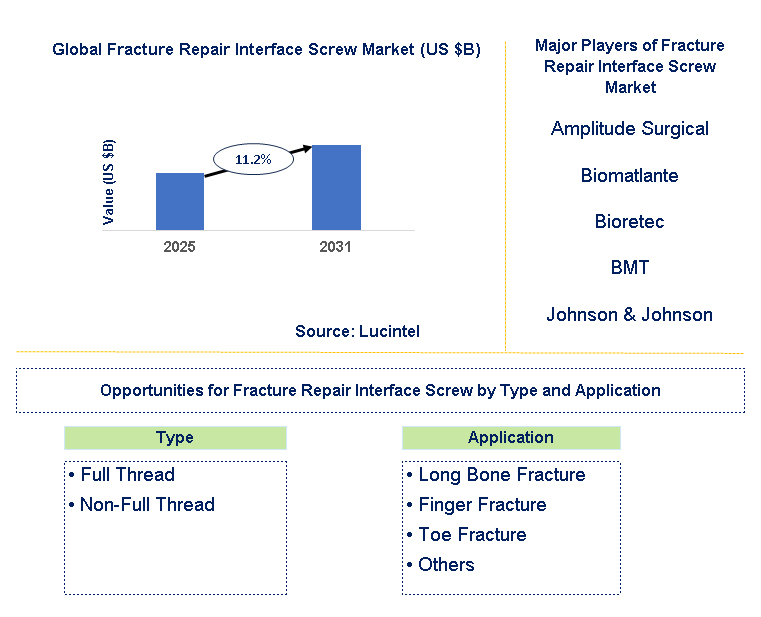
Key data points: The growth forecast = 11.2% annually for the next 7 years. Scroll below to get more insights. This market report covers trends, opportunities and forecasts in fracture repair interface screw market to 2031 by type (full thread and non-full thread), application (long bone fracture, finger fracture, toe fracture, and others), and region (North America, Europe, Asia Pacific, and the Rest of the World)
We'll send your sample report shortly.
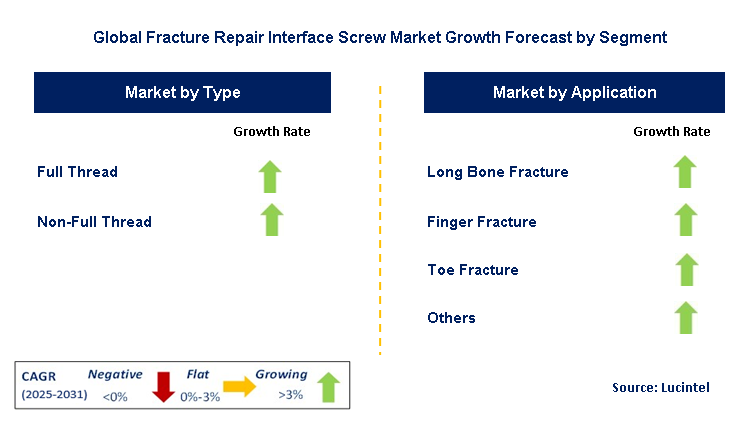
• Lucintel forecasts that, within the type category, full thread is expected to witness higher growth over the forecast period.
• Within the application category, long bone fracture is expected to witness the highest growth.
• In terms of region, APAC is expected to witness the highest growth over the forecast period. Gain valuable insights for your business decisions with our comprehensive 150+ page report. Sample figures with some insights are shown below.
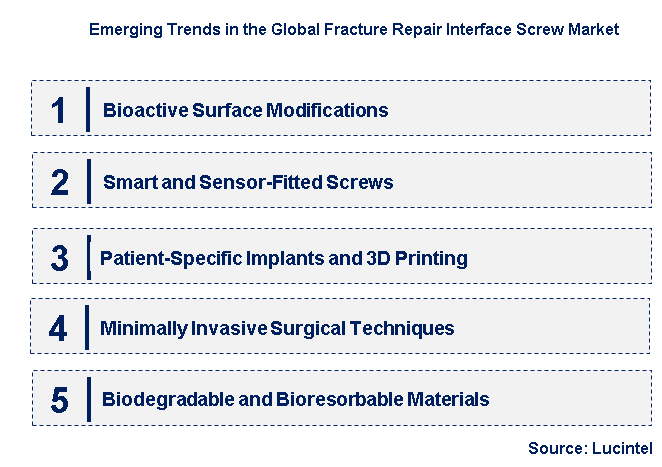
• Bioactive Surface Modifications: One major emerging trend is the growing application of bioactive surface modifications to fracture repair interface screws. These surface coatings, like hydroxyapatite or other osteoconductive materials, enhance quicker and stronger bone ingrowth surrounding the screw, resulting in greater fixation stability and faster fracture healing. This trend is focused on enhancing long-term results and decreasing the likelihood of implant loosening.
• Smart and Sensor-Fitted Screws: The incorporation of smart technologies in fracture fixation interface screws is an emerging trend. The screws are fitted with sensors that are capable of monitoring several parameters in the fracture area, including strain, pressure, and temperature. The real-time data from the sensors could offer useful information about the healing process and even warn surgeons of any complications, allowing them to intervene and manage the patient in a more personalized manner.
• Patient-Specific Implants and 3D Printing: The advent of patient-specific implants manufactured through 3D printing technology is a new trend in fracture repair. This enables the fabrication of interface screws with geometries that closely match the patient‘s individual bone anatomy, resulting in ideal fit, stability, and load distribution at the fracture site. This personalized technique has the potential to enhance surgical outcome, particularly in difficult fractures.
• Minimally Invasive Surgical Techniques: Ongoing developments in minimally invasive surgical (MIS) techniques are spurring the design of specialized interface screws and insertion systems. Such screws are designed to be inserted accurately with minimal incisions, causing less soft tissue damage, less blood loss, and earlier patient recovery. This trend suggests the demand for ergonomic and image-guided screw insertion instruments.
• Biodegradable and Bioresorbable Materials: Although metallic screws are still the most prevalent, bioabsorbable or biodegradable interface screws for some fracture indications are increasingly the focus of interest and development. Such screws obviate secondary removal surgery, lowering patient morbidity and healthcare expense. Research is ongoing in creating materials with adequate initial strength and controlled rates of degradation matching fracture healing periods. These new trends of bioactive surfaces, intelligent implants, patient-specific, minimally invasive procedures, and biodegradable materials are all together remodeling the fracture repair interface screw market towards more efficient, individualized, and patient-friendly fracture fixation techniques.
• Innovative Thread Designs to Increase Fixation: An essential innovation has been the improvement in screw thread design. Contemporary interface screws commonly contain customized thread patterns, like two-lead threads, variable thread pitch, or self-tapping shapes, with higher pullout resistance, bone purchase, and better screw loosening resistance, especially in nonoptimal bone.
• Advanced Screw Materials and Biocompatibility: There has been a huge improvement in screw materials for repair of fractures using the interface. Modern screws tend to be produced from high strength titanium alloys having good biocompatibility and resistance to corrosion. Surface treatments including anodizing or plasma spraying enhance osseointegration, as well as minimize the probability of adverse reaction of tissues.
• Cannulated and Fenestrated Screw Development: The availability of cannulated and fenestrated interface screws has increased their use in fracture fixation. Cannulated screws permit exact positioning over a guide wire, and fenestrated screws allow for delivery of local bone graft material or therapeutic agents at the site of the fracture, facilitating healing.
• Insertion Instrumentation Advances: Concurrent with screw design, major advances have been made in instrumentation for screw insertion. These include ergonomic handles, torque-limiting instruments, and image-guided systems that allow precise and controlled screw placement, reducing the potential for surgical errors and enhancing overall results.
• Integration with Fracture Fixation Systems: Fracture repair interface screws are being developed more and more as components of total fracture management systems. Such systems consist of plates, rods, and other fixation devices intended to synergize with certain screw types, offering the surgeon an integrated and biomechanically optimal solution for particular fracture patterns. These most important advances in thread design, materials and biocompatibility, cannulated and fenestrated designs, instrumentation for insertion, and integration into fracture management systems are influencing the fracture repair interface screw market by giving surgeons better, more effective, and versatile tools for successful and stable fracture fixation.
• Complex Trauma and Polytrauma Cases: One of the greatest opportunities for growth is in managing polytrauma patients and complex fractures. These difficult cases frequently need advanced fixation techniques, and interface screws with greater stability and versatility are key to successful outcomes. The creation of specialized screws and systems for these complicated situations is a leading opportunity for growth.
• Osteoporotic Fractures: As the population of the world ages, there is a growth opportunity for fracture in osteoporotic bone due to increased occurrences. There exists a growth opportunity for interface screws that are purposefully designed for secure fixation when bone quality is compromised. Osteoporotic fractures can have stability improved in them by including features such as expanding screw geometry or bioactive coatings.
• Pediatric Fracture Fixation: The specific challenges of fracture fixation in children, such as growth plate considerations, present a growth opportunity for specialized interface screws. Creating screws with the right sizes, biocompatible materials, and designs that reduce the risk of growth disturbances is important in this application.
• Minimally Invasive Fracture Surgery: Growing use of minimally invasive surgical methods for fracture fixation propels the need for dedicated interface screws and insertion tools compatible with such procedures. The development of low-profile screws and image-guided insertion devices allowing accurate fixation via small incisions is a primary growth opportunity.
• Revision Fracture Surgery and Nonunions: Revision fracture surgery and the healing of nonunions frequently necessitate strong and stable fixation in order to produce healing. Interface screws that provide improved stability and can stimulate bone ingrowth are essential in these difficult applications, posing a strategic opportunity for advanced implant designs. These strategic areas of growth in complex trauma, osteoporotic fractures, pediatric use, minimally invasive surgery, and revision cases demonstrate the potential for growth in the fracture repair interface screw market by fulfilling the unique needs and challenges of these varied orthopedic uses.
• Amplitude Surgical
• Biomatlante
• Bioretec
• BMT
• Johnson & Johnson
• Noraker
• Orthomed
• Altimed
• Bonegraft
• Dedienne santé
• Full Thread
• Non-Full Thread
• Long Bone Fracture
• Finger Fracture
• Toe Fracture
• Others
• North America
• Europe
• Asia Pacific
• The Rest of the World
• United States: The United States market is dominated by high focus on technological innovation and strict regulatory approval processes. Recent advances involve the development of interface screws with newer thread designs for enhanced pullout strength and angular stability. In addition, screws with bioactive coatings to enhance bone ingrowth and healing are also gaining interest. Also, the incorporation of smart technologies, including sensor-enabled screws for tracking healing, is a new area of development.
• China: The Chinese market is seeing strong growth in the uptake of high-tech fracture fixation devices. Recent trends have included greater domestic manufacturers‘ production of interface screws, with many emphasizing cost efficiency and responding to the high trauma case volumes. Increasingly, there is also a trend towards screw development with enhanced biocompatibility and biomechanics in order to achieve international standards and counter well-established global players.
• Germany: High-quality and clinically established orthopedic implants are the priority of the German market. New trends in fracture repair interface screws concentrate on ensuring optimized screw geometry and thread designs to provide increased primary stability, especially in osteoporotic bone. Ergonomic designs for easy, accurate, and efficient screw insertion to benefit surgeons with reduced surgical time and higher accuracy are also important.
• India: The Indian market is dominated by a demand for cost-effective and trustworthy fracture fixation solutions. Advances in the last few years have included the expanding availability of interface screws with enhanced design features at more competitive prices, allowing better access to advanced fixation options. An increasing emphasis on surgeon training and education on the selection and use of these specialized screws for different fracture types is also seen.
• Japan: Precision and minimal invasiveness are the focus in the Japanese orthopedic market. New technology in fracture repair interface screws includes low-profile screw head design and minimally invasive insertion methods to minimize disruption of soft tissues. Biocompatibility and surface treatment that enhances osseointegration and long-term stability, especially in elderly patients with poor bone quality, is also a priority.


• Amplitude Surgical
• Biomatlante
• Bioretec
• BMT
• Johnson & Johnson
• Noraker
• Orthomed
• Altimed
• Bonegraft
• Dedienne santé Q5. Which fracture repair interface screw market segment will be the largest in future? Answer: Lucintel forecasts that, within the type category, full thread is expected to witness higher growth over the forecast period. Q6. In fracture repair interface screw market, which region is expected to be the largest in next 5 years? Answer: In terms of region, APAC is expected to witness the highest growth over the forecast period. Q7. Do we receive customization in this report? Answer: Yes, Lucintel provides 10% customization without any additional cost.


Choose a license that fits your team. Instant PDF delivery.
Prices exclude taxes. Instant delivery. Custom licensing available on request.
Market Report · July 22, 2026
Market Report · July 22, 2026
Market Report · July 22, 2026
Trusted partner for strategic intelligence and business growth


Receive a complimentary market analysis tailored to your industry. Our analysts will identify key growth opportunities and competitive dynamics specific to your business.

Market size, growth rate, and key trend analysis for your specific sector.

Top competitor positioning and market share analysis.

Strategic recommendations backed by data-driven insights.
Get curated market intelligence and competitive moves straight to your inbox.
By subscribing, you agree to receive our monthly insights. Unsubscribe anytime.
Receive a complimentary market analysis tailored to your industry. Our analysts will identify key growth opportunities and competitive dynamics specific to your business.
Market size, growth rate, and key trend analysis for your specific sector.
Top competitor positioning and market share analysis.
Strategic recommendations backed by data-driven insights.
Get curated market intelligence, emerging trends, and competitive moves straight to your inbox each month.
By subscribing, you agree to receive our monthly insights. Unsubscribe anytime.
We'll send your sample report shortly.