
Market Report · July 22, 2026

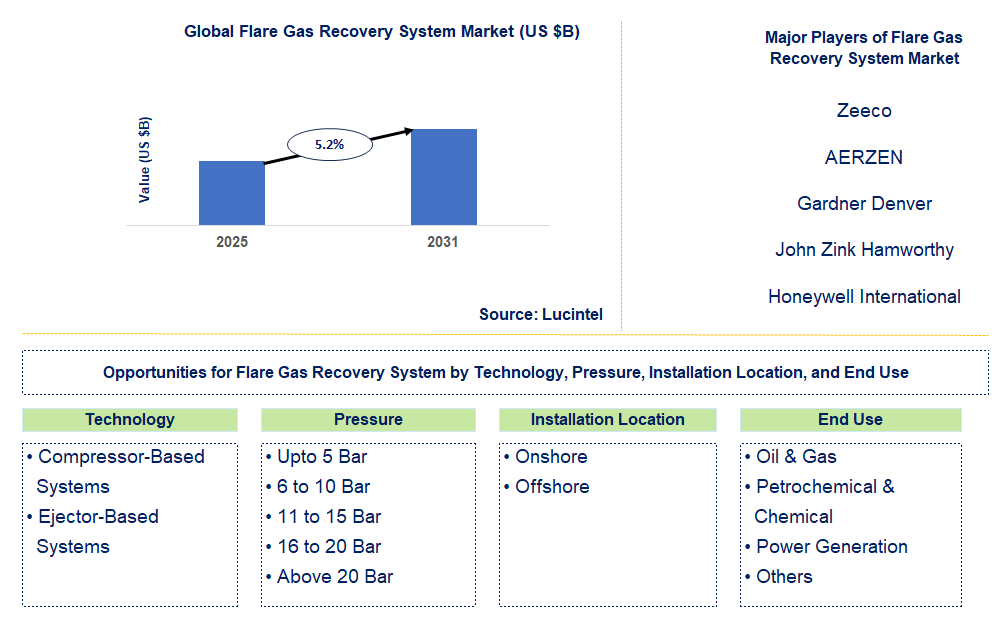
Key data points: The growth forecast = 5.2% annually for the next 7 years. Scroll below to get more insights. This market report covers trends, opportunities and forecasts in flare gas recovery system market to 2031 by technology (compressor-based systems and ejector-based systems), pressure (upto 5 bar, 6 to 10 bar, 11 to 15 bar, 16 to 20 bar, and above 20 bar), installation location (onshore and offshore), end use (oil & gas, petrochemical & chemical, power generation, and others), and region (North America, Europe, Asia Pacific, and the Rest of the World)
We'll send your sample report shortly.
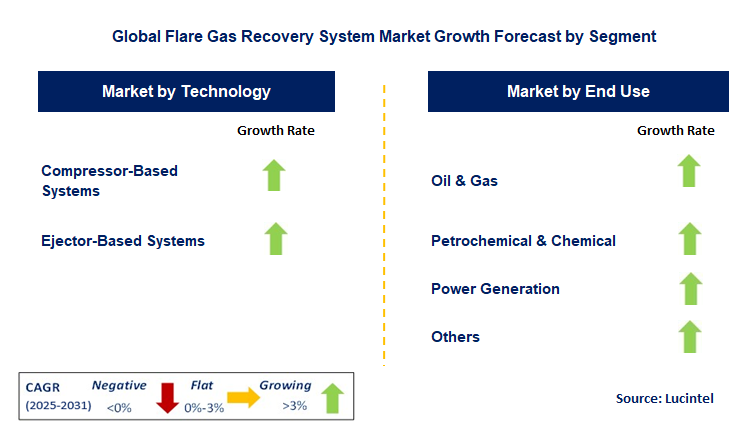
• Lucintel forecasts that, within the technology category, compressor-based system is expected to witness higher growth over the forecast period.
• Within the end use category, oil & gas is expected to witness the highest growth.
• In terms of region, APAC is expected to witness the highest growth over the forecast period. Gain valuable insights for your business decisions with our comprehensive 150+ page report. Sample figures with some insights are shown below.
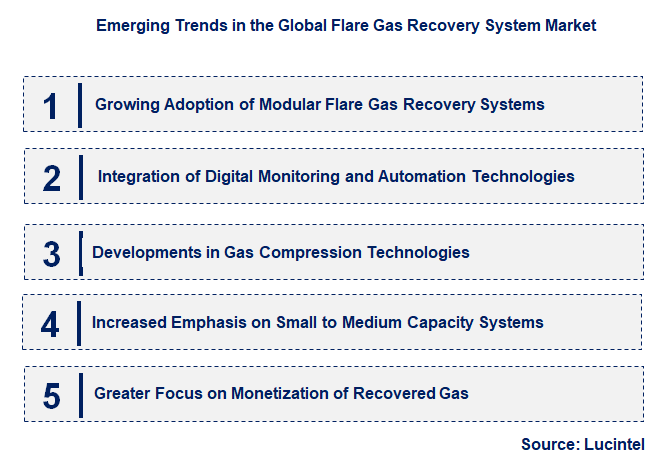
• Growing Adoption of Modular Flare Gas Recovery Systems: Modular flare gas recovery systems are being preferred by industries with growing emphasis on flexibility and economics. In contrast to conventional large-scale systems, modular units may be installed in phases, giving operators the capability to add capacity as required or as regulations intensify. The trend offers an expandable option that can readily be incorporated within existing infrastructure with lower initial capital outlay and more flexibility in responding to different operational requirements.
• Integration of Digital Monitoring and Automation Technologies: Integration of digital monitoring and automation technologies is a major trend. Real-time data on flare gas emissions and recovery processes enables optimized system control, minimized manual intervention, and improved safety. Sophisticated digital tools such as wireless flare monitoring systems and AI-driven analytics offer valuable insights for operational efficiency and predictive maintenance, in line with the overall industry trend towards smart operations and Industry 4.0 practices.
• Developments in Gas Compression Technologies: Technological developments in gas compression technologies play a vital role in enhancing the efficiency and efficacy of flare gas recovery. Technology advancements like high efficiency compressors provide enhanced gas capture and processing capacities, which result in higher recovery rates and better overall system performance. Such developments also increase the reliability and lifespan of flare gas recovery systems, providing an earlier return on investment to end users.
• Increased Emphasis on Small to Medium Capacity Systems: Although large capacity systems continue to maintain a prominent market share, increased interest is being generated in small to medium capacity flare gas recovery systems. These systems represent a cost-efficient solution for mid-sized oil and gas processing facilities and other industrial uses. Their flexibility to fluctuating flare gas volumes and high efficiency make them a viable option for a greater number of operations, leading to increased market application.
• Greater Focus on Monetization of Recovered Gas: The trend for not just recovering but monetizing the trapped flare gas is also increasing. Recovered gas, in the form of mostly methane, can be utilized for onsite power generation, heating, or as feedstock in petrochemical operations. In certain instances, it can also be exported to outside markets, generating a new source of income for businesses. This emphasis on the value to the bottom line of gas that is being recovered, combined with the environmental benefits, is a key incentive for the implementation of flare gas recovery systems. These trends collectively are redefining the flare gas recovery system market by promoting the development and implementation of more efficient, flexible, and economically sound solutions. The use of advanced technologies and increased focus on resource utilization are propelling the market towards a future where gas flaring is reduced to the minimum, and recovered gas helps create environmental sustainability and economic value.
• Technological Advances in Processing and Compression: New gas compression, refrigeration, and gas processing technologies are making flare gas recovery systems more efficient and reliable. Newer compressor designs enable greater rates of gas recovery, while advances in separation and purification technology are enhancing the quality of the recovered gas so that it can be used for a greater number of applications.
• Expanded Deployment of Zero Flaring Programs: More and more oil and gas producers are embracing zero flaring programs, pledging to dispense with routine gas flaring at their facilities. Both regulatory forces and an increasing focus on corporate sustainability are compelling this pledge from producers. Deploying sophisticated flare gas recovery equipment to extract and utilize associated gas rather than flaring it is required to implement these programs.
• Emergence of Mobile and Scalable Recovery Solutions: The industry is observing more mobile and scalable flare gas recovery solutions being developed and put to use. The systems provide better flexibility and can be quickly implemented in other sites or increased or decreased as per the requirements of the operations. This is quite helpful for minor operations or seasonal production facilities where fixed, big-scale infrastructure cannot be economically justifiable.
• Reducing Methane Emissions: As awareness of methane's very strong greenhouse gas effect has grown, there has been a greater emphasis on utilizing flare gas recovery systems that are engineered to reduce methane emissions. Technologies have been in the process of emerging to recover even low pressure and intermittent flare gas streams so that methane, one of the primary constituents of flared gas, is recovered and put to use instead of being emitted to the air.
• Increasing Government Incentives and Regulations: Increasingly stringent environmental regulations on gas flaring are being enforced worldwide, along with incentives to promote the use of flare gas recovery systems. Governments are establishing emission reduction goals and, in certain instances, providing financial assistance or tax credits for firms investing in such technologies. This regulatory pressure is a key driver for market growth and innovation in the flare gas recovery industry. These major developments are collectively influencing the flare gas recovery system market by propelling the need for more efficient, flexible, and environmentally friendly solutions. The emphasis on technological innovation, zero flaring efforts, and methane emission reduction, with the support of government regulations, is resulting in a more sustainable and resource-efficient method of managing associated gas in the oil and gas and other concerned industries.
• Petroleum Refineries: Refineries are a major application area for flare gas recovery systems because of the constant and frequently large quantities of associated gas produced during several refining operations. Opportunities for growth exist in the application of sophisticated recovery technologies that are capable of managing the complex gas compositions and variable flow rates characteristic of refinery operations. Upgrading the existing flaring infrastructure with effective recovery systems not only minimizes emissions but also offers a useful source of energy for on-site utilization or as feedstock for other processes, improving operational efficiency and cost savings.
• Chemical Plants: Chemical plants also produce flare gas as a byproduct of chemical reactions and processes. Installation of flare gas recovery systems in chemical plants presents great growth opportunity by reducing the environmental footprint and recuperating valuable hydrocarbons that can be reused as fuel or raw material by the plant. Solutions that can address the diverse gas compositions and operation conditions of various chemical processes will be crucial in exploiting this potential.
• NGL Plants and Gas Treatment Plants: Natural gas liquids (NGL) plants and gas treatment plants are prime locations for flare gas recovery. While processing natural gas, flaring occurs on the associated gases that are not able to be fed directly into pipelines. Recovery systems placed here would be able to recover valuable such as methane, ethane, and propane, which could be further processed as NGLs or could be utilized as a fuel. This not only minimizes flaring but also makes gas processing operations economically more viable by maximizing recovery of valuable resources.
• FPSO Platforms (Floating Production Storage and Offloading): Offshore oil and gas production through FPSO platforms poses special challenges for managing gas because of space constraints and environmental concerns. Installation of compact and efficient flare gas recovery systems on FPSO platforms is a major growth opportunity. Such systems reduce the offshore environmental impact of operations by capturing and utilizing associated gas for generating power or for reinjection, limiting flaring in sensitive marine environments and distant areas.
• Storage Tank Vent Recovery: Vents from storage tanks, though typically lower in volume than process flaring, are nonetheless potential causes of environmental contamination and of loss of usable hydrocarbons. Utilizing vapor recovery units (VRUs) to recover and reuse such vented gases is an opportunity for growth. Such units may be developed to serve in multiple storage tank uses in the oil and gas, petrochemical, and chemical industries and eliminate fugitive emissions while capturing worthwhile products for reuse in the process stream or resale. These strategic growth opportunities in major applications reflect the growing acceptance of flare gas recovery as a critical technology for environmental stewardship and economic value creation. Adapting recovery solutions to the unique requirements and challenges of each application will be essential for maximizing their effectiveness and driving market growth.
• Zeeco
• AERZEN
• Gardner Denver
• John Zink Hamworthy
• Honeywell International
• Wärtsilä
• SoEnergy
• Aerzen
• K. LUND Offshore
• Koch Industries
• Compressor-Based Systems
• Ejector-Based Systems
• Upto 5 Bar
• 6 to 10 Bar
• 11 to 15 Bar
• 16 to 20 Bar
• Above 20 Bar
• North America
• Europe
• Asia Pacific
• The Rest of the World
• United States: The United States market is growing strongly, spurred by strict environmental regulations and growing emphasis on curbing methane emissions from shale gas production and tight oil extraction operations. Advances in technology are enhancing the efficiency and scalability of recovery systems, with operators using advanced gas compression and control systems. The onshore installation segment dominates due to better accessibility and cost-effectiveness. The oil and gas industry is still the largest end user, propelled by the demand for green energy practices.
• China: The market for flare gas recovery systems in China is growing at a fast pace due to rising environmental consciousness and encouraging government regulations to control emissions. Compressor based systems are leading the market share-wise at present. However, ejector based systems are expected to be the fastest developing technology segment. The market is expected to experience significant growth in the years to come as China strengthens its efforts towards energy conservation and environmental protection in its growing industrial sector.
• Germany: Germany is experiencing consistent growth in its flare gas recovery system market, driven by robust environmental policies and industrial sustainability commitment. Recent trends involve enhanced production of ATEX certified blowers for biogas and flare gas recovery. Additionally, the launch of mobile oil free recovery skids addresses industries with limited space and high carbon compliance needs, reflecting a commitment to flexible and effective solutions.
• India: India's market for flare gas recovery systems is being one of the fastest growing markets of the Asia Pacific region. Growing industrial operations, especially in the oil and gas industry, combined with increasing green consciousness and government supportive policies, are propelling this growth. Compressor based systems have the highest market share, while ejector based systems are projected to have the fastest growth rate. The emphasis is on the adoption of technologies that improve energy efficiency and minimize the environmental footprint of industrial processes.
• Japan: Japan's flare gas recovery system market is defined by its emphasis on energy resilience and waste reduction, which reflects the country's focus on sustainable infrastructure. The market will continue to grow steadily, based on the demand to maximize the use of resources and meet environmental regulations. The technology is regarded as central to maximizing energy security and minimizing the carbon footprint of industrial processes in the country.


• Zeeco
• AERZEN
• Gardner Denver
• John Zink Hamworthy
• Honeywell International
• Wärtsilä
• SoEnergy
• Aerzen
• K. LUND Offshore
• Koch Industries Q5. Which flare gas recovery system market segment will be the largest in future? Answer: Lucintel forecasts that, within the technology category, compressor-based system is expected to witness higher growth over the forecast period. Q6. In flare gas recovery system market, which region is expected to be the largest in next 5 years? Answer: In terms of region, APAC is expected to witness the highest growth over the forecast period. Q7. Do we receive customization in this report? Answer: Yes, Lucintel provides 10% customization without any additional cost.


Choose a license that fits your team. Instant PDF delivery.
Prices exclude taxes. Instant delivery. Custom licensing available on request.
Market Report · July 22, 2026
Market Report · June 26, 2026
Market Report · May 18, 2026
Trusted partner for strategic intelligence and business growth


Receive a complimentary market analysis tailored to your industry. Our analysts will identify key growth opportunities and competitive dynamics specific to your business.

Market size, growth rate, and key trend analysis for your specific sector.

Top competitor positioning and market share analysis.

Strategic recommendations backed by data-driven insights.
Get curated market intelligence and competitive moves straight to your inbox.
By subscribing, you agree to receive our monthly insights. Unsubscribe anytime.
Receive a complimentary market analysis tailored to your industry. Our analysts will identify key growth opportunities and competitive dynamics specific to your business.
Market size, growth rate, and key trend analysis for your specific sector.
Top competitor positioning and market share analysis.
Strategic recommendations backed by data-driven insights.
Get curated market intelligence, emerging trends, and competitive moves straight to your inbox each month.
By subscribing, you agree to receive our monthly insights. Unsubscribe anytime.
We'll send your sample report shortly.