
Market Report · July 22, 2026

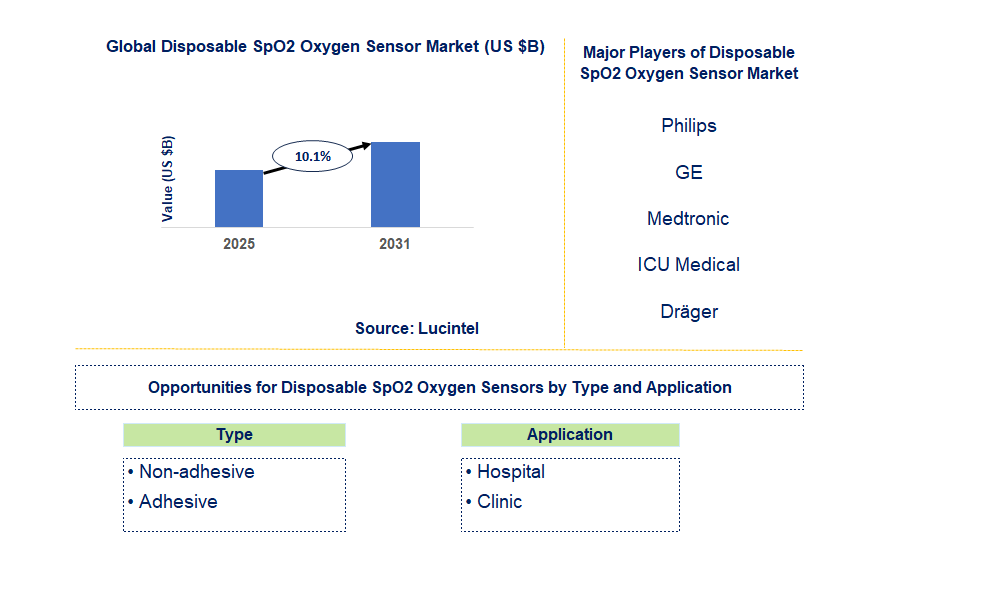
Key data points: The growth forecast = 10.2% annually for the next 7 years. Scroll below to get more insights. This market report covers trends, opportunities and forecasts in disposable SpO2 oxygen sensor market to 2031 by type (non-adhesive and adhesive), application (hospital and clinic), and region (North America, Europe, Asia Pacific, and the Rest of the World)
We'll send your sample report shortly.
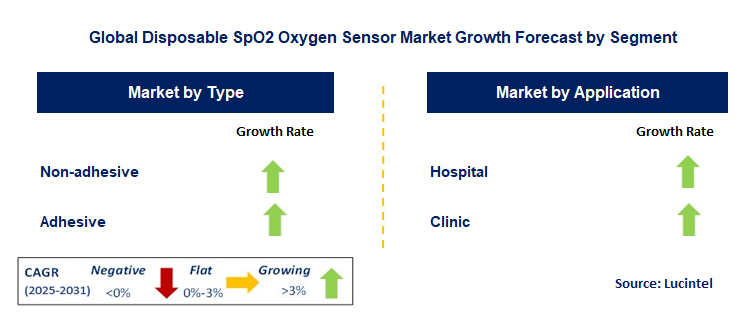
• Lucintel forecasts that, within the type category, adhesive is expected to witness higher growth over the forecast period.
• Within the application category, the hospital is expected to witness higher growth.
• In terms of region, APAC is expected to witness the highest growth over the forecast period. Gain valuable insights for your business decisions with our comprehensive 150+ page report. Sample figures with some insights are shown below.
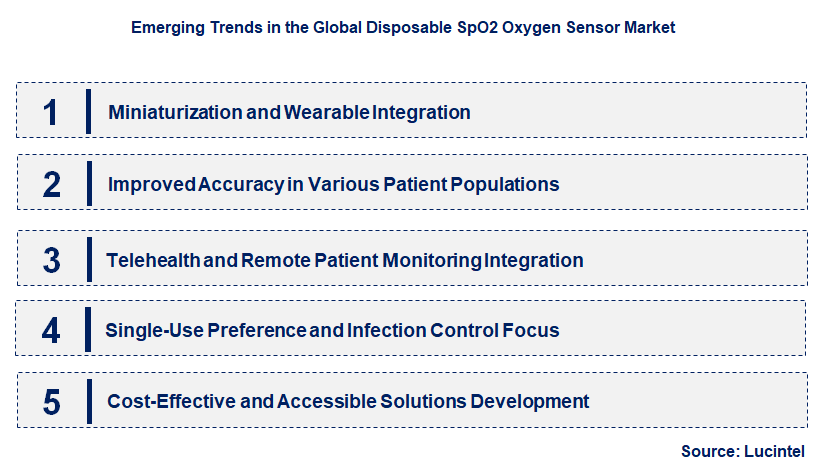
• Miniaturization and Wearable Integration: It encompasses the creation of smaller, less obtrusive disposable SpO2 sensors that can be easily integrated into wearable products such as smart patches, wristbands, or purpose-designed clothing. These smaller form factors increase patient comfort and allow for continuous, non-invasive monitoring outside of the hospital environment. The effect is a dramatic growth of SpO2 monitoring beyond the hospital into home care, remote patient monitoring, and even into fitness applications. This enables early desaturation detection, better management of chronic diseases, and increased patient mobility, fueling broad adoption in preventative and post-acute care.
• Improved Accuracy in Various Patient Populations: There is increased focus on the accuracy of disposable SpO2 sensors in a more extensive population range, such as in patients with different skin colorations, low perfusion, or with patient movement. New sensor materials and algorithms continue to be designed to offset past performance limitations and offer better readings. The effect is enhanced diagnostic confidence and fewer misdiagnoses or delayed treatment. This innovation is important for maintaining equitable and effective patient care, especially in heterogeneous clinical environments and among susceptible populations where precise oxygen saturation information is essential for making therapeutic choices.
• Telehealth and Remote Patient Monitoring Integration: One of the predominant trends is the direct integration of disposable SpO2 sensors into telehealth platforms and RPM systems. These sensors report real-time oxygen saturation wirelessly to healthcare professionals, allowing for constant monitoring of patients in the home or distant locations. The result is a patient management paradigm shift, enabling timely interventions, minimizing hospital readmissions, and decreasing healthcare expenses. This trend has been facilitated by the need for decentralized care models, allowing patients with chronic respiratory illnesses or post-operative requirements to be remotely monitored safely.
• Single-Use Preference and Infection Control Focus: The COVID-19 pandemic dramatically highlighted the role of infection prevention, further propelling the trend towards the use of disposable medical devices. Disposable SpO2 sensors naturally reduce the risk of cross-contamination among patients, providing a hygienic and safe option. The effect is a firm preference for disposable sensors in hospitals, clinics, and emergency care environments, propelling market growth and product evolution towards more affordable and environmentally friendly disposable solutions. The trend improves patient safety practices and minimizes the workload of sterilization processes in healthcare institutions.
• Cost-Effective and Accessible Solutions Development: The market trend is toward more affordable disposable SpO2 sensors with no reduced accuracy or performance. This is especially applicable for increased access to oxygen monitoring in resource-poor settings and for increased acceptance in home healthcare. The effect is a greater availability of critical oxygen saturation monitoring to a larger global population. It facilitates enhanced respiratory condition management among underserved populations and aids in universal health awareness, making necessary diagnostic equipment more economically feasible for both healthcare practitioners and private consumers. These new trends are fundamentally redefining the disposable SpO2 oxygen sensor market by moving toward smarter, inclusive, and integrated solutions. The emphasis on miniaturization, improved accuracy, remote monitoring, infection prevention, and affordability is fueling tremendous innovation. This change is revolutionizing SpO2 monitoring from a largely hospital-based application to a critical part of expanded health management, enabling proactive care, enhancing patient safety, and making crucial health information more accessible to a global population.
• Sensor Accuracy Technology Advances: One development is the dramatic advancement in the precision and performance of disposable SpO2 sensors. Manufacturers are using sophisticated algorithms and more advanced sensor designs to produce more accurate readings, even in difficult environments like low perfusion, motion artifact, or changing skin colorations. The result is fewer false alarms and more reliable data for clinicians, resulting in enhanced diagnostic confidence and improved treatment decisions. This increased precision is essential in critical care, neonatal monitoring, and in accurate readings for varied patient populations, ultimately enhancing patient safety.
• Growth in Home Healthcare and Remote Monitoring: The industry has witnessed a significant growth in the usage of disposable SpO2 sensors in home healthcare and remote patient monitoring (RPM) programs. Sensors have been increasingly coupled with transportable pulse oximeters and wearable sensors so that patients can measure their oxygen levels at home and send data to healthcare professionals. The effect is a care revolution with continuous surveillance of chronic diseases, post-operative care, and detection of deteriorating health at an early stage. Hospital visits are minimized, patient convenience is enhanced, and the delivery of healthcare services is widened.
• Increased Emphasis on Infection Control: The global health landscape has intensified the focus on infection control, leading to a strong preference for disposable SpO2 sensors. Their single-use nature inherently eliminates the risk of cross-contamination between patients, a critical concern in hospitals and clinics. The impact is a more hygienic and safer monitoring environment, reducing the incidence of hospital-acquired infections. This innovation greatly simplifies clinical procedures by eliminating the requirement of reprocessing and sterilizing reusable sensors, lending to operational efficiency as well as adherence to infection prevention practices.
• Neonatal and Pediatric Specific Sensor Development: New technology involves the development of very specialized disposable SpO2 sensors specific for neonates and pediatric patients. These monitors have smaller dimensions, more gentle adhesives, and optimized geometry to provide accurate and comfortable monitoring on fragile skin and small limbs. The result is enhanced patient safety and comfort in fragile populations, where accurate and sustained oxygen saturation monitoring is crucial for diagnoses such as respiratory distress syndrome or congenital heart malformations. This niche ensures optimal fulfillment of the special physiological requirements of children and infants.
• Cost-Effectiveness and Accessibility: The market has seen an effort to create and mass-produce cost-effective disposable SpO2 sensors. The aim is to make basic oxygen monitoring available to more healthcare facilities, including those in developing areas, and to enable widespread use in the home environment. The effect is enhanced worldwide availability of life-saving diagnostic devices, and is especially essential to the care of respiratory diseases and enhancing health outcomes for historically underserved populations. This price decrease democratizes access to essential health monitoring technology. These newer innovations are having a deep influence on the disposable SpO2 oxygen sensor market by propelling it to grow and diversify. The emphasis on improved accuracy, entry into new care environments such as home healthcare, rigorous infection control, specialized patient uses, and greater affordability is collectively redefining the monitoring of oxygen saturation. These innovations are not only enhancing patient safety and outcomes but also transforming models of healthcare delivery to be more distributed, cost-effective, and available worldwide.
• Hospitals and Critical Care: This continues as a primary use, with growth coming through creating sensors for advanced critical care applications, including those for acutely critically ill patients with severe respiratory compromise, during difficult operations, or in intensive care units with critically unstable environments necessitating stable and precise readings. The effect is greater patient protection and enhanced clinical decision-making in high-acuity environments. Opportunities include sensors with better signal processing to limit motion artifacts, durable designs for prolonged monitoring, and compatibility with cutting-edge multi-parameter patient monitors, which are essential for maximum critical care management.
• Home Healthcare and Remote Monitoring of Patients: It is one of the fastest-growing application segments. Strategic opportunities involve creating user-friendly disposable SpO2 sensors that integrate well with consumer-grade pulse oximeters and remote monitoring platforms for usage by caregivers and patients at home. The effect is greater patient participation in their own care, decreased hospital readmissions, and cost savings to healthcare systems. Opportunity for growth is in creating comfortable, easy-to-use sensors with wireless connectivity and extended battery life, allowing continuous and reliable monitoring of chronic diseases remotely.
• Emergency Medical Services and Ambulatory Care Centers: Opportunity for growth is in creating disposable SpO2 sensors optimized for pre-hospital care and urgent care settings. These devices need sensors that can withstand rugged environments, be rapidly applied, and deliver precise measurements in dynamic, frequently hostile environments. The effect is better initial evaluation and stabilization of patients during emergencies, enabling early and optimal medical interventions. Opportunities are sensors with the ability to function well under different environmental conditions and are compatible with paramedics' portable, ruggedized monitoring equipment and urgent care clinics.
• Neonatal and Pediatric Care: A high-growth but specialized field, this application targets creating disposable SpO2 sensors that are tailored to the special physiological requirements of infants and neonates. They come in smaller sizes, use soft adhesives to guard the tender skin, and are highly accurate for taking readings on extremely small patients. The benefit is improved safety and effectiveness of monitoring for at-risk patient populations in which small changes in oxygen saturation are life-critical. Opportunities include new sensor materials and form factors to optimize comfort and reduce skin irritation for premature infants and toddlers.
• Anesthesia and Surgical Monitoring: Growth opportunities for strategic expansion lie in creating disposable SpO2 sensors designed for operating rooms and post-anesthesia care units (PACUs). They require sensors that provide stable and accurate readings amidst different surgical procedures, which may involve patient transport or particular surgical positions. The consequence is uninterrupted and consistent oxygen saturation monitoring throughout the perioperative process, essential in avoiding hypoxemia and guaranteeing patient safety intra- and postoperatively. Opportunities are sensors tailored for use on certain surgical locations or with improved adhesive properties to stay in place during procedures. These strategic growth markets are vastly influencing the disposable SpO2 oxygen sensor market by pushing innovation to various application segments. By targeting the distinctive demands of hospitals, home care, EMS, pediatrics, and operating rooms, producers are creating niche products that improve patient safety, enhance clinical outcomes, and extend the scope of oxygen saturation monitoring. This application-focused strategy is driving market diversification and making the disposable SpO2 sensor an essential component in contemporary healthcare.
• Philips
• GE
• Medtronic
• ICU Medical
• Dräger
• Masimo
• Covidien
• SOLARIS
• Datex Ohmeda
• Plinma International
• Non-adhesive
• Adhesive
• Hospital
• Clinic
• North America
• Europe
• Asia Pacific
• The Rest of the World
• United States: In the United States, the disposable SpO2 oxygen sensor markets have a significant emphasis on premium sensor technology and compatibility with digital health platforms. The focus is on high-precision sensors providing better accuracy across varied skin colorations and during patient movement, correcting earlier shortcomings. There is also an important emphasis on sensors that are compatible with remote patient monitoring systems as well as telehealth platforms, driven by the growing uptake of home healthcare. Regulatory agencies such as the FDA remain key determinants of product innovation and market entry, with strict standards of safety and efficacy.
• China: The market for disposable SpO2 oxygen sensors is witnessing fast expansion, driven by its large population, rising healthcare spending, and growing domestic medical device industry. Recent advances involve the mass production of inexpensive sensors, usually bundled with portable and wearable pulse oximeters, to serve both hospital and growing home care demand. There is also significant investment in research and development to increase sensor reliability and accuracy, making China a key player in the global supply chain. The market enjoys strong government support for the modernization of healthcare infrastructure.
• Germany: The market for disposable SpO2 oxygen sensors emphasizes high quality, reliability, and compliance with strict European standards regulations. Technological advances stress rugged and accurate sensors for surgical and critical care applications, where accuracy is of paramount importance. Environmentally friendly materials and sustainable manufacturing processes are increasingly being used, aligning with larger European "green" initiatives. German firms are also investing in research to enhance sensor performance in difficult clinical environments to ensure patient safety and best results, especially within its established healthcare system.
• India: The Indian disposable SpO2 oxygen sensor market is experiencing enormous growth fueled by growing healthcare awareness, growing chronic disease burden, and enhanced healthcare infrastructure, especially in urban regions. Recent developments feature the advent of local players providing low-cost but trustworthy sensor solutions to eliminate the need for imports. The demand for sensors in various clinical environments, ranging from large-scale hospitals to small clinics and home care environments, is on the rise. The market is also witnessing higher use of portable and user-friendly devices to increase accessibility for patient monitoring.
• Japan: The Japanese SpO2 oxygen sensor market for disposable use prioritizes miniaturization, high accuracy, and integration with sophisticated medical devices. Innovations target small and very accurate sensors for neonates and children, in accordance with the medical technology leadership of the country. Innovative sensor designs that are more comfortable and less invasive are strongly pushed. Japanese companies are also looking into sensors that have stable output even under demanding physiological conditions, providing top-notch patient monitoring for critical care and specialized medical treatments while upholding a reputation for technological supremacy.


• Philips
• GE
• Medtronic
• ICU Medical
• Dräger
• Masimo
• Covidien
• SOLARIS
• Datex Ohmeda
• Plinma International Q5. Which disposable SpO2 oxygen sensor market segment will be the largest in future? Answer: Lucintel forecasts that, within the type category, adhesive is expected to witness higher growth over the forecast period. Q6. In disposable SpO2 oxygen sensor market, which region is expected to be the largest in next 5 years? Answer: In terms of region, APAC is expected to witness the highest growth over the forecast period. Q7. Do we receive customization in this report? Answer: Yes, Lucintel provides 10% customization without any additional cost.


Choose a license that fits your team. Instant PDF delivery.
Prices exclude taxes. Instant delivery. Custom licensing available on request.
Market Report · July 22, 2026
Market Report · July 22, 2026
Market Report · July 22, 2026
Trusted partner for strategic intelligence and business growth


Receive a complimentary market analysis tailored to your industry. Our analysts will identify key growth opportunities and competitive dynamics specific to your business.

Market size, growth rate, and key trend analysis for your specific sector.

Top competitor positioning and market share analysis.

Strategic recommendations backed by data-driven insights.
Get curated market intelligence and competitive moves straight to your inbox.
By subscribing, you agree to receive our monthly insights. Unsubscribe anytime.
Receive a complimentary market analysis tailored to your industry. Our analysts will identify key growth opportunities and competitive dynamics specific to your business.
Market size, growth rate, and key trend analysis for your specific sector.
Top competitor positioning and market share analysis.
Strategic recommendations backed by data-driven insights.
Get curated market intelligence, emerging trends, and competitive moves straight to your inbox each month.
By subscribing, you agree to receive our monthly insights. Unsubscribe anytime.
We'll send your sample report shortly.