
Market Report · July 20, 2026

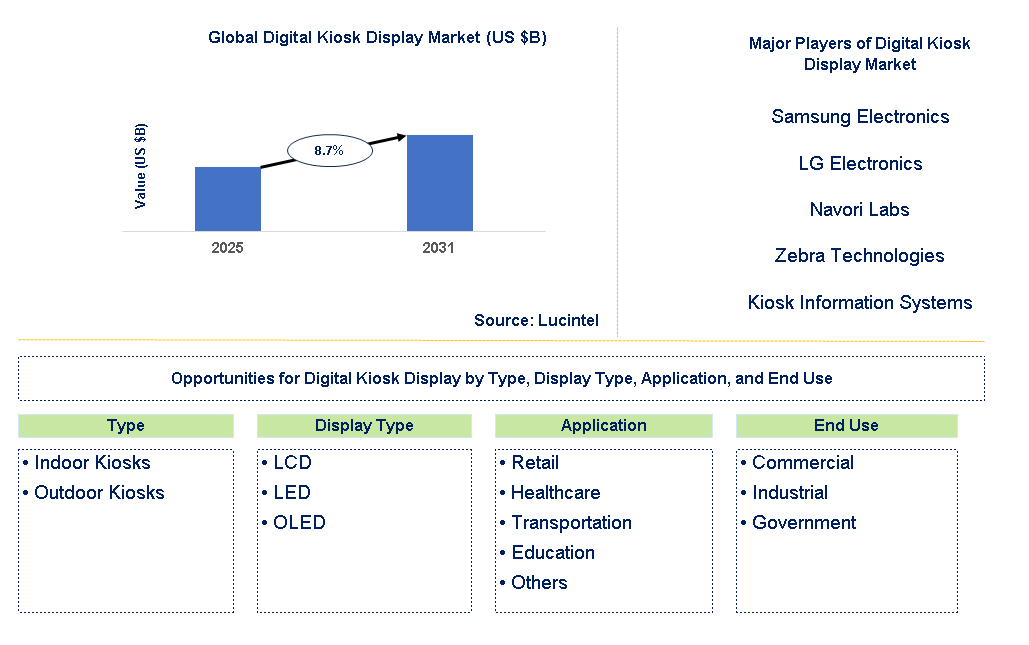
Key data points: The growth forecast = 8.7% annually for the next 7 years. Scroll below to get more insights. This market report covers trends, opportunities and forecasts in digital kiosk display market to 2031 by type (indoor kiosks and outdoor kiosks), display type (LCD, LED, and OLED), application (retail, healthcare, transportation, education, and others), end use (commercial, industrial, and government), and region (North America, Europe, Asia Pacific, and the Rest of the World)
We'll send your sample report shortly.
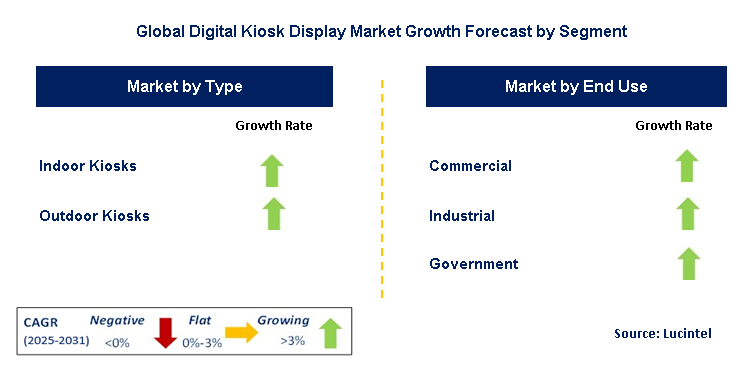
• Lucintel forecasts that, within the type category, indoor kiosk is expected to witness higher growth over the forecast period.
• Within the end use category, industrial is expected to witness the highest growth.
• In terms of region, APAC is expected to witness the highest growth over the forecast period. Gain valuable insights for your business decisions with our comprehensive 150+ page report. Sample figures with some insights are shown below.
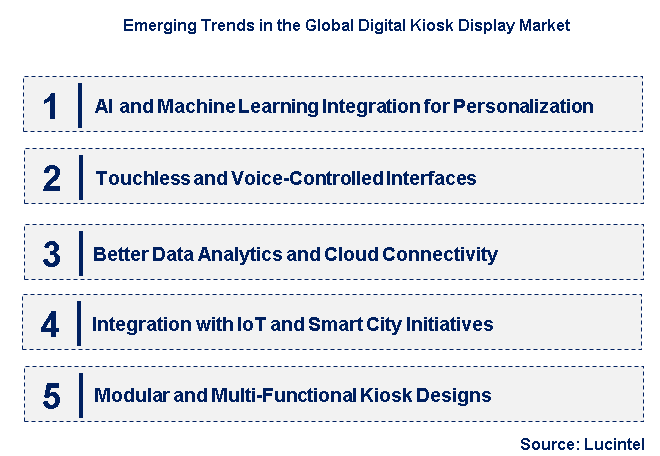
• AI and Machine Learning Integration for Personalization: One of the most important upcoming trends is the integration of artificial intelligence (AI) and machine learning (ML) into digital kiosk screens. This allows kiosks to provide personalized experiences, for example, customized product suggestions according to user history or past purchases, dynamic pricing, and location-based promotions. AI-driven chatbots and voice assistants offer instant, intuitive customer service, negating the requirement for intricate menu navigation. This customization increases the level of user interaction, enhances sales conversion rates, and builds a more streamlined service landscape, rendering kiosks extremely intelligent customer touchpoints.
• Touchless and Voice-Controlled Interfaces: Gunned by concerns for hygiene and calls for increased accessibility, touchless and voice-controlled interfaces are a new trend. Gesture control, eye-tracking, and voice recognition technologies enable users to engage with kiosks without having to type or touch them. This not only handles public health issues but also enhances accessibility for people with disabilities or those who have difficulty using touchscreens. The creation of robust natural language processing (NLP) functionality guarantees seamless and intuitive voice control, providing a more accessible and safer experience for users in different public and commercial environments.
• Better Data Analytics and Cloud Connectivity: Digital kiosks are increasingly taking advantage of cloud computing and sophisticated data analysis. This new trend allows for real-time gathering and analysis of usage data from users, yielding valuable information on customer behavior, peak usage periods, and operational performance. Cloud connection makes it easier to remotely manage, update content, and provide predictive maintenance, reducing downtime. Companies can leverage such data to maximize inventories, fine-tune marketing campaigns, and enhance services, making kiosks smart tools for evidence-based decision-making and ongoing improvement.
• Integration with IoT and Smart City Initiatives: One of the major emerging trends is integrating digital kiosks with the Internet of Things (IoT), especially for smart city initiatives. IoT-connected kiosks can share real-time public information, environmental data, smart parking directions, and emergency notifications. In business environments, IoT-based kiosks can communicate with other intelligent devices, like stock sensors or networks of digital signage, to form a more integrated and automated ecosystem. This makes urban life and business more efficient and integrated, with interconnected services and a more responsive infrastructure.
• Modular and Multi-Functional Kiosk Designs: There is a growing trend in the market towards the development of modular and multi-functional kiosk designs. These versatile units are simple to tailor with a range of peripherals like barcode readers, payment terminals, printers, and biometric authentication interfaces. Such modularity enables companies to set up kiosks for different applications, ranging from wayfinding and self-checkout to virtual customer service and public information points. The multi-functional character optimizes return on investment, minimizes the use of several single-purpose devices, and offers more flexibility in rolling out bundled solutions to multiple industries. These new trends are also fundamentally transforming the digital kiosk display market by converting kiosks into smart, user-focused, and highly integrated platforms. AI-enabled personalization, touchless experience, data analytics, IoT integration, and module designs are building more dynamic, efficient, and attractive solutions. This innovation guarantees that digital kiosks are always leading in terms of automation and customer interaction, pushing high levels of progress in retail, public services, hospitality, and other critical industries.
• Installation of Advanced Self-Checkout Systems: A major recent trend is the mass installation of advanced self-checkout terminals, especially in grocery and retail environments. These terminals have quicker scanning, built-in payment solutions, such as contactless and mobile wallets, and user-friendly interfaces. Most of them now have AI capabilities to detect produce and curb shrinkage, making the experience more efficient and decreasing wait times for customers. This addresses the shortage of labor directly and enhances customer satisfaction by making the shopping experience better.
• Biometric Authentication and Secure Payments Integration: Current developments indicate a strong movement to embed biometric authentication (e.g., facial recognition, fingerprint scanning) and highly secure payment processing into digital kiosks, particularly in banking and public services. It strengthens security for transactions, lowers fraud, and offers a quicker, more efficient user experience. Integration is indispensable for applications such as ATM services, government ID verification, and secure access control, creating trust in self-service technologies.
• Interactive Wayfinding and Information Kiosks Emergence: The spread of big, interactive wayfinding and information kiosks in public areas, transportation terminals, and company campuses is a second significant development. These kiosks use high-resolution screens, touch, and sometimes augmented reality overlays to give active maps, live schedules, and facility data. This enhances wayfinding and access to important information, driving user convenience and minimizing the necessity for human intervention in complicated environments.
• Demand Increase for Outdoor and Rugged Kiosks: New advancements feature increased demand for solid, outdoor digital kiosk displays that are resistant to harsh weather conditions. These devices have improved brightness for sun visibility, waterproofing, and vandal-proof designs. Their installation in smart city projects, public transportation, and outdoor marketing sends digital information and services beyond indoor environments, opening up new avenues for public interaction and business.
• Cloud-Based Content Management Systems Adoption: The universal proliferation of cloud-based content management systems (CMS) for digital kiosks is a key recent trend. This enables companies to update, plan, and manage content remotely on a network of kiosks from a centralized office. Cloud CMS solutions make things easier, allow for dynamic advertising, and provide for real-time information delivery, making kiosks more responsive and cheaper to operate in dispersed environments. These recent advancements are significantly influencing the digital kiosk display market by increasing functionality, strengthening security, and enhancing accessibility in numerous applications. Improvements in self-checkout, biometric integration, interactive wayfinding, rugged outdoor designs, and cloud-based management are turning digital kiosks into indispensable assets for business and government services, increasing efficiency and revolutionizing the customer experience.
• Retail and Self-Checkout Automation: The retail industry offers a top strategic expansion potential for digital kiosk screens, especially in self-checkout robotics. Potential exists in creating sophisticated, intuitive self-checkout kiosks that minimize wait times, deter shrinkage via AI-empowered scanning, and offer seamless payment facilities such as mobile wallets and contactless payments. Additional expansion potential exists through the addition of targeted promotions and rewards program integration, improving customer experience and allowing personnel to become more specialized in customer care.
• Healthcare Patient Information and Management: The health care sector presents considerable strategic expansion prospects for digital kiosks for patient management and information delivery. These include self-check-in kiosks that minimize administrative workload, interactive directories for navigating through large hospital campuses, and kiosks for secure access to patient records or scheduling appointments. Prospects also lie in telemedicine kiosks facilitating remote consultations or virtual health monitoring, enhancing patient flow and care access with privacy.
• Banking and Financial Services Automation: The BFSI industry continues to be a focus area for strategic growth for digital kiosk screens, particularly for automating transactions and customer services. Scope includes sophisticated ATM and cash recycling kiosks, digital kiosks for account inquiries, loan requests, and new account openings. Incorporating biometric identification and secure payment interfaces can boost confidence and efficiency. The kiosks lower operating costs in branches, provide longer service hours, and enhance customers’ accessibility, particularly for those in remote or under-served locations.
• Transportation and Public Information Services: Public areas and transport terminals provide enormous strategic development potential for digital kiosk screens. This encompasses interactive ticketing machines, public transport schedules in real time, wayfinding, and emergency information screens at airports, railway stations, and bus terminals. There is also potential in smart city projects for public information terminals providing local directories, event guides, and environmental information. These installations enrich passenger experience, optimize operation flow, and convey important information in an effective manner.
• Food and Drink Ordering and Loyalty Schemes: The quick-service restaurant (QSR) and food and beverage market offers a huge strategic growth area for digital kiosk screens. Self-service kiosks minimize order mistakes, boost average order value with upselling nudges, and improve customer experience with faster wait times. The opportunities include incorporating loyalty programs, customized menu suggestions from previous orders, and secure payment processing. This optimizes labor costs and gives a seamless, efficient ordering process in a fast-paced world. These strategic opportunities for growth will have a great influence on the digital kiosk display market by promoting specialization and innovation across major industries. Through the emphasis on retail automation, patient care in healthcare, streamlined banking, effective public information in transportation, and ordering improvement in food and beverage, the market can cement its role as essential in customer modernization and operational efficiencies around the world.
• Samsung Electronics
• LG Electronics
• Navori Labs
• Zebra Technologies
• Kiosk Information Systems
• Meridian Kiosks
• Peerless
• Indoor Kiosks
• Outdoor Kiosks
• LCD
• LED
• OLED
• Retail
• Healthcare
• Transportation
• Education
• Others
• Commercial
• Industrial
• Government
• North America
• Europe
• Asia Pacific
• The Rest of the World
• United States: The United States digital kiosk display market is dominated by a strong emphasis on customer experience and service automation, especially in the retail and quick-service restaurant sectors. Recent innovation involves widespread usage of self-checkout kiosks, usually combined with mobile payment and AI-powered personalization to offer product suggestions. "Smart stores" with kiosks used in inventory and virtual try-on are an increasing trend. The industry also witnesses ongoing investment in patient engagement kiosks in healthcare and self-service check-in solutions in hospitality.
• China: China’s digital kiosk screen market is growing very quickly, fueled by sophisticated digital infrastructure and an initiative for smart cities. Recent advancements involve major breakthroughs in interactive kiosks with eye-tracking control, voice interaction, and conversational AI integration for highly intuitive usage experiences. China is a key manufacturing base for these technologies with firms emphasizing affordable, high-quality solutions for retail, education, and commercial uses. There is a great focus on automated store concepts and sophisticated payment technologies.
• Germany: The digital kiosk display market in Germany is characterized by a great focus on efficiency, security, and integration with already established digital environments. Developments of late include growing usage of interactive kiosks across the BFSI industry for automated teller machines and self-service banking, with an emphasis on secure hardware and secure software. There is also considerable expansion in retail and public services, with the use of kiosks for information, wayfinding, and ticketing. German companies emphasize quality and long-term dependability in their kiosk offerings.
• India: India’s digital kiosk display market is witnessing robust growth, driven by speedy digitalization, urbanization, and government programs for financial inclusion and smart cities. Recent trends involve a high demand for ATM and cash recycling kiosks in rural areas to reach out for formal financial services. The use of smart displays and interactive kiosks is also seeing more deployment in the retail sector, transportation, and healthcare to enhance customer interaction and operational effectiveness. Domestic companies are concentrating on cost-effective and long-lasting units to serve local needs.
• Japan: Japan’s market for digital kiosk displays is advanced, fueled by a technology-embracing populace and emphasis on efficiency and convenience. Current trends involve strong demand for interactive kiosks for information, ticketing, and self-service in different industries, particularly in transport and retail. Interest is also rising in integrating sophisticated technologies such as AI, IoT, and augmented reality to improve user experience. Japanese companies are innovating in display technologies, including transparent LED screens and eco-friendly ePaper posters, reflecting a balance of advanced functionality and sustainability.


• Samsung Electronics
• LG Electronics
• Navori Labs
• Zebra Technologies
• Kiosk Information Systems
• Meridian Kiosks
• Peerless Q5. Which digital kiosk display market segment will be the largest in future? Answer: Lucintel forecasts that, within the type category, indoor kiosk is expected to witness higher growth over the forecast period. Q6. In digital kiosk display market, which region is expected to be the largest in next 5 years? Answer: In terms of region, APAC is expected to witness the highest growth over the forecast period. Q7. Do we receive customization in this report? Answer: Yes, Lucintel provides 10% customization without any additional cost.


Choose a license that fits your team. Instant PDF delivery.
Prices exclude taxes. Instant delivery. Custom licensing available on request.
Market Report · July 20, 2026
Market Report · July 16, 2026
Market Report · July 15, 2026
Trusted partner for strategic intelligence and business growth


Receive a complimentary market analysis tailored to your industry. Our analysts will identify key growth opportunities and competitive dynamics specific to your business.

Market size, growth rate, and key trend analysis for your specific sector.

Top competitor positioning and market share analysis.

Strategic recommendations backed by data-driven insights.
Get curated market intelligence and competitive moves straight to your inbox.
By subscribing, you agree to receive our monthly insights. Unsubscribe anytime.
Receive a complimentary market analysis tailored to your industry. Our analysts will identify key growth opportunities and competitive dynamics specific to your business.
Market size, growth rate, and key trend analysis for your specific sector.
Top competitor positioning and market share analysis.
Strategic recommendations backed by data-driven insights.
Get curated market intelligence, emerging trends, and competitive moves straight to your inbox each month.
By subscribing, you agree to receive our monthly insights. Unsubscribe anytime.
We'll send your sample report shortly.