
Market Report · July 22, 2026

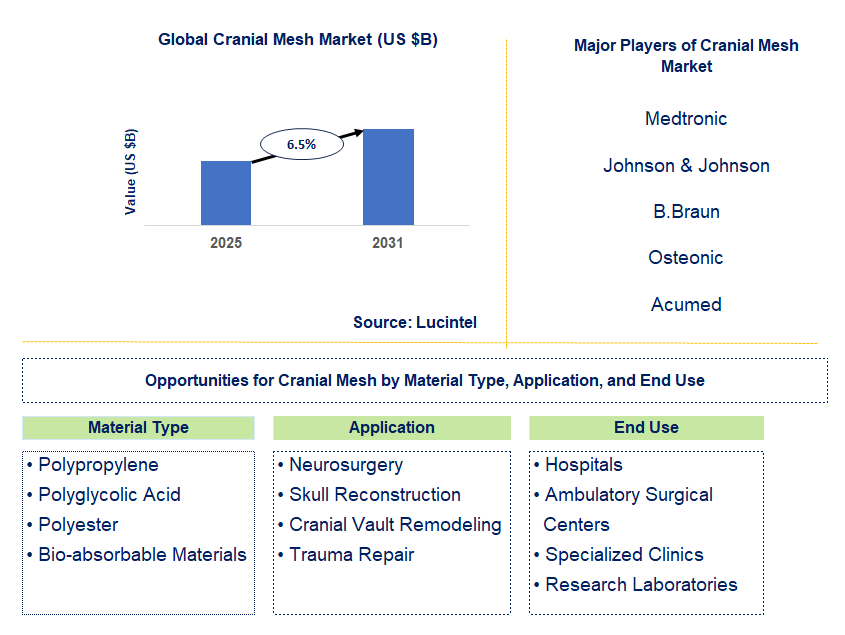
Key data points: The growth forecast = 6.5% annually for the next 7 years. Scroll below to get more insights. This market report covers trends, opportunities and forecasts in cranial mesh market to 2031 by material type (polypropylene, polyglycolic acid, polyester, and bio-absorbable materials), application (neurosurgery, skull reconstruction, cranial vault remodeling, and trauma repair), end use (hospitals, ambulatory surgical centers, specialized clinics, and research laboratories), and region (North America, Europe, Asia Pacific, and the Rest of the World)
We'll send your sample report shortly.
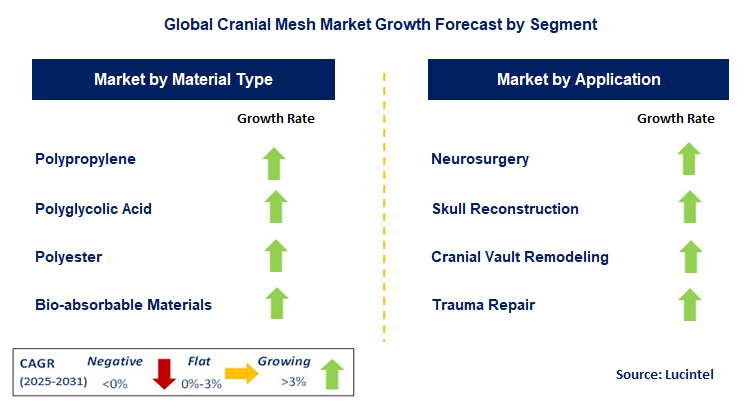
• Lucintel forecasts that, within the material type category, bio-absorbable material is expected to witness the highest growth over the forecast period.
• Within the application category, neurosurgery is expected to witness the highest growth.
• In terms of region, APAC is expected to witness the highest growth over the forecast period. Gain valuable insights for your business decisions with our comprehensive 150+ page report. Sample figures with some insights are shown below.
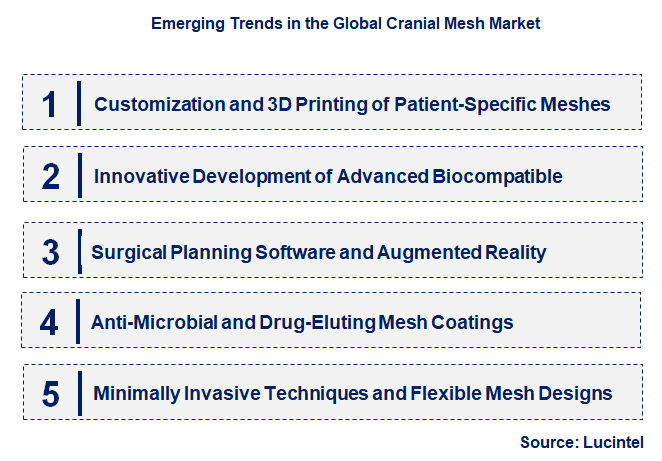
• Customization and 3D Printing of Patient-Specific Meshes: One of the prominent upcoming trends is the universal use of 3D printing to manufacture patient-specific cranial meshes. Using preoperative imaging (CT, MRI), computer-aided design makes it possible to produce meshes that exactly fit a patient's individual skull defect contours. This accuracy reduces intraoperative adjustments and enhances aesthetic and functional results. The benefits include decreased surgical time, a better fit that reduces the chances of complications such as infection or migration, and improved patient satisfaction through highly precise anatomical restoration.
• Innovative Development of Advanced Biocompatible: The second dominant emerging trend includes the development of advanced biocompatible and progressively more bioactive materials for cranial meshes. While titanium is still the most common choice, emerging polymers such as PEEK with tailored porosities, and composite materials that include hydroxyapatite or other osteoconductive components, are becoming increasingly popular. They are optimized to enhance bone ingrowth, minimize foreign body reactions, and decrease artifacts in imaging following surgery. The result is enhanced long-term integration of the implant, fewer complications, and potentially more rapid healing and bone growth.
• Surgical Planning Software and Augmented Reality: The combination of cranial mesh design and positioning with advanced surgical planning software and new Augmented Reality (AR) technologies is a fast-developing trend. Surgeons are able to preplan the cranioplasty procedure, including fixation and mesh contouring, and even superimpose holographic surgical guides in the operating room. The effect is decidedly improved surgical accuracy, decreased operative mistakes, enhanced outcome predictability, and the ability to approach more complicated defects with increased confidence, resulting in safer and more effective procedures.
• Anti-Microbial and Drug-Eluting Mesh Coatings: A significant trend in the future is the creation of anti-microbial or drug-eluting cranial meshes. Post-operative infection is still a significant complication of cranioplasty. Coating with antimicrobial agents or bone growth factors can actively lower infection risk and facilitate tissue regeneration near the implant. The effect is a tremendous reduction in post-operative infection, improved bone integration, and possibly accelerated healing. This technology holds potential to enhance patient safety and lower revision operations.
• Minimally Invasive Techniques and Flexible Mesh Designs: The trend towards minimally invasive surgery is fueling the research for more flexible and conformable cranial mesh designs. Meshes are being designed to enable smaller incisions, simplified insertion, and accurate contouring intraoperatively. This encompasses pre-bent or foldable mesh designs that may be shaped through openings smaller than they would be rigidly. The benefit is less surgical trauma, reduced scarring, quicker patient recovery times, and shorter hospital stays, resulting in enhanced patient comfort and overall efficiency of healthcare. These new trends are heavily transforming the cranial mesh market by promoting highly customized, tech-enabled, and biological solutions. This transformation holds the promise of higher accuracy, improved safety, faster recovery, and more long-lasting reconstructive results for patients.
• General Use of 3D Printed Patient-Specific Titanium Mesh: One of the significant recent advances is the general use of 3D printed patient-specific titanium mesh. This enables tailored meshes that accurately match the individual shape of a patient's cranial defect, as defined from pre-operative CT scans. This has become more widely available and affordable. The result is improved anatomical fit, with less gap and overlap, which shortens surgical time and intraoperative adjustment. This results in improved cosmetic results and fewer risks of complications such as cerebrospinal fluid leakage or infection.
• Polymer-Based Mesh Advancements: Recent innovations are adding important breakthroughs in polymer-based cranial meshes, especially those composed of Polyetheretherketone (PEEK). PEEK meshes have a number of benefits over conventional metal meshes, including being radiolucent, permitting post-operative imaging to be clearer without artifact, and natural bone closer mechanical properties. The effect is enhanced imaging capability after surgery, decreased stress shielding on the adjacent bone, and increased patient comfort due to the material's reduced thermal conductivity in comparison to metal.
• Advanced Surface Treatments and Coatings for Increased Biocompatibility: Another significant recent innovation includes advanced surface treatments and specialized coatings to increase biocompatibility of cranial meshes. Companies are creating meshes with micro-textured surfaces or coatings to facilitate osteointegration, where bone cells will naturally grow onto and through the mesh. Antimicrobial coatings are also investigated in order to minimize the risk of infections after the surgery. The effect is increased long-term stability and integration of the mesh, minimized inflammatory reactions, and reduced occurrence of implant-associated infection, which results in improved prognosis for the patient.
• Integration of Advanced Surgical Planning and Navigation Systems: Current advances evidence strong integration of cranial mesh solutions and advanced surgical planning software as well as intraoperative navigation systems. This enables surgeons to virtually plan the mesh, plan the best surgical technique, and employ real-time intraoperative guidance to accurately position and secure the mesh. The effect is greatly enhanced surgical precision and predictability, especially in complicated cases. This shortens operating time, lessens trauma to adjacent tissues, and results in more uniform and desirable patient outcomes.
• Emphasis on Lightweight and Malleable Mesh Designs: There is increasing recent progress towards developing even lighter and more pliable cranial mesh designs, particularly for simpler defects or aesthetic contouring. Such meshes are simpler to shape and mold to the curvature of the skull during operation, providing surgeons with flexibility. The effect is increased surgeon ease of use, decreased operative burden, and enhanced comfort for the patient by lessening the weight and rigidity of the implant. This enables a more customized strategy for different types and sizes of cranial defects. These new advances are having a profound impact on the cranial mesh market by propelling innovations towards very personalized, state-of-the-art technologies, and biologically enhanced solutions. Together, they contribute to enhancing the accuracy of surgery, patient safety, and better functional and esthetic results in cranial reconstruction.
• Traumatic Brain Injury Reconstruction: There is a significant strategic growth potential in cranial mesh uses for traumatic brain injury (TBI) reconstruction. TBI commonly results in extensive skull defects that need tough and protective mesh implants. As the incidence of global accidents increases, there is a steady and high demand for short- and long-term solutions. Potentialities lie in the creation of easily customizable, durable, and possibly resorbable meshes that can be quickly placed in trauma environments, enhancing effective cranial protection and cosmetic restoration of TBI patients.
• Oncological Resection and Post-Tumor Cranioplasty: The rising worldwide prevalence of brain tumors and the need for surgical removal present another critical strategic growth opportunity. Post-tumor resection, extensive cranial defects are often reconstructed using mesh. The use for this indication requires meshes with features such as radiolucency (to facilitate improved post-op imaging during follow-up radiation or chemotherapy) and good biocompatibility. Opportunities include the creation of tailored mesh designs and materials that easily interface with oncology treatment protocols while offering outstanding reconstructive results.
• Congenital Craniofacial Anomaly Correction: Treatment of congenital craniofacial deformities, including craniosynostosis or severe pediatric skull deformities, is a major strategic growth opportunity. The cases are usually very complex and involve highly individualized and sometimes expanding mesh implants that must grow with a child. Growth opportunities exist in leadership bioresorbable meshes that resorb gradually as the child's bone regenerates, possibly eliminating secondary surgeries, and in creating flexible mesh products customized for complex pediatric reconstruction.
• Infection Management and Revision Cranioplasty: An emerging strategic potential lies in cranial mesh solutions for infection control and revision cranioplasty. Infection is a major complication of cranial reconstruction, usually requiring removal and subsequent re-implantation of the implant. Opportunities include creating anti-microbial coated meshes, meshes with improved resistance to biofilm development, or solutions enabling a two-stage strategy for infected situations. This solves a key clinical problem, minimizes patient morbidity, and enhances success in revision procedures.
• Aesthetic and Cosmetically Driven Cranioplasty: The growing emphasis on cosmetic results in reconstructive surgery creates a clear strategic growth opportunity. In addition to functional correction, patients are increasingly demanding cranial meshes that yield superior cosmetic outcomes, correcting deformities due to trauma, prior surgery, or aesthetic abnormalities. This use is particularly focused on highly customized, thinly contoured meshes that are engineered for smooth integration into adjacent bone and soft tissue. Opportunities include partnering with plastic and reconstructive surgeons to develop meshes that produce outstanding aesthetic contouring and patient satisfaction. These strategic expansion prospects are deeply affecting the cranial mesh market by propelling innovation and investment toward individual clinical requirements. They underline the significance of customized solutions that increase surgical accuracy, better ensure patient safety, and deliver enhanced functional and aesthetic results across a broad spectrum of cranial reconstruction indications.
• Medtronic
• Johnson & Johnson
• B.Braun
• Osteonic
• Acumed
• Stryker
• Bioplate
• Biomet
• Xilloc
• Renishaw
• Polypropylene
• Polyglycolic Acid
• Polyester
• Bio-absorbable Materials
• Neurosurgery
• Skull Reconstruction
• Cranial Vault Remodeling
• Trauma Repair
• North America
• Europe
• Asia Pacific
• The Rest of the World
• United States: The United States dominates the market for cranial mesh with intense focus on individualized solutions and sophisticated materials. Recent advances are with enhanced use of patient-specific titanium mesh implants, usually made with 3D printing, enabling accurate anatomical match and shorter surgical time. More studies are being pursued with new polymeric meshes, such as PEEK, providing benefits such as radiolucency and enhanced biocompatibility. Efforts are directed toward combining these mesh solutions with advanced surgical planning software to maximize precision and be able to predict outcomes.
• China: The Chinese cranial mesh market is witnessing swift growth, fueled by a vast patient base, enhanced healthcare infrastructure, and increased indigenous manufacturing capacity. Key developments in the recent past have been huge investments in indigenous 3D printing units, which are now facilitating the production of custom titanium mesh implants to cater to the increasing demand. Chinese companies are also aiming at creating affordable mesh solutions, balancing price and performance to make them more accessible among various economic segments. Research into biodegradable mesh materials is also gaining momentum.
• Germany: Germany, a front-runner in high-precision medical devices, is seeing advancements in cranial mesh aimed at material science and improved manufacturing processes. Recent breakthroughs include manufacturing high-grade titanium meshes with optimized porosity for enhanced tissue integration and lower infection rates. German manufacturers are also developing composite meshes that merge the strength of metals with the flexibility of polymers. Market focuses on strict quality control and smooth integration of mesh products with high-technology surgical navigation systems for increased intraoperative accuracy.
• India: The Indian cranial mesh market is dominated by rising demand for cost-effective yet efficient reconstructive solutions. Recent trends involve enhanced usage of patient-specific meshes, with local companies embracing 3D printing technologies to produce personalized titanium mesh at attractive prices. There is also emphasis on creating anti-microbial coated meshes to lower the rates of post-operative infections, a keen issue in the country. Enhancing surgical facilities and campaigns for awareness are also propelling demand for advanced cranial mesh products.
• Japan: Japan's cranial mesh business is focused on technology and research of new materials. Some developments in recent times have been the study of titanium meshes with altered surface characteristics to induce accelerated bone growth and lesser inflammatory reactions. Japanese studies are also investigating microporous titanium meshes for guided bone growth. The market is centered on providing superior quality, light, and accurate mesh implants that work harmoniously with prevailing surgical practices, thus providing enhanced patient comfort and long-term functional and cosmetic results.


• Medtronic
• Johnson & Johnson
• B.Braun
• Osteonic
• Acumed
• Stryker
• Bioplate
• Biomet
• Xilloc
• Renishaw Q5. Which cranial mesh market segment will be the largest in future? Answer: Lucintel forecasts that, within the material type category, bio-absorbable material is expected to witness the highest growth over the forecast period. Q6. In cranial mesh market, which region is expected to be the largest in next 5 years? Answer: In terms of region, APAC is expected to witness the highest growth over the forecast period. Q7. Do we receive customization in this report? Answer: Yes, Lucintel provides 10% customization without any additional cost.


Choose a license that fits your team. Instant PDF delivery.
Prices exclude taxes. Instant delivery. Custom licensing available on request.
Market Report · July 22, 2026
Market Report · July 22, 2026
Market Report · July 22, 2026
Trusted partner for strategic intelligence and business growth


Receive a complimentary market analysis tailored to your industry. Our analysts will identify key growth opportunities and competitive dynamics specific to your business.

Market size, growth rate, and key trend analysis for your specific sector.

Top competitor positioning and market share analysis.

Strategic recommendations backed by data-driven insights.
Get curated market intelligence and competitive moves straight to your inbox.
By subscribing, you agree to receive our monthly insights. Unsubscribe anytime.
Receive a complimentary market analysis tailored to your industry. Our analysts will identify key growth opportunities and competitive dynamics specific to your business.
Market size, growth rate, and key trend analysis for your specific sector.
Top competitor positioning and market share analysis.
Strategic recommendations backed by data-driven insights.
Get curated market intelligence, emerging trends, and competitive moves straight to your inbox each month.
By subscribing, you agree to receive our monthly insights. Unsubscribe anytime.
We'll send your sample report shortly.