
Market Report · July 22, 2026

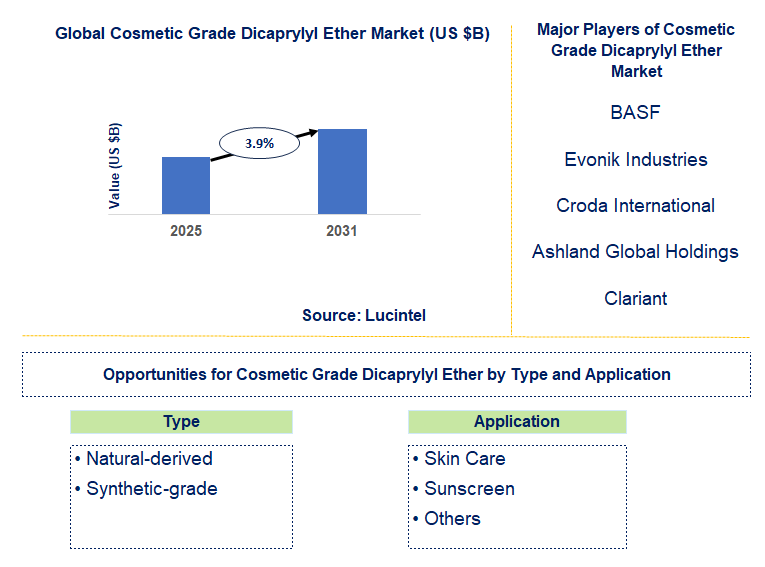
Key data points: The growth forecast = 3.9% annually for the next 7 years. Scroll below to get more insights. This market report covers trends, opportunities and forecasts in cosmetic grade dicaprylyl ether market to 2031 by type (natural-derived and synthetic-grade), application (skin care, sunscreen, and others), and region (North America, Europe, Asia Pacific, and the Rest of the World)
We'll send your sample report shortly.
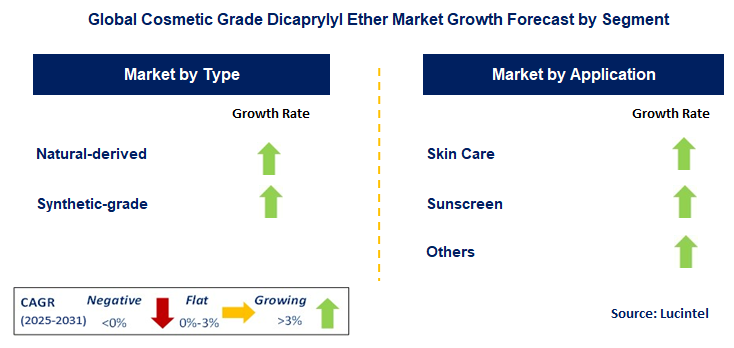
• Lucintel forecasts that, within the type category, natural-derived is expected to witness higher growth over the forecast period.
• Within the application category, skin care is expected to witness higher growth.
• In terms of region, APAC is expected to witness the highest growth over the forecast period. Gain valuable insights for your business decisions with our comprehensive 150+ page report. Sample figures with some insights are shown below.
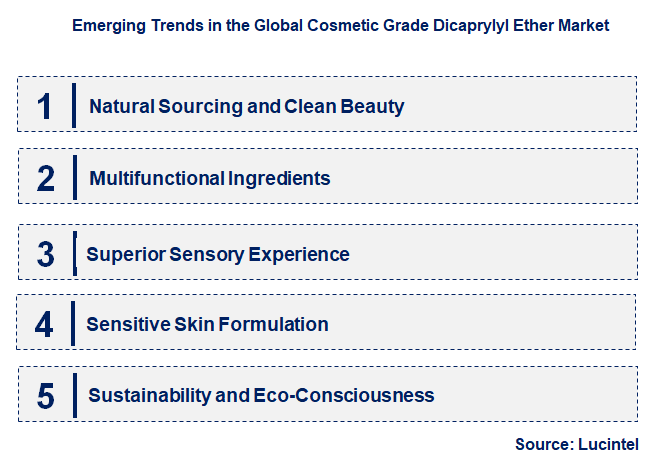
• Natural Sourcing and Clean Beauty: There is a growing demand from consumers for cosmetic products that are made with "clean" ingredients, without potentially toxic chemicals. This drives demand for dicaprylyl ether, which is frequently sourced from natural, renewable resources such as coconut oil. Its image as a non-toxic, safer, and biodegradable alternative to conventional emollients matches the clean beauty movement’s messaging, which has led manufacturers to focus on sustainable sourcing as well as eco-friendly production methods.
• Multifunctional Ingredients: The market is seeing a strong movement toward multifunctional ingredients that provide multiple benefits in one ingredient. Dicaprylyl ether is becoming increasingly popular because it can serve as a multifunctional ingredient, being not only a very good emollient but also a spreading agent, solvent, and sensory enhancer. Such functionality enables manufacturers to simplify formulations, decrease ingredient counts, and create simpler but highly effective products that are attractive to consumer desire for efficacy and simplicity.
• Superior Sensory Experience: There is increasing consumer demand for an improved sensory experience in cosmetic products. Dicaprylyl ether gives a characteristic light, silky, and non-greasy touch, greatly enhancing spread ability and absorption of the formulation. This sought-after tactile effect is important to consumer acceptance and repeat business, particularly for products such as creams, lotions, and sunscreens, in which smooth, non-tacky finish is particularly important.
• Sensitive Skin Formulation: As there is a growing incidence of sensitive skin issues, more demand for mild and non-irritant cosmetic materials is seen. Dicaprylyl ether can be labeled as non-comedogenic and is tolerated by most skin types, even sensitive skin. Its gentle character is perfect for hypoallergenic and dermatologically tested products, addressing the expanding base of consumers looking for products that are less likely to irritate or cause allergic reactions.
• Sustainability and Eco-Consciousness: The world’s pursuit of sustainability is deeply influencing the world of cosmetics. Consumers and the regulatory agencies are putting more pressure on the environmental impact of cosmetic ingredients and their manufacture. Dicaprylyl ether, especially when derived in a sustainable manner, finds itself in step with this trend since it is biodegradable and carries less environmental burden than some synthetic versions. This focus on green practices is leading to innovation in green chemistry and sustainable ingredient innovation. These new trends are basically transforming the cosmetic grade dicaprylyl ether market by pressurizing manufacturers to use more natural, multifunctional, and sustainably derived ingredients. The emphasis on delivering a superior sensory experience and meeting sensitive skin types is also influencing product innovation. This combined trend is creating a market in which dicaprylyl ether is emerging as an ever-more essential ingredient, playing its part in the creation of safer, more effective, and more environmentally friendly cosmetic products.
• Growth in Silicone-Free Formulations: A notable trend is the growth in use of dicaprylyl ether as a desired silicone replacement in cosmetic products. Consumers are demanding more and more silicone-free products because of supposed health or environmental issues. Dicaprylyl ether provides a comparable non-greasy, lightweight texture and good spread ability so that it can serve as a good replacement without affecting product performance or sensory qualities. This trend is propelling its application into more and more types of products, ranging from hair care to skin care.
• Sun Care Products Growth: Dicaprylyl ether is seeing a significant increase in use within sun care products. Its capacity to efficiently dissolve crystalline UV filters and disperses pigments while contributing a non-oily feel makes it particularly effective for sunscreens. With a growing awareness among consumers regarding sun protection and greater demand for cosmetically beautiful sunscreens, dicaprylyl ether is emerging as a critical ingredient for improving the feel and function of these products.
• Natural and Sustainable Grade Innovations: There is increasing activity developing and marketing natural and sustainably sourced grades of dicaprylyl ether. Companies are investing in green chemistry production and using renewable resources to source raw materials to satisfy the increasing demand for green ingredients. This emphasis on sustainability not only attracts consumers who are mindful of the environment but also conforms to the wider industry shift toward responsible ingredient sourcing and production.
• Growing Application in Serums and Light Textures: Serum and other light facial cosmetics are increasingly popular, and dicaprylyl ether is helping satisfy that demand. Its spreading quickness and non-greasiness make it perfectly suited to highly effective, nice-to-apply serums, facial oils, and other fluid-like textures. This trend appeases consumers wanting quickly absorbing products that weigh nothing on the skin.
• Technological Innovation in Emulsification: Technological innovations in emulsification processes have added even further to the versatility of dicaprylyl ether. Advanced formulation processes enable its easy incorporation into a broader range of emulsion types for enhancing product stability and visual appeal. This technological advancement enables formulators to formulate more advanced and stable cosmetic products while unlocking the sensory advantages of dicaprylyl ether. All these advancements are cumulatively influencing the cosmetic grade dicaprylyl ether market to make it an extremely versatile and sought-after ingredient. Its status as a substitute for silicones, its increasing use in sun care, its emphasis on natural and sustainable forms, its applicability in light formulas, and the development of emulsions are all helping to increase its market base and consolidate its significance in the modern world of cosmetic ingredients.
• Skincare Products: The most promising area of growth is in the skincare category, with moisturizers, lotions, and anti-aging creams being key opportunities. The light, non-greasy feel, quick penetration, and high spread ability of Dicaprylyl ether make it ideal for these products. As consumers increasingly demand comfortable and effective skincare, the addition of this ingredient will contribute to product appearance and efficacy, expanding market acceptance in mass and premium markets.
• Sun Care Formulations: The sun care market provides significant growth opportunities for dicaprylyl ether. Its performance as a solvent for organic UV filters and its capacity to diminish the greasiness usually found with high-SPF products render it precious. As consumers increasingly desire cosmetically elegant and comfortable-to-use sunscreens, products containing dicaprylyl ether can deliver enhanced sensory profiles, driving daily use and increasing its share in the expanding sun protection category.
• Haircare Products: Haircare opportunities are rising as consumers turn to light, non-oily hair solutions. Dicaprylyl ether can enhance conditioner, serum, and styling product spread ability, with a smooth, non-tacky finish that won’t weigh the hair down. Use of dicaprylyl ether in silicone-free haircare products is also an important growth opportunity, meeting the growing consumer trend for natural and residue-free hair products.
• Color Cosmetics: In color cosmetics, dicaprylyl ether may be used as a pigment dispersant and emollient in foundations, concealers, and lip care products. Its capacity to provide a uniform, silky application and augment the sensory texture of makeup makes it a desirable tool for formulators. As the color cosmetics industry keeps pushing boundaries with lighter textures and better wear, dicaprylyl ether presents a strategic benefit for product development.
• Natural and Clean Beauty Formulations: The overall trend of clean and natural beauty offers a cross-cutting opportunity across all uses. As both a naturally sourced and biodegradable component, dicaprylyl ether is perfectly positioned to address the stringent standards of clean beauty brands. Companies that prioritize environmentally friendly sourcing and clear ingredient labeling can take advantage of dicaprylyl ether to attract the eco-aware consumer and build their role in this fast-evolving market segment. These growth opportunities, by use, are greatly influencing the cosmetic grade dicaprylyl ether market by extending its use and broadening its overall market penetration. By targeting skincare, sun care, hair care, color cosmetics, and capitalizing on the natural and clean beauty movement, manufacturers can realize great potential in the market and fuel continued growth of dicaprylyl ether as a leading ingredient in the personal care sector.
• BASF
• Evonik Industries
• Croda International
• Ashland Global Holdings
• Clariant
• Daebong Inchem Factory
• Innocentriq
• Wilmar International
• Ecogreen Oleochemicals
• Guangzhou Meisheng Cosmetics
• Natural-derived
• Synthetic-grade
• Skin Care
• Sunscreen
• Others
• North America
• Europe
• Asia Pacific
• The Rest of the World
• United States: The US market for cosmetic grade dicaprylyl ether is experiencing healthy growth due to strong consumer demand for natural and organic personal care products. There exists a steady need for innovative formulations that provide better skin feel and performance. Research and development expenditure by formulators is growing, with an emphasis on developing breakthrough products that address changing consumer demands for clean and effective beauty products. The online business sector has also contributed immensely towards the increase in sales, bringing more products with dicaprylyl ether within the reach of consumers.
• China: China’s dicaprylyl ether market for cosmetics is growing fast, fueled by a rapidly expanding middle class, growing disposable incomes, and increased personal grooming focus. Recent regulatory reforms in China, including the National Institutes for Food and Drug Control (NIFDC) statements concerning cosmetic ingredients, are influencing ingredient use and safety evaluation. These initiatives have the intention of promoting the quality and safety of cosmetic products, and hence may boost the demand for properly documented and compliant ingredients such as dicaprylyl ether.
• Germany: Germany, which is a major part of the European cosmetics industry, has a high demand for cosmetic grade dicaprylyl ether due to its consumer base that looks for high-quality, scientifically proven, and environmentally friendly ingredients. The stringent regulatory conditions in the country promote using safe and well-studied emollients. German producers are constantly formulating new ideas and tend to use dicaprylyl ether frequently due to its good sensory characteristics and adaptability to various active ingredients, in line with the clean beauty trend dominant in Europe.
• India: The Indian market for cosmetic grade dicaprylyl ether is set for major growth, driven by the increasing beauty and personal care sector and rising awareness among consumers. India is fast becoming a future chemicals manufacturing center, which will help promote local production of cosmetic ingredients. Growing demand for quality and performance-oriented cosmetics, along with the growing online market, is driving the usage of ingredients such as dicaprylyl ether in a range of skincare and haircare products.
• Japan: Japan’s cosmetic-grade dicaprylyl ether market is driven by a focus on advanced formulations and an extremely sophisticated consumer base. Japanese beauty firms specialize in innovation and texture, efficacy, and safety. Dicaprylyl ether is also appreciated for its light, non-greasy texture and good spread ability, and it is a favored ingredient in premium skincare and make-up products. The market also demonstrates increasing demand for naturally sourced and minimalist formulations.


• BASF
• Evonik Industries
• Croda International
• Ashland Global Holdings
• Clariant
• Daebong Inchem Factory
• Innocentriq
• Wilmar International
• Ecogreen Oleochemicals
• Guangzhou Meisheng Cosmetics Q5. Which cosmetic grade dicaprylyl ether market segment will be the largest in future? Answer: Lucintel forecasts that, within the type category, natural-derived is expected to witness higher growth over the forecast period. Q6. In cosmetic grade dicaprylyl ether market, which region is expected to be the largest in next 5 years? Answer: In terms of region, APAC is expected to witness the highest growth over the forecast period. Q7. Do we receive customization in this report? Answer: Yes, Lucintel provides 10% customization without any additional cost.


Choose a license that fits your team. Instant PDF delivery.
Prices exclude taxes. Instant delivery. Custom licensing available on request.
Market Report · July 22, 2026
Market Report · July 22, 2026
Market Report · July 22, 2026
Trusted partner for strategic intelligence and business growth


Receive a complimentary market analysis tailored to your industry. Our analysts will identify key growth opportunities and competitive dynamics specific to your business.

Market size, growth rate, and key trend analysis for your specific sector.

Top competitor positioning and market share analysis.

Strategic recommendations backed by data-driven insights.
Get curated market intelligence and competitive moves straight to your inbox.
By subscribing, you agree to receive our monthly insights. Unsubscribe anytime.
Receive a complimentary market analysis tailored to your industry. Our analysts will identify key growth opportunities and competitive dynamics specific to your business.
Market size, growth rate, and key trend analysis for your specific sector.
Top competitor positioning and market share analysis.
Strategic recommendations backed by data-driven insights.
Get curated market intelligence, emerging trends, and competitive moves straight to your inbox each month.
By subscribing, you agree to receive our monthly insights. Unsubscribe anytime.
We'll send your sample report shortly.