
Market Report · July 22, 2026

Key data points: The growth forecast = 7.2% annually for the next 7 years. Scroll below to get more insights. This market report covers trends, opportunities and forecasts in coronary microcatheter market to 2031 by type (cardiovascular, neurovascular, and others), application (clinic, hospital, and others), and region (North America, Europe, Asia Pacific, and the Rest of the World)
We'll send your sample report shortly.
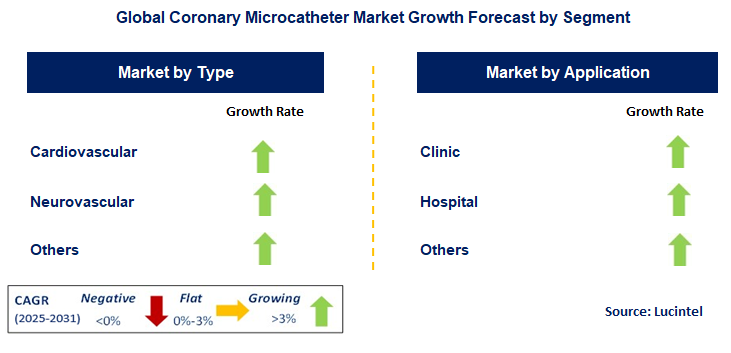
• Lucintel forecasts that, within the type category, cardiovascular is expected to witness higher growth over the forecast period.
• Within the application category, the hospital is expected to witness higher growth.
• In terms of region, APAC is expected to witness the highest growth over the forecast period. Gain valuable insights for your business decisions with our comprehensive 150+ page report. Sample figures with some insights are shown below.
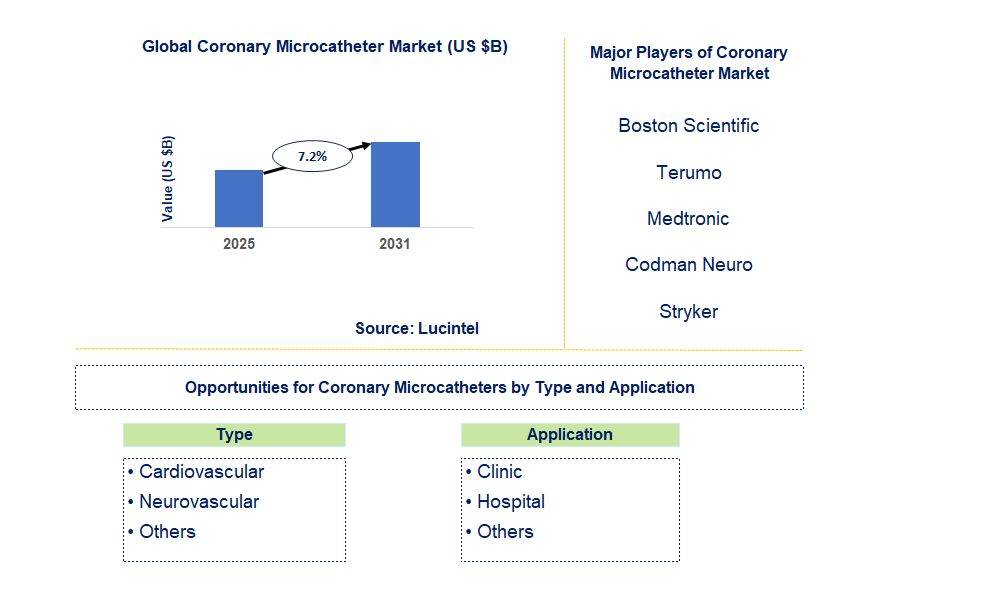
• Miniaturization and Improved Deliverability: This is a trend geared toward decreasing the outer diameter of microcatheters while preserving or enhancing lumen size for guidewire and contrast delivery. The purpose is to provide less difficult access to smaller, more tortuous, or distally positioned coronary lesions with less vessel trauma and higher procedural success rates. Companies are using high-tech materials and braiding methods to provide higher flexibility, pushability, and torque response to enable clinicians to better control and precision in navigating complex anatomies.
• Compatibility with Advanced Imaging Modalities: Seamless compatibility of coronary microcatheters with real-time imaging modalities such as Intravascular Ultrasound (IVUS) and Optical Coherence Tomography (OCT) is an essential trend. This compatibility offers physicians high-resolution images of the coronary artery lumen and wall in real time, allowing for more precise lesion evaluation, better stent deployment, and identification of successful intervention. It minimizes dependence on conventional angiography alone, resulting in more accurate procedures and possibly improved long-term patient outcomes.
• Special Microcatheters for Difficult Lesions: The emphasis continues to be placed on creating microcatheters that are tailored for difficult coronary lesions like CTOs, calcified lesions, and bifurcation lesions. These specialized microcatheters usually incorporate novel tip designs, increased support, or the ability for accurate lesion crossing and balloon/stent delivery. Their creation fulfills unmet clinical requirements, enabling interventional cardiologists to approach cases that once would have been considered untreatable or risky, thus broadening the applicability of percutaneous coronary intervention (PCI).
• Therapeutic Delivery Microcatheter Development: More than simple navigation and guidewire assistance, microcatheters are becoming more sophisticated to enable the targeted delivery of therapeutic drugs. This involves localized drug delivery, gene therapy, or embolic material delivery directly to the site of the lesion, improving the likelihood of increased treatment effectiveness while minimizing systemic side effects. This direction is a major move towards more targeted and personalized interventions, creating new opportunities for the treatment of a range of coronary diseases with increased specificity.
• Growth of Artificial Intelligence and Robotics: Although in their infancy, the combined use of artificial intelligence (AI) and robotics with interventional cardiology equipment, such as microcatheters, is a growing trend. AI can be used to aid image analysis, planning, and real-time navigation, whereas robotic platforms provide improved accuracy, stability, and lower radiation doses for physicians. This convergence is intended to automate parts of intricate procedures, standardize results, and possibly enhance safety for patients and medical staff. These new trends are playing a very important role in transforming the coronary microcatheter market through the maintenance of an environment of constant innovation and expertise. They are breaking boundaries in what can be achieved in interventional cardiology by making procedures more complex and accurate. Focusing on improved deliverability, imaging integration, and therapeutic capabilities is enhancing clinical outcomes and increasing treatment options for patient cohorts with difficult-to-treat coronary disease, eventually fueling market growth and revolutionizing patient care.

• Introduction of Advanced Polymer Materials: A key innovation is the extensive use of advanced polymer materials for the production of microcatheters. Advanced polymer materials are more flexible, lubricious, and kink-resistant than traditional materials, which allows microcatheters to be pushed through very tortuous coronary arteries with less friction and better trackability. This reduces the risk of vessel injury and provides better access to distal lesions with ease and safety, improving the success rates of complex percutaneous coronary intervention treatments and patient outcomes.
• Increased Radiopacity and Visibility: Recent research has aimed at maximizing the radiopacity of microcatheters, hence their visibility on fluoroscopic images. This is done by adding radiopaque markers or components to the catheter shaft and tip. Increased visibility enables interventional cardiologists to be able to accurately locate the position of the microcatheter in the coronary vasculature in real-time, enabling them to accurately place the guidewire, inject contrast, and deliver devices, thus raising the level of procedural precision and safety.
• Multi-lumen and Steerable Microcatheter Development: The development and advancement of multi-lumen and steerable microcatheters is a landmark development. Multi-lumen configurations enable guidewire support, contrast injection, or pressure measurement to be performed in parallel, simplifying cumbersome procedures. Steerable tips enable active tip control, allowing physicians to lead the catheter through difficult anatomy with accuracy. These developments provide increased flexibility and control during interventions, especially for chronic total occlusions and bifurcation lesions.
• Chronic Total Occlusion Specific Microcatheters: A concerted development effort has been made for microcatheters that are expressly designed for chronic total occlusion (CTO) procedures. These microcatheters typically possess improved tip penetration, excellent support for guidewire advancement, and tolerance to a variety of CTO methods. This special focus fulfills an important unmet need, as CTOs are difficult lesions that demand extremely specialized devices to successfully recanalize, greatly enhancing the treatment for these complicated scenarios.
• Integration with Diagnostic Sensors or Drug-Eluting Technologies: Another significant development is the initial integration of diagnostic sensors or drug-eluting technologies into microcatheters. Although still in development, it enables localized drug delivery to the site of the lesion, which may decrease restenosis, or offers real-time physiological information during the procedure. This development takes microcatheters beyond being merely mechanical devices, opening the door to more therapeutic and diagnostic functions, thus improving the effectiveness of treatment and monitoring of patients. These advances are deeply affecting the coronary microcatheter market by spurring innovation and increasing the scope of interventional cardiology. They are resulting in safer, more accurate, and more effective procedures, especially for challenging coronary lesions. Emphasis on better navigability, visibility, and specialized functions is increasing physician confidence and leading to improved patient outcomes, eventually growing the market and cementing the microcatheter’s essential position in contemporary cardiac treatment.
• Advanced Percutaneous Coronary Intervention: The market has immense growth opportunities for the development of advanced microcatheters for advanced PCI procedures, particularly in the treatment of chronic total occlusions (CTOs), calcified plaques, and bifurcation lesions. These procedures need microcatheters with better push ability, torque ability, and trackability to deal with extremely challenging anatomies. Advances in tip design, material science, and support capabilities for guidewire advancement will grab an expanding niche of the market dedicated to these hard-to-treat cases, resulting in enhanced success rates.
• Localized Therapy and Drug Delivery: A new opportunity is developing in using microcatheters to deliver therapeutic agents in a precise, localized manner within coronary arteries. This might involve delivering anti-retinoic medicines, gene therapy, or regenerative medicine elements directly to the site of the lesion, reducing systemic side effects and maximizing treatment outcomes. Microcatheter development for controlled release or drug-specific compatibility will open up new therapeutic options and increase their use beyond that of mechanical intervention.
• Diagnostic and Imaging-Guided Procedures: Combining microcatheters with sophisticated diagnostic functions and imaging technologies is a high-growth opportunity. It includes microcatheters that can have real-time physiological sensors for measuring fractional flow reserve (FFR) or instantaneous wave-free ratio, or intravascular imaging system-compatible microcatheters like IVUS and OCT. This integration gives more accurate lesion information and facilitates targeted intervention, minimizing guesswork and enhancing procedural results, and hence their adoption.
• Pediatric and Small Vessel Interventions: There is a niche but expanding opportunity in creating ultra-small diameter microcatheters for specific applications in pediatric cardiology and small or fragile coronary vessel interventions. Such procedures require utmost precision and minimal invasiveness to avoid trauma. Miniaturization, flexibility, and the use of soft tips will appeal to this niche patient group and fill an unmet requirement for safer and more efficient tools in small vessel interventions or complex congenital heart disease.
• Robotic-Assisted and Remote Interventions: The long-term strategic potential is in the creation of microcatheters that are compatible with robotic-assisted and remote interventional equipment. Robotics can provide greater accuracy, stability, and potentially lower radiation exposure to operators. As these technologies continue to mature, there will be a need for microcatheters for robotic manipulation, incorporating feedback mechanisms and sophisticated steerability. This will create new options for remote procedures and expand the capabilities of interventional cardiologists, especially in underserved populations. These strategic opportunities for growth are profoundly shaping the coronary microcatheter marketplace through innovation and specialization. Through targeting challenging cases, therapeutic delivery, enhanced diagnostics, specialized uses such as pediatrics, and compatible integration with new technologies such as robotics, the market is increasing its utility and value. These opportunities are not only driving technology forward but also enhancing patient outcomes and cementing the microcatheter’s position as a mandatory device in the rapidly changing interventional cardiology landscape.
• Boston Scientific
• Terumo
• Medtronic
• Codman Neuro
• Stryker
• Merit Medical
• ASAHI INTECC
• Navilyst Medical
• Cook Medical
• Penumbra
• Cardiovascular
• Neurovascular
• Others
• Clinic
• Hospital
• Others
• North America
• Europe
• Asia Pacific
• The Rest of the World
• United States: The US coronary microcatheter market is marked by high technology adoption rates and a focus on minimally invasive interventions. Some important developments are the engineering of highly steerable and dual-lumen microcatheters, enhancing accuracy in challenging cases such as chronic total occlusions (CTOs). Supportive reimbursement policies and the presence of global medical device leaders ensure ongoing innovation and fast market penetration. The increase in the aged population and the increased prevalence of cardiovascular diseases also contribute to demand, keeping the US a prominent market.
• China: China is a fast-growing market for coronary microcatheters, driven by a vast patient base, enhanced healthcare infrastructure, and growing investment in medical technology. The emphasis is on increasing access to sophisticated interventional cardiology procedures in urban and rural areas alike. Domestic manufacturers are stepping up, in addition to global players, paving the way for competition and reducing costs. Government programs encouraging domestic manufacturing and growing cardiovascular disease incidence are powerful drivers for growth within this burgeoning market.
• Germany: The German coronary microcatheter market is focused on premium, precision-made devices, a testament to its strong healthcare system and strict regulatory environment. There is high adoption of microcatheters that are integrated with premium imaging modalities such as IVUS and OCT for improved procedural guidance and safety. The market has an established interventional cardiology community and interest in patient outcomes. R&D work is focused on enhancing device flexibility and torque response for complex anatomies.
• India: The Indian coronary microcatheter market is growing significantly with the increasing burden of cardiovascular diseases, healthcare expenditure, and the number of cardiac catheterization labs. Though cost-effectiveness is a key consideration, there is an overall trend towards procuring more sophisticated microcatheters, especially in large cities. Efforts at expanding healthcare access and medical tourism are also driving the market. Internal manufacturing capacities are also emerging to address the increasing demand.
• Japan: The Japanese coronary microcatheter market is characterized by high technological levels and stringent clinical standards. Japanese firms are leaders in the design of ultra-thin and very flexible microcatheters, important for tracing highly complex and tortuous coronary arteries that are typical of their population. Demand is supported by an elderly population with a high incidence of cardiovascular disease and a high value placed on patient safety and minimal invasiveness. Innovations in guidewire support and contrast injection capabilities are key areas of development.


• Boston Scientific
• Terumo
• Medtronic
• Codman Neuro
• Stryker
• Merit Medical
• ASAHI INTECC
• Navilyst Medical
• Cook Medical
• Penumbra Q5. Which coronary microcatheter market segment will be the largest in future? Answer: Lucintel forecasts that, within the type category, cardiovascular is expected to witness higher growth over the forecast period. Q6. In coronary microcatheter market, which region is expected to be the largest in next 5 years? Answer: In terms of region, APAC is expected to witness the highest growth over the forecast period. Q7. Do we receive customization in this report? Answer: Yes, Lucintel provides 10% customization without any additional cost.


Choose a license that fits your team. Instant PDF delivery.
Prices exclude taxes. Instant delivery. Custom licensing available on request.
Market Report · July 22, 2026
Market Report · July 22, 2026
Market Report · July 22, 2026
Trusted partner for strategic intelligence and business growth


Receive a complimentary market analysis tailored to your industry. Our analysts will identify key growth opportunities and competitive dynamics specific to your business.

Market size, growth rate, and key trend analysis for your specific sector.

Top competitor positioning and market share analysis.

Strategic recommendations backed by data-driven insights.
Get curated market intelligence and competitive moves straight to your inbox.
By subscribing, you agree to receive our monthly insights. Unsubscribe anytime.
Receive a complimentary market analysis tailored to your industry. Our analysts will identify key growth opportunities and competitive dynamics specific to your business.
Market size, growth rate, and key trend analysis for your specific sector.
Top competitor positioning and market share analysis.
Strategic recommendations backed by data-driven insights.
Get curated market intelligence, emerging trends, and competitive moves straight to your inbox each month.
By subscribing, you agree to receive our monthly insights. Unsubscribe anytime.
We'll send your sample report shortly.