
Market Report · May 18, 2026

This market report covers trends, opportunities, and forecasts in the global computer graphic market to 2031 by technology (cad/cam, visualization/simulation, digital video, imaging, modeling/animation, and others), end use industry (aerospace & defense, automobile, entertainment & advertising, healthcare, manufacturing, and others), and region (North America, Europe, Asia Pacific, and the Rest of the World)
We'll send your sample report shortly.
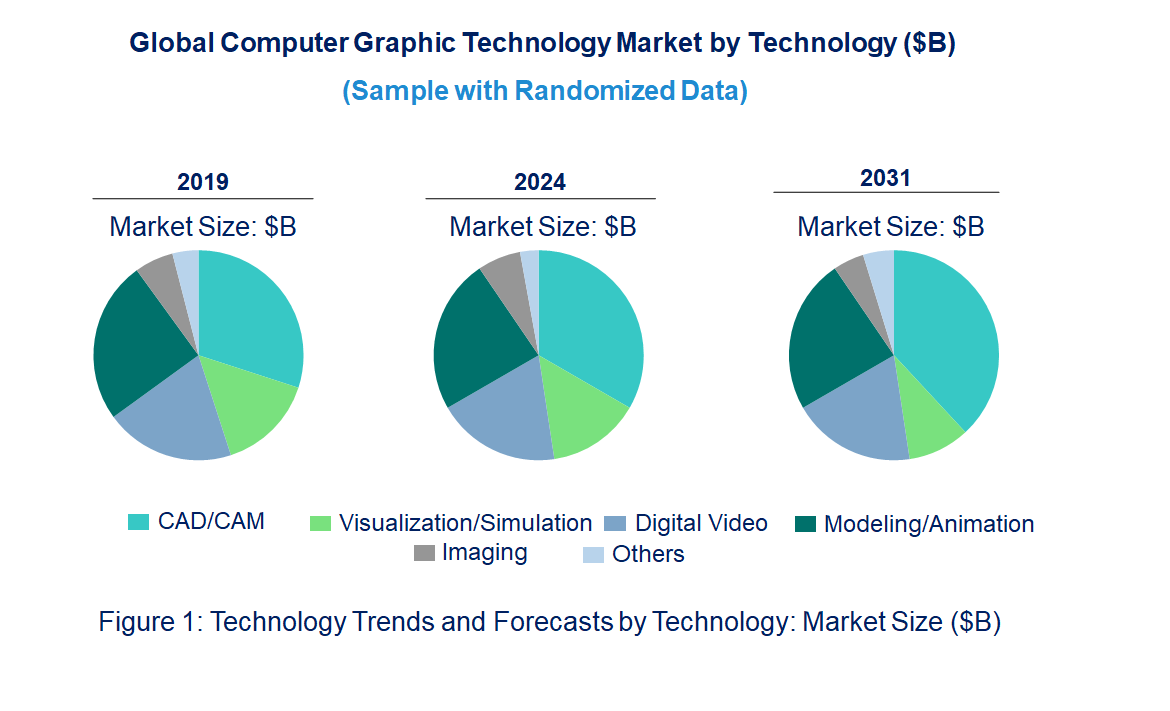
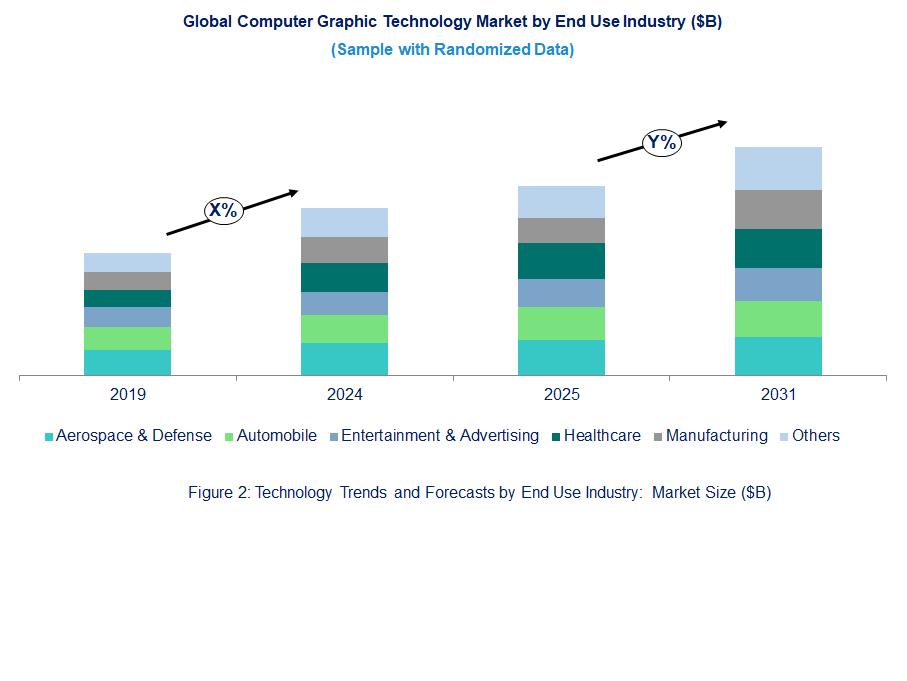
• Adoption of Real-Time 3D Rendering and Augmented Reality (AR): Real-time 3D rendering and AR are becoming integrated into the gaming, architecture, and retail industries. These technologies allow users to view and manipulate 3D models in real-time, providing an immersive and interactive experience. AR applications are increasingly in demand as companies seek new approaches to customer engagement, better product design, more effective training, and innovative marketing strategies.
• AI-Powered Graphics Generation and Automation: Artificial intelligence and machine learning are revolutionizing the creation of computer graphics. AI-powered tools automate tasks such as texture mapping, character animation, and object recognition, saving time and improving the quality of visuals. This trend is especially important for industries like entertainment, where faster content creation is necessary to meet consumer demand for new material.
• Cloud-Based Rendering and Collaborative Tools: Cloud-based rendering allows users to offload processing-intensive tasks to powerful servers, speeding up the rendering of complex graphics. This makes high-performance rendering more accessible to smaller studios and individual creators. Additionally, collaborative tools improve teamwork by enabling real-time feedback and seamless collaboration, even when team members are geographically distant.
• Introduction of Virtual Reality (VR) and Mixed Reality (MR): Virtual reality and mixed reality technologies are growing in popularity, especially in sectors such as healthcare, education, and engineering. VR is used to create immersive simulations for medical training or architectural visualization, while MR enhances the physical world by overlaying digital information, creating new opportunities for interactive design and product development.
• High-Performance Graphics for AI and Machine Learning Applications: The increasing use of AI and machine learning algorithms has led to a growing demand for high-performance graphics. AI applications require massive data processing, and specialized GPUs and hardware accelerators are crucial for executing complex tasks efficiently. These advancements are particularly beneficial for applications like autonomous driving and data analysis, where faster and more accurate graphics processing is required. These emerging trends highlight the convergence of computing power, creative innovation, and user interactivity in the computer graphics market. As technologies like AR, VR, AI, and cloud computing continue to evolve, they are driving the development of more dynamic, immersive, and efficient graphics solutions. The integration of these technologies into industries like entertainment and healthcare is already elevating these sectors, while also opening new avenues for creative professionals to engage audiences with richer, more interactive content.
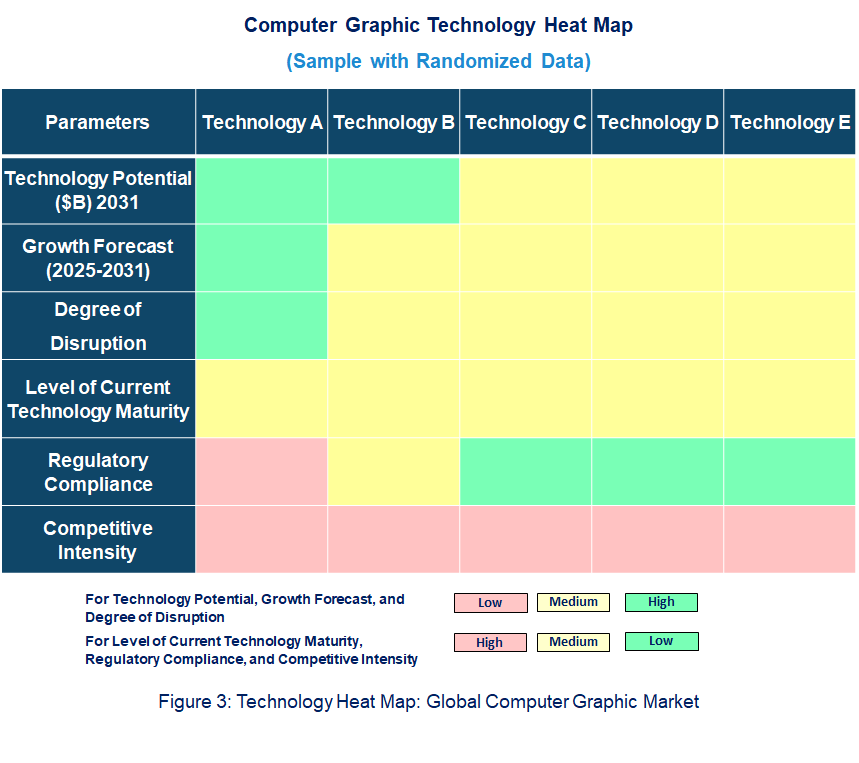
• Technology Potential: The technology potential for computer graphics lies in advancements such as real-time rendering, AI-powered graphics generation, and cloud-based solutions. These innovations can revolutionize industries by improving visual quality, rendering speeds, and accessibility, enabling a new level of user interaction and immersive experiences.
• Degree of Disruption: The degree of disruption in the computer graphics market is substantial, especially with the rise of AI, virtual reality (VR), augmented reality (AR), and cloud computing. These technologies are transforming traditional workflows, from gaming development to film production, pushing the boundaries of what’s possible and creating new market opportunities.
• Level of Current Technology Maturity: The current maturity of computer graphics technology is relatively high, particularly in sectors like gaming and film, where real-time rendering, ray tracing, and photorealistic graphics have been integrated into mainstream products. However, further advancements in AI, machine learning, and cloud computing are still evolving and will drive future growth.
• Regulatory Compliance: Regulatory compliance in the computer graphics market primarily involves data privacy and intellectual property laws. As cloud-based platforms and AI-driven graphics become more prevalent, ensuring compliance with regional regulations, such as GDPR, will be crucial to maintaining industry standards and protecting user data.
• Mentor Graphics: Mentor Graphics, a leader in electronic design automation (EDA), has expanded its offerings in the computer graphics market with new simulation and modeling tools. Their latest software enhancements for designing complex graphics chips are designed to accelerate AI, machine learning, and autonomous driving applications, enabling faster design cycles and more efficient hardware integration. This development positions Mentor Graphics at the forefront of hardware acceleration for next-gen graphics-intensive applications.
• Microsoft: Microsoft has further strengthened its position in the computer graphics space through its Azure cloud platform. The company has integrated powerful cloud-based rendering services, enabling creators to offload heavy rendering tasks to the cloud. Additionally, with the launch of Azure AI and its advancements in AR with HoloLens, Microsoft is providing businesses with enhanced immersive experiences and real-time graphics processing, transforming industries like gaming, healthcare, and manufacturing.
• Nvidia: Nvidia has made significant strides in both hardware and software with its latest graphics processing units (GPUs) and AI-powered technologies. The launch of its RTX series GPUs has revolutionized real-time ray tracing for more realistic visual effects in gaming and entertainment. Nvidia’s advancements in AI, including its DLSS (Deep Learning Super Sampling) technology, also allow for enhanced graphics rendering with lower computational power, significantly improving performance in demanding applications.
• Siemens PLM Software: Siemens PLM Software has made major updates to its NX and Solid Edge platforms, which are widely used for product design and digital manufacturing. With a focus on enhancing 3D modeling, Siemens’ recent developments enable industries to create more detailed and accurate visualizations of complex designs. Their integration of cloud-based solutions allows teams to collaborate on 3D models in real-time, improving efficiency and reducing development time in industries such as automotive and aerospace.
• Sony: Sony has expanded its influence in the computer graphics market with its advancements in virtual production technology. The company has integrated high-end graphics capabilities into its entertainment systems, including innovations in camera and LED wall technologies for creating virtual sets in film production. Sony’s contribution has revolutionized how studios design and produce realistic visuals, allowing for more cost-effective and creative production methods.
• Adobe Systems: Adobe has continued to innovate in the computer graphics market with its suite of creative software tools like Photoshop, Illustrator, and After Effects. The company has integrated AI features into its products through Adobe Sensei, which helps automate time-consuming tasks such as image enhancement, object recognition, and motion graphics creation. These advancements empower creative professionals with powerful tools to generate high-quality visuals more efficiently, accelerating the content creation process.
• Advanced Micro Devices (AMD): AMD has been a major player in pushing the boundaries of GPU technology with its Radeon graphics cards and Ryzen processors. AMD’s advancements in real-time rendering, paired with its open-source graphics architecture, have made high-performance computing more accessible. AMD’s innovative work in gaming and professional graphics markets helps drive immersive virtual environments, with a particular focus on enhancing AI-driven applications in gaming, VR, and data visualization. These developments by key players highlight the diverse applications of computer graphics technology, from gaming and entertainment to industrial design and AI. The advancements in cloud rendering, AI-driven graphics, immersive virtual environments, and real-time rendering are setting the stage for the next wave of innovation in the market, creating new opportunities and pushing the boundaries of what is possible in digital visualization.
• Advancements in AI and Machine Learning for Graphics Rendering: AI and machine learning algorithms are significantly improving the speed and efficiency of graphics rendering. This allows for the creation of realistic graphics at faster rates, making it a valuable tool for industries such as gaming, animation, and virtual reality. The integration of AI improves performance and quality, reducing rendering times.
• Increasing Demand for High-Performance Gaming and VR/AR: The growing popularity of gaming and virtual/augmented reality experiences is driving demand for advanced computer graphics. As consumers and businesses alike demand more immersive experiences, the market sees a rise in the development of GPUs and software designed to meet these performance expectations. This enhances gaming, simulation, and training applications.
• Emergence of Cloud-Based Graphics Solutions: With cloud computing, powerful and scalable graphics rendering solutions can be used without heavy local investments in hardware. Cloud-based solutions help businesses and consumers have on-demand access to high-quality graphics services while saving on service costs and maintaining performance levels.
• 3D Visualization Outside the Gaming Industry (Healthcare, Architecture, etc.): 3D modeling and computer graphics applications are increasingly being applied in areas like healthcare, architecture, and product design. These industries use graphics for visual simulation, virtual testing, and high-level diagnostics. Non-entertainment sectors are fueling market growth as they begin adopting 3D and augmented reality for better decision-making and efficiency. Challenges in the computer graphics market are:
• Real-Time Graphics Rendering in Film and Animation Integration: The need for real-time graphics rendering has been increasing in the film and animation industries, allowing for faster production times and more dynamic visual content. The use of real-time engines like Unreal Engine for both production and live events is attracting a growing number of creators and studios due to the time and cost efficiency of these tools.
• High Costs and Resource Demands of Advanced Graphics Technology: While advancements in graphics technology provide considerable benefits, they are accompanied by a very high price tag. The requirement for powerful GPUs, high-speed processors, and software licenses results in significant expenses, making these technologies inaccessible to small businesses and regular users. This restricts access to top technological advancements.
• Developing Sophisticated Graphics Software and Tools: Developing quality graphics software requires high-level specialization in algorithms, physics, and user interfaces. With increased demand for more complex graphics tools, the process of creating such software has become both more complex and costly, limiting the ability of small companies to keep up with rapid developments. The computer graphics market is experiencing dynamic growth fueled by innovation in AI, gaming, virtual reality, and 3D visualization across various industries. These opportunities are shaping the market by improving capabilities, enhancing efficiency, and democratizing access to powerful graphics solutions. Challenges related to high costs, complexity, and resource requirements continue to impact how companies and industries can fully capitalize on these developments. The evolution of the market will continue, with the integration of the latest technologies and efficient cloud solutions paving the way for wider adoption and deeper innovation.
• Mentor Graphics
• Microsoft
• Nvidia
• Siemens PLM Software
• Sony
• Adobe Systems
• Technology Readiness by Technology Type: Technologies such as CAD/CAM and digital video are highly mature, with broad industry adoption in manufacturing, automotive, and entertainment. CAD/CAM offers robust solutions in product design, while digital video is at the forefront of the film and streaming industries, with advancements in 4K/8K content and real-time rendering. Visualization/Simulation technologies are well-developed, particularly in gaming and training, but still evolving in sectors like healthcare. Imaging technologies are advancing with AI, especially in diagnostics and surveillance, although regulatory challenges remain. Modeling/Animation technologies are mature in gaming and film but are continuously evolving to meet the demands of VR/AR applications. Other technologies like cloud-based rendering and AI are still emerging but show immense promise. Competitive levels vary, with well-established companies dominating some areas and newer startups disrupting others. Regulatory compliance, particularly for data privacy, intellectual property, and industry-specific standards, remains a key challenge across all technologies, especially in healthcare and cloud-based applications.
• Competitive Intensity and Regulatory Compliance: Competitive intensity varies across technologies like CAD/CAM, visualization/simulation, digital video, imaging, and modeling/animation. CAD/CAM faces strong competition from established players in industrial sectors, while Visualization/Simulation technologies are highly competitive in sectors like gaming and training. Digital video technologies are dominated by a few large companies, with intense competition over new formats and quality standards. Imaging technologies are witnessing rapid innovation, particularly in AI, with fierce competition from healthcare and security firms. Modeling/Animation faces significant competition as the demand for high-quality content increases. Regulatory compliance across these technologies focuses on data privacy, intellectual property rights, and ethical standards. CAD/CAM is heavily regulated in industrial applications, while digital video and imaging technologies are subject to copyright laws. Healthcare imaging must comply with medical regulations, and gaming and VR/AR technologies must navigate evolving data security concerns.
• Disruption Potential of Different Technologies: Technologies like CAD/CAM, visualization/simulation, digital video, imaging, and modeling/animation are fundamentally disrupting the computer graphics market. CAD/CAM has revolutionized design and manufacturing, enhancing precision and efficiency. Visualization and simulation technologies allow for immersive virtual environments, impacting sectors like healthcare, architecture, and automotive. Digital video technologies, including real-time rendering and 4K/8K resolution, are transforming entertainment and media, pushing boundaries in film and gaming. Imaging technologies, particularly AI-driven image processing, are reshaping healthcare diagnostics and security. Modeling and animation advancements, especially in 3D rendering, are improving user experiences in gaming, film, and VR/AR applications. Other emerging technologies like cloud computing and AI also offer significant disruption by making high-quality graphics more accessible and scalable.
• CAD/CAM
• Visualization/Simulation
• Digital Video
• Imaging
• Modeling/Animation
• Others
• Aerospace & Defense
• Automobile
• Entertainment & Advertising
• Healthcare
• Manufacturing
• Others
• North America
• Europe
• Asia Pacific
• The Rest of the World
• Latest Developments and Innovations in the Computer Graphic Technologies
• Companies / Ecosystems
• Strategic Opportunities by Technology Type


Choose a license that fits your team. Instant PDF delivery.
Prices exclude taxes. Instant delivery. Custom licensing available on request.
Market Report · May 18, 2026
Market Report · May 18, 2026
Market Report · May 18, 2026
Trusted partner for strategic intelligence and business growth


Receive a complimentary market analysis tailored to your industry. Our analysts will identify key growth opportunities and competitive dynamics specific to your business.

Market size, growth rate, and key trend analysis for your specific sector.

Top competitor positioning and market share analysis.

Strategic recommendations backed by data-driven insights.
Get curated market intelligence and competitive moves straight to your inbox.
By subscribing, you agree to receive our monthly insights. Unsubscribe anytime.
Receive a complimentary market analysis tailored to your industry. Our analysts will identify key growth opportunities and competitive dynamics specific to your business.
Market size, growth rate, and key trend analysis for your specific sector.
Top competitor positioning and market share analysis.
Strategic recommendations backed by data-driven insights.
Get curated market intelligence, emerging trends, and competitive moves straight to your inbox each month.
By subscribing, you agree to receive our monthly insights. Unsubscribe anytime.
We'll send your sample report shortly.