
Market Report · May 18, 2026

This market report covers trends, opportunities, and forecasts in the global communications pcb market to 2031 by technology (single-layer communication pcb and multi-layer communication pcb), end use industry (enterprises, education, government, healthcare, and others), and region (North America, Europe, Asia Pacific, and the Rest of the World)
We'll send your sample report shortly.
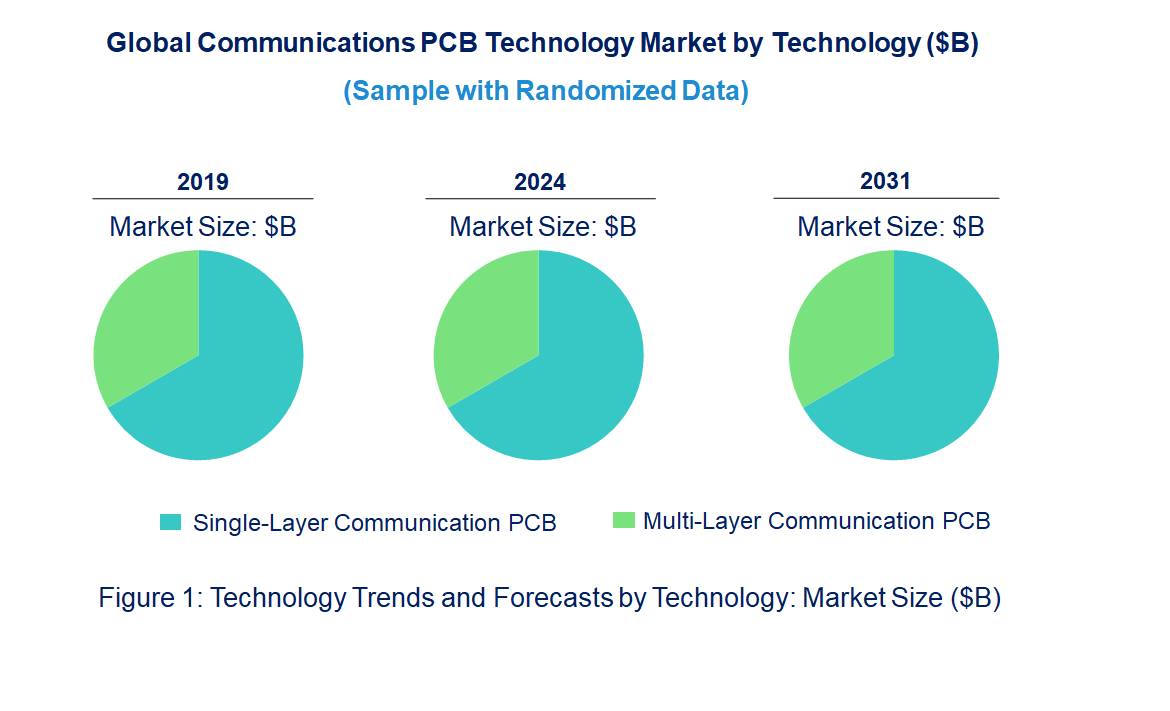
![Communications PCB Market Trend and Forecast by End Use Industry [Value from 2019 to 2031]:](https://lucintel.com/images/Communications-PCB-Technology-Market-Segment.png "Communications PCB Market Trend and Forecast by End Use Industry [Value from 2019 to 2031]:")
• HDI PCBs Development: HDI PCBs enable more complex circuit designs and higher component density. This trend is driven by the need for compact, lightweight, and powerful circuit boards that can accommodate the increasing number of components required for modern communication devices, boosting performance and reducing size.
• Flexible and Rigid-Flex PCBs: Flexible and rigid-flex PCBs are becoming popular because of their ability to conform to various shapes and spaces in devices. This innovation supports the development of flexible antennas, wearable technology, and other applications requiring adaptability, thereby enhancing the versatility and functionality of communication devices.
• Use of Advanced Manufacturing Techniques: This has been possible because of the use of advanced manufacturing processes that include automated laser drilling and advanced lamination techniques. The methods help in reducing defects and improving yield, hence allowing manufacturers to meet the growing demand for high-quality, high-performance PCBs.
• Sustainability and Eco-Friendly Materials: Environmental sustainability has become a focus, so the industry is shifting towards greener materials and manufacturing processes. These include recyclable substrates in PCB production and decreasing hazardous substances, in keeping with global environmental standards for sustainability over the long run. These emerging trends bring revolution to Communications PCB technology; they enhance performance, support miniaturization, and practices that are eco-friendly as well. The adoption of high-frequency materials, flexible solutions, HDI designs, advanced manufacturing, and practice that is sustainable practices enables it to meet the demands of present communication networks and devices and thus makes the Communications PCB market more capable of dealing with the future of connectivity from 5G infrastructures to next-gen IoT and data centers.
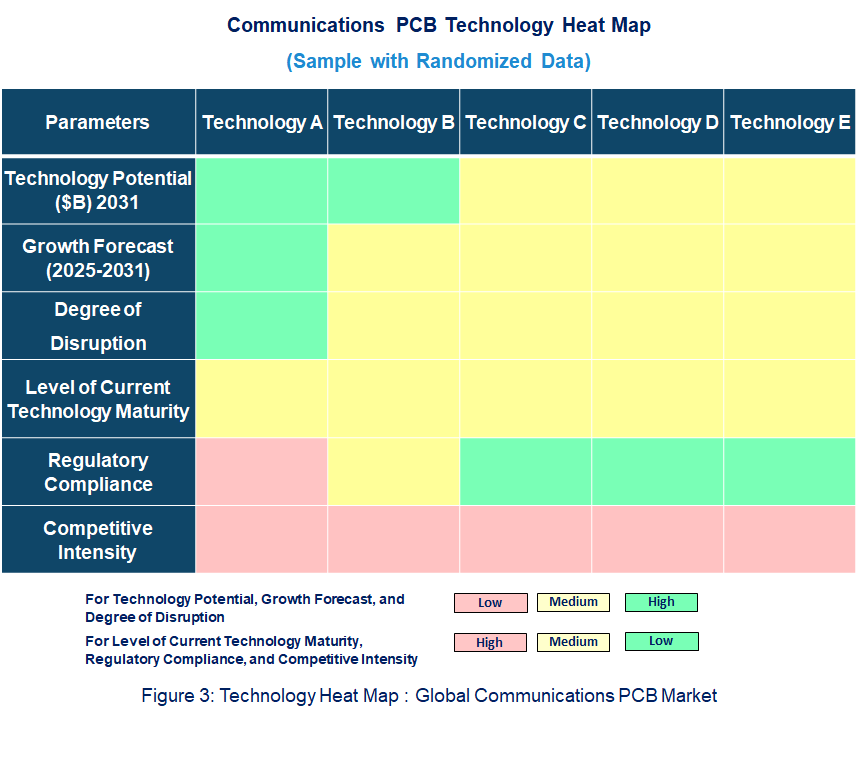
• Technology Potential: Communications PCBs have tremendous potential to change the landscape of electronics, especially with the advent of 5G and future 6G technologies. The transition to high-frequency materials and HDI PCBs is allowing for faster data transfer and supporting more complex circuits with reduced size, thus fostering compact, high-performance devices.
• Degree of Disruption: Flexible and rigid-flex PCBs are further disrupting the industry by allowing the creation of adaptable electronic devices, such as wearables and flexible antennas.
• Current Technology Maturity Level: Although traditional FR4-based PCBs are still the most popular, newer technologies such as HDI and flexible PCBs are becoming more mature with greater market acceptance. High-frequency materials are still in the developing stage but are gaining traction as 5G and IoT demand higher performance standards.
• Regulatory Compliance: Communications PCB technology must comply with environmental regulations such as RoHS and WEEE, which restrict the use of hazardous substances and promote recycling. Compliance with industry standards, such as IPC for manufacturing practices, ensures product quality and safety, aligning with global regulatory requirements.
• Zhen Ding Technology Holding: Zhen Ding Technology Holding Company increased its concentration on high-frequency and multi-layer PCBs to emerge as a forerunner in producing sophisticated PCBs for 5G networks. Research and development have enabled the company to optimize its circuit boards in efficiency and capability to achieve high-performance levels in communication equipment, as well as enhance data transfer speed.
• NOK Corporation: NOK Corporation has developed new flexible and rigid-flex PCBs that aim to meet the increasing demand for smaller and more flexible communication products. This innovation opens the doors to wearables and foldable smartphones, further expanding the markets for their PCB products.
• TTM Technologies: TTM Technologies has taken a step towards using modern, advanced HDI PCB technology to obtain increased density of circuits with high performance. This facilitates the smaller, powerful devices of modern times communicating in 5G and related networking in advanced means.
• Unimicron Technology: Unimicron Technology invests in environmentally friendly production methods and materials to keep up with international standards. Green technologies and recyclable substrates adopted by Unimicron are fast gaining precedence among consumers as well as the government.
• Compeq Manufacturing: Compeq Manufacturing is moving ahead to produce high-frequency PCBs for 5G and other next-generation wireless technologies. In that manner, their products are assured of faster data rates and less latency, and become critical in the production of telecom and data center equipment demanding high-speed performance.
• Young Poong Electronics: Young Poong Electronics had been emphasizing advanced PCB manufacturing capabilities for telecommunication applications, as well as smart device integration, with the aid of fine line and high-density interconnect technologies that enhance circuit performance by addressing the needs of devices connected to IoT systems, in addition to data transfer.
• Samsung Electro-Mechanics: Samsung Electro-Mechanics has enhanced its technology to produce high-quality multi-layer and flexible PCBs to cater to the demand of compact consumer electronics and communication devices. This technology helps in supporting various applications, such as smartphones and IoT devices, for faster and reliable communication.
• Tripod Technology: Tripod Technology has been improving the processes of HDI PCBs to manufacture high-density and high-performance circuit boards. This innovation has supported the telecommunication infrastructure and devices that require a stable and high-speed data transfer system, making them a dominant company in the global market.
• Ibiden: Ibiden has been frontward in developing PCBs that are eco-friendly and advanced manufacturing techniques, keeping with the trend of using greener electronics. Their contributions to high frequency and HDI are making high-speed networks and compact communication equipment possible. New and innovative PCBs developed by key players in the field indicate these developments to high-performance, sustainable, and adaptive PCBs designed towards more growth requirements for modern communication technology. This industry evolves around providing solutions faster, more reliably, and more environmentally friendly for 5G, IoT, and next-generation networks.
• Increasing Demand for 5G and High-Speed Connectivity: High frequency and high-performance PCBs to transfer data at higher speeds with fewer delays have increased the demand with the global rollout of 5G networks. The growing demand for more advanced, compact PCBs to support next-gen telecommunications has improved growth in the market.
• Miniaturization of Electronic Devices: With increasing demand for smaller, powerful electronic devices, the demand for HDI and flexible PCBs has also increased. With higher complexity and compact circuit design, they are becoming necessary in smartphones, wearables, and IoT applications. In this regard, it can cater to consumers who desire compact devices that still carry efficient functions.
• Environment-Friendly and Sustainable Manufacturing: Increasing environmental concerns and stricter regulations push the market toward sustainable PCB manufacturing practices. The adoption of recyclable materials and environmentally friendly production processes supports compliance with global standards, enhances brand reputation, and meets consumer and regulatory expectations for sustainable technology.
• Manufacturing Technology Advancements: The automation of production and improvement in manufacturing techniques enhance the precision and reliability of PCB production. These innovations reduce defects and costs in production, which translates into increased yields and efficiency, and therefore support the growth of high-performance PCB production for telecom applications.
• Increased Investment in Research and Development: Significant investments in R&D by key players are driving breakthroughs in PCB technology, such as high-density interconnects and new substrate materials. These developments are critical for the creation of next-generation circuit boards that can meet the complex demands of 5G, IoT, and smart infrastructure. The communications PCB technology market is driven by factors such as the expansion of 5G networks, miniaturization of devices, and sustainable practices. However, challenges like high production costs and regulatory compliance must be managed. Overall, these opportunities are pushing the market toward high-performance, eco-friendly, and innovative solutions, ensuring that the industry can support future technological advancements.
• Zhen Ding Technology Holding
• Nok Corporation
• TTM Technologies
• Unimicron Technology
• Compeq Manufacturing
• Young Poong Electronics
• Technology Readiness: Single-layer communication PCBs are mature technologies commonly used in basic devices, like simple consumer electronics and low-frequency applications. Multi-layer communication PCBs, on the other hand, are highly advanced and support modern applications requiring higher performance, such as 5G base stations, routers, and data center infrastructure. Multi-layer PCBs are more technologically advanced and capable of meeting the high-speed, high-frequency demands of next-generation communication systems, driving their readiness in the market. Their ability to handle complex circuits and dense components has made them essential for high-performance networking and telecommunications equipment, showcasing their role in facilitating current and future connectivity needs.
• Competitive Intensity and Regulatory Compliance: The competitive intensity in the communications PCB market is higher for multi-layer PCBs, as they are more complex to manufacture and require advanced technology, leading to fierce competition among leading PCB manufacturers. Single-layer PCBs face less competition, as they are widely used for basic electronic functions. Regulatory compliance for both types must meet global standards such as RoHS and WEEE to ensure safe, non-toxic, and environmentally friendly production. Multi-layer PCBs, given their complexity and applications in telecommunications, often face stricter quality control measures and compliance requirements to meet high-performance specifications.
• Disruption Potential: Single-layer communication PCBs are less disruptive compared to multi-layer PCBs, as they are used for simpler applications with lower performance demands. However, multi-layer communication PCBs have significant disruption potential, supporting high-speed, high-frequency signals necessary for advanced technologies like 5G and data center infrastructure. They enable complex circuit designs that can handle increased data loads, providing more efficient and compact solutions. The demand for multi-layer PCBs is rising due to their ability to support miniaturization and higher functionality in modern devices. This evolution is reshaping how electronics are designed, paving the way for smarter, more connected technology.
• Single-Layer Communication PCB
• Multi-Layer Communication PCB
• Enterprises
• Education
• Government
• Healthcare
• Others
• North America
• Europe
• Asia Pacific
• The Rest of the World
• Latest Developments and Innovations in the Communications PCB Technologies
• Companies / Ecosystems
• Strategic Opportunities by Technology Type


Choose a license that fits your team. Instant PDF delivery.
Prices exclude taxes. Instant delivery. Custom licensing available on request.
Market Report · May 18, 2026
Market Report · May 18, 2026
Market Report · May 18, 2026
Trusted partner for strategic intelligence and business growth


Receive a complimentary market analysis tailored to your industry. Our analysts will identify key growth opportunities and competitive dynamics specific to your business.

Market size, growth rate, and key trend analysis for your specific sector.

Top competitor positioning and market share analysis.

Strategic recommendations backed by data-driven insights.
Get curated market intelligence and competitive moves straight to your inbox.
By subscribing, you agree to receive our monthly insights. Unsubscribe anytime.
Receive a complimentary market analysis tailored to your industry. Our analysts will identify key growth opportunities and competitive dynamics specific to your business.
Market size, growth rate, and key trend analysis for your specific sector.
Top competitor positioning and market share analysis.
Strategic recommendations backed by data-driven insights.
Get curated market intelligence, emerging trends, and competitive moves straight to your inbox each month.
By subscribing, you agree to receive our monthly insights. Unsubscribe anytime.
We'll send your sample report shortly.