
Market Report · July 22, 2026

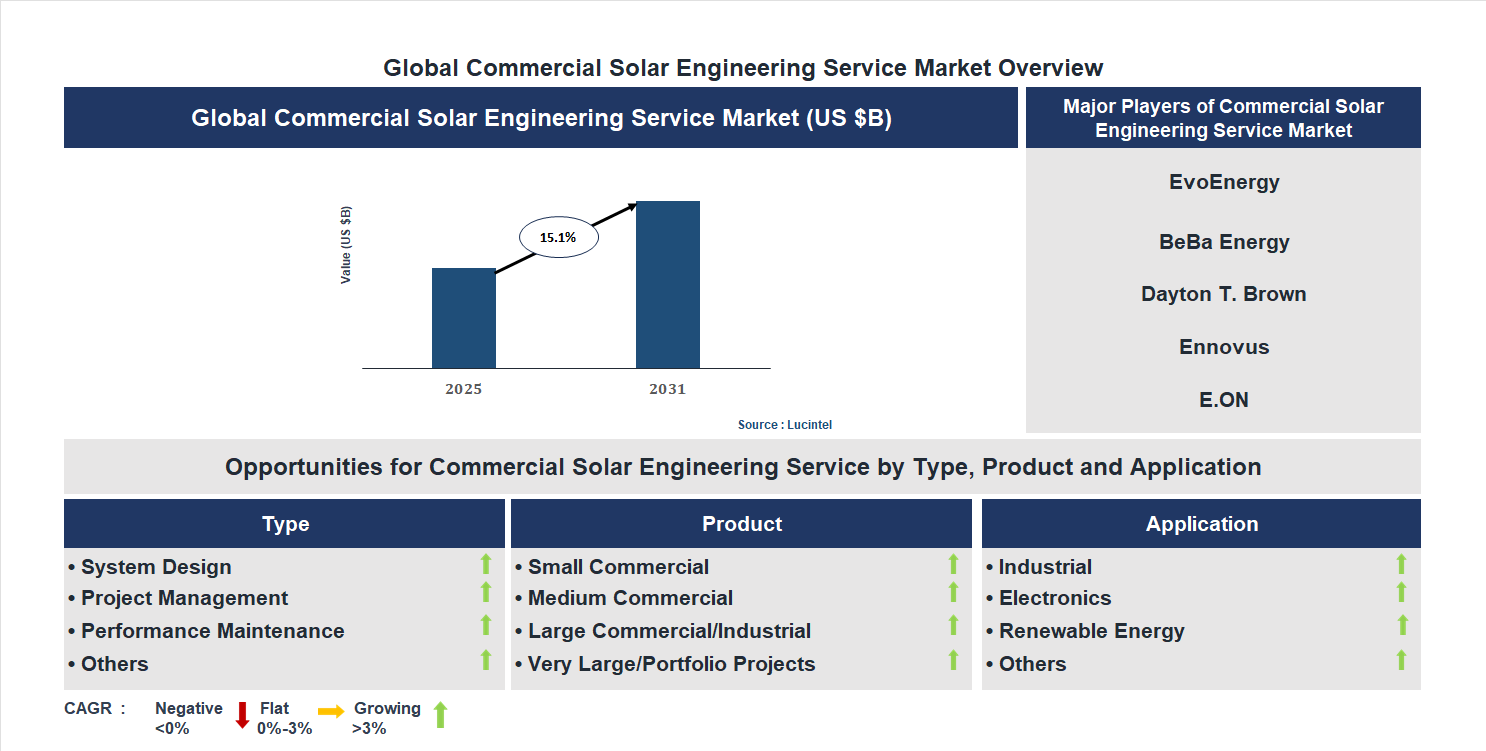
Key data points: The growth forecast = 15.1% annually for the next 6 years. Scroll below to get more insights. This market report covers trends, opportunities and forecasts in commercial solar engineering service market to 2031 by type (system design, project management, performance maintenance, and others), product (small commercial, medium commercial, large commercial/industrial, and very large/portfolio projects), application (industrial, electronics, renewable energy, and others), and region (North America, Europe, Asia Pacific, and the Rest of the World)
We'll send your sample report shortly.
• Lucintel forecasts that, within the type category, system design is expected to witness the highest growth over the forecast period.
• Within the application category, renewable energy is expected to witness the highest growth.
• In terms of region, APAC is expected to witness the highest growth over the forecast period. Gain valuable insights for your business decisions with our comprehensive 150+ page report. Sample figures with some insights are shown below.
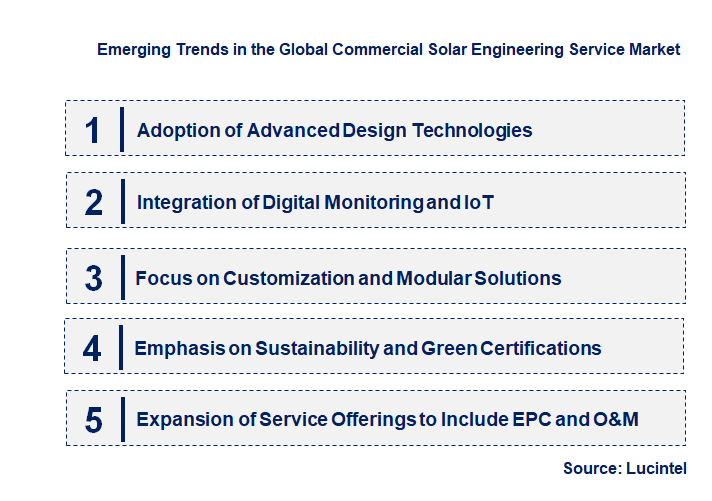
• Adoption of Advanced Design Technologies: Utilization of 3D modeling, simulation software, and AI-driven tools enhances project accuracy and efficiency. These technologies enable precise system design, optimize resource allocation, and reduce errors, leading to faster project completion and cost savings. As a result, clients benefit from more reliable and efficient solar solutions, boosting market confidence and adoption rates.
• Integration of Digital Monitoring and IoT: The deployment of Internet of Things (IoT) devices and digital monitoring systems allows real-time performance tracking of solar installations. This trend improves maintenance efficiency, predicts system failures, and maximizes energy output. Enhanced data analytics support better decision-making, reduce operational costs, and extend the lifespan of solar assets, making projects more sustainable and profitable.
• Focus on Customization and Modular Solutions: Increasing demand for tailored solar engineering services to meet specific client needs drives the development of modular and scalable solutions. These adaptable systems facilitate easier upgrades, maintenance, and expansion, appealing to diverse commercial sectors. Customization enhances project relevance, improves client satisfaction, and accelerates market penetration.
• Emphasis on Sustainability and Green Certifications: Growing awareness of environmental impact encourages the adoption of sustainable engineering practices and green certifications such as LEED. Engineers are integrating eco-friendly materials, optimizing energy efficiency, and ensuring compliance with environmental standards. This focus enhances project credibility, attracts environmentally conscious clients, and aligns with global sustainability goals.
• Expansion of Service Offerings to Include EPC and O&M: Engineering service providers are increasingly offering comprehensive solutions, including Engineering, Procurement, and Construction (EPC) and Operations & Maintenance (O&M). This integrated approach ensures project quality, reduces risks, and provides ongoing support, fostering long-term client relationships. It also creates new revenue streams and positions service providers as end-to-end solution partners. In summary, these emerging trends are significantly reshaping the commercial solar engineering service market by enhancing technological capabilities, promoting sustainability, and offering more flexible, integrated solutions. They are driving increased efficiency, cost-effectiveness, and customization, which collectively accelerate market growth and competitiveness in the renewable energy sector.
• Growing Demand for Sustainable Energy Solutions: The push for renewable energy sources is accelerating, with businesses and governments investing heavily in solar projects. This demand is fueling the need for specialized engineering services to design, optimize, and implement large-scale solar installations. As sustainability becomes a core business objective, the market for commercial solar engineering services is expanding rapidly, creating new opportunities for service providers to develop innovative solutions that meet diverse client needs.
• Technological Advancements in Solar Engineering: Innovations such as bifacial panels, energy storage integration, and smart monitoring systems are transforming solar engineering. These advancements improve system efficiency, reduce costs, and enhance performance. Service providers are adopting cutting-edge technologies to deliver more effective solutions, which in turn attracts more clients seeking reliable and high-performing solar systems. This technological evolution is driving market growth and setting new industry standards.
• Supportive Government Policies and Incentives: Governments worldwide are implementing policies, subsidies, and tax incentives to promote solar energy adoption. These initiatives lower installation costs and improve project viability, encouraging more businesses to invest in solar infrastructure. As a result, the demand for specialized engineering services to navigate regulatory frameworks and optimize project execution is increasing, further propelling market expansion and fostering a more sustainable energy landscape.
• Increasing Adoption of Custom Engineering Solutions: Customized solar engineering services tailored to specific business needs are gaining popularity. Companies seek bespoke solutions that maximize energy output and minimize costs. Service providers are offering tailored design, engineering, and consulting services to meet these demands, leading to higher customer satisfaction and project success rates. This trend enhances market competitiveness and encourages innovation within the industry.
• Expansion of Service Offerings and Market Reach: The industry is diversifying its service portfolio to include project management, maintenance, and performance optimization. Additionally, market players are expanding geographically to emerging regions with high solar potential. This broadening of services and markets increases revenue streams and market resilience. It also promotes the adoption of solar energy in new sectors, contributing to global sustainability goals and economic development. Conclusion: These developments are significantly impacting the commercial solar engineering service market by driving growth, innovation, and global adoption. Enhanced technological capabilities, supportive policies, and customized solutions are attracting more clients and expanding market reach. As a result, the industry is poised for sustained expansion, contributing to a greener economy and helping meet global renewable energy targets.
• Increasing Adoption of Solar Technologies in the Commercial Sector: The rising shift towards solar energy in commercial buildings is driven by cost savings, environmental regulations, and corporate sustainability goals. Engineering services are crucial for designing, installing, and maintaining efficient solar systems tailored to diverse commercial needs. As awareness and incentives grow, demand for expert engineering solutions will surge, creating opportunities for firms to expand their service offerings, improve project execution, and establish long-term client relationships in this expanding market segment.
• Integration of Advanced Engineering Software and Technologies: The adoption of innovative software tools like 3D modeling, simulation, and automation enhances the precision and efficiency of solar project design and implementation. These technologies reduce costs, minimize errors, and accelerate project timelines, making engineering services more attractive to clients. Companies investing in cutting-edge tools can differentiate themselves, improve project outcomes, and capture larger market shares, especially as digital transformation becomes integral to the solar engineering landscape.
• Growing Focus on Customization and Complex System Design: As commercial solar projects become more sophisticated, there is an increasing need for customized engineering solutions that address unique site conditions, energy requirements, and aesthetic considerations. This trend opens opportunities for specialized engineering firms to develop innovative, tailored solutions that optimize performance and compliance. Emphasizing expertise in complex system integration and innovative design will enable firms to meet evolving client demands and secure high-value projects.
• Expansion into Emerging Markets and Underdeveloped Regions: Developing regions with untapped renewable energy potential present significant growth opportunities for commercial solar engineering services. Infrastructure development, government initiatives, and international investments are driving market entry in these areas. Firms that establish local partnerships, understand regional regulations, and adapt engineering solutions to local conditions can capitalize on early-mover advantages, fostering long-term growth and market penetration in these emerging markets.
• Increasing Emphasis on Sustainability and Regulatory Compliance: Stringent environmental standards and sustainability commitments are compelling commercial clients to prioritize eco-friendly energy solutions. Engineering services that focus on optimizing system efficiency, reducing environmental impact, and ensuring compliance with evolving regulations are in high demand. Firms that develop expertise in sustainable design practices and regulatory navigation will be better positioned to attract clients, secure projects, and establish a competitive edge in the rapidly evolving solar engineering landscape. Conclusion: These growth opportunities collectively position the commercial solar engineering service market for substantial expansion, driven by technological innovation, regional development, and increasing sustainability commitments. Companies that proactively adapt to these trends, invest in advanced solutions, and expand into new markets will enhance their competitive advantage. As the market evolves, strategic focus on customization, technology integration, and regulatory expertise will be key to capturing emerging opportunities and ensuring long-term success.
• Technological Advancements: The continuous development of more efficient solar panels, energy storage solutions, and innovative engineering techniques enhances the feasibility and attractiveness of solar projects. These technological improvements reduce costs, improve performance, and enable customization for diverse commercial applications. As technology evolves, service providers can offer more sophisticated solutions, increasing market competitiveness and customer confidence. This progress also facilitates integration with existing infrastructure, making solar adoption more seamless for commercial clients. Overall, technological innovation is a key driver propelling market growth by making solar solutions more effective and accessible.
• Government Policies and Incentives: Favorable regulatory frameworks, including tax credits, subsidies, and renewable energy mandates, significantly boost market growth. Governments worldwide are implementing policies to meet climate goals, encouraging businesses to adopt solar energy. These incentives lower the financial barriers for commercial entities, making solar projects more economically viable. Additionally, regulatory support often includes streamlined permitting processes and renewable portfolio standards, which further incentivize adoption. Such policies not only stimulate demand but also foster a competitive environment for engineering service providers, driving innovation and investment in the sector.
• Rising Demand for Sustainable Business Practices: Increasing awareness of environmental issues and corporate social responsibility is prompting businesses to adopt sustainable energy solutions. Solar engineering services enable companies to reduce their carbon footprint, meet sustainability targets, and enhance brand reputation. This demand is particularly strong among large corporations and multinational firms seeking to demonstrate environmental stewardship. As sustainability becomes a core component of corporate strategy, the market for specialized engineering services expands, supporting the deployment of large-scale solar projects tailored to commercial needs.
• Cost Reductions in Solar Technologies: The declining costs of solar panels, inverters, and related components have made solar projects more financially attractive for commercial clients. Economies of scale, technological improvements, and increased competition among manufacturers contribute to lower prices. These cost reductions improve return on investment and shorten payback periods, encouraging more businesses to invest in solar infrastructure. As costs continue to fall, the market is expected to see accelerated adoption, with engineering services playing a crucial role in designing and implementing cost-effective solutions.
• Growing Infrastructure and Urbanization: The expansion of commercial infrastructure and urban development projects creates a substantial demand for solar engineering services. New commercial buildings, industrial facilities, and urban spaces are increasingly integrating solar solutions into their design to meet energy needs sustainably. This trend drives demand for specialized engineering expertise to optimize solar system integration within complex infrastructure projects. The growth of smart cities and green building initiatives further amplifies this demand, positioning solar engineering services as essential components of modern urban development. The challenges facing this commercial solar engineering service market include:
• High Initial Capital Investment: Despite decreasing costs, the upfront investment required for commercial solar projects remains significant. This financial barrier can deter small and medium-sized enterprises from adopting solar solutions. Securing funding and financing options can be complex, especially in regions with less developed financial markets. Additionally, the long payback periods and uncertain return on investment may discourage some businesses from committing to solar projects, thereby limiting market growth and the expansion of engineering services.
• Technological Complexities and Customization: Designing and implementing solar solutions for diverse commercial applications involves complex engineering challenges. Variations in building structures, shading issues, and energy requirements necessitate customized solutions, which can increase project complexity and costs. Keeping pace with rapidly evolving technologies and integrating innovations into existing infrastructure requires specialized expertise. These complexities can lead to project delays, increased costs, and potential technical failures, posing risks to service providers and clients alike.
• Evolving Regulatory and Policy Environment: Changes in government policies, tariffs, and environmental regulations can create uncertainty in the market. Sudden policy shifts or the removal of incentives may impact project viability and investment decisions. Navigating complex regulatory landscapes across different regions requires significant expertise and resources. Non-compliance risks, legal challenges, and policy unpredictability can hinder project development and slow market growth, making it essential for stakeholders to stay adaptable and informed. In summary, the commercial solar engineering service market is driven by technological innovations, supportive policies, sustainability trends, cost reductions, and infrastructure growth. However, high initial investments, technological complexities, and regulatory uncertainties pose significant challenges. These factors collectively influence market dynamics, requiring stakeholders to strategically navigate opportunities and risks. The overall impact is a market poised for growth, provided that technological, financial, and regulatory hurdles are effectively managed, enabling sustainable expansion and innovation in commercial solar engineering services.
• EvoEnergy
• BeBa Energy
• Dayton T. Brown
• Ennovus
• E.ON
• SolarSense
• B-engineering Group
• Applus+
• Perfect Sense Energy
• Joju Solar
• System Design
• Project Management
• Performance Maintenance
• Others
• Small Commercial
• Medium Commercial
• Large Commercial/Industrial
• Very Large/Portfolio Projects
• Industrial
• Electronics
• Renewable Energy
• Others
• North America
• Europe
• Asia Pacific
• The Rest of the World
• United States: The US market has seen rapid adoption of advanced solar engineering services, driven by federal incentives and state-level policies. Innovations include the integration of AI for project design and predictive maintenance, along with increased focus on large-scale solar farms. Companies are also emphasizing modular and scalable solutions to meet diverse client needs, with a growing trend toward hybrid systems combining solar with energy storage.
• China: China continues to dominate the global solar market, expanding its engineering services to support massive solar farm projects and urban solar initiatives. The country has invested heavily in R&D for high-efficiency photovoltaic systems and automation in installation processes. Government policies favor large-scale infrastructure projects, and domestic firms are increasingly offering comprehensive engineering solutions to meet export demands.
• Germany: Germany remains a leader in sustainable solar engineering, emphasizing innovative design and integration with existing infrastructure. Recent developments include the adoption of floating solar solutions and the use of digital twin technology for project planning and monitoring. The market benefits from strong regulatory support and a focus on eco-friendly, long-term solutions, with a growing emphasis on repowering older installations.
• India: The Indian market is witnessing rapid growth driven by government initiatives like the National Solar Mission. Engineering services are evolving to include customized solutions for diverse terrains and climates, with a focus on cost efficiency. Recent advancements involve modular engineering approaches and the deployment of smart grid integration to enhance system performance and reliability in rural and urban areas.
• Japan: Japans solar engineering services are characterized by innovations in earthquake-resistant design and integration with smart city infrastructure. The market has seen increased adoption of bifacial panels and floating solar projects, supported by government incentives and private sector investments. Emphasis is also placed on optimizing maintenance through IoT-enabled monitoring systems, ensuring high efficiency and durability.


• EvoEnergy
• BeBa Energy
• Dayton T. Brown
• Ennovus
• E.ON
• SolarSense
• B-engineering Group
• Applus+
• Perfect Sense Energy
• Joju Solar Q5. Which commercial solar engineering service market segment will be the largest in future? Answer: Lucintel forecasts that, within the type category, system design is expected to witness the highest growth over the forecast period. Q6. In commercial solar engineering service market, which region is expected to be the largest in next 5 years? Answer: In terms of region, APAC is expected to witness the highest growth over the forecast period. Q7. Do we receive customization in this report? Answer: Yes, Lucintel provides 10% customization without any additional cost.


Choose a license that fits your team. Instant PDF delivery.
Prices exclude taxes. Instant delivery. Custom licensing available on request.
Market Report · July 22, 2026
Market Report · June 26, 2026
Market Report · May 18, 2026
Trusted partner for strategic intelligence and business growth


Receive a complimentary market analysis tailored to your industry. Our analysts will identify key growth opportunities and competitive dynamics specific to your business.

Market size, growth rate, and key trend analysis for your specific sector.

Top competitor positioning and market share analysis.

Strategic recommendations backed by data-driven insights.
Get curated market intelligence and competitive moves straight to your inbox.
By subscribing, you agree to receive our monthly insights. Unsubscribe anytime.
Receive a complimentary market analysis tailored to your industry. Our analysts will identify key growth opportunities and competitive dynamics specific to your business.
Market size, growth rate, and key trend analysis for your specific sector.
Top competitor positioning and market share analysis.
Strategic recommendations backed by data-driven insights.
Get curated market intelligence, emerging trends, and competitive moves straight to your inbox each month.
By subscribing, you agree to receive our monthly insights. Unsubscribe anytime.
We'll send your sample report shortly.